
How Long Do Fillers Last? A Dubai Guide by Area, Product and Person
How Long Do Fillers Last? A Dubai Guide by Area, Product and Person
Hyaluronic acid fillers usually last from around six months to two years, depending mainly on the area treated and the product used: soft fillers in the lips tend to fade first, often within six to twelve months, while firmer fillers placed deep in the cheeks or chin commonly last twelve to eighteen months or longer. Metabolism, movement, the volume used and lifestyle all shift these timelines, so no duration can be promised for any individual.
This guide explains how long filler typically lasts in each area of the face, why it lasts longer in some places and people than others, why filler can remain in the tissue after it stops being visible, how biostimulators compare, how top-ups are planned and when filler is dissolved. It also covers costs in Dubai. Results vary between people, and a treatment plan must be made in person by a licensed physician.
Why Does Filler Wear Off?
How hyaluronic acid filler is broken down
Hyaluronic acid occurs naturally in the skin, and the body constantly breaks it down with enzymes called hyaluronidases and by oxidation. Natural hyaluronic acid lasts only days. Fillers survive for months because the chains are cross-linked into a gel that resists this breakdown. Over time, the cross-links are gradually broken, the gel loses volume and the body absorbs it. The rate depends on how densely the gel is cross-linked, how much hyaluronic acid it contains and the conditions where it sits.
Why it fades gradually
Filler does not disappear suddenly. As the gel breaks down, it holds less water and the result softens slowly. Many people first notice the change in photographs or at the end of the day rather than from one week to the next. Hyaluronic acid gels also hold water as they break down, which helps the result look stable for much of its life before fading becomes noticeable.
How Long Does Filler Last in Each Area?
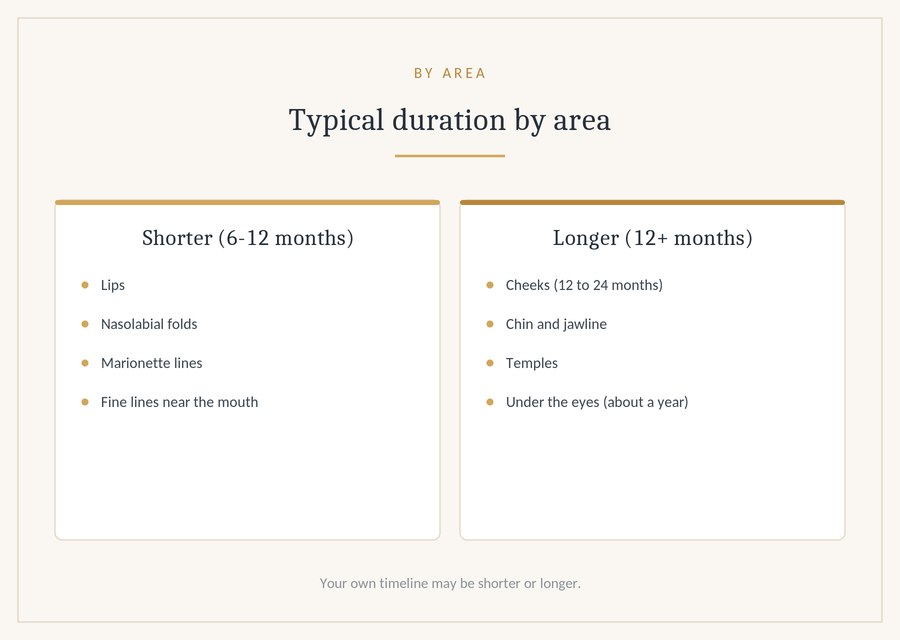
The figures below are typical ranges reported in product information and clinical experience. They are not promises, and your own timeline may be shorter or longer.
Lips: often six to twelve months
The lips move constantly when you speak, eat and smile, and they have a good blood supply, so filler is broken down relatively quickly. Soft gels are used to keep the lips natural in movement, and these also tend to fade sooner. Our article on how long lip filler lasts looks at the lips in detail.
Lines around the mouth: often six to twelve months
Nasolabial folds and marionette lines are in mobile areas. Results often last around six to twelve months, and longer when the underlying cause, such as midface volume loss, is also addressed.
Cheeks: often twelve to twenty-four months
Cheek filler is usually a firmer gel placed deep, near the bone, in an area with less movement. Some cheek products report results lasting up to around two years in trials. The cheek filler guide explains how this area is planned.
Chin and jawline: often twelve to eighteen months
Firm, shape-holding gels placed on the bone tend to last well. Results of around a year to eighteen months are common, though the chewing muscles and the movement of the lower face can shorten this. The article on chin filler covers what is involved.
Under the eyes: often around a year, sometimes longer
The tear trough has little movement, and small amounts of filler placed deep can last a year or more. Filler under the eyes can also hold water and cause puffiness, and it may remain visible longer than expected, which is why very small volumes and careful product choice matter. Our guide to under-eye filler explains who suits it.
Temples: often twelve to eighteen months
Temple filler is placed deep in an area with little visible movement, and results commonly last around a year or longer.
What Affects How Long Filler Lasts?
The product
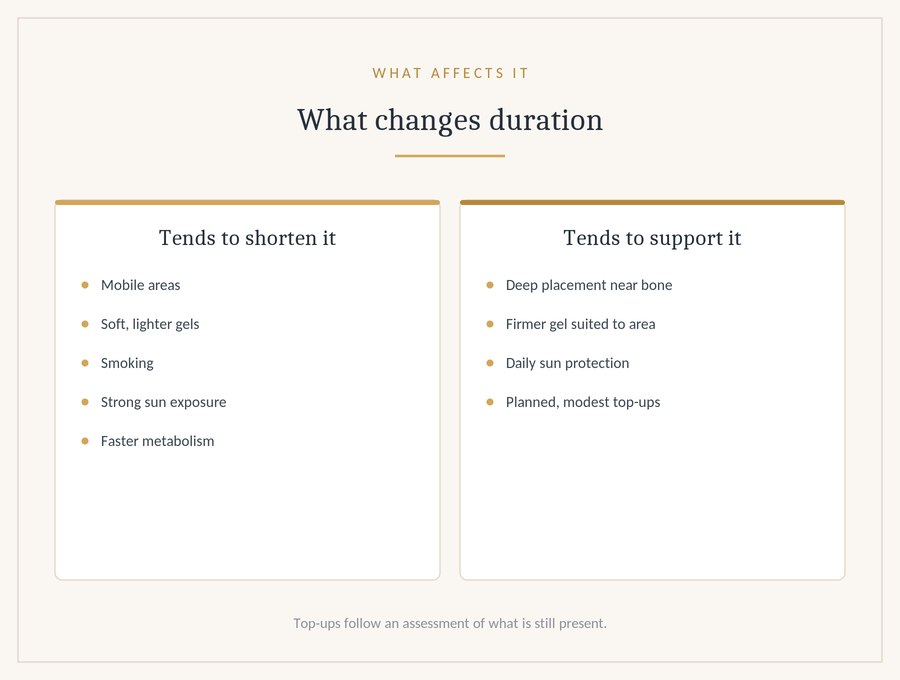
Gels with more hyaluronic acid and denser cross-linking generally resist breakdown longer, but they are also firmer and are not suitable for every area. Each manufacturer’s range, including Stylage and Juvederm, which Dr Soheila works with, has softer and firmer products designed for different jobs. Choosing a long-lasting product for the wrong area is not a good trade, because a firm gel in the lips can look unnatural. Our comparison of Juvederm and Stylage explains how these ranges are organised.
The area and the depth
Filler in mobile areas fades faster than filler in still areas, and filler placed deep near the bone usually lasts longer than filler placed close to the surface.
The volume
Larger volumes take longer to break down, but using more filler to make it last longer risks an overfilled look and puts more strain on the tissue. A small, well-placed volume that is topped up when needed usually looks more natural.
The person
Metabolism varies between individuals, and younger people sometimes break filler down faster. Smoking and sun exposure speed up the breakdown of both filler and the skin’s own collagen. Some people believe that intense exercise shortens filler duration, but the evidence for this is limited. Significant weight change can alter how filler looks, even when the gel is still present.
Why Filler Can Last Longer Than You Can See
Imaging studies using ultrasound and MRI have found hyaluronic acid filler still present in some people long after the visible effect had faded. This matters for two reasons. First, adding filler routinely every few months, on the assumption that the previous treatment has gone, can lead to a gradual build-up that looks heavy or causes the face to lose its natural shape. Second, filler that remains can occasionally move away from where it was placed, which is called migration.
For these reasons, top-ups should be planned after an assessment of what is still present, rather than on a fixed schedule. Where earlier filler has built up or moved, dissolving it before any further treatment is sometimes the most appropriate step.
How Long Do Biostimulators Last Compared With Fillers?
Biostimulators work differently. Calcium hydroxylapatite, such as Radiesse, adds some immediate support and stimulates collagen, and results commonly last around twelve to eighteen months. Polylactic acid, such as Sculptra, works mainly by stimulating collagen over a course of sessions, and studies report results lasting up to around two years. These products cannot be dissolved, so they are used more conservatively and are not suitable for the lips or under the eyes. Our article on Radiesse and hyaluronic acid filler compares the two approaches.
How Can You Tell Filler Is Wearing Off?
The signs are usually gradual. Lips may look less defined at the border or slightly flatter, cheeks may lose some of their support so that the lower face looks a little heavier, and lines that had softened may become visible again, particularly in photographs or in overhead lighting. Some people notice the change most at the end of a long day or after illness or weight loss.
Comparing photographs taken at the same angle and in the same light is more reliable than the mirror. If one side seems to have faded faster than the other, or you feel a lump where there was none, a review is worthwhile, because these can reflect migration or an inflammatory reaction rather than normal fading.
Does Filler Last Longer With Repeated Treatment?
Some people find that their results seem to last longer after several treatments. Possible explanations include filler that remains in the tissue, and some laboratory evidence that hyaluronic acid filler may encourage a modest collagen response around the gel. The evidence is limited, and the effect, if present, varies between people. It is not a reason to add filler more often, and it is one more reason for each top-up to follow an assessment of what is already there.
Is a Longer-Lasting Filler Always Better?
Not necessarily. A filler that lasts a long time is only an advantage if the result suits you. A softer product that lasts less long may look more natural in a mobile area, and a result that fades gradually gives you the chance to reconsider. Products that cannot be dissolved last longer but leave fewer options if something goes wrong, which is why hyaluronic acid filler is generally preferred for delicate areas such as the lips and under the eyes.
How Are Top-Ups Planned?
Many people choose a review at around nine to twelve months for the lips and twelve to eighteen months for deeper areas, but the right time depends on how the result looks, not the calendar. A top-up often needs less filler than the first treatment, because some of the original structure remains. Some people prefer to let filler wear off completely before deciding whether to repeat it, which is a reasonable choice and gives a clear view of the face without filler.
A good plan considers the whole face rather than refilling the same point each time. As the face ages, the areas that need support change, and sometimes a different treatment, such as a biostimulator, a skin booster or anti-wrinkle injections, suits a concern better than more filler.
Can Filler Be Removed Before It Wears Off?
Yes, hyaluronic acid filler can be dissolved with the enzyme hyaluronidase. This is used to correct lumps, unevenness, migration or a result you are unhappy with, and it is the emergency treatment if filler blocks a blood vessel. Some highly cross-linked gels need more than one session. Hyaluronidase has its own risks, including allergic reactions, so it is given by a physician after assessment. Our guide to dissolving filler explains the process.
What Are the Risks of Filler?
Swelling, tenderness and bruising are common after any filler treatment and usually settle within days to two weeks. Lumps, visible filler, migration, infection and delayed inflammatory reactions can occur. The most serious risk is filler entering or pressing on a blood vessel, which can damage the skin and, rarely, affect vision. Severe pain, blanching or dusky discolouration of the skin, or any change in vision after treatment need immediate medical attention.
Who Should Avoid Filler?
Filler is usually postponed during pregnancy and breastfeeding, during active infection or cold sores near the site, and around dental work or illness. It is avoided in people with allergy to the product or to lidocaine. People with autoimmune conditions, bleeding disorders, those taking blood thinners, and those who have had previous filler complications need a careful assessment first. A licensed physician must confirm suitability in person.
Choosing Who Treats You
Filler should be injected by a licensed physician whose DHA licence you can verify on the DHA Sheryan portal and who treats the area you are interested in regularly. Ask which product will be used and why, how long it typically lasts in that area, and how the physician will check what remains before adding more.
A sound plan also includes written aftercare, a review at around two weeks and a clear route to the clinic if you notice severe pain or skin colour changes. The overview of dermal fillers describes the treatment areas. At dr-soheila.com, treatments are planned and performed by Dr Soheila Eskandari, a DHA-licensed general practitioner with aesthetic privileges with 20 years of experience in aesthetic medicine.
The Short Version
Hyaluronic acid filler usually lasts from around six months to two years. Lips and the lines around the mouth tend to fade first, often within six to twelve months, while the cheeks, chin, jawline and temples commonly last twelve to eighteen months or longer. The product, the depth, the volume, metabolism, smoking and sun exposure all affect duration.
Filler can remain in the tissue after it stops being visible, so top-ups should follow an assessment rather than a fixed schedule. Hyaluronic acid filler can be dissolved if needed, while biostimulators cannot. Risks include swelling, bruising, lumps and, rarely, a blocked blood vessel, and a licensed physician must assess suitability in person.
Questions Worth Asking
How long does this product usually last in this area? The answer should be a realistic range, not a promise.
How will you check what is left before adding more? A top-up should follow an assessment of the existing result.
Could a smaller volume or a different treatment suit me better? More filler is not always the right answer to a fading result.
What would happen if I wanted the filler dissolved? You should know whether the product can be dissolved and how.
Frequently Asked Questions
How long do dermal fillers last?
Hyaluronic acid fillers usually last from around six months to two years, depending on the area, the product, the volume and the person.
How long does lip filler last?
Lip filler often lasts around six to twelve months, because the lips move constantly and soft gels are used to keep them natural.
How long does cheek filler last?
Cheek filler commonly lasts around twelve to twenty-four months, because firmer gels are placed deep in an area with less movement.
How long does under-eye filler last?
Under-eye filler often lasts around a year and sometimes longer, because the area moves little; very small volumes are used to reduce puffiness.
Why does filler wear off faster in some people?
Metabolism, the movement of the area, the product, the depth and volume used, smoking and sun exposure all affect how quickly filler is broken down.
Does exercise make filler wear off faster?
Some people believe so, but the evidence is limited; the area treated and the product used have a clearer effect on duration.
Can filler stay in the face after it stops being visible?
Yes, imaging studies have found filler in some people long after the visible effect faded, which is why top-ups should follow an assessment.
When should I get a filler top-up?
When the result has softened enough to matter to you, after an assessment of what remains; a top-up often needs less filler than the first treatment.
Can I make my filler last longer?
Choosing the right product for the area, avoiding smoking, protecting your skin from the sun and avoiding unnecessary extra volume all help, but no duration can be promised.
What does filler cost in Dubai?
Market rates generally run from around AED 1,000 to AED 2,500 per 1 ml syringe of hyaluronic acid filler, depending on the product and the clinic, and the total depends on how many syringes are needed, so ask for a written quote.
This article is general information about aesthetic and dermatological treatments and is not medical advice, a diagnosis, or a treatment recommendation for any individual. Outcomes vary between patients and no result is guaranteed. Prescription medications and injectable products carry risks and contraindications that must be assessed by a licensed physician during a personal consultation. Dr Soheila Eskandari is licensed by the Dubai Health Authority. Prices quoted are general market ranges for information only and are not an offer.


 English
 Arabic