
Dissolving Filler in Dubai: How Hyaluronidase Works and When to Use It
Dissolving Filler in Dubai: How Hyaluronidase Works and When to Use It
Dissolving filler is the least discussed part of the filler conversation and one of the most important. It is the reason hyaluronic acid became the dominant material in aesthetic medicine, and it is the option that makes an unsatisfactory result a correctable problem rather than a permanent one.
It is also, unhelpfully, marketed either as a trivial add-on or as something to be feared. Neither is accurate. It is a medical procedure with real benefits, real limitations and a small but genuine risk profile, and it deserves the same honest framing as the treatment that made it necessary.
What Hyaluronidase Actually Does
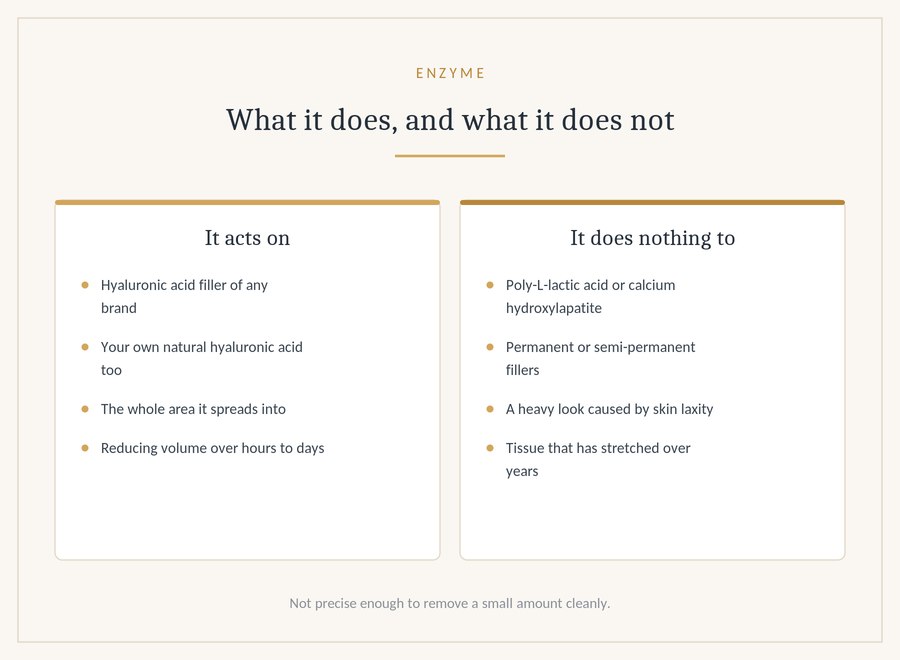
Hyaluronidase is an enzyme that breaks down hyaluronic acid. Injected into an area containing hyaluronic acid filler, it degrades the product, and the volume reduces over hours to days.
It is not selective in the way patients sometimes assume. The enzyme acts on hyaluronic acid generally, which includes the hyaluronic acid naturally present in your own tissue. That natural component is replaced by the body over a period of weeks, which is why the area can look slightly flat or deflated at first and then recovers.
Two consequences follow from this. First, it is difficult to remove a small amount of filler with surgical precision — the enzyme spreads. Second, dissolving the wrong area, or dissolving more than intended, is a recognised outcome rather than a hypothetical one.
The Two Very Different Reasons It Is Used
These are worth separating, because they are not the same clinical situation at all.
Emergency Use
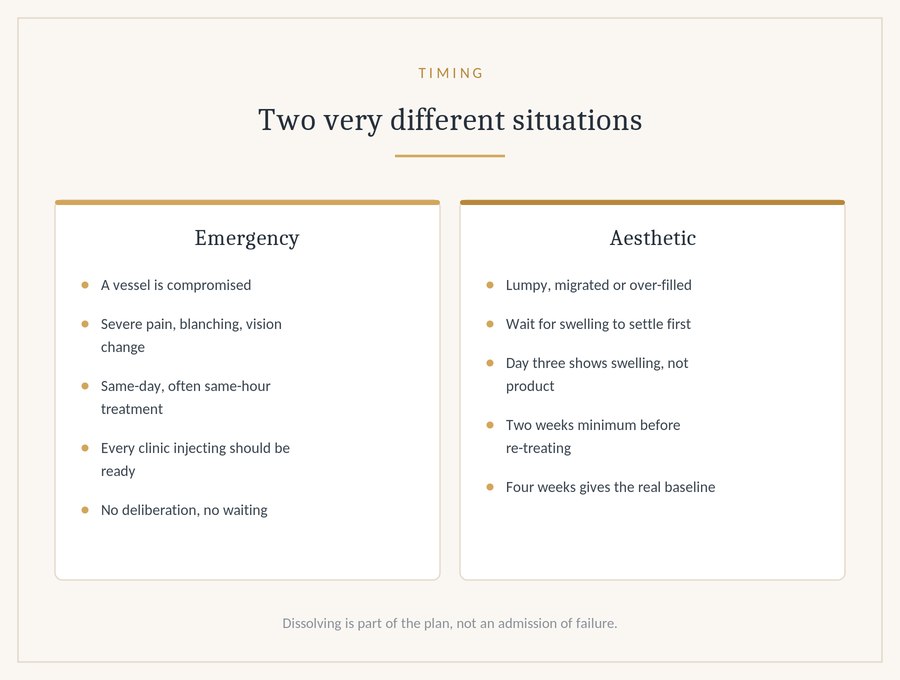
If filler compromises a blood vessel, the tissue supplied by that vessel is at risk. Hyaluronidase injected promptly and in adequate quantity is the treatment, and the time frame matters enormously — this is a same-day, often same-hour, intervention.
This is the reason every clinic injecting hyaluronic acid filler should keep hyaluronidase on site and have a practitioner who knows the protocol. A clinic that does not is not equipped for the treatment it is selling, and asking the question before you are injected is entirely reasonable.
Aesthetic Use
The much more common situation: the result is lumpy, asymmetrical, migrated, over-filled, or simply not what was wanted. Here there is no urgency, and the sensible approach is different — assess properly, wait until swelling has settled so the actual result is visible, and then decide.
The most common mistake in aesthetic dissolving is doing it too early, on day three, when what is being seen is swelling rather than product.
What It Can and Cannot Correct
It works on hyaluronic acid filler only. This is the central limitation. Collagen biostimulators such as poly-L-lactic acid and calcium hydroxylapatite are not affected by it, and neither are permanent fillers. Anyone considering a non-reversible product should weigh that fact carefully, and it is discussed further in the guide to collagen biostimulators.
It reduces volume; it does not restore what was there before. In most cases the tissue returns to something close to its pre-treatment state over several weeks. Where a large volume has been in place for years and the tissue has stretched around it, the result after dissolving can be slightly laxer than the starting point.
It does not fix a result that was never about filler. If the dissatisfaction came from a heavy look caused by laxity rather than product, removing product will not produce the wanted outcome.
What the Procedure Involves
An allergy consideration comes first. Hyaluronidase is derived from animal or recombinant sources depending on the preparation, and allergic reactions, while uncommon, are documented. Practice on patch testing varies; in a non-urgent aesthetic case there is time to be cautious, and in an emergency the risk calculation is entirely different because the alternative is tissue loss.
The injection itself is quick. Small amounts are placed into the area containing filler, usually through a few entry points. Some practitioners massage the area afterwards to help distribution.
Swelling for a day or two is normal and can be marked — the area often looks larger before it looks smaller, which is disconcerting if nobody has warned you. Most of the reduction is visible within twenty-four to seventy-two hours, and the area settles fully over two to four weeks.
More than one session is sometimes needed, particularly with firm, highly cross-linked products or large volumes. That is a normal course rather than a sign of failure.
The Waiting Period Before Re-Treating
The enzyme remains active in the tissue for a period after injection, so placing new filler immediately risks it being degraded as well. A gap of at least two weeks is commonly advised before re-treating, and allowing the tissue to settle fully — often four weeks or more — gives a clearer picture of what the area actually needs.
There is a second reason to wait. A patient who dissolves and re-fills within a week has not given themselves the chance to see their own face without product, which is precisely the information needed to decide what, if anything, to do next.
Risks Worth Knowing
Allergic reaction. Uncommon but documented, ranging from local swelling and redness to, very rarely, a systemic reaction. This is one reason the procedure belongs in a medical setting rather than anywhere less equipped.
Over-dissolving. Because the enzyme spreads and also acts on natural hyaluronic acid, the area can look flatter than intended in the first weeks. This generally recovers, but it is unsettling if unexpected.
Incomplete removal. Firm products, large volumes and product that has been in place a long time may need repeated sessions.
Bruising and swelling. Routine, and usually short-lived.
Filler Migration — the Most Common Reason People Ask
Migration describes product that has moved from where it was placed. It is most discussed in the lips, where it produces a shelf above the lip border or a general loss of the line between lip and skin, but it occurs elsewhere too.
The contributing factors are placement that is too superficial, product that is too soft or too mobile for the area, volumes larger than the tissue can hold, and repeated treatments stacked on top of old product without assessment.
Dissolving is the reliable correction. The approach that usually works is to remove the migrated product, wait for the area to settle, and then decide whether to re-treat at all — frequently with less product, placed differently. The longer-term view of lip treatment is set out in the guide to lip filler in Dubai.
Cost in Dubai
Market rates generally run from around AED 800 to AED 2,000 per session, depending on the area, the volume involved and the clinic. Where more than one session is needed, that is the figure to multiply.
A point worth making plainly: many clinics perform dissolving of their own work at reduced cost or without charge when a result has not met expectations, and it is a reasonable thing to ask about before treatment rather than after.
The Short Version
Hyaluronidase breaks down hyaluronic acid filler and is the reason that category is reversible. It is used urgently when a vessel is compromised and electively when a result is lumpy, migrated or over-filled.
It works only on hyaluronic acid, it is not precise enough to remove a small amount cleanly, it temporarily affects the body’s own hyaluronic acid, and it carries a small risk of allergic reaction. Waiting for swelling to settle before deciding, and waiting again before re-treating, is what separates a good outcome from a cycle of correction.
Questions Worth Asking
Before filler: do you keep hyaluronidase on site? For any hyaluronic acid treatment, particularly in the nose, glabella or under-eye, the answer should be yes.
Is what I am seeing swelling or product? Before dissolving anything, this needs answering.
How long should I wait before considering new filler? Two weeks is a minimum; longer gives a clearer picture.
How many sessions do you expect? Firm products and old, large volumes often need more than one.
Deciding Whether to Dissolve at All
Not every disappointing result needs the enzyme, and it is worth thinking this through before booking.
Wait, if the treatment was recent. Swelling accounts for a great deal of what people dislike in the first two weeks, and asymmetry in the first few days is extremely common and usually temporary.
Wait, if the concern is mild. Hyaluronic acid breaks down on its own. A modest over-correction in an area where the product lasts six to nine months may be easier to live with than to treat, particularly if the alternative is an enzyme injection and a further settling period.
Dissolve, if the problem is structural. Migration, visible lumps, a bluish tinge under thin skin, or a shape that is simply wrong will not improve with time in any meaningful way.
Dissolve, if product has accumulated over years. Where repeated treatments have stacked up and the face reads as heavy or altered, removing and starting from a clean assessment is usually better than adding again.
Dissolve immediately, without deliberation, if there are signs of vascular compromise. Severe pain, blanching, mottling or vision change are not situations for a considered discussion.
Seeing Your Own Face Again
One thing patients consistently report after dissolving is surprise — the face looks different from what they remembered, sometimes better, occasionally worse. Filler placed gradually over several years changes the reference point, and the memory of the starting face is unreliable.
That is an argument for allowing several weeks after dissolving before making any decision about re-treating. The face at week four is the real baseline; the face at week one is still recovering from the enzyme.
Frequently Asked Questions
What is hyaluronidase?
An enzyme that breaks down hyaluronic acid. Injected into an area containing hyaluronic acid filler, it degrades the product so the volume reduces over hours to days. It is the reason this category of filler is described as reversible.
Does it work on all fillers?
No — only on hyaluronic acid. Collagen biostimulators such as poly-L-lactic acid and calcium hydroxylapatite, and permanent fillers, are unaffected by it. That limitation is one of the most important points to weigh before choosing a non-reversible product.
How quickly does it work?
Most of the reduction is visible within twenty-four to seventy-two hours. The area continues to settle over two to four weeks, and it commonly swells before it shrinks, which is expected rather than a problem.
Will my face go back to how it was before filler?
Usually close to it, over several weeks. Where a large volume has been in place for years and the tissue has stretched around it, the result can be slightly laxer than the original starting point.
Is it painful?
The injections are quick and most people describe them as uncomfortable rather than painful. Swelling afterwards is the more noticeable part, and it usually settles within a couple of days.
Can I have new filler straight afterwards?
No. The enzyme stays active in the tissue for a period, so new product placed immediately may be degraded too. At least two weeks is commonly advised, and waiting four weeks or more gives a clearer view of what the area actually needs.
Is it risky?
Allergic reactions are uncommon but documented, which is why it belongs in a medical setting with appropriate emergency provision. Over-dissolving and temporary flatness are the other recognised outcomes, since the enzyme also acts on the body’s own hyaluronic acid.
Can it fix migrated lip filler?
Yes, and it is the reliable correction for it. The usual approach is to dissolve the migrated product, allow the area to settle, and only then decide whether to re-treat — often with less product placed differently, or not at all.
How many sessions will I need?
Often one, but firm, highly cross-linked products and large volumes that have been in place a long time may need two or more. Needing a second session is a normal part of the course rather than an indication that something has gone wrong.
What does it cost in Dubai?
Market rates generally run from around AED 800 to AED 2,000 per session depending on area and volume. Many clinics apply a reduced rate or no charge when correcting their own work, which is worth asking about before any filler treatment rather than after one.
This article is general information about aesthetic and dermatological treatments and is not medical advice, a diagnosis, or a treatment recommendation for any individual. Outcomes vary between patients and no result is guaranteed. Prescription medications and injectable products carry risks and contraindications that must be assessed by a licensed physician during a personal consultation. Dr Soheila Eskandari is licensed by the Dubai Health Authority. Prices quoted are general market ranges for information only and are not an offer.


 English
  Arabic