
Chin Filler in Dubai: Profile, Evidence and Honest Expectations
Chin Filler in Dubai: Profile, Evidence and Honest Expectations
Chin filler is one of the least talked-about and most transformative treatments in facial aesthetics. Most people who book a consultation with Dr Soheila come in asking about their jawline, their profile, or “something about my side photos that I can’t put my finger on.” Very often, the answer is the chin — and very often, they had never considered it.
This guide explains what chin filler actually does, what the evidence says about how long it lasts, what it costs in Dubai, who it suits, who it does not, and the specific risks worth understanding before you agree to anything. It is written to be useful whether you end up treating with Dr Soheila or with someone else entirely.
Why the Chin Matters More Than People Think
The chin is a structural feature, not a cosmetic detail. It sits at the end of the mandible and defines three things at once: how long your face looks, how defined your jawline appears, and how your profile reads from the side.
When the chin projects too little — a condition clinicians call microgenia or chin retrusion — several things happen that people usually blame on something else:
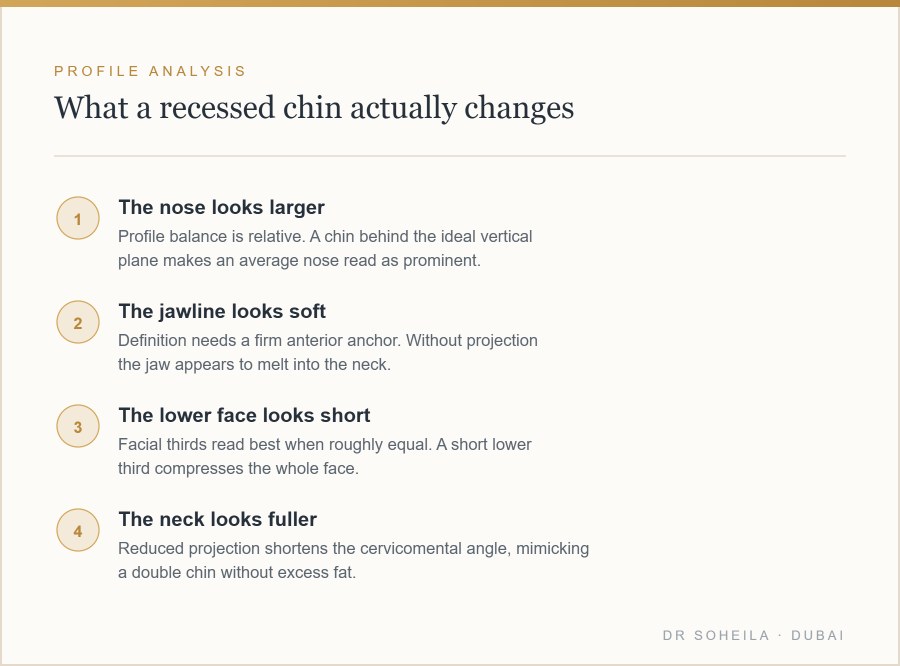
- The nose looks larger. Profile balance is relative. A chin that sits behind the ideal vertical plane makes an average nose read as prominent. A meaningful share of people who ask about rhinoplasty are actually looking at a chin issue.
- The jawline looks soft. Definition along the jaw depends on having a firm anterior anchor point. Without projection, the jawline appears to melt into the neck even in someone with very little submental fat.
- The lower face looks short. Facial thirds — hairline to brow, brow to nose base, nose base to chin — read best when roughly equal. A short lower third compresses the whole face.
- The neck looks fuller than it is. Reduced chin projection shortens the cervicomental angle, which is the crease between chin and neck. This creates the appearance of a double chin in people who are not carrying excess fat there at all.
Dr Soheila assesses all four of these in profile before any needle is discussed, because the answer to “should I treat the chin?” is genuinely different depending on which of them is driving your concern.
What Chin Filler Actually Is
Chin filler uses hyaluronic acid — the same family of gel used for lips and cheeks, but a much firmer, higher-cohesivity formulation. The gels used for chin work are specifically engineered to resist compression, because the chin is a load-bearing area that moves constantly with speech and expression. A soft lip gel placed in the chin would flatten, spread, and look poor within weeks.
The critical technical point is the plane. Chin filler is placed deep, directly onto the periosteum — the fibrous membrane covering the bone — rather than in the fat or under the skin. Published technique papers describe a supraperiosteal approach using a fine needle at the pogonion and along the superior base of the mandible, often through a single midline entry point with retrograde lateral-to-medial tunnelling.
This matters for you as a patient for two reasons:
- Stability. The periosteum provides a fixed foundation. Product placed correctly on bone does not wander. Migration — the complication people worry about after seeing lip filler horror stories online — is genuinely rare in properly executed chin work.
- Efficiency. Product on bone projects the tissue outward. Product placed superficially just adds bulk. Deep placement means you get more visible change from less volume.
Published case series report a median injected volume of around 2.25 mL for mental-area augmentation, though the right volume for you depends entirely on how far your chin sits from where it should.
What the Evidence Says About Longevity
This is where honest reporting matters, because the marketing claims and the imaging studies do not always agree.
Manufacturers of the firmest cross-linked gels cite up to 24 months of duration. That number comes from cheek studies. When researchers followed hyaluronic acid in the chin specifically using MRI, the picture was less flattering: one long-term follow-up found near-complete degradation of chin filler at 19 months, in contrast to deep fat compartments elsewhere in the face where product persisted longer.
The mechanical explanation is straightforward. The chin is one of the most active regions in the face. The mentalis muscle contracts every time you speak, chew, or purse your lips. Mechanical stress accelerates the breakdown of hyaluronic acid.
The practical implication is a realistic expectation of 12 to 18 months for most patients, with meaningful variation:
| Factor | Effect on duration |
|---|---|
| Hyperactive mentalis muscle (visible chin dimpling) | Shortens — constant mechanical load |
| Small dose of botulinum toxin into mentalis alongside filler | Extends — reduces the load and improves the aesthetic result |
| Superficial rather than supraperiosteal placement | Shortens, and increases migration risk |
| High metabolic rate, endurance training | Shortens modestly |
| Top-up before full degradation | Extends — less product needed each time |
Dr Soheila will often combine a small mentalis dose with chin filler in patients whose chin visibly dimples or “orange-peels” when they speak. It is not upselling — it addresses a mechanical cause and typically means the filler result holds better. If you want to understand how the two product categories differ, our guide to botox versus fillers covers the distinction in detail.
The Bone Resorption Question — What Nobody Tells You
This is the part of chin filler that is under-discussed in clinics and worth reading carefully.
Retrospective imaging studies have reported discernible bone resorption at the mentum in a meaningful proportion of patients who have had repeated hyaluronic acid chin augmentation — one retrospective cohort put the figure at around 36% on imaging review. Prospective controlled work has been more reassuring and the clinical significance of these radiographic findings remains genuinely debated in the literature.
What does this mean for you in practice?
- It is a radiographic finding, not usually a visible or symptomatic one. Patients in these studies were not complaining of deformity.
- It appears related to sustained pressure over repeated cycles, which argues against very high volumes and very frequent top-ups.
- It is a reason to have a plan rather than an open-ended series of injections. If you are on your fifth round of increasing volume, the conversation should shift to whether a surgical implant or genioplasty is the more appropriate answer.
Dr Soheila raises this in consultation rather than after the fact. Patients who understand it tend to make better decisions about volume and interval — and some decide that filler is the right answer for the next few years while a surgical option is the right answer eventually.
Who Chin Filler Suits
Good candidates share a fairly specific profile:
- Chin projection that sits behind the ideal vertical line in profile, with otherwise reasonable bone structure
- Mild to moderate retrusion — a deficit of roughly 2 to 6 mm rather than a severe skeletal discrepancy
- Good skin quality over the chin and jaw, without significant laxity
- A normal bite. A significant Class II malocclusion is a dental and skeletal issue, not a filler issue
- Realistic expectations about degree of change and duration
Who it does not suit
- Severe skeletal retrognathia. Filler cannot substitute for orthognathic surgery. Attempting it produces a heavy, unnatural chin with no real profile improvement.
- Significant lower-face laxity. Adding projection under loose skin can accentuate jowling rather than improve it.
- Active infection, or inflammatory skin conditions in the treatment area.
- Pregnancy and breastfeeding. Not because of documented harm, but because there is no safety data and no urgency.
- Body dysmorphic patterns. A responsible clinician will decline. Adding filler to a chin that is objectively normal does not resolve the underlying distress.
What Happens at the Appointment
Consultation and assessment
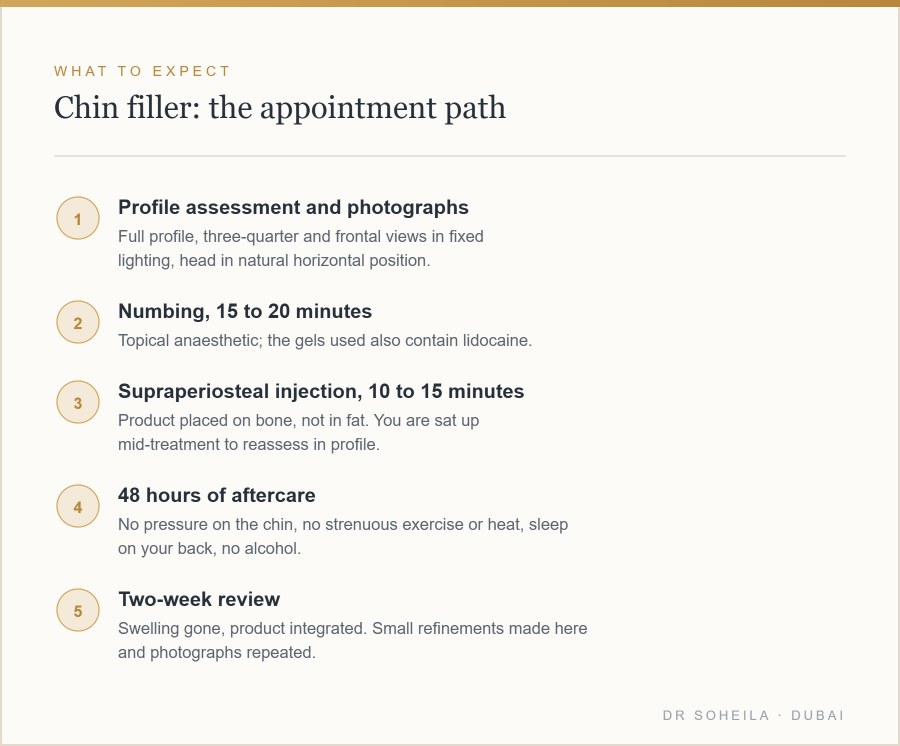
Dr Soheila photographs you in full profile, three-quarter, and frontal view, in consistent lighting, with the head in natural horizontal position. Profile analysis uses reference planes rather than opinion — this is measurable, and having the before images matters when you assess your own result at review.
The assessment covers chin projection, chin height, cervicomental angle, jawline definition, mentalis activity, dental occlusion, and how the chin relates to the nose and lips. Medical history, medications, previous filler in the area, and any autoimmune or bleeding conditions are all reviewed.
The treatment itself
Numbing cream is applied for 15 to 20 minutes. Most chin gels also contain lidocaine. The area is cleaned thoroughly — antisepsis matters more than patients realise, because the chin sits close to the perioral region.
Injection takes 10 to 15 minutes. Most patients describe pressure rather than pain. You will feel the needle contact bone; this is expected and is the point. Dr Soheila will sit you up mid-treatment to reassess in profile, because a chin that looks correct lying flat can look under- or over-projected upright.
Immediately after
Expect mild swelling and possibly a small bruise. The chin is well vascularised and bruising is more common here than in cheeks. Most patients are socially presentable the same day and fully settled within a week.
Aftercare
- No pressure on the chin for 48 hours — no leaning your face on your hand, no face-down massage, no tight chin straps
- No strenuous exercise or hot yoga for 24 to 48 hours
- Sleep on your back for the first two nights if you can
- Avoid alcohol for 24 hours; it worsens bruising and swelling
- No dental work for two weeks where avoidable, and tell your dentist you have had chin filler
- Report increasing pain, blanching, mottled discolouration, or vision change immediately — these are urgent
The two-week review
This appointment is not optional in Dr Soheila’s protocol. Swelling has resolved, product has integrated, and the result is genuinely assessable. If a small refinement is needed — and in chin work it sometimes is, because bone contour is individual — this is when it is done. Photographs are repeated in the same lighting for honest comparison.
Chin Filler Cost in Dubai
Prices in Dubai are quoted per syringe, and chin work usually needs one to two syringes depending on the degree of correction. Market rates in DHA-licensed clinics generally sit in the range of AED 1,800 to AED 3,500 per syringe for the firm, cross-linked gels appropriate for this area, with variation by product brand, clinician seniority, and clinic location.
Several things legitimately move the price:
- Product. The high-cohesivity gels engineered for bone-level structural work cost the clinic considerably more than standard mid-range gels.
- Who injects. A physician with specific facial-anatomy training and years of profile work is not priced the same as a general practitioner who does filler occasionally.
- Whether a review is included. Ask directly. A two-week review with a small top-up allowance included is worth real money.
- Combination work. Chin plus jawline, or chin plus mentalis toxin, is usually packaged differently from chin alone.
A note worth stating plainly: an unusually low price in this category is a warning sign, not a bargain. Chin filler is a deep, bone-level injection near significant vasculature. The cost of correcting a poor outcome — dissolving, treating a vascular event, or living with an unnatural profile for a year — exceeds any saving. Our article on how aesthetic pricing works in Dubai explains what actually sits behind a quoted number.
Risks You Should Actually Know About
Common and expected: swelling, bruising, tenderness, temporary firmness, minor asymmetry that settles.
Uncommon: prolonged swelling, palpable nodules, infection, and product visibility if placed too superficially. Most of these are manageable, and hyaluronic acid can be dissolved with hyaluronidase if needed.
Rare but serious: vascular occlusion. The submental and inferior labial arteries run in the region. If filler enters or compresses an artery, tissue supplied by that vessel can be compromised. The warning signs are immediate severe pain out of proportion to the procedure, blanching, and a mottled purple pattern developing over hours. This is a medical emergency and is why you treat with a physician who has hyaluronidase on site, knows the protocol, and answers their phone.
Ask any clinic directly: what is your protocol if I develop a vascular occlusion, and do you keep hyaluronidase on the premises? A clinic that cannot answer that crisply should not be injecting your chin.
Chin Filler Versus the Alternatives
| Option | Best for | Duration | Reversible |
|---|---|---|---|
| Hyaluronic acid filler | Mild to moderate retrusion; trialling a change | 12–18 months | Yes |
| Calcium hydroxylapatite | Firmer projection in selected cases | 12–18 months | No |
| Silicone or porous implant | Moderate to severe deficit; permanence wanted | Permanent | Surgically removable |
| Sliding genioplasty | Severe skeletal discrepancy, bite involvement | Permanent | No |
There is a strong argument for starting with filler even if you suspect you will eventually want an implant. Filler lets you and your clinician see the change on your actual face, in your actual photographs, before committing to something permanent. A number of Dr Soheila’s patients have used chin filler exactly this way — and roughly as many have decided the filler result was all they wanted.
A Decision Checklist Before You Book
- Take an honest side profile photograph in neutral light, head level, teeth together. Look at it for a week before deciding anything.
- Ask yourself whether your concern is the chin, the jawline, the neck, or the nose. They are treated differently.
- Confirm the clinic and the injector hold current DHA licensing. This is verifiable and you are entitled to ask.
- Ask which product will be used, and why that one for the chin specifically.
- Ask whether the injection will be supraperiosteal.
- Ask about the vascular occlusion protocol and on-site hyaluronidase.
- Confirm whether a two-week review is included in the quoted price.
- Ask to see before-and-after profile images taken in consistent lighting and position — not filtered, not at different angles.
Treating With Dr Soheila
Dr Soheila Eskandari practises aesthetic medicine in Dubai under DHA licence and treats the chin as part of a full lower-face assessment rather than as an isolated request. In practice that means some consultations end with a recommendation not to treat the chin at all — because the presenting concern was jawline laxity, submental fullness, or a dental issue that filler would not address.
Where chin filler is appropriate, the approach is deliberately conservative: correct placement on bone, a volume matched to the measured deficit rather than to a package, mentalis assessment as part of the plan, and a review appointment built in. Patients who want a dramatic change in a single sitting are usually better served by a surgical referral, and Dr Soheila will say so.
If you are considering chin work, related reading on this site includes our guides to masseter botox and jawline slimming and under-eye filler, both of which frequently come up in the same consultation.
Frequently Asked Questions
Does chin filler hurt?
Most patients describe pressure rather than sharp pain. Topical anaesthetic is applied beforehand and the gels used contain lidocaine. You will feel the needle contact bone, which is expected. The procedure takes 10 to 15 minutes.
How long does chin filler last?
Realistically 12 to 18 months for most people. MRI follow-up work has shown near-complete degradation of chin filler by around 19 months, which is shorter than the manufacturer figures quoted for cheeks. The chin is a high-movement area and mechanical stress accelerates breakdown.
Will chin filler make my face look longer?
Correctly placed, it improves the balance of the facial thirds and usually makes the face look better proportioned rather than longer. Excessive vertical projection can lengthen the lower face, which is one reason volume should be matched to a measured deficit rather than added generously.
Can chin filler fix a double chin?
Partly, and it depends on cause. If the appearance is due to a shallow cervicomental angle from poor chin projection, filler can improve it noticeably. If it is due to submental fat or skin laxity, chin filler will not address it and a different treatment is needed. This distinction is made at consultation.
Is chin filler reversible?
Yes, if hyaluronic acid is used. Hyaluronidase dissolves it within a day or two. Calcium hydroxylapatite and permanent implants are not reversible in the same way, which is a reason many patients start with hyaluronic acid.
Does chin filler migrate?
Migration is rare when the product is placed supraperiosteally, because the periosteum provides a stable foundation. Migration is far more associated with superficial placement, excessive volume, and repeated over-treatment.
Should I get chin filler or a chin implant?
Filler suits mild to moderate deficits and anyone who wants reversibility or wants to trial the change. An implant or genioplasty suits larger skeletal deficits and anyone who wants a permanent result. Many patients use filler first specifically to see the change on their own face before committing.
How much does chin filler cost in Dubai?
Market rates in DHA-licensed clinics generally sit between AED 1,800 and AED 3,500 per syringe for the firm gels used in this area, with most cases needing one to two syringes. Price varies by product, injector experience, and whether a review appointment is included.
Can I combine chin filler with botox?
Yes, and in patients with a hyperactive mentalis muscle it is often the better plan. A small toxin dose reduces the mechanical load on the filler, improves chin surface texture, and may extend how long the filler result holds.
What should I avoid after chin filler?
Pressure on the chin for 48 hours, strenuous exercise and heat for 24 to 48 hours, alcohol for 24 hours, and non-urgent dental work for two weeks. Sleeping on your back for the first two nights helps.
This article is general information about aesthetic treatments and is not medical advice, a diagnosis, or a treatment recommendation for any individual. Outcomes vary between patients and no result is guaranteed. All injectable treatments carry risks that should be discussed with a licensed physician during a personal consultation. Dr Soheila Eskandari is licensed by the Dubai Health Authority. Prices quoted are general market ranges for information only and are not an offer.


 English
  Arabic