
Stem Cell Therapy in the UAE: What the Term Means and How It Is Regulated
Stem Cell Therapy in the UAE: What the Term Means and How It Is Regulated
Few phrases in aesthetic medicine are used as loosely as “stem cell therapy”. It appears on facial menus, in IV drip packages, on skincare labels and in hair loss brochures — and in most of those settings it does not mean what the reader assumes it means.
This article is written to be useful rather than promotional. Dr Soheila Eskandari does not offer stem cell therapy, and nothing here is an offer of one. The purpose is to explain what the term actually refers to, where the evidence genuinely stands, how these therapies are regulated in the United Arab Emirates, and what to ask before paying for anything sold under that name.
What a Stem Cell Actually Is
A stem cell is an unspecialised cell with two defining properties: it can divide to produce more of itself, and it can differentiate into one or more specialised cell types. That is the whole definition, and it is narrower than the marketing implies.
Several distinct categories exist, and they are not interchangeable.
Haematopoietic stem cells give rise to blood cells. They are found in bone marrow, peripheral blood and umbilical cord blood, and their transplantation is the one stem cell treatment with decades of established clinical use.
Mesenchymal stromal cells are harvested from bone marrow, fat tissue or umbilical cord tissue. They are the cells most often referred to in regenerative and aesthetic marketing. Their behaviour in the body is still an active research question, and even the name is contested among researchers.
Tissue-specific stem cells reside in particular organs — the limbal cells at the edge of the cornea, for example, or the stem cells in the hair follicle bulge.
Pluripotent stem cells, whether embryonic or induced from adult cells in a laboratory, can become almost any cell type. They are central to research and are not used as routine treatments anywhere.
What matters for a patient is this: a product or procedure is only a stem cell therapy if living stem cells are actually delivered and are expected to engraft or act. Most of what is sold under the label does not meet that description.
What Is Usually Being Sold Under That Name
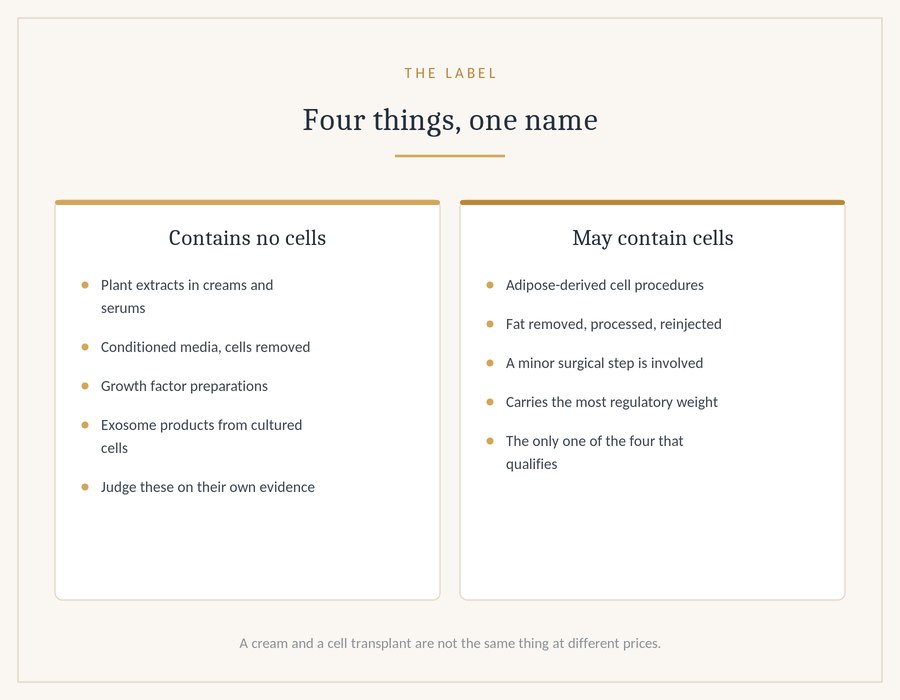
In aesthetic settings, four very different things share the same label.
Plant “stem cell” skincare. Creams and serums containing extracts derived from plant cell cultures. Plant cells cannot function as human stem cells, and the ingredient acts as a topical antioxidant at best. Whatever the product’s merits, the name is doing marketing work rather than biological work.
Conditioned media and growth factor products. Cells are grown in a laboratory, then the cells are removed and the liquid they were cultured in is collected. That liquid contains the proteins the cells secreted. There are no stem cells in the final product. These are frequently applied topically after microneedling and described as “stem cell facials”.
Exosome products. Small vesicles released by cultured cells, carrying signalling molecules. Again, no cells are present in the finished product. The evidence in human skin and hair is early, preparations are not standardised between manufacturers, and several regulators internationally have issued warnings about unapproved exosome products marketed for aesthetic use. The comparison with a better-established option is set out in the guide to PRP versus exosomes for hair loss.
Adipose-derived cell procedures. Fat is removed by a minor surgical procedure, processed, and reinjected. Depending on how it is processed, the product may genuinely contain a mixed population of cells including mesenchymal stromal cells. This is the only one of the four that involves actual cells, and it is also the one carrying the most significant regulatory and procedural weight.
Why the Distinction Is Not Pedantic
The four categories differ in what is delivered, what could plausibly happen, what it should cost and what oversight applies. A cream and a cell transplant are not the same intervention with different prices. Being clear about which one is on offer is the first practical step a patient can take.
Where the Evidence Actually Stands
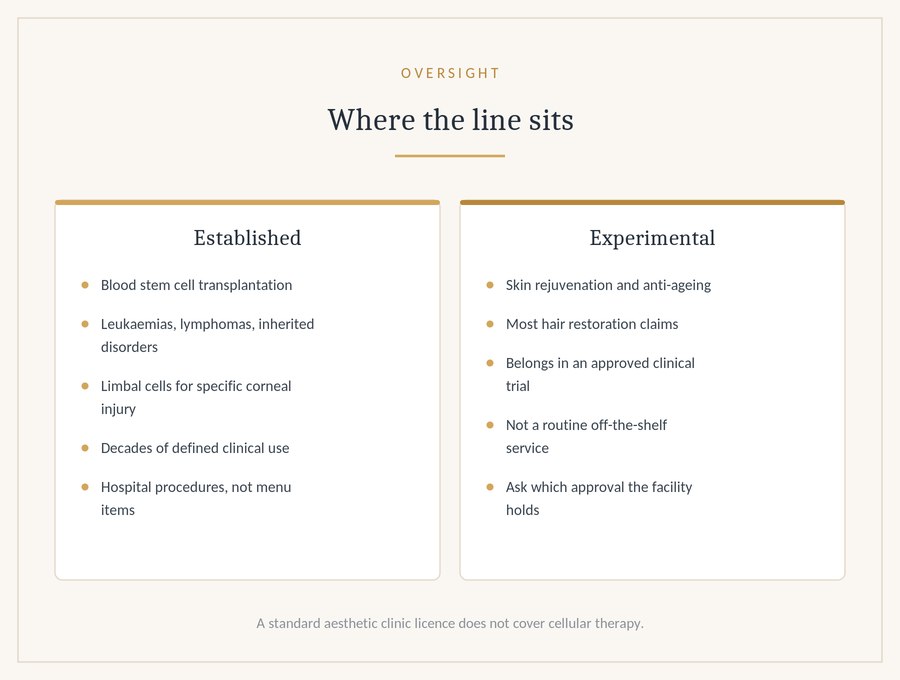
It helps to separate the established from the experimental, because the gap is wide.
Established. Haematopoietic stem cell transplantation for leukaemias, lymphomas and certain inherited blood and immune disorders has been standard care for decades. Limbal stem cell treatment for specific corneal injuries is an accepted, if specialised, application. These are serious hospital procedures with defined indications.
Under active investigation. Mesenchymal stromal cells in orthopaedic conditions, certain autoimmune diseases and some cardiac and neurological indications are the subject of a large number of trials. Results are mixed and the field has struggled with small studies, inconsistent cell preparations and short follow-up.
Early or unsupported. Cosmetic skin rejuvenation, general “anti-ageing”, and most hair restoration claims sit here. There are published reports, some of them encouraging, but they are typically small, uncontrolled, and use preparations that differ from one clinic to the next. What does not exist is the kind of large, independent, randomised evidence that would justify the pricing and the confidence commonly attached to these offerings.
A reasonable summary is that the biology is genuinely interesting, the research is real and ongoing, and the marketing has run a long way ahead of both.
How These Therapies Are Regulated in the UAE
This is the part most articles omit, and it is the part that protects patients.
Cellular therapies in the UAE do not sit under an ordinary clinic licence. They fall under a separate federal framework. At federal level the Ministry of Health and Prevention (MOHAP) oversees this area, and Cabinet Decision No. 6 of 2020 sets out regulations covering cord blood and stem cell centres — including collection, testing, processing, preservation, storage, distribution, and import and export of cells.
Alongside that, the health authority of each emirate applies its own licensing and oversight: the Dubai Health Authority (DHA) in Dubai, the Department of Health (DoH) in Abu Dhabi, and Dubai Healthcare City Authority within that free zone. Requirements and interpretations are not identical across the country, which is one reason patients encounter confusing and contradictory claims.
Two practical consequences follow.
A standard clinic or dermatology licence does not authorise cellular therapy. A facility holding a normal aesthetic licence is not thereby permitted to process and administer stem cells. Specific additional approval is required, and the facility should be able to identify it.
Unproven applications generally belong in approved clinical trials. Where a use is not established, the appropriate route is a trial approved by the relevant authority with ethical review and defined follow-up — not an off-the-shelf treatment sold from a price list. If you are being offered an experimental therapy as a routine service, that framing itself is a signal.
Regulations in this area are updated periodically. Anyone considering such a treatment should verify the current status and the specific facility’s approvals directly with MOHAP or the relevant emirate authority rather than relying on a clinic’s own description, including this article.
Questions Worth Asking Before You Pay
These are not confrontational questions. A properly licensed provider will answer them without difficulty.
Does the product contain living cells, and which cells? If the answer is no, it is not stem cell therapy, whatever the brochure says.
Where do the cells come from, and how are they processed? Source, processing method and the facility doing the processing should all be identifiable.
What specific regulatory approval does this facility hold for cellular therapy? Not the general clinic licence — the approval covering this category of treatment.
Is this treatment or a clinical trial? If it is a trial, there should be an approval reference, an ethics review, a consent process and a follow-up schedule.
What published evidence supports this for my specific concern? “Studies show” is not an answer. A named indication with a body of literature is.
What happens if it does not work? Unlike hyaluronic acid filler, cellular treatments cannot be reversed. That asymmetry deserves weight in the decision.
Signals That Should Give You Pause
A single treatment offered for a long list of unrelated conditions. Testimonials and before-and-after images in place of published evidence. Pressure to decide quickly, or a discount that expires. Reluctance to name the product, the source of the cells or the regulatory approval. A price that seems designed to signal sophistication rather than to reflect a procedure.
None of these prove that an offering is illegitimate. All of them are reasons to slow down and verify.
What Is Actually Available and Regulated for Skin and Hair
Patients who arrive asking about stem cells are usually describing a real concern — thinning hair, skin that has lost quality, scarring, general facial tiredness. Those concerns have treatments with established regulatory status and a more honest evidence base, and none of them requires the stem cell label.
Platelet-rich plasma. Prepared from the patient’s own blood at the point of care and reinjected. It contains platelets and the growth factors they release — not stem cells. It has the largest published literature of the regenerative options used in aesthetics, particularly in hair loss, and is covered in the guide to PRP for hair loss.
Polynucleotides. Purified DNA fragments used to support skin quality and reduce inflammation, discussed in the guide to polynucleotide skin boosters. Again, no cells are involved.
Collagen biostimulators. Poly-L-lactic acid and calcium hydroxylapatite provoke the body’s own collagen production over months. These are structural treatments with a clear mechanism and a known duration, set out in the guide to collagen biostimulators. They are not reversible, which is the main point to weigh before consenting.
Microneedling with growth factors. Controlled injury to provoke repair, with or without a topical or injected product alongside, described in the guide to microneedling with growth factors.
These are more modest propositions than the language surrounding stem cells. They are also the ones a licensed aesthetic clinic can properly offer, and the ones where a realistic result can be described in advance.
A Note on Cost
Treatments marketed as stem cell therapy in the region are commonly priced in the tens of thousands of dirhams, and occasionally far above that. The number itself carries no information about what is in the syringe or whether the facility is approved to administer it.
For context, the established aesthetic alternatives described above generally sit in the range of around AED 1,200 to AED 5,000 per session depending on the treatment, with courses and maintenance planned accordingly. A very large price difference between two things described in similar language is a reason to ask what, precisely, is different about them.
The Short Version
A stem cell therapy delivers living stem cells. Most products sold under that name — plant extracts, conditioned media, growth factor preparations and exosome products — contain no stem cells at all, and should be assessed on their own evidence rather than on the label.
Genuine cellular therapy in the UAE sits under federal oversight through MOHAP and the emirate health authorities, with Cabinet Decision No. 6 of 2020 governing cord blood and stem cell centres. A standard aesthetic clinic licence does not cover it, and unproven applications belong in approved clinical trials rather than on a treatment menu.
If the underlying concern is skin quality, scarring or hair loss, there are regulated treatments with a clearer evidence base and a describable outcome. Dr Soheila Eskandari does not offer stem cell therapy, and this article is not an offer of one.
Why This Page Exists
Publishing an explanation of a treatment a clinic does not provide is unusual. The reason is straightforward: patients ask about it regularly, the information available to them is largely written by people selling it, and a decision made on that basis is not an informed one.
A consultation is the right place to work out what is actually causing a concern and which regulated options address it. If the honest answer in a given case is that nothing available will achieve what someone hopes for, that answer is more useful than a procedure.
Frequently Asked Questions
Does Dr Soheila Eskandari offer stem cell therapy?
No. The clinic does not provide stem cell or cellular therapy, and this article is educational rather than an offer of treatment. The regulated treatments available for skin quality, scarring and hair loss are described above, and a consultation can establish which, if any, is appropriate.
Is stem cell therapy legal in the UAE?
Cellular therapies are regulated at federal level by the Ministry of Health and Prevention, with Cabinet Decision No. 6 of 2020 covering cord blood and stem cell centres, alongside oversight from the emirate health authorities such as the DHA in Dubai. Established uses are permitted within that framework; unproven applications generally belong in approved clinical trials. Verify the current position and any facility’s specific approvals directly with the relevant authority.
Do “stem cell facials” contain stem cells?
Generally no. Most use conditioned media or growth factor preparations — the liquid cells were cultured in, with the cells removed — or plant-derived extracts. They may still have an effect on the skin, but they should be judged as topical or mesotherapy products rather than as cellular therapy.
Are exosomes the same as stem cells?
No. Exosomes are small vesicles released by cells and contain no cells themselves. The evidence in human skin and hair is early, preparations are not standardised between manufacturers, and several regulators internationally have issued warnings about unapproved exosome products marketed for aesthetic use.
What is the difference between PRP and stem cell therapy?
PRP is made from the patient’s own blood on the day and contains concentrated platelets and the growth factors they release — not stem cells. It has a substantially larger published literature in aesthetic use, a well-understood safety profile, and a clear regulatory position as a point-of-care preparation.
Can stem cells regrow hair?
There is no established stem cell treatment for pattern hair loss. Research exists and some early reports are encouraging, but the evidence does not currently support it as a routine treatment. Pattern hair loss has medical treatments with considerably stronger evidence, and a proper diagnosis matters more than the choice of injection.
How can I check whether a clinic is approved for this?
Ask the facility to identify the specific approval covering cellular therapy rather than its general clinic licence, then verify it with MOHAP or the relevant emirate authority — the DHA in Dubai, the DoH in Abu Dhabi, or Dubai Healthcare City Authority within that free zone.
Why do prices vary so much?
Because the products described by the phrase vary enormously — from a topical cream to a procedure involving cell processing. Price alone tells you nothing about what is being administered or whether the facility is approved to administer it, which is why the composition question comes first.
Is stem cell banking the same thing?
No. Cord blood and stem cell banking is the collection and storage of cells for possible future use, and it is directly addressed by the UAE regulations covering storage centres. It is a separate matter from being treated with cells, and storing cells does not imply that a therapy using them is available or established.
What should I do if I am considering one of these treatments?
Establish what the product actually contains, what specific approval the facility holds, whether it is treatment or a trial, and what published evidence supports it for your particular concern. Then consider whether a regulated treatment with a clearer evidence base would address the same problem — and be prepared for the possibility that the honest answer is that no current treatment will deliver what you are hoping for.
This article is general information about aesthetic and dermatological treatments and is not medical advice, a diagnosis, or a treatment recommendation for any individual. It is not an offer of stem cell or cellular therapy, which Dr Soheila Eskandari does not provide. Regulatory requirements in the United Arab Emirates are subject to change and should be verified directly with the Ministry of Health and Prevention or the relevant emirate health authority. Outcomes vary between patients and no result is guaranteed. Prescription medications and injectable products carry risks and contraindications that must be assessed by a licensed physician during a personal consultation. Dr Soheila Eskandari is licensed by the Dubai Health Authority. Prices quoted are general market ranges for information only and are not an offer.


 English
  Arabic