
How Long Does Lip Filler Last? A Realistic Timeline
How Long Does Lip Filler Last? A Realistic Timeline
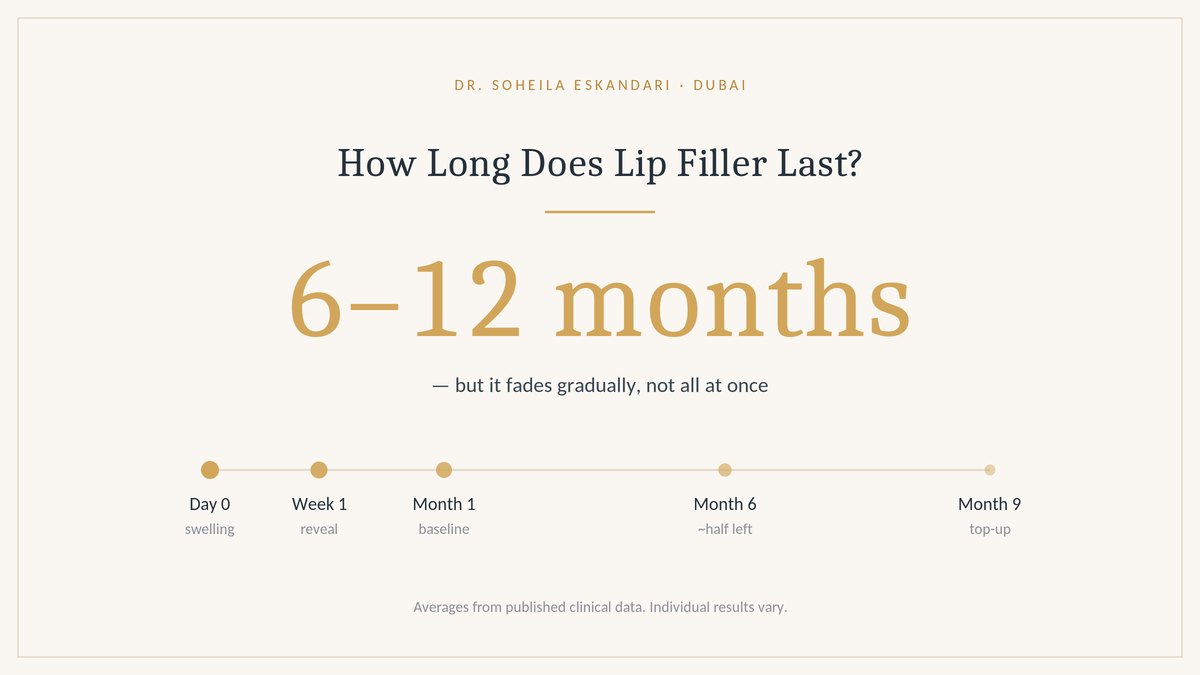
The honest answer is six to twelve months — but that range is so wide it is almost useless on its own. Two patients can receive the same 1 ml of the same hyaluronic acid filler on the same afternoon, and one will still be happy at fourteen months while the other is booking a top-up at month five.
More importantly, “lasting” is not a switch that flips off. Lip filler fades gradually, and the point at which you personally decide it has “gone” depends as much on what you were expecting as on what is physically left in your lips. Understanding the actual curve of that fade — what happens week by week, and which variables you can and cannot control — is what separates a patient who feels well informed from one who feels short-changed.
This guide, prepared with Dr. Soheila Eskandari at her Dubai clinic, walks through the real timeline, the clinical evidence behind it, the specific factors that shorten it, and what genuinely helps make results last longer.
Why Lips Are the Shortest-Lasting Filler Area
Hyaluronic acid fillers as a category last anywhere from four to eighteen months depending on the area treated. Lips sit firmly at the shorter end of that range, and there are three anatomical reasons why.
- Constant movement. Your lips are in near-perpetual motion — talking, eating, drinking, smiling, kissing, pursing. Mechanical stress accelerates the breakdown of hyaluronic acid gel far faster than in a static area like the cheekbone or temple.
- Rich blood supply. The perioral region is highly vascularised. Good circulation is excellent for healing and terrible for filler longevity, because the body clears the gel more efficiently where blood flow is high.
- Soft product by necessity. Lips require a soft, flexible, low-cohesivity gel so they move and feel natural. Those softer formulations are inherently less resistant to degradation than the firm, highly cross-linked products used for structural support in the mid-face.
A filler that lasted two years in the lips would almost certainly feel wrong to the touch. The relative impermanence is, to some extent, the price of a natural result — and Dr. Soheila considers it a feature rather than a defect, because it means an aesthetic decision made at twenty-eight is not binding at thirty-five.
What the Clinical Data Shows
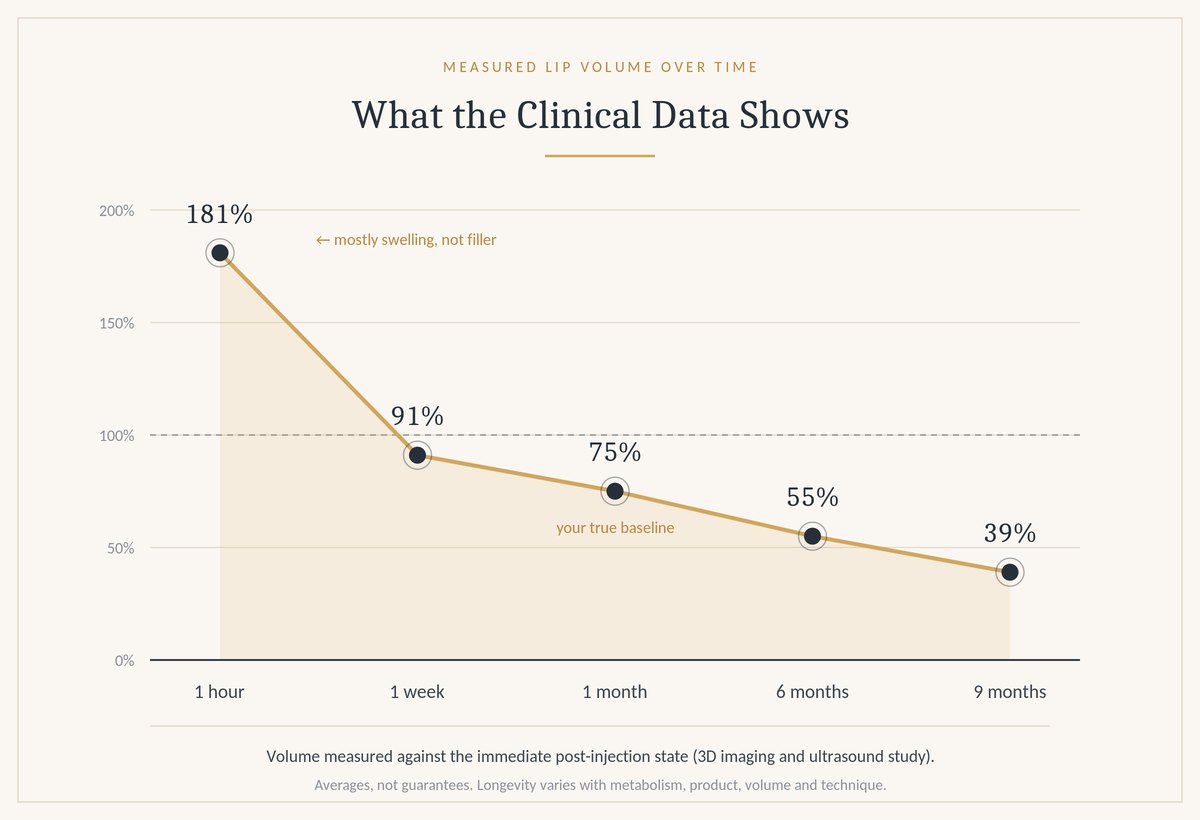
Published research gives a clearer picture than the marketing figures clinics often quote. One prospective study using three-dimensional imaging and ultrasound to measure lip volume after particle-type hyaluronic acid injection tracked the decline precisely. Taking the immediately post-injection state as the reference point, measured lip volume was:
| Time after injection | Measured volume | What this means in practice |
|---|---|---|
| 1 hour | ~181% | Mostly swelling, not filler. Do not judge anything today. |
| 1 week | ~91% | Swelling largely resolved. Close to the real result. |
| 1 month | ~75% | Settled and integrated. This is your baseline. |
| 6 months | ~55% | Noticeably softer, still clearly present. |
| 9 months | ~39% | Most patients start considering a top-up here. |
Separately, a prospective safety study of newer hyaluronic acid formulations found that at twelve months, roughly two-thirds of participants still showed a measurable improvement of at least one point on assessment scales for the lips. So filler is not simply “gone” at twelve months — but it is typically well past the point most patients would describe as their result.
Note what the one-hour figure tells you. Nearly double the volume on day one is swelling, not product. Judging your lips on the day of treatment — or panicking about them — is judging a temporary state.
The Week-by-Week Timeline
Day 0 — the day of treatment
Immediate swelling, often significant and often asymmetric. Some tenderness. Possible small bruises at injection points. Your lips will look bigger than the intended result. This is normal and expected.
Days 1–3 — peak swelling
Swelling frequently peaks on the morning after rather than on the day itself. Lips may feel firm or slightly lumpy to the touch. Sleeping slightly elevated and using a cold compress intermittently helps. Avoid the temptation to send anxious photographs to friends at this stage.
Days 4–7 — the reveal
Most swelling resolves. Bruises fade. Minor firmness begins to soften. By day seven you are looking at something close to your actual result — around 91% of the initial volume by measured data.
Weeks 2–4 — integration
The gel integrates with your tissue and softens. Volume settles to roughly three-quarters of the immediate post-injection figure. This is your true baseline, and it is the point at which Dr. Soheila Eskandari reviews results and decides whether any small refinement is warranted. Any assessment made before the two-week mark is premature.
Months 2–5 — the plateau
The most stable and typically the most satisfying stretch. Lips look and feel natural. Decline is happening but too gradually to notice day to day.
Months 6–9 — the fade
Around half the volume remains at six months, dropping to roughly 40% by nine. Definition at the lip border tends to soften before volume disappears, which is often the first thing patients consciously notice. Most people book their top-up somewhere in this window.
Months 10–14 — the tail
A residual amount often persists longer than expected, particularly after repeated treatments. Many patients find that maintenance sessions require less product than the original treatment.
What Makes Lip Filler Fade Faster
Your metabolism — the factor you cannot change
This is the single largest variable and it is genetic. Individuals with faster metabolic rates break down hyaluronic acid more quickly. It explains most of the difference between two patients treated identically, and it is not something diet or supplements meaningfully alter.
Intense, frequent exercise
Highly active patients and athletes generally need touch-ups sooner. Elevated metabolic rate and increased circulation accelerate clearance. This is not a reason to train less — simply a reason to expect a shorter interval.
Product choice
Different hyaluronic acid families differ substantially in cross-linking density, concentration and resistance to degradation. A softer gel chosen for a delicate, natural finish will not last as long as a firmer one — and in the lips, softer is frequently the correct clinical choice. Longevity is a trade-off against feel, not a free upgrade.
Volume injected
0.5 ml will appear to fade sooner than 1 ml simply because there is less to lose before the change becomes visible. This is a common reason patients feel their filler “didn’t last,” when in fact the decline rate was entirely normal.
Injection technique and depth
Placement plane matters. Product positioned correctly relative to the vermilion border and the wet-dry junction is better supported and less exposed to mechanical shear than product placed too superficially. This is one of several reasons why injector experience influences not just how lips look but how long they stay looking that way.
Sun and heat — the Dubai factor
Chronic ultraviolet exposure degrades collagen and hyaluronic acid, and Dubai delivers UV exposure at levels most European patients simply have not experienced. Combined with air conditioning that dehydrates the skin and long summer months of heat, the local environment is not filler-friendly. An SPF lip balm is a genuinely worthwhile habit here — inexpensive, easy, and one of the few longevity factors entirely within your control.
Smoking and vaping
Repetitive pursing places continuous mechanical stress on exactly the area treated, and smoking impairs microcirculation and tissue quality. Both work against your result.
What Actually Helps It Last
There is a great deal of misinformation in this area, much of it involving supplements. The measures with a plausible basis are unglamorous.
- Follow the first 48 hours properly. Avoid intense exercise, saunas, steam rooms, hot yoga and alcohol. Heat and elevated circulation in the immediate healing window increase swelling and bruising.
- Do not massage or press the lips unless specifically instructed to. Let the product integrate where it was placed.
- Stay properly hydrated. Hyaluronic acid is hydrophilic; systemic dehydration does your lips no favours in a climate like Dubai’s.
- Use SPF on the lips daily. The most underrated step, and the one almost nobody does.
- Avoid straws, and be careful with very hot drinks in the first few days. Both involve repeated pursing.
- Top up before it disappears completely. Maintaining at the six-to-nine-month mark often requires less product than rebuilding from nothing, which can make maintenance both cheaper and more consistent over time.
- Do not over-fill. Excess volume in a mobile area is under more mechanical stress, and beyond a certain point additional product does not translate into a proportionally better or longer-lasting result.
If You Do Not Like It, You Do Not Have to Wait
One of the genuine advantages of hyaluronic acid over permanent implants is reversibility. An enzyme called hyaluronidase breaks down hyaluronic acid filler, typically within one to a few days. Lips can be returned close to their previous state without waiting out the full duration.
It is used for correcting asymmetry, reducing over-filling, addressing product placed in the wrong plane, resolving nodules, and managing complications. It is a medical procedure with its own risks and requires a physician who can manage those risks — not something to be treated casually. See filler dissolving for detail.
Knowing this exists should make a first treatment less frightening. It is a strong argument for starting conservatively: you can always add more in two weeks.
Not Sure You Want Filler at All?
A number of patients who ask about lip filler are actually after something subtler. Two alternatives worth knowing about:
- The lip flip — a few units of botulinum toxin relax the muscle around the upper lip so it rolls slightly outward, showing a little more pink without adding any volume. Very subtle, and shorter-lived at roughly two to three months.
- Hydration-focused treatments — skin boosters and perioral treatments that improve texture and hydration around the mouth rather than changing shape.
Both come up regularly in consultations with Dr. Soheila with patients who want improvement without a visible change in size. If you are not certain filler is what you want, say so — it is a legitimate starting position, and understanding how Botox and fillers differ often clarifies things.
Cost Over Time in Dubai
Across the Dubai market, a 1 ml hyaluronic acid lip filler commonly falls somewhere between roughly AED 1,500 and AED 3,500, with premium product lines and highly experienced injectors sitting at the upper end and beyond. Because results typically last six to twelve months, most patients maintaining their lips are looking at one to two sessions a year.
Those are general market ranges observed across Dubai clinics, not a quotation from this clinic — an accurate figure follows an assessment of what you actually need. It is worth thinking in annual rather than per-session terms: a cheaper syringe that needs replacing twice as often, or correcting, is not the saving it appears to be.
Frequently Asked Questions
How long does lip filler last the first time?
Typically six to twelve months, with most patients noticing a meaningful reduction between months six and nine. Some patients find that subsequent treatments appear to last slightly longer, partly because a residual base remains.
When will my lips stop being swollen?
Most swelling resolves within four to seven days. Full settling and integration takes about two weeks, which is why Dr. Soheila Eskandari reviews results at the two-week mark rather than earlier.
Does lip filler stretch the lips permanently?
Conservative, appropriately spaced treatment is not generally associated with permanent stretching. Repeated high-volume filling in the same area over many years is a different situation, and it is one reason moderation matters more than most patients expect.
Do lips look smaller than before once filler wears off?
They generally return to close to their pre-treatment appearance. Lips that seem smaller afterwards are usually a perception effect — you have become accustomed to the fuller version — although natural age-related volume loss also continues in the background regardless of treatment.
How soon can I have a top-up?
A small refinement can be considered from two weeks once swelling has fully resolved. Routine maintenance is more typically scheduled at six to nine months.
Is 0.5 ml enough?
For a first treatment aiming at subtle hydration and definition, frequently yes — and starting there is often the wiser choice. It will appear to fade sooner than 1 ml, simply because there is less product present.
Does the Dubai climate really affect longevity?
Intense year-round UV exposure and persistent dryness are not favourable to skin quality or to hyaluronic acid. Daily SPF on the lips and adequate hydration are sensible local habits.
What are the risks?
Swelling, bruising and tenderness are common and temporary. Less commonly, lumps, asymmetry, nodules or infection. Rarely but seriously, vascular occlusion — filler compromising a blood vessel — which is why injector anatomical expertise and immediate access to dissolving enzyme matter. Filler is not suitable during pregnancy or breastfeeding. All of this is discussed in detail before treatment.
Considering lip filler in Dubai?
Book a consultation with Dr. Soheila Eskandari to discuss your lip anatomy, the right product and volume for your goals, realistic longevity for your metabolism and lifestyle, and the risks involved — before any decision is made.
Lip filler treatment · Book a consultation · WhatsApp +971 50 514 5129
Medically reviewed by Dr. Soheila Eskandari, DHA-licensed physician (Licence No. 00216960-005), Riviera Clinic, Dubai. This article is general education and not medical advice. All medical and aesthetic procedures carry potential risks and benefits, which are discussed during consultation. Individual results vary. Longevity figures are drawn from published clinical studies and describe averages, not guarantees. Prices quoted are general Dubai market ranges observed at the time of writing and are not a quotation. Last updated July 2026.


 English
  Arabic