
Juvederm vs Stylage in Dubai: Two Hyaluronic Acid Filler Ranges Compared
Juvederm vs Stylage in Dubai: Two Hyaluronic Acid Filler Ranges Compared
Juvederm and Stylage are both ranges of cross-linked hyaluronic acid filler, so in the hands of a trained physician they work in the same basic way: the gel adds volume or support where it is placed, and it can be dissolved with an enzyme if needed. The real differences lie in how each manufacturer cross-links its gel, how firm or soft each product in the range is, and how much published clinical research sits behind it, rather than in one brand being better than the other.
This guide explains how the Juvederm and Stylage ranges are organised, what their manufacturing technologies mean in practice, which kinds of gel suit which areas, how long results tend to last, the risks, who should avoid treatment and what filler costs in Dubai. Results vary between people, and the choice of product for any area must be made by a licensed physician after an in-person assessment.
What Do Juvederm and Stylage Have in Common?
Both are cross-linked hyaluronic acid gels
Hyaluronic acid is a sugar molecule found naturally in skin, where it binds water and helps tissue stay plump. On its own it breaks down within days, so filler manufacturers link the chains together with a cross-linking agent to make a gel that lasts for months. Both Juvederm and Stylage use this approach. The amount of hyaluronic acid, the degree of cross-linking and the size and shape of the gel particles decide how firm a product feels, how well it holds a shape and how far it spreads after injection.
Because both ranges are hyaluronic acid, results are visible straight away, apart from swelling, and the enzyme hyaluronidase can break the gel down if a result is uneven or, much more urgently, if filler blocks a blood vessel.
Why the product name matters more than the brand
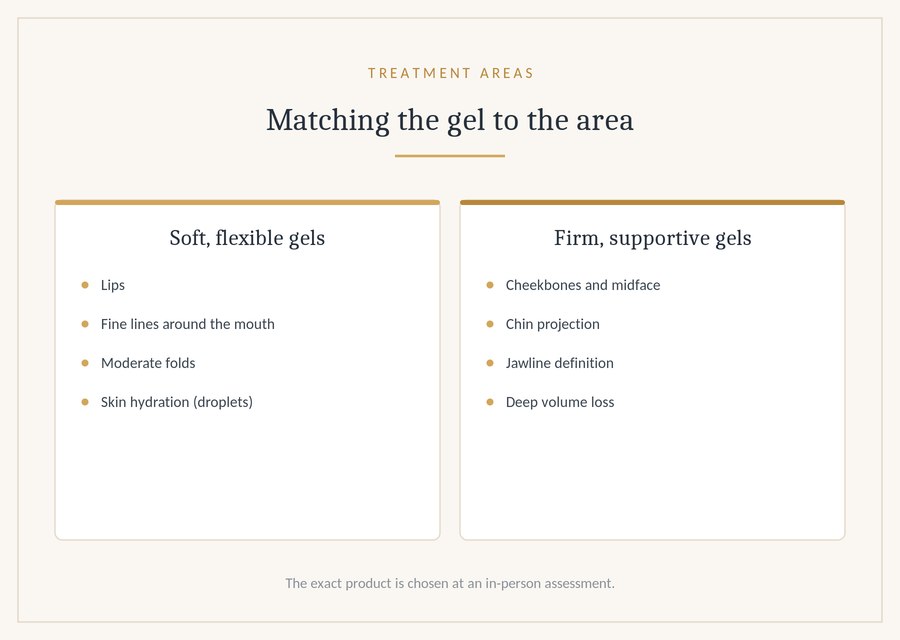
Each brand is a family of products, not a single gel. Within each family there are soft, flexible products designed for fine lines and lips, and firmer, more cohesive products designed to support the cheeks, chin and jawline. A soft Juvederm product and a soft Stylage product are closer to each other in purpose than a soft and a firm product from the same brand. When you compare quotes or discuss a plan, the useful question is which specific product will be used and why, not just which brand.
How Is the Juvederm Range Organised?
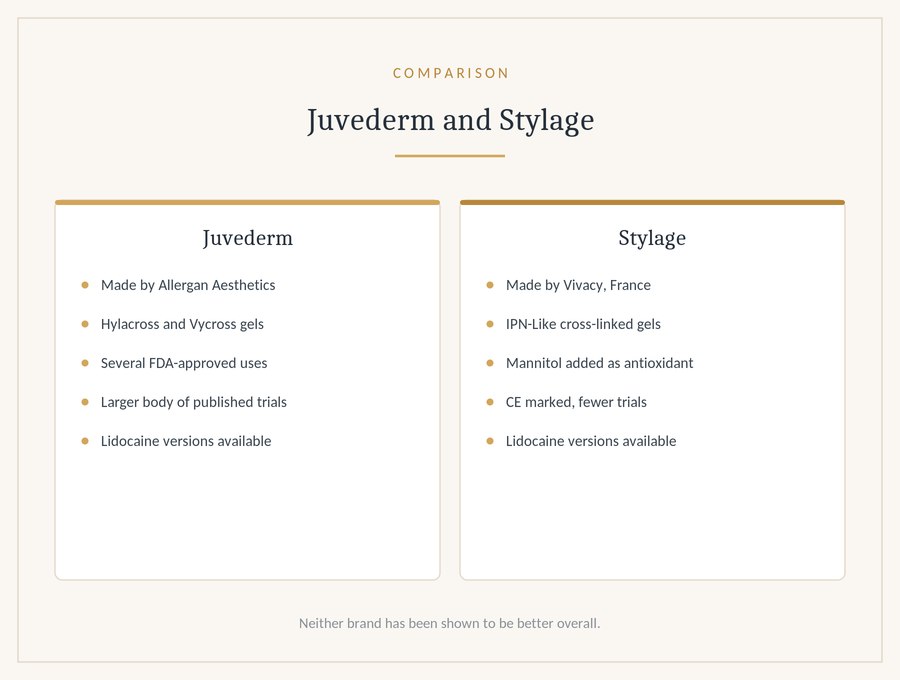
Juvederm is made by Allergan Aesthetics, part of AbbVie. Its products are built on two manufacturing technologies, and the names you hear in clinics usually belong to one of them.
Hylacross products
The older Hylacross technology uses hyaluronic acid of a single, high molecular weight. Products in the Juvederm Ultra family are made this way and are commonly used for lips and for lines around the mouth. They tend to be smooth and mouldable, which suits areas where the filler needs to blend with movement.
Vycross products
The newer Vycross technology mixes short and long hyaluronic acid chains before cross-linking. According to the manufacturer, this allows a lower concentration of hyaluronic acid to form a gel that holds its shape, with less tendency to attract water. Products made this way include Volbella for the lips and fine lines, Volift for moderate folds, Voluma for cheek volume and Volux for the chin and jawline. Many Juvederm products are available with lidocaine, a local anaesthetic mixed into the gel to make injection more comfortable.
Approvals and research
Several Juvederm products hold approval from the US Food and Drug Administration for specific uses, such as cheek volume, lip augmentation, the chin and the jawline. These approvals came from controlled trials, and the product labels report how long results lasted in those studies. That body of published evidence is one reason Juvederm is widely used. It does not mean every Juvederm product suits every area, and approvals in another country are not the same as registration in the UAE, so it is reasonable to ask how the product in use is registered here.
How Is the Stylage Range Organised?
Stylage is made by Laboratoires Vivacy in France. Its gels are produced with what the manufacturer calls IPN-Like technology, in which hyaluronic acid networks with different cross-linking densities are combined into one gel. The aim is a product that holds its shape while staying smooth to inject.
Antioxidant added to the gel
A distinctive feature of Stylage is the addition of mannitol, or sorbitol in some products, to the gel. These sugar alcohols act as antioxidants. The manufacturer describes them as helping to protect the hyaluronic acid from breakdown by free radicals, which form during the inflammation that follows any injection. This is a reasonable rationale, but there is no independent head-to-head trial showing that it changes how long results last compared with other gels.
The Stylage product family
The range runs from softer to firmer products: S for fine superficial lines, M for moderate lines, L for deeper folds, and XL and XXL for volume and contour. There are dedicated lip products, Lips and Special Lips, and hydrating products, Hydro and HydroMax, for skin quality rather than shape. Most are available with lidocaine. Published figures for the hyaluronic acid concentration of individual Stylage products vary between sources, so it is sensible to rely on the current instructions for use rather than a number quoted online.
Evidence and regulation
Stylage is CE marked for use in Europe and is used in the UAE, Europe and many other countries. Its published clinical research is smaller than Juvederm’s, and it is not among the fillers approved by the US FDA. That is a regulatory and research difference, not proof that results differ. As with any product, ask how it is registered for use in the UAE.
What Actually Differs Between the Two?
Firmness, cohesivity and spread
Physicians describe filler gels by properties such as elasticity, often written as G prime, and cohesivity. A higher G prime gel resists pressure and holds a projection, which suits the chin or cheekbone, while a softer gel moves with the tissue, which suits the lips. Both brands make products across this spectrum, so the relevant comparison is between products intended for the same job.
Water attraction and swelling
Every hyaluronic acid filler draws in some water. Gels with a lower concentration or a manufacturing process designed to limit swelling may look more predictable in delicate areas such as the lips and under the eyes. Swelling also depends on the injection technique, the volume placed and the individual, so it cannot be predicted from the brand alone.
Comfort during treatment
Both ranges include versions with lidocaine. Most patients describe the sensation as pressure with brief stinging, and a numbing cream can be applied beforehand. Comfort is more affected by the area treated, the use of a needle or a blunt cannula and the injector’s technique than by the brand.
Which Areas Suit Which Type of Gel?
Lips
Lips move constantly, so a soft, flexible gel is usually chosen. Volbella and the Juvederm Ultra products, and Stylage Lips and Special Lips, are designed for this area. A natural result depends far more on the volume and placement than on the brand, which is why many physicians treat the lips in small steps. Our guide to natural lip filler explains how a subtle plan is made.
Cheeks and midface
Cheek support needs a firmer gel placed deep, often on the bone. Voluma and Stylage XL are examples of products designed for volume. The cheek filler guide covers how the midface is assessed and why overfilling the cheeks can change the whole face.
Chin and jawline
The chin and jaw need the firmest, most shape-holding gels, such as Volux or the firmer Stylage products, placed close to the bone. Small amounts can improve the profile and the balance between the chin, lips and nose without making the lower face look heavy.
Folds and lines
Moderate folds such as the lines from the nose to the mouth often suit a medium gel, for example Volift or Stylage M or L. Deep folds are frequently a sign of volume loss in the midface, so supporting the cheek may soften them more naturally than filling the fold itself.
Under the eyes
The tear trough is one of the most delicate areas, with thin skin and a tendency to hold fluid. Only some products are suitable, used in small amounts by an experienced physician, and some people are better served by other approaches. Suitability must be judged in person.
How Long Do Juvederm and Stylage Last?
Duration depends on the product, the area, the volume and the person. Firmer gels placed deep in areas with little movement, such as the cheeks and chin, tend to last longer than soft gels in the lips. Juvederm product labels report results lasting around a year for the lips and jawline in trials, and up to around two years for some cheek products. Stylage materials commonly describe results of around nine to twelve months for many products, though there is less published trial data. In practice, many people choose a review and a top-up at around nine to eighteen months depending on the area. Our article on how long lip filler lasts looks at the lips in detail.
Metabolism, sun exposure, smoking and how mobile the area is can all shorten duration. Filler can also be present in tissue for longer than it is visible, which is one reason repeated treatments should be planned rather than added routinely.
Can Juvederm and Stylage Be Dissolved?
Yes. Both are hyaluronic acid, so hyaluronidase can break them down. This is used to correct lumps, unevenness or filler that has moved, and it is the emergency treatment if filler blocks a blood vessel. Some highly cross-linked gels may need more than one session of hyaluronidase. The procedure has its own risks, including allergy to the enzyme, so it is done by a physician. Our guide to dissolving filler explains what is involved.
What Are the Risks of Hyaluronic Acid Filler?
Common and expected effects
Swelling, redness, tenderness and bruising at the injection points are common and usually settle within days to two weeks. Small lumps can often be felt early and usually soften. Lidocaine can cause brief numbness.
Less common complications
Persistent lumps, visible filler, a bluish tinge when gel sits too close to the surface, filler migration, infection and delayed inflammatory reactions can occur. Delayed reactions may appear weeks or months later, sometimes after an illness or dental work, and need medical review.
Vascular occlusion
The most serious risk is filler entering or pressing on a blood vessel. This can starve the skin of blood and, rarely, affect vision. Warning signs include severe pain, blanching or a mottled, dusky colour of the skin, and any change in vision. This needs immediate treatment with hyaluronidase, which is one reason hyaluronic acid filler should only be injected by a physician who has it on hand and knows the anatomy.
Who Should Avoid Hyaluronic Acid Filler?
Treatment is usually postponed during pregnancy and breastfeeding, during active skin infection, cold sores or acne at the site, and around dental work or vaccinations. It is avoided in people with a known allergy to the product or to lidocaine. People with autoimmune conditions, bleeding disorders, those taking blood-thinning medicines, and those with a history of severe allergic reactions or previous filler complications need a careful medical assessment first. Anyone with an unrealistic goal, or who feels pressured into treatment, is better served by waiting.
How Does Dr Soheila Choose Between Them?
Dr Soheila works with Stylage and Juvederm. The choice for each area starts with the assessment: the face at rest and in movement, the skin thickness, the bone and fat support, the person’s goals and any history with filler. From there the question is which gel properties fit the job, a soft gel for the lips, a firm gel for the jawline, a hydrating product for skin quality, and then which specific product provides them.
Sometimes the answer is to use different products in different areas of the same face. Sometimes it is to use less filler than expected, or another treatment, such as a calcium hydroxylapatite biostimulator, a skin booster or anti-wrinkle injections. The overview of dermal fillers describes the treatment areas.
Choosing Who Treats You
Filler is a medical procedure and should be performed by a licensed physician whose DHA licence you can verify on the DHA Sheryan portal and who treats the area you are interested in regularly. Ask for a proper assessment before anything is injected, and ask the clinic to name the product, the volume and the reason for the choice.
A sound plan also includes written aftercare, a review at around two weeks and a clear route to the clinic if you notice severe pain or skin colour changes. At dr-soheila.com, treatments are planned and performed by Dr Soheila Eskandari, a DHA-licensed general practitioner with aesthetic privileges with 20 years of experience in aesthetic medicine.
The Short Version
Juvederm and Stylage are both cross-linked hyaluronic acid fillers that can be dissolved with hyaluronidase. Juvederm uses Hylacross and Vycross technologies and has a larger body of published trials, including FDA approvals for specific uses. Stylage uses IPN-Like technology with an added antioxidant and has less published research. Neither brand is better overall.
What matters is the specific product for each area, the volume and the technique. Soft gels suit the lips and fine lines, and firm gels suit the cheeks, chin and jaw. Results commonly last around nine months to two years depending on the product and area. Risks include swelling, bruising, lumps and, rarely, a blocked blood vessel, and a licensed physician must assess suitability in person.
Questions Worth Asking
Which exact product will you use in each area, and why? The answer should name the product, not just the brand, and explain how its firmness fits the area.
How much filler do you recommend, and can we start with less? A clear volume helps you compare quotes and avoid overfilling.
Do you keep hyaluronidase in the clinic? It should be immediately available in case of a vascular complication.
When will you review the result? A review at around two weeks allows swelling to settle before any adjustment is made.
Frequently Asked Questions
What is the difference between Juvederm and Stylage?
Both are cross-linked hyaluronic acid fillers; Juvederm is made with Hylacross and Vycross technologies and has more published trials, while Stylage uses IPN-Like technology with an added antioxidant, and neither has been shown to be better overall.
Which is better, Juvederm or Stylage?
Neither can be called better in general; the right choice depends on the area, the firmness of gel needed, the volume and the physician’s assessment.
Is Stylage FDA approved?
No, Stylage is CE marked in Europe and used in many countries but is not among the fillers approved by the US FDA; ask how the product in use is registered in the UAE.
What is the mannitol in Stylage for?
Mannitol is an antioxidant that the manufacturer adds to help protect the hyaluronic acid from breakdown, although no head-to-head trial shows that it makes results last longer.
Which Juvederm products are used for which areas?
Volbella and the Ultra products are commonly used for the lips, Volift for moderate folds, Voluma for cheek volume and Volux for the chin and jawline.
How long do Juvederm and Stylage last?
Commonly around nine months to two years, depending on the product, area and person; soft gels in the lips usually last a shorter time than firm gels in the cheeks or chin.
Can Juvederm and Stylage be dissolved?
Yes, both are hyaluronic acid and can be broken down with hyaluronidase, which is also the emergency treatment for a blocked blood vessel.
Does filler injection hurt?
Most people feel pressure and brief stinging; many products contain lidocaine and a numbing cream can be used, so discomfort is usually manageable.
Who should avoid Juvederm or Stylage?
Treatment is postponed in pregnancy, breastfeeding and active infection at the site, avoided with allergy to the product or lidocaine, and needs careful assessment with autoimmune disease, bleeding disorders or blood thinners.
What does Juvederm or Stylage filler cost in Dubai?
Market rates generally run from around AED 1,000 to AED 2,500 per 1 ml syringe, depending on the product and the clinic, and the total depends on how many syringes are needed, so ask for a written quote naming the product.
This article is general information about aesthetic and dermatological treatments and is not medical advice, a diagnosis, or a treatment recommendation for any individual. Outcomes vary between patients and no result is guaranteed. Prescription medications and injectable products carry risks and contraindications that must be assessed by a licensed physician during a personal consultation. Dr Soheila Eskandari is licensed by the Dubai Health Authority. Prices quoted are general market ranges for information only and are not an offer.


 English
 Arabic