
Cheek Filler in Dubai: Anatomy, Technique and Honest Expectations
Cheek Filler in Dubai: Anatomy, Technique and Honest Expectations
Cheek filler is the treatment most often done badly, and the one where doing it well changes a face more than anything else on the menu. The difference between the two outcomes is not the product. It is whether the injector understood which layer of the cheek had actually lost volume — and most of the “overfilled” results people fear come from putting the right product in the wrong place.
This guide explains the anatomy that governs the result, what the imaging and cadaveric research shows about where filler should sit, how much a realistic treatment costs in Dubai, and how to judge whether a proposed plan is sound before you commit. Dr Soheila treats the midface as a structural problem rather than a volume request, and the reasoning behind that is worth understanding as a patient.
What Actually Happens to the Cheek With Age
The cheek is not a single pad of fat. Anatomical work describes a layered arrangement running from bone to skin: deep fat compartments that sit directly on the maxilla, a thin muscular layer, and superficial mobile fat pads above it.
These layers do not age the same way, and this is the whole story:
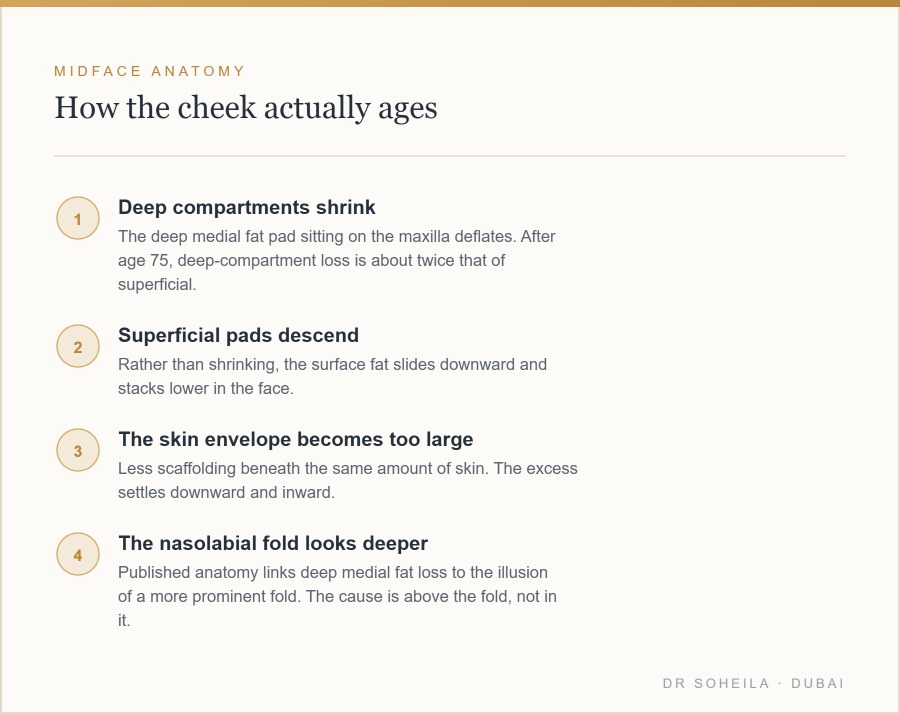
- The deep compartments shrink. The deep medial fat compartment — which sits on the maxilla and abuts the pyriform aperture near the nose — loses volume with age. Quantitative anatomical study has found that volume loss after the age of 75 in the deep compartments is roughly twice that of the superficial compartments.
- The superficial compartments descend. Rather than shrinking, the superficial pads tend to become ptotic — they slide downward — and in some people become relatively hypertrophic.
Put those two together and the classic ageing midface makes sense. The scaffolding underneath deflates, so the skin envelope becomes relatively too large. That excess skin has to go somewhere, and it settles downward and inward. Published anatomical work links diminished volume of the deep medial fat compartment directly to an excess skin envelope and the illusion of a more prominent nasolabial fold.
That word — illusion — is the single most useful concept in this article. A great many people who ask about their nasolabial folds do not have a nasolabial problem. They have a deep midface problem that is showing up one level lower.
Why the Injection Plane Decides the Result
If the deep compartments deflated, then that is where product needs to go. This is not stylistic preference; it is mechanical.
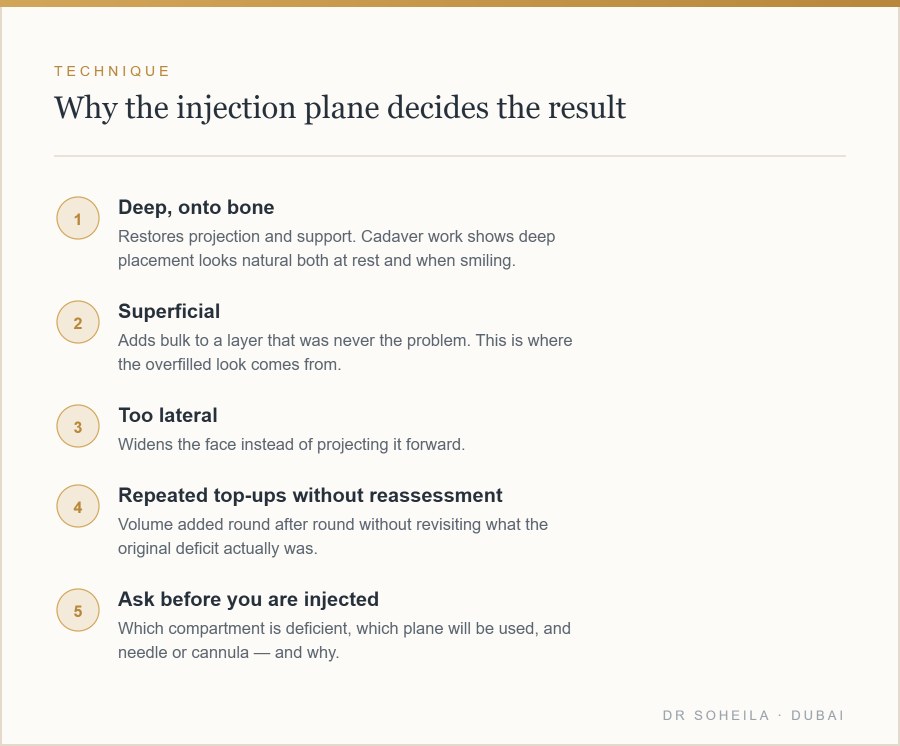
Modern injection guidance for the midface is built on three principles: detailed anatomical knowledge, precise identification of the tissue plane, and selection of a hyaluronic acid gel matched to that specific plane — deep, superficial, or dermal. Filler placed deep, onto bone, restores projection and support. Filler placed superficially adds bulk to a layer that was never the problem.
Research using a “smiling cadaver” approach — mapping how fat compartments move during facial animation — demonstrated that product placed in the deep fat compartments produces natural projection both at rest and during expression. That distinction matters enormously. A cheek that looks acceptable in a still photograph but distorts when you smile is almost always a cheek filled in the wrong layer.
The behaviour of the product is governed by the biomechanical stability of the compartment boundaries. Deep compartments are relatively fixed; superficial ones move. Product in a fixed compartment stays where it was placed and behaves predictably. Product in a mobile compartment shifts with every expression.
What “overfilled” actually looks like — and why it happens
The recognisable overfilled look is a specific pattern: a shelf of fullness sitting high and lateral on the cheek, wide across the face, that becomes more obvious rather than less when the person smiles. It rarely comes from too much product overall. It comes from:
- Product placed superficially where it bulks rather than supports
- Product placed too laterally, widening the face instead of projecting it
- Repeated top-ups added without reassessing what the original deficit was
- Treating the cheek in isolation, rather than as part of a midface that also involves the temple, the tear trough, and the jawline
What Cheek Filler Can and Cannot Do
It does well
- Restore midface projection and the light-reflecting highpoint that reads as a healthy cheek
- Soften the nasolabial fold indirectly — often more effectively than injecting the fold itself
- Improve the tear trough transition, because the cheek is what the lower eyelid sits on. A hollow midface makes under-eye shadowing worse regardless of what is done to the eye area
- Restore facial shape in people who have lost weight — a common presentation in Dubai, particularly after significant weight loss on GLP-1 medication
- Provide gentle lift by re-supporting a descended soft-tissue envelope
It does not do
- Replace a facelift. Filler restores volume; it does not reposition tissue. Significant laxity needs a different conversation
- Fix skin quality. Crepiness, texture, and pigment are separate problems requiring separate treatments
- Create a bone structure you do not have. Filler can reveal and support the cheekbone you have. Attempting to manufacture a dramatically different facial skeleton with gel is how faces start looking artificial
- Correct heavy jowling. Adding weight above a lax jawline can make the jowl more visible
The Assessment That Should Happen First
Dr Soheila’s cheek consultation is deliberately not a conversation about how many syringes. It covers:
- Which compartment is deficient. Deep medial, deep lateral, superficial, or a combination. This determines placement, product, and volume.
- Bone support. The underlying maxilla and zygoma determine what projection is achievable and where product will be stable.
- Skin quality and laxity. If the skin envelope is very lax, volume alone will disappoint and should be said so at consultation, not discovered at review.
- Adjacent zones. Temple hollowing, tear trough, and jawline definition all interact with the cheek. Treating one in isolation can look odd.
- Animation. You will be asked to smile and to speak. A cheek assessed only at rest is half assessed.
- Photographs in fixed lighting and position, frontal, three-quarter and profile.
Some consultations end with a recommendation to treat the temple or the tear trough first — or, occasionally, to treat nothing and revisit in a year. That is a legitimate outcome of an assessment.
The Treatment Itself
Before
Avoid blood-thinning supplements — fish oil, high-dose vitamin E, ginkgo — for several days if your physician agrees. Avoid alcohol for 24 hours. Come without makeup where possible. Tell the clinic about any previous filler in the midface, even years ago, and about any autoimmune condition, anticoagulant, or recent dental work.
During
Topical anaesthetic for 15 to 20 minutes; most midface gels also contain lidocaine. The area is cleaned thoroughly.
Injection may use a needle, a cannula, or both. A cannula is a blunt-tipped instrument introduced through a single entry point that pushes vessels aside rather than piercing them, and it is widely preferred for larger-volume midface work. Needles allow more precise deep bolus placement onto bone. Which is used, and where, is a clinical judgement — but you are entitled to ask why.
Treatment takes 20 to 30 minutes. Dr Soheila will sit you upright partway through and reassess, because a midface judged lying flat reads differently upright under normal light.
Afterwards
| Time | What to expect |
|---|---|
| First 48 hours | Swelling, sometimes noticeable. Possible small bruises at entry points |
| Days 3–7 | Swelling settles substantially; any bruising fades |
| Week 2 | Product integrated. This is when the result is genuinely assessable |
| Week 4 onward | Final settled appearance |
| 12–24 months | Gradual degradation. Deep midface placement is among the longer-lasting sites |
Aftercare
- No pressure or massage on the cheeks for 48 hours — including sleeping face-down and resting your face on your hand
- No strenuous exercise, sauna, steam, or hot yoga for 24 to 48 hours
- No alcohol for 24 hours
- Sleep on your back for the first two nights
- Avoid non-urgent dental work for two weeks, and mention the filler to your dentist
- Contact the clinic immediately for severe pain, blanching, mottled discolouration, or any vision change
How Long Cheek Filler Lasts
The midface is one of the better-performing sites for duration, because the deep compartments are relatively immobile and mechanical stress on the product is lower than in the lips or chin. Realistic expectation for a well-placed deep midface treatment is 12 to 24 months, with meaningful individual variation.
Factors that shorten it: high metabolic rate and endurance training, very superficial placement, small volumes spread thinly rather than placed as supported boluses, and significant weight fluctuation.
An important practical point: topping up before the previous treatment has fully degraded generally requires less product each time and produces a more stable long-term result than allowing complete degradation and rebuilding from scratch.
Cheek Filler Cost in Dubai
Pricing is per syringe. Midface correction commonly requires two syringes for a first treatment — one per side — with some cases needing more and some needing considerably less.
Market rates in DHA-licensed clinics generally sit in the range of AED 1,800 to AED 3,500 per syringe for the structural gels appropriate for deep midface work, varying by product, injector, and clinic.
What legitimately affects the number:
- Product selection. The firm, high-lift gels engineered to sit on bone cost the clinic more than softer gels intended for superficial hydration
- Injector experience. Midface anatomy is genuinely complex and the consequences of getting it wrong are both aesthetic and vascular
- Whether cannula technique and a two-week review are included
- Whether adjacent zones are treated in the same session
A caution worth stating: cheek filler priced far below market is not a saving. This is a high-volume injection in an area with significant vasculature, and correcting a poor result — dissolving, managing a complication, or living with an unnatural midface for two years — costs far more than the difference. Our guide to how aesthetic pricing works in Dubai explains what sits behind a quoted figure.
Risks, Honestly Stated
Common and expected: swelling, bruising, tenderness, temporary firmness, mild asymmetry that settles within two weeks.
Uncommon: prolonged swelling, palpable or visible product where placement was too superficial, nodules, infection, and delayed-onset inflammatory reactions. Hyaluronic acid can be dissolved with hyaluronidase if needed, which is a genuine advantage of this product class.
Rare but serious: vascular occlusion. The midface contains branches of the facial and infraorbital arteries, and the region has connections to the ophthalmic circulation. Warning signs are immediate severe pain disproportionate to the procedure, skin blanching, a mottled purple pattern developing over hours, and — critically — any change in vision. These require immediate treatment.
Ask your clinic directly: do you keep hyaluronidase on site, what is your vascular occlusion protocol, and how do I reach you out of hours? A clinic without a crisp answer should not be injecting your midface.
Cheek Filler Versus the Alternatives
| Option | Best for | Duration |
|---|---|---|
| Hyaluronic acid filler | Defined volume deficit; wants reversibility | 12–24 months |
| Collagen biostimulators | Diffuse volume loss, gradual change preferred | Up to 2 years, builds slowly |
| Thread lift | Mild descent with adequate volume | 12–18 months |
| Fat grafting | Large-volume restoration, permanence wanted | Long-term, partly unpredictable |
| Surgical lift | Significant laxity and tissue descent | Years |
Questions Worth Asking Before You Book
- Which fat compartment do you think has lost volume in my face?
- Will you inject deep onto bone, or superficially, and why?
- Needle or cannula for my case — and what is the reasoning?
- Which product, and why that one for the midface specifically?
- How will my result look when I smile, not just at rest?
- Should anything else be treated first — temple, tear trough, jawline?
- Is a two-week review included in the price?
- What is your vascular occlusion protocol, and is hyaluronidase kept on site?
- Are you and the clinic currently DHA-licensed for this treatment?
Treating With Dr Soheila
Dr Soheila Eskandari practises aesthetic medicine in Dubai under DHA licence and approaches the cheek as the structural centre of the face rather than as an isolated area to be filled. In practice that means the assessment identifies the deficient compartment first, product volume follows the measured deficit rather than a package, and the plan accounts for how the midface interacts with the eyes, temples, and jawline.
It also means some patients are told that filler is not their answer — that their concern is skin laxity, or skin quality, or a jawline issue — and are given a straight explanation of what would actually help. Patients who want a dramatic single-session transformation are usually better served by a surgical referral, and Dr Soheila will say so rather than attempt it with gel.
Related reading on this site: our guides to chin filler and under-eye filler, both of which are frequently part of the same midface conversation, and botox versus fillers if you are still deciding which category of treatment fits your concern.
Frequently Asked Questions
How many syringes do I need for cheek filler?
Most first treatments use two syringes — approximately one per side — though the correct amount depends on the measured deficit rather than a standard package. Some cases need less; significant volume loss may need more, ideally staged across sessions rather than done all at once.
How long does cheek filler last?
Typically 12 to 24 months when placed deep in the midface. The deep compartments are relatively immobile, so mechanical stress on the product is lower than in high-movement areas such as the lips or chin, and duration tends to be correspondingly better.
Will cheek filler make my face look wide or puffy?
Not when placed correctly. The overfilled appearance usually comes from product placed too superficially or too laterally, or from repeated top-ups added without reassessing the original deficit. Deep placement onto bone projects the cheek forward rather than widening it.
Can cheek filler help my nasolabial folds?
Often yes, and frequently better than injecting the fold itself. Anatomical work links loss of volume in the deep medial fat compartment to an excess skin envelope and the illusion of a more prominent nasolabial fold. Restoring the midface support addresses the cause rather than the symptom.
Does cheek filler lift the face?
It provides gentle support by re-inflating deflated deep compartments, which can improve the position of descended soft tissue. It does not reposition tissue the way surgery does. Significant laxity needs a different treatment.
Needle or cannula — which is better?
Both have a place. A cannula is blunt-tipped and tends to push vessels aside rather than pierce them, which is often preferred for larger-volume midface work. A needle allows precise deep bolus placement onto bone. Many treatments use both, and the choice should be explained to you.
Is cheek filler reversible?
Hyaluronic acid filler is, using hyaluronidase, usually within a day or two. This is a genuine advantage over permanent or semi-permanent options, and a reason many patients start with hyaluronic acid.
How much does cheek filler cost in Dubai?
Market rates in DHA-licensed clinics generally range from AED 1,800 to AED 3,500 per syringe for the structural gels used in the deep midface, with two syringes typical for a first treatment. Price varies by product, injector experience, and whether a review appointment is included.
I lost a lot of weight and my face looks hollow — is this the right treatment?
Frequently yes. Significant weight loss disproportionately affects the deep midface compartments, which is why the face can look drawn while the body looks better. Assessment should confirm which compartments are affected before treatment.
What are the warning signs I should watch for after treatment?
Severe pain out of proportion to the procedure, blanching of the skin, a mottled purple pattern developing over hours, or any change in vision. These suggest vascular compromise and require immediate contact with your clinic — not waiting until the next working day.
This article is general information about aesthetic treatments and is not medical advice, a diagnosis, or a treatment recommendation for any individual. Outcomes vary between patients and no result is guaranteed. All injectable treatments carry risks that should be discussed with a licensed physician during a personal consultation. Dr Soheila Eskandari is licensed by the Dubai Health Authority. Prices quoted are general market ranges for information only and are not an offer.


 English
  Arabic