
Under-Eye Filler in Dubai: Who It Suits, and Who It Does Not
Under-Eye Filler in Dubai: Who It Suits, and Who It Does Not
Under-eye filler produces some of the most transformative results in aesthetic medicine and some of the most visible failures. Both facts come from the same source: the skin below the eye is among the thinnest on the body, the anatomy is unforgiving, and the margin between “rested” and “puffy” is measured in fractions of a millilitre.
The most useful thing this article can tell you is not how it works. It is who should not have it — because the single biggest predictor of a poor under-eye filler outcome is treating the wrong patient, not treating them badly.
This guide, prepared with Dr. Soheila Eskandari at her Dubai clinic, covers what causes under-eye shadows, who is genuinely a candidate, the specific complications of this area, the alternatives, and what treatment costs in Dubai.

First: What Is Actually Causing Your Dark Circles?
“Dark circles” is a description, not a diagnosis. There are four distinct causes and filler correctly addresses only one of them.
| What you see | Underlying cause | Does filler help? |
|---|---|---|
| A shadow that changes with lighting | Structural hollow — the tear trough groove | Yes — this is the indication |
| Brown discolouration | Pigmentation — genetic or sun-induced | No |
| Blue or purple tone | Vascular — vessels visible through thin skin | Rarely, and cautiously |
| Puffiness or a bulge | Fat pad herniation or fluid retention | No — and it can make it worse |
There is a rough test you can do at home. Look in the mirror in ordinary overhead light, then tilt your chin up towards the light. If the darkness lightens substantially as the angle changes, you are looking at a shadow — a structural problem, and the one filler is for. If the colour stays the same regardless of angle, it is pigment or vessels, and no amount of filler will change it.
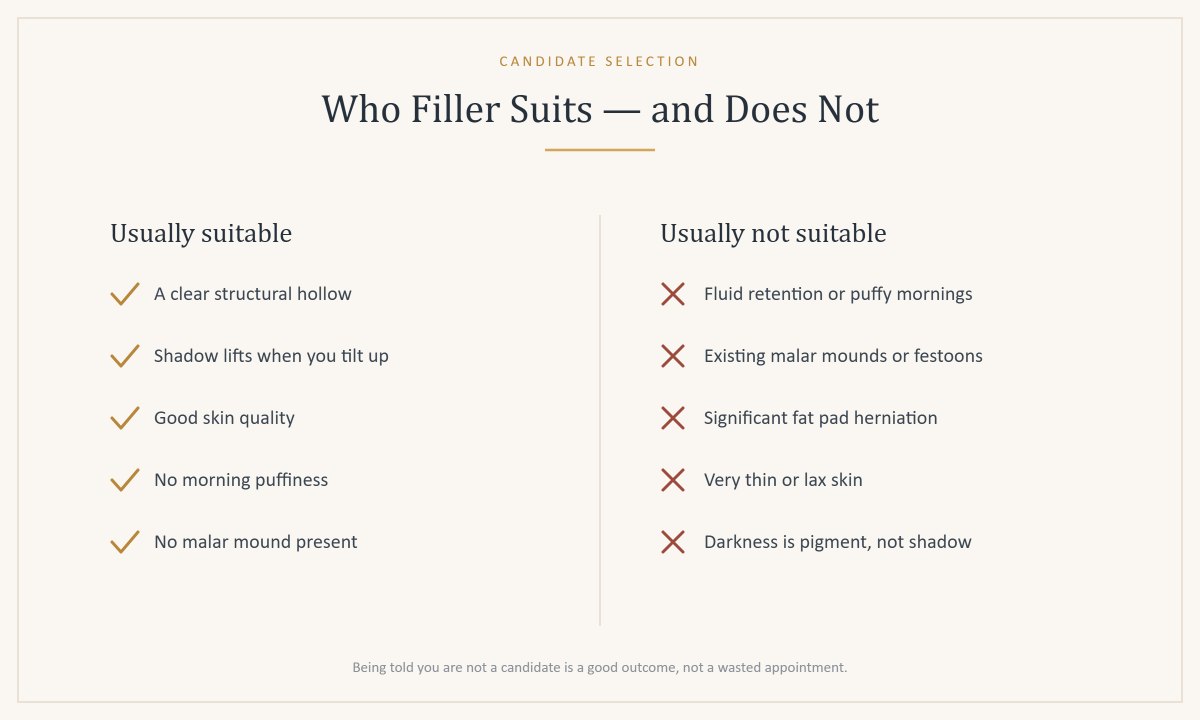
Who Is Not a Good Candidate
This is the section most clinics leave out. Several presentations make under-eye filler a poor idea, and in some it makes the appearance actively worse.
Fluid retention and puffy mornings
Hyaluronic acid attracts water. Placing a water-loving gel into a region that already holds fluid is asking for a swollen result. Patients whose under-eyes are markedly puffier in the morning, or after salt or alcohol, need this discussed honestly before anything is injected.
Malar mounds and festoons
A malar mound is a soft fullness sitting on the upper cheek, below the true tear trough. Filler placed above it can obstruct lymphatic drainage and produce chronic, doughy swelling — malar oedema — which is one of the most difficult complications to manage in this region. Patients with existing malar mounds are, in most hands, not filler candidates.
Significant fat pad herniation
If there is a genuine bulge of orbital fat, filling the groove beneath it does not remove the bulge — it fills the valley next to the hill and can make the whole area look fuller rather than fresher. This is a surgical conversation.
Very thin or lax skin
Extremely thin skin raises the risk of visible product and of the Tyndall effect — a bluish-grey tinge that appears when filler sits too superficially and scatters light. Where skin quality is the limiting factor, treating the skin first is the better sequence.
Being told you are not a candidate is a good outcome, not a wasted appointment. In this area particularly, Dr. Soheila Eskandari declines more often than in any other part of the face.
How It Is Done Properly
Where treatment is appropriate, the principles are consistent:
- A soft, low-water-binding product. Firm, highly hydrophilic fillers designed for cheekbones do not belong under the eye.
- Deep placement, on the bone. Product is placed beneath the muscle against the orbital rim, not superficially in the dermis. Depth is what prevents the Tyndall effect.
- Small volumes. Often 0.5 ml or less across both sides. This is not an area where more is better.
- Staged treatment. Treat conservatively, review at two to four weeks, add only if genuinely needed. Under-eye filler settles and integrates slowly, and volume that looks insufficient at week one is frequently correct at week four.
- Cannula where appropriate. A blunt cannula reduces — though does not eliminate — the risk of vessel injury compared with a sharp needle in this vascular region.
- Supporting the mid-face first. Often the tear trough shadow is a consequence of cheek volume descent. Restoring support at the cheek can soften the groove without injecting under the eye at all — the safer route when it works.
The Specific Risks of This Area
All medical and aesthetic procedures carry potential risks alongside their potential benefits, and the under-eye region carries a distinctive set.
- Prolonged swelling. More common here than elsewhere and can take weeks to settle.
- Malar oedema. Chronic doughy upper-cheek swelling from impaired lymphatic drainage. Managed by limiting volume, selecting the right product and correct depth — and by not treating unsuitable candidates.
- Tyndall effect. Bluish discolouration from product placed too superficially. Correctable by dissolving.
- Lumps, irregularity and asymmetry. The thin skin here hides nothing.
- Bruising. Common, and can be pronounced given the vascularity.
- Vascular occlusion. Rare but serious. The periorbital region has connections to the ophthalmic circulation, which is why this area demands anatomical expertise, appropriate technique, and immediate access to dissolving enzyme.
The meaningful safety advantage is that hyaluronic acid filler is dissolvable with hyaluronidase. A result you dislike, an irregularity, or a Tyndall tinge can be reversed within days rather than waited out. Permanent and semi-permanent products offer no such exit and have no place here.
Treatment is not suitable during pregnancy or breastfeeding, over active infection, or without a full medical history including autoimmune conditions, blood-thinning medication and previous injectables in the area.
The Alternatives Worth Knowing About
For patients who are not filler candidates — or who want to improve the area without adding volume — there are real options:
- Polynucleotides. Rejuran and related PDRN treatments target the quality of the skin itself — thickness, texture, tone. The most commonly chosen option where the complaint is crepiness or discolouration rather than hollowing. See our comparison of Rejuran and Profhilo.
- Skin boosters. Sunekos is frequently used around the eyes, where amino acids plus hyaluronic acid improve texture without volume. See Profhilo versus skin boosters.
- PRP. Growth factors from your own blood, used to thicken thin under-eye skin and improve circulation.
- Mesotherapy and pigment-directed treatment. Where the cause is genuinely melanin rather than shadow.
- Botulinum toxin. For the fine crow’s feet lines that often accompany the complaint but are a separate problem.
Frequently the right plan is a combination — treat the skin, support the cheek, and use only a small amount of filler if any is needed at all.
The Appointment, Start to Finish
- Assessment first. Examination in different lighting and head positions, a decision on whether the darkness is shadow, pigment or vessels, and a check for malar mounds and fluid retention. This is the part that determines the outcome.
- Numbing. Topical anaesthetic for roughly twenty minutes. Most products also contain lidocaine.
- Treatment. Ten to fifteen minutes. Most patients report pressure rather than sharp pain.
- Immediately after. Mild swelling and sometimes a small bruise. You are presentable, though not photograph-ready.
- Review at two to four weeks. Non-negotiable in this area. Product settles and integrates slowly here, and what looks under-corrected at week one is frequently correct at week four.
Aftercare that genuinely matters
Sleep slightly elevated for the first two or three nights — this region holds fluid readily and gravity helps. Avoid intense exercise, saunas, steam and alcohol for 48 hours. Do not rub, press or massage the area. Reduce salt for a few days if you are prone to puffiness. And do not judge the result, or photograph it anxiously, before two weeks have passed.
The Dubai Context
Three local factors are relevant here. Dubai’s UV index is in the high-risk band for most of the year and peaks around 13 in July, and chronic UV exposure both drives periorbital pigmentation and thins the skin over time. Persistent air conditioning dehydrates already-thin skin. And a significant proportion of “dark circles” presenting in this climate turn out to be pigmentation rather than shadow — which changes the treatment entirely. See our guide to sun and water damage in Dubai.
Sunglasses and daily SPF around the eyes are not a substitute for treatment, but they are the reason some patients need less of it.
Cost in Dubai
Across the Dubai market, tear trough and under-eye filler commonly falls between roughly AED 1,500 and AED 3,500 per syringe, with premium product lines and experienced injectors at the upper end. Results typically last around nine to eighteen months in this area — longer than the lips, because there is far less movement.
These are general market ranges observed across Dubai clinics, not a quotation. In this region more than any other, the injector’s experience is the thing you are paying for, and a discounted under-eye treatment is the last place to economise. Correction — whether dissolving, managing malar oedema, or worse — costs considerably more than doing it properly once.
Frequently Asked Questions
Will under-eye filler fix my dark circles?
Only if they are shadows cast by a structural hollow. If the darkness is pigmentation or visible blood vessels, filler will not change the colour — and may add a puffy appearance to an unchanged darkness.
How long does it last?
Commonly nine to eighteen months, longer than most other filler sites because the area moves relatively little. Individual results vary with metabolism, product and volume.
How long will I be swollen?
Most swelling settles within one to two weeks, but this area can take up to four weeks to fully integrate. Judging the result at week one is judging an unfinished outcome.
What is the Tyndall effect?
A bluish-grey tint that appears when filler is placed too superficially and scatters light beneath thin skin. It is a placement issue, and it is correctable by dissolving the product.
Can it be dissolved if I do not like it?
Yes. Hyaluronic acid filler can be dissolved with hyaluronidase, usually within days. This reversibility is one of the strongest arguments for using only hyaluronic acid in this region.
Is it painful?
Topical numbing is used and most products contain local anaesthetic. Most patients describe pressure rather than pain. Bruising is the more common complaint afterwards.
I look tired but I sleep fine. Why?
Usually because the tired appearance is structural rather than behavioural — mid-face fat pads descend with age and leave a groove that casts a shadow regardless of how well you slept.
What is malar oedema and how likely is it?
It is persistent, doughy swelling on the upper cheek caused by filler interfering with lymphatic drainage. It is uncommon in appropriately selected patients treated with small volumes at the correct depth, and considerably more likely in patients who already have malar mounds or a tendency to fluid retention.
Can I have it done before a holiday?
Leave a minimum of three to four weeks. Swelling in this region is unpredictable and can persist longer than elsewhere, bruising is common, and you want the review appointment to happen before you travel rather than after.
Should I have my cheeks done instead?
Sometimes, yes. If the tear trough shadow is caused by mid-face descent, restoring cheek support can soften it without injecting the delicate under-eye region at all. It is the safer route where it works, and it is assessed at consultation.
Find out whether you are a candidate — before you book a treatment
Under-eye filler suits some patients extremely well and is the wrong choice for others. Dr. Soheila Eskandari will identify what is actually causing your under-eye appearance and tell you honestly if filler is not the answer.
Medically reviewed by Dr. Soheila Eskandari, DHA-licensed physician (Licence No. 00216960-005), Riviera Clinic, Umm Suqeim 1, Dubai. This article is general education and not medical advice. All medical and aesthetic procedures carry potential risks and benefits, which are discussed during consultation. Individual results vary and no outcome is guaranteed. Prices quoted are general Dubai market ranges observed at the time of writing and are not a quotation. Last updated August 2026.


 English
  Arabic