
Radiesse vs Hyaluronic Acid Filler in Dubai: Structure, Longevity and Reversibility
Radiesse vs Hyaluronic Acid Filler in Dubai: Structure, Longevity and Reversibility
Radiesse and hyaluronic acid filler are both injected to restore shape to the face, and in some areas they are used almost interchangeably. Yet they are made of different materials, they behave differently over time, and one of them can be dissolved while the other cannot. That last difference alone makes the choice worth understanding before any syringe is opened.
This is not a question of which is better. Each has areas where it is the stronger option and areas where it should not be used at all.
What Each Material Is
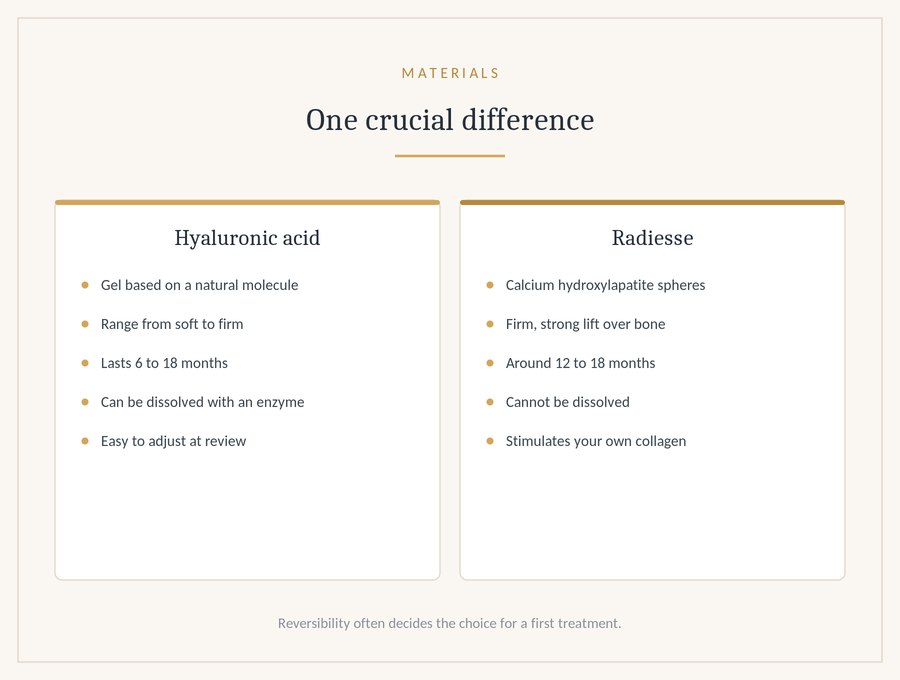
Hyaluronic acid filler. Hyaluronic acid is a sugar molecule the body produces naturally. In fillers it is cross-linked into a gel, made in a range of firmness from soft products for lips to firm products for structure. It adds volume immediately and attracts some water, and the body breaks it down gradually over months.
Radiesse. Calcium hydroxylapatite — tiny mineral-like microspheres — suspended in a gel carrier. The carrier gives immediate correction. Over the following months the carrier is absorbed and the microspheres stimulate the body to lay down its own collagen around them, which is why Radiesse is also classed as a collagen biostimulator. The wider family of these products is described in the guide to collagen biostimulators.
The Difference That Matters Most: Reversibility
Hyaluronic acid filler can be dissolved with an enzyme called hyaluronidase. If a result is lumpy, misplaced or simply not liked — or, far more seriously, if filler compromises a blood vessel — there is a direct way to remove it. The process is explained in the guide to dissolving filler.
Radiesse cannot be dissolved in the same way. Once placed, it remains until the body gradually breaks it down, and the collagen it stimulates is the patient’s own tissue. Problems such as lumps or an unwanted shape are harder to correct, and a vascular complication cannot be reversed with an enzyme.
For a first injectable treatment, or in any area where a small misjudgement would be very visible, that difference often decides the question in favour of hyaluronic acid.
Where Each One Belongs
Where Radiesse Is Often Chosen
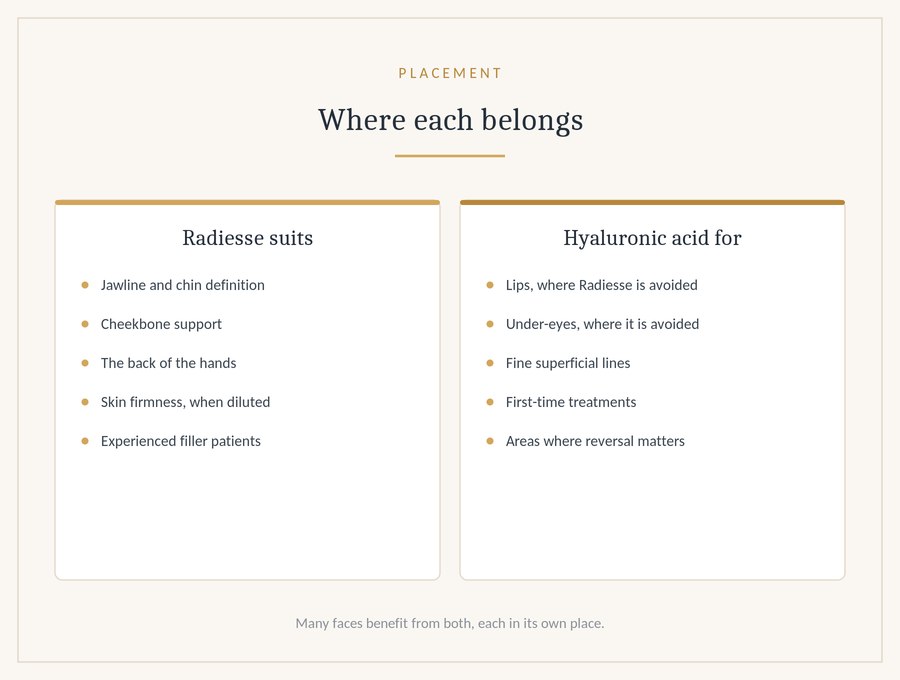
Jawline and chin. Its firmness and lift make it well suited to defining bony contours. The planning of this area is discussed in the guide to jawline filler.
Cheekbones. Placed deep on the bone, it provides support and lift.
The back of the hands. Used to soften the prominence of veins and tendons as volume is lost with age.
Skin firmness. Diluted Radiesse is spread in the deeper skin of the neck, décolletage, arms or face to stimulate collagen and improve firmness, without adding noticeable volume.
Where Radiesse Is Avoided
Lips. Radiesse is not used in the lips, where it can form nodules and the result cannot be dissolved.
Under the eyes. The tear trough has thin skin and little room for error. Hyaluronic acid products designed for this area are used instead, as discussed in the guide to under-eye filler.
Fine superficial lines. Soft hyaluronic acid products or skin treatments suit these better.
Where Hyaluronic Acid Is Preferred
Lips, under-eyes, fine lines, first-time treatments, and any area where the option to dissolve adds meaningful safety. Hyaluronic acid is also the more adjustable material: small top-ups at a review appointment are straightforward.
How Long Each Lasts
Radiesse is commonly quoted at around twelve to eighteen months, with part of the effect coming from the patient’s own new collagen. Hyaluronic acid filler lasts anywhere from six to eighteen months depending on the product and the area — longer in areas that move little, such as the chin and under-eyes, and shorter in mobile areas such as the lips.
Longevity is not always an advantage. A longer-lasting result is welcome when it is right and a problem when it is not, which is another reason reversibility matters.
How Each Feels and Settles
Radiesse is firm, which gives strong lift and definition over bone but makes it unsuitable for soft, mobile tissue. Hyaluronic acid products range from very soft to firm, so the product can be matched to the area.
Both cause swelling for a few days and possible bruising. Radiesse should be massaged or moulded as the injector advises in the early days, and its final result evolves over several months as collagen forms. Hyaluronic acid results are mostly visible once swelling settles at around two weeks.
Safety
Both carry the rare but serious risk of vascular occlusion, where filler blocks or compresses a blood vessel. With hyaluronic acid, the enzyme gives a direct treatment; with Radiesse, management is harder. This is one reason Radiesse is placed in specific, deep planes by experienced injectors and kept away from the highest-risk areas.
Other risks include lumps, asymmetry and, uncommonly, delayed inflammatory reactions. Treatment is postponed in pregnancy and breastfeeding, during active skin infection, and requires caution in people with certain autoimmune conditions.
Using Both Together
Many faces benefit from both: Radiesse for deep structure along the jaw or cheekbones, and hyaluronic acid for the lips or under-eyes. They are placed in different areas and sometimes at different visits. The combination is common and sensible, provided each material is used where it belongs.
Cost in Dubai
Market rates generally run from around AED 2,000 to AED 4,500 per syringe of Radiesse and from around AED 800 to AED 3,500 per millilitre of hyaluronic acid filler, depending on the product, the area and the clinic.
Comparing the two by syringe price alone is misleading. The volume needed, the longevity in that specific area and the value of being able to dissolve the result all belong in the comparison.
If This Is Your First Filler Treatment
For someone who has never had filler, the choice deserves particular care, because a first treatment sets expectations for everything afterwards.
Hyaluronic acid is usually the sensible starting point. It allows a conservative first step, a review at two weeks and small adjustments, and it can be dissolved if the result does not feel right. It also lets you learn how your face responds — how much swelling you get, how long product lasts in your tissue and what degree of change you are comfortable with.
Radiesse becomes a more reasonable option once you know how your face responds to filler, when the goal is clearly structural — a defined jawline or chin, stronger cheekbone support — and when you value longevity and collagen stimulation over reversibility. It is a considered choice rather than a first experiment.
What Recovery Looks Like
The first two to three days. Swelling, tenderness and possible bruising are normal for both materials. The area may feel firm, particularly with Radiesse. Follow the injector’s advice on any massage or moulding.
The first two weeks. Swelling settles and the shape becomes clearer. With hyaluronic acid, what you see at two weeks is close to the final result, and this is when a review and any small adjustment take place.
The following months. With Radiesse, the gel carrier is gradually absorbed while collagen forms around the microspheres, so the result continues to evolve for several months. With hyaluronic acid the result stays broadly stable and then slowly softens as the product breaks down.
Warning signs after either treatment — severe or increasing pain, skin that turns pale, dusky or mottled, or any change in vision — need same-day medical attention.
The Short Version
Hyaluronic acid filler is versatile, adjustable and dissolvable, which makes it the default for lips, under-eyes and first-time treatments. Radiesse is firmer, stimulates your own collagen and lasts around twelve to eighteen months, making it strong for the jawline, chin, cheekbones, hands and skin firmness — but it cannot be dissolved and is not used in the lips or under the eyes.
The right choice depends on the area and on how much the option to reverse the result matters to you. In many faces the answer is both, each in its own place.
Questions Worth Asking
Which material, and why for this area? The answer should relate to the area’s anatomy and your goals.
Can this be reversed if I do not like it? For hyaluronic acid, yes; for Radiesse, no. You should hear this clearly before consenting.
How much product will I need, and how long will it last here? Both vary by area.
What happens if there is a complication? A clinic should explain its plan, including keeping hyaluronidase on site.
Frequently Asked Questions
What is the difference between Radiesse and hyaluronic acid filler?
Hyaluronic acid filler is a gel based on a molecule the body makes naturally and can be dissolved with an enzyme. Radiesse is calcium hydroxylapatite microspheres in a gel carrier; it gives immediate correction and stimulates collagen over time, but cannot be dissolved.
Can Radiesse be dissolved?
No. Unlike hyaluronic acid filler, it cannot be removed with hyaluronidase. This is the most important point to weigh before choosing it.
Which lasts longer?
Radiesse is commonly quoted at around twelve to eighteen months. Hyaluronic acid filler lasts six to eighteen months depending on product and area.
Can Radiesse be used in the lips?
No. It can form nodules in the lips and cannot be dissolved. Hyaluronic acid products are used for lips.
Can Radiesse be used under the eyes?
It is avoided in the tear trough, where the skin is thin and there is little room for error. Specialised hyaluronic acid products are used instead.
Which is better for the jawline?
Both are used. Radiesse is often chosen for its firmness and lift over bone, while hyaluronic acid offers adjustability and reversibility. The assessment of whether volume or laxity is the problem matters more than the product.
What is diluted Radiesse?
Radiesse mixed to a thinner consistency and spread in the deeper skin to stimulate collagen and improve firmness in areas such as the neck, décolletage and arms, rather than to add volume.
Is one safer than the other?
Both carry similar rare risks, including vascular occlusion. Hyaluronic acid has the advantage that an enzyme can dissolve it in an emergency, which is why Radiesse is kept to specific deep planes and areas.
Can I have both?
Yes. A common approach uses Radiesse for deep structure and hyaluronic acid for areas such as the lips or under-eyes.
What do they cost in Dubai?
Market rates generally run from around AED 2,000 to AED 4,500 per syringe of Radiesse and from around AED 800 to AED 3,500 per millilitre of hyaluronic acid filler, depending on product, area and clinic.
This article is general information about aesthetic and dermatological treatments and is not medical advice, a diagnosis, or a treatment recommendation for any individual. Outcomes vary between patients and no result is guaranteed. Injectable products carry risks and contraindications that must be assessed by a licensed physician during a personal consultation. Dr Soheila Eskandari is licensed by the Dubai Health Authority. Prices quoted are general market ranges for information only and are not an offer.


 English
  Arabic