
Full Face Botox in Dubai: What It Covers, How Units Differ and the Risks
Full Face Botox in Dubai: What It Covers, How Units Differ and the Risks
Full face Botox in Dubai usually means anti-wrinkle injections to the upper face: the forehead lines, the frown lines between the brows and the crow’s feet at the outer corners of the eyes, treated together in one session. The three areas are planned as a set because the muscle that lifts the brow and the muscles that pull it down work against each other, and treating one area without the others can leave the brow too low, too high or uneven. The effect starts within days, is judged at around two weeks and typically lasts three to four months.
This guide explains what the term covers and leaves out, why the areas are balanced, why a unit of Dysport is not a unit of Botox, the risks, including brow or eyelid heaviness, who should avoid treatment and what it costs in Dubai. Our page on Botox and anti-wrinkle injections gives an overview. The guide is general information, and your own physician’s assessment always takes priority.
What Does Full Face Botox Include?
Full face is a descriptive label, not a medical term, and clinics use it differently. It is sometimes called upper face Botox, because it usually covers the forehead, the glabella (the area between the eyebrows) and the outer corners of the eyes. Botox is also a brand name, onabotulinumtoxinA from Allergan, that many people use for every botulinum toxin type A product, so Botox on a price list does not always mean that brand. Dr Soheila works with Dysport (abobotulinumtoxinA), Botox (Allergan) and Nabota (prabotulinumtoxinA).
All three contain a purified botulinum toxin type A, which blocks the nerve signal that tells a muscle to contract. The injected muscle weakens for a few months and the skin over it folds less, which softens lines caused by movement. Lines that stay visible at rest usually respond more slowly and may need other treatments as well.
Forehead lines
The frontalis, the broad muscle across the forehead, raises the eyebrows and creates the horizontal lines. It is treated in the upper forehead, well above the brow, with a modest dose. Our guide to forehead Botox in Dubai covers it in detail.
Frown lines between the brows
The corrugator and procerus muscles pull the brows together and down, which creates the vertical lines often called the 11 lines and a horizontal crease between the eyes. Our article on frown line Botox in Dubai explains this area fully.
Crow’s feet
The outer part of the orbicularis oculi, the ring of muscle around the eye, folds the skin into a fan of lines when you smile or squint. Our guide to crow’s feet Botox in Dubai explains how the lines are softened while the smile still reaches the eyes.
What Does Full Face Botox Not Include?
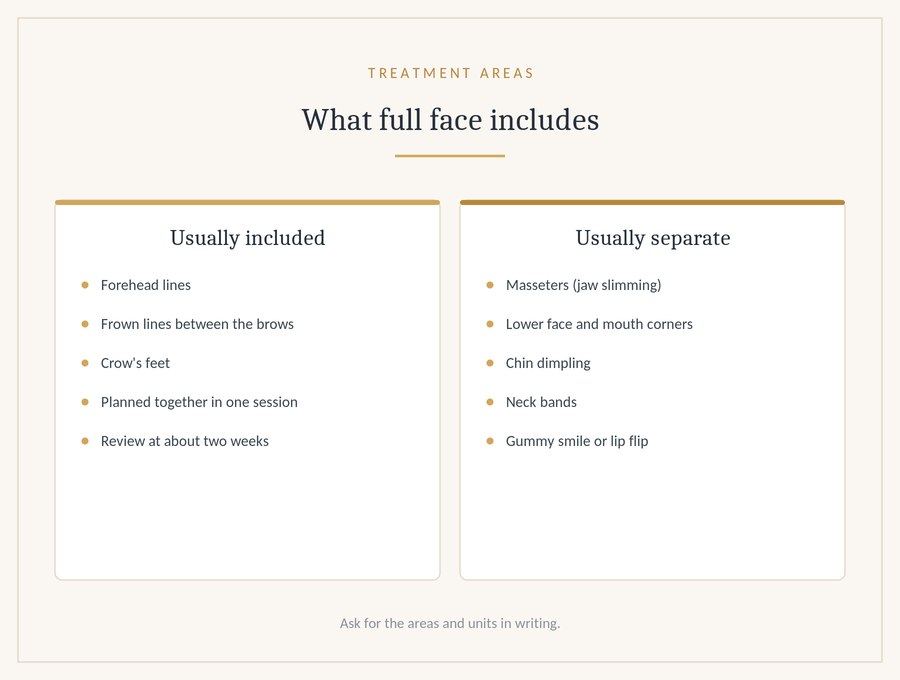
Full face does not usually include the lower face, the neck or the masseters. These are separate treatments, planned and priced separately. The lower face covers the muscles that pull down the corners of the mouth, the chin muscle that causes dimpling and fine lines around the lips. The neck means platysmal bands, the vertical cords that can show below the jaw. The masseters are the chewing muscles at the angle of the jaw, treated for jaw slimming or clenching.
Some clinics add other areas, such as bunny lines, a lip flip, a gummy smile or a brow lift. Ask for the areas and units in writing.
Why Are the Three Areas Planned Together?
The upper face works as a balance. The frontalis is the only muscle that lifts the eyebrows, and several muscles pull them down: the corrugators and procerus between the brows, and the outer part of the orbicularis oculi at the corner of the eye. Treating one area changes the load on the others.
Relaxing the forehead alone weakens the only lifting muscle and leaves the pulling muscles at full strength, so the brows can sit lower and feel heavy. For this reason the Botox label, meaning the manufacturer’s prescribing information, advises treating forehead lines together with the frown lines. Relaxing the central forehead while the outer fibres stay active can give an over-arched outer brow, sometimes called a Spock brow, which a small extra dose at the review can correct. Relaxing the muscle at the corner of the eye removes some downward pull on the tail of the brow and can lift it slightly.
Brow position, eyelid shape, muscle strength, symmetry and the movement you want to keep all change the plan. Someone with low-set brows or heavy upper lids who relies on the forehead to hold the eyes open may be advised to leave the forehead untreated or to treat it very lightly, so treating fewer areas can be the right plan.
Why Do Dysport, Botox and Nabota Units Differ?
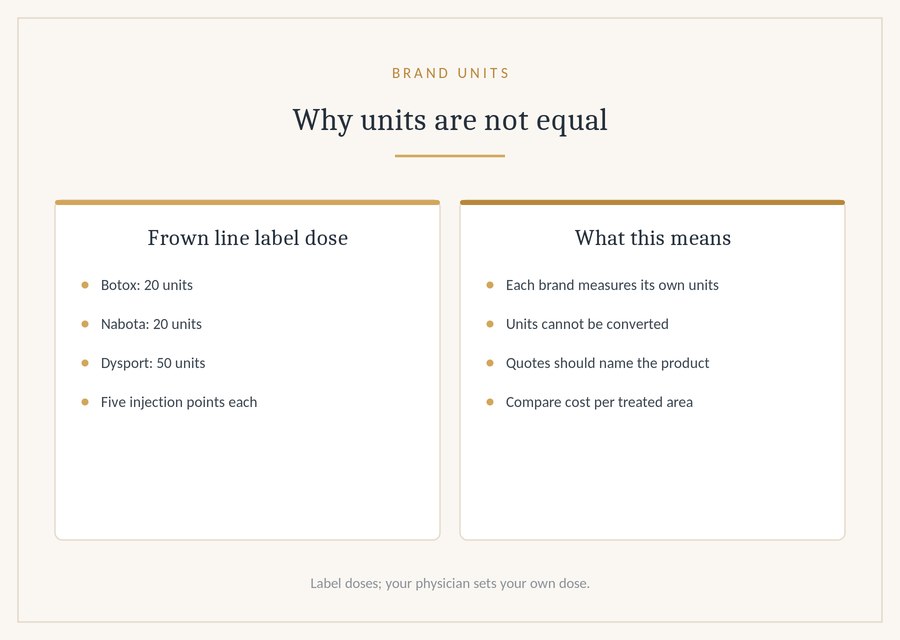
Each manufacturer measures a unit of biological activity with its own laboratory method. The Botox and Dysport labels both state that their units cannot be compared to, or converted into, units of any other botulinum toxin product, and the Nabota product information gives the same warning.
The labelled doses show the difference. For frown lines the Botox dose is 20 units, the Nabota dose is 20 units and the Dysport dose is 50 units, each split between five injection points. The Botox label also lists 20 units for the forehead, given together with the frown-line dose, and 24 units for crow’s feet, a total of 64 units for the three areas. In practice injectors commonly work at roughly 2.5 to 3 Dysport units for each Botox unit, but the products are not equivalent at any fixed ratio, so the dose follows your muscles, not a formula.
A quote should name the product and the units for each area, because 40 units is a different amount of treatment in each product. A lower price per unit also does not mean a lower price for the treatment, since a product dosed in larger numbers needs more units; the fair comparison is the cost of treating defined areas with a named product, as our guide to Botox prices in Dubai explains.
Neither choice is better in general. A physician’s preference for one product in a particular area usually rests on experience of how it behaves in that person, since comparative evidence on spread and duration is limited. Our article on Botox versus Dysport in Dubai sets out the other differences.
How Soon Does It Work and How Long Does It Last?
The Botox label describes the effect on the injected muscle beginning one to two days after injection and increasing over the first week. Most people first notice movement softening after three to five days, and the result is judged at around two weeks, when a review is usually planned.
The effect typically lasts about three to four months. The Botox label gives approximately three to four months for frown lines, and the Dysport label says the effect may last up to four months. Movement returns gradually, and duration varies with the dose, the strength of the muscles and the individual. The Dysport label advises no more than one treatment every three months, and the Botox label notes that dosing more often has not been clinically evaluated.
How Is a Natural Result Kept?
The aim is to soften the lines, not to remove all movement, so the dose and injection points are chosen to keep some expression in the forehead and around the eyes. A first treatment is usually conservative, because a small extra dose can be added at the two-week review, whereas toxin cannot be removed once injected.
The forehead is treated high and lightly, away from the brow, so that the lift is preserved; the Botox label places the lower row of forehead injections at least 2 cm above the eyebrow. Your preferred brow shape is discussed, and your face is assessed at rest and while you frown, raise the brows and smile, because the way you move guides placement. At the review, symmetry and any over-arched or low brow are checked and adjusted in small steps.
What Are the Risks and Side Effects?
Common effects are mild and temporary: small raised marks that settle within an hour or two, tenderness, redness, a small bruise and headache, which 9 per cent of people treated for forehead lines reported in the Botox label trials. Tightness or heaviness in the treated areas is expected as the muscles weaken.
Brow or eyelid heaviness
In the Botox label trials, brow ptosis (a lowered brow) was reported in 2 per cent of people treated for forehead lines, and eyelid ptosis (a drooping upper lid) in 3 per cent of people treated for frown lines. Brow heaviness usually follows weakening the forehead too much or too low, or leaving the pulling muscles unopposed. Eyelid ptosis occurs when a small amount of toxin reaches the muscle that lifts the lid. It usually appears within one to two weeks, and most reported cases are mild to moderate. Both effects are temporary and settle over several weeks as the toxin wears off. A physician may prescribe eye drops that lift the lid by about 1 to 3 mm in some people, but they do not reverse the toxin.
The labels describe ways to lower the risk: injecting at least 1 cm above the bony ridge over the eye, using the smallest effective dose, and checking the upper lids and how much the forehead compensates before treatment.
Other side effects
Treatment near the eyes can cause eyelid swelling (reported by 1 per cent of people treated for crow’s feet in the label trials) and, if the product spreads to neighbouring muscles, an uneven smile, dry or watery eyes or, rarely, double vision. Allergic reactions are rare. The Botox label notes no definitive serious reports of distant spread at its labelled cosmetic doses, but the warning applies to all botulinum toxins, and difficulty swallowing, speaking or breathing needs immediate medical attention.
Who Should Avoid Full Face Botox?
Treatment is usually postponed in pregnancy and breastfeeding, because there are no adequate human data and animal studies have reported effects on development before birth. It is not given with infection at the injection sites or a known allergy to any botulinum toxin or its ingredients. Dysport may contain trace amounts of cow’s milk protein, so a cow’s milk protein allergy rules it out.
Extra care applies with neuromuscular conditions such as myasthenia gravis, Lambert-Eaton syndrome and motor neurone disease, because the effect can be exaggerated; with aminoglycoside antibiotics and muscle relaxants, which can strengthen the toxin; and with blood thinners, which increase bruising. Existing eyelid ptosis, very low or heavy brows, excess upper eyelid skin, marked asymmetry, inflammation or scarring in the area, previous facial surgery or facial nerve weakness need particular assessment, and the plan may be limited to some areas or advised against. Avoid booking within about two weeks of an important event. A licensed physician must assess suitability in person.
Choosing Who Treats You
Botulinum toxin is a prescription medicine and should be injected by a licensed physician whose DHA licence you can verify on the DHA Sheryan portal and who treats the upper face regularly. Ask whether your brows, eyelids and muscle strength are assessed before anything is injected, which product will be used, and how many units are planned for each area.
A sound plan also includes written aftercare, a review at around two weeks and a way to reach the clinic if an eyelid or brow feels heavy. The page on Botox and anti-wrinkle treatment gives an overview. At dr-soheila.com, treatments are planned and performed by Dr Soheila Eskandari, a DHA-licensed general practitioner with aesthetic privileges with 20 years of experience in aesthetic medicine.
The Short Version
Full face Botox in Dubai usually means treating the forehead lines, frown lines and crow’s feet together, because the forehead muscle lifts the brow while the other two areas pull it down. It does not usually include the lower face, neck or masseters. Units are specific to each product and cannot be converted: the Dysport frown-line dose is 50 units against 20 for Botox.
Effects begin within days, are judged at around two weeks and typically last three to four months. A natural result depends on a conservative dose and a review. The main risks are brow or eyelid heaviness, bruising, headache and an uneven result. Pregnancy, breastfeeding, neuromuscular disease, infection and allergy are reasons to avoid treatment, and a licensed physician must assess suitability in person.
Questions Worth Asking
Which product will you use, and how many units for each area? The answer should name the product and the units, because units cannot be compared between brands.
Why do I need all three areas? The plan should follow your brow position and muscle strength, not a fixed package.
Will I be reviewed at about two weeks? The effect is judged when it is fully developed, and a small adjustment can be made then.
What should I do if an eyelid or brow feels heavy? You should be told what to watch for and how to reach the clinic.
Frequently Asked Questions
What is full face Botox?
It usually means anti-wrinkle injections to the forehead, frown lines and crow’s feet, planned together; the term has no fixed definition, so ask which areas and units a quote covers.
How many units does full face Botox need?
It depends on your muscles and brow position. The Botox label lists 20 units for the forehead, 20 for the frown lines and 24 for crow’s feet, a total of 64; Dysport is dosed in larger numbers.
Can I compare Dysport units with Botox units?
No, because each manufacturer measures units differently and the labels state that they cannot be converted; compare the cost of a defined treatment instead.
How soon does full face Botox start to work?
The effect begins one to two days after injection and builds over the first week; most people notice a change after three to five days, and the result is judged at around two weeks.
How long does full face Botox last?
It typically lasts about three to four months, with movement returning gradually; duration varies with the dose and your muscles, and treatment is not usually repeated more often than every three months.
Does full face Botox include the lower face, neck or masseters?
Usually not; these are separate treatments with different muscles and doses, planned and priced separately, so confirm the exact areas before you book.
Will full face Botox make my face look frozen?
A frozen look is more likely with a high dose; the aim is to keep some movement, so a first treatment is cautious and a small extra dose can be added at the two-week review.
Can full face Botox make my eyebrows or eyelids droop?
Yes, it can; in the Botox label trials brow ptosis was reported in 2 per cent of people treated for forehead lines and eyelid ptosis in 3 per cent of those treated for frown lines, and both usually settle over several weeks.
Who should not have full face Botox?
It is usually postponed in pregnancy and breastfeeding and avoided with infection at the injection sites or allergy to a toxin or its ingredients, including cow’s milk protein with Dysport; neuromuscular disease and some medicines need extra care.
What does full face Botox cost in Dubai?
Market rates generally run from around AED 1,500 to AED 4,000 for the forehead, frown lines and crow’s feet together, depending on the product, the number of units and the injector; the quote should name the product and the units.
This article is general information about aesthetic and dermatological treatments and is not medical advice, a diagnosis, or a treatment recommendation for any individual. Outcomes vary between patients and no result is guaranteed. Prescription medications and injectable products carry risks and contraindications that must be assessed by a licensed physician during a personal consultation. Dr Soheila Eskandari is licensed by the Dubai Health Authority. Prices quoted are general market ranges for information only and are not an offer.

 English
 Arabic