
Forehead Botox in Dubai: Why the Brow Matters More Than the Lines
Forehead Botox in Dubai: Why the Brow Matters More Than the Lines
Forehead Botox is the most requested injectable treatment in the world and the one most often done badly. The reason is anatomical rather than technical: the forehead muscle you are asking to relax is the only muscle that lifts your eyebrows. Relax too much of it and the brow drops. That single fact explains almost every disappointing forehead result you have ever seen.
This guide, prepared with Dr. Soheila Eskandari at her Dubai clinic, covers how forehead treatment actually works, why a heavy brow happens and how it is avoided, how many units are typical, what it costs in Dubai, and — importantly — who should not have their forehead treated first.
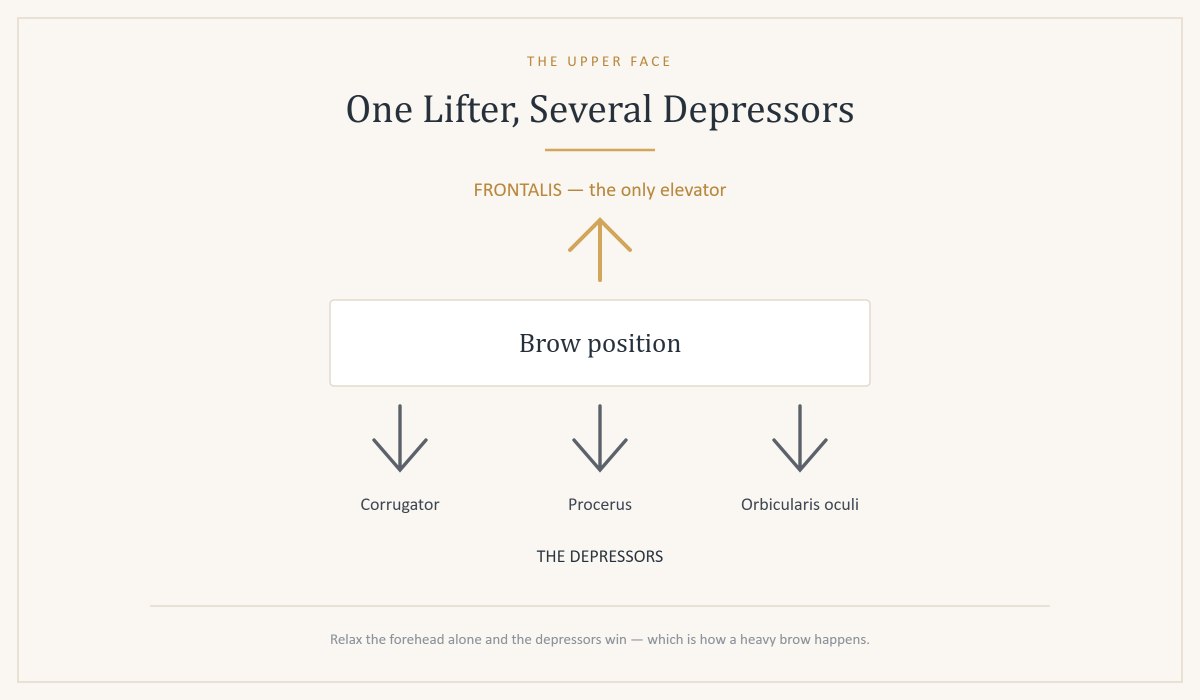
The Tug of War You Cannot Ignore
The upper face runs on a simple mechanical argument. One muscle — the frontalis, the broad sheet across your forehead — pulls the brows up. Several muscles pull them down: the corrugators and procerus between the brows, and the upper fibres of the orbicularis oculi at the outer corner of the eye.
Horizontal forehead lines are simply the skin folding as the frontalis contracts. So the obvious move is to relax the frontalis. The problem is that you have just weakened the only lifter while leaving all the depressors at full strength. The result is a smooth forehead and brows that sit lower than they did — the “heavy” look patients describe as feeling tired or hooded.
This is why Dr. Soheila almost never treats the forehead in isolation. Treating the glabellar complex — the frown muscles — at the same time reduces the downward pull and lets a conservative forehead dose do its work without dropping the brow. Balance, not erasure, is the aim.
Why Brow Heaviness Happens — and How It Is Prevented
Brow ptosis after forehead treatment is not bad luck. It is a predictable consequence of over-treating, injecting too low, or failing to assess the patient’s baseline brow position before starting. The preventable causes are well understood:
- Too much product. The forehead needs far less than most patients assume. More units do not buy a better result here; past a point they buy a heavier brow.
- Injecting too low. Product placed close to the brow relaxes exactly the fibres that were holding it up. Staying well above the brow line and treating the upper portion of the muscle preserves lift.
- Ignoring the depressors. Treating the forehead while leaving strong frown muscles untouched guarantees depressor dominance.
- Not assessing the starting point. A patient who already has low-set brows, heavy upper lids or significant hooding has little margin. In some of these patients, the correct answer is to treat the frown lines and crow’s feet and leave the forehead alone entirely.
The mirror image of this is “Spock brows” — an over-arched, quizzical outer brow that happens when the central forehead is relaxed but the outer fibres are left active. It is easily corrected with a small amount of product at the review appointment, which is one of several reasons that review appointment is not optional.
How Many Units?
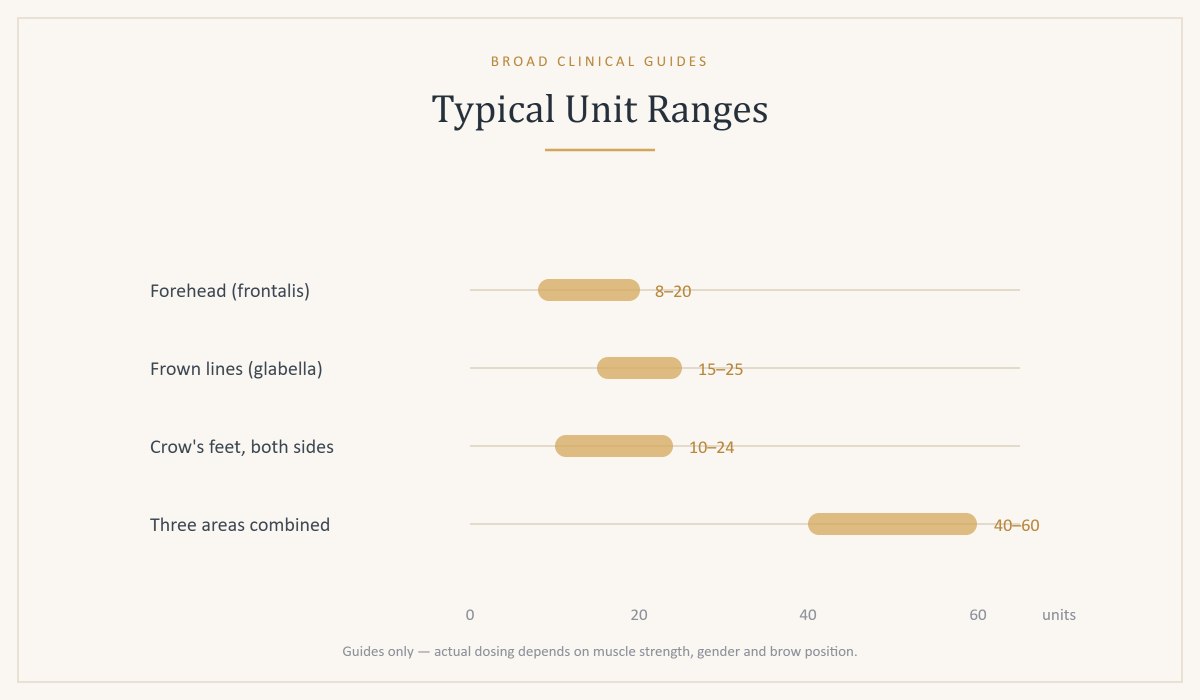
Broad clinical guides exist, but they are guides. Actual dosing depends on muscle strength, muscle mass, gender, skin thickness, brow position, treatment history and how much movement you want to keep.
| Area | Typical range | Notes |
|---|---|---|
| Forehead (frontalis) | Approx. 8–20 units | Lower end for first-time patients, low brows or hooding |
| Frown lines (glabella) | Approx. 15–25 units | Usually treated alongside the forehead |
| Crow’s feet | Approx. 10–24 units | Completes the upper-face balance |
| Three areas combined | Approx. 40–60 units | The most commonly requested package |
Men generally require higher dosing than women in the same areas — the frontalis is typically stronger and the muscle mass greater. A first treatment is deliberately conservative: you can add at the two-week review, but you cannot remove botulinum toxin once it is in.
The Timeline
- Day 0: Treatment takes about 10–15 minutes. Small raised bumps at the injection points settle within roughly an hour. You look exactly as you did when you arrived.
- Days 3–5: Movement begins to soften. Most people notice it first when raising their brows.
- Days 10–14: Full effect. This is the only fair point at which to judge the result.
- Week 2 review: Asymmetry, residual movement or an over-arched brow are assessed and adjusted with small top-ups.
- Months 3–4: Movement returns gradually. Most patients maintaining results treat three to four times a year.
Patients who have had regular treatment for a long time sometimes find intervals lengthen, because a muscle that has been repeatedly relaxed tends to weaken over time and the habitual expression pattern softens.
When the Forehead Is the Wrong Place to Start
A meaningful proportion of patients who ask for forehead Botox should be treated somewhere else, or not at all:
- Lines still visible at complete rest. Deep static etching is a skin-quality and structural problem. Toxin softens it but will not erase it; skin boosters, microneedling or resurfacing address the remainder. Our guide to Botox versus fillers explains the distinction, and Profhilo versus skin boosters covers the skin-quality options.
- Heavy or hooded upper lids. If the frontalis is working hard to hold the brows up, relaxing it removes a compensation the patient is relying on. Sometimes the honest answer is that the concern is surgical.
- Brows already low-set. Little margin. Treat the depressors, review, and reconsider.
- Patients who want zero movement. Achievable, and it is what produces the frozen look people say they do not want.
Declining to inject, or injecting less than requested, is a legitimate clinical decision and a frequent one in Dr. Soheila Eskandari’s consultations.
The Dubai Angle
Two local factors are worth naming.
The first is squinting. Dubai’s UV index sits in the high-risk band for most of the year and peaks around 13 in July. People squint far more here than they realise, which drives both crow’s feet and, indirectly, frontalis activity. Sunglasses are a genuinely effective preventive measure, unglamorous as that sounds.
The second is that chronic UV exposure degrades collagen and elastin, which converts dynamic lines into static ones faster than in a temperate climate. Botulinum toxin addresses the movement component. It does nothing for the sun damage underneath — which is why daily broad-spectrum SPF does more for a forehead over five years than any injection schedule. See our guide to sun and water damage in Dubai.
If This Is Your First Treatment
A few things make a first forehead treatment go well, and most of them are decisions taken before the needle appears.
- Come with a complaint, not a prescription. “I look angry in photographs” is far more useful than “I want twenty units in my forehead.” The first tells the physician what to solve; the second pre-empts the assessment.
- Ask for the conservative dose. You can add at two weeks. You cannot subtract. Patients who start low and adjust almost never end up unhappy; patients who start high sometimes wait three months.
- Bring photographs of yourself. Not of other people. Your own face from a few years ago is more informative than anyone else’s result.
- Do not book it three days before an event. Full effect takes two weeks and bruising, though uncommon, is possible. Two to three weeks of margin is sensible.
- Expect to be asked to make faces. Raising the brows, frowning hard, squeezing the eyes shut — the assessment depends on seeing the muscles work, not on looking at a still face.
What Happens at the Two-Week Review
The review appointment is where forehead treatment is actually finished, and skipping it is the most common reason a good plan produces a mediocre result.
At two weeks the product has reached full effect, so what you see is what you have. Four things are checked: whether the lines have softened to the intended degree, whether the two sides match, where the brow is now sitting relative to before, and whether any individual muscle fibres have escaped treatment and are producing an over-arched or peaked brow.
Small corrections at this point are routine — a few units to balance an asymmetry or settle an arch — and in a properly structured quote they are included rather than charged as a second treatment. It is worth confirming that before you book anywhere, because “the price of Botox” and “the price of a finished result” are not always the same number.
Cost in Dubai
Across the Dubai market, botulinum toxin is quoted either per unit — broadly AED 30 to AED 60 at licensed clinics — or per treated area, with single areas commonly between AED 800 and AED 1,500 and three-area packages typically AED 2,000 to AED 4,000.
These are general market ranges observed across Dubai clinics, not a price list for this clinic. Because forehead treatment is so often combined with the frown lines by clinical necessity rather than upselling, ask specifically whether a quoted “forehead” price includes the glabella — the answer changes the comparison entirely. Our full guide to Botox pricing in Dubai covers what a fair quote should include.
Risks
All medical and aesthetic procedures carry potential risks alongside their potential benefits. For forehead treatment the realistic list is: temporary bruising, headache in the first day or two, asymmetry, brow heaviness or an over-arched brow from imprecise placement, and — uncommonly — eyelid ptosis if product reaches the levator muscle.
All of these are temporary and resolve as the product wears off over three to four months, but there is no dissolving agent for botulinum toxin as there is for hyaluronic acid filler. That asymmetry of reversibility is precisely why conservative first dosing and a two-week review are the standard of care rather than an optional extra.
Treatment is not suitable during pregnancy or breastfeeding, over active infection at the site, or in certain neuromuscular conditions. A full medical history — including medication and previous injectables — is taken before treatment.
Frequently Asked Questions
Will forehead Botox make my brows drop?
Not if it is dosed and placed correctly and the frown muscles are addressed at the same time. Brow heaviness is a consequence of over-treatment, injecting too low, or not assessing baseline brow position — not an inherent property of the treatment.
Can I treat only my forehead?
It is possible, but in most patients it is not advisable, because relaxing the only brow elevator while leaving the depressors at full strength is what produces a heavy brow. Treating the glabella at the same time is usually the safer plan.
How long until I see results?
Softening begins around day three to five; full effect at ten to fourteen days. Judging the result before two weeks is judging an incomplete outcome.
Will my forehead lines come back worse?
No. Movement returns to its previous baseline as the product wears off — lines do not become worse than they would have been. If anything, long-term regular treatment tends to slow the deepening of static lines.
Can I exercise afterwards?
Avoid intense exercise, saunas and lying face-down for the rest of the day. Stay upright for about four hours and avoid rubbing the treated area.
Is it safe to have this every three months indefinitely?
Botulinum toxin has decades of clinical use behind it at cosmetic doses. Appropriate intervals — generally not more often than every three months — and conservative dosing are the two things that matter most.
I have hooded eyelids. Will this help?
Usually not, and it can make the appearance worse. Some patients with hooding rely on frontalis activity to hold the brow up. This needs assessment before anything is injected, and occasionally the honest answer is that the concern is surgical rather than injectable.
Get your brow position assessed before anything is injected
Dr. Soheila Eskandari, DHA-licensed physician, will assess your forehead in movement and at rest, check brow position and depressor strength, and plan a dose that softens lines without costing you your brow.
Forehead & crow’s feet treatment · Book a consultation · WhatsApp +971 50 514 5129
Medically reviewed by Dr. Soheila Eskandari, DHA-licensed physician (Licence No. 00216960-005), Riviera Clinic, Umm Suqeim 1, Dubai. This article is general education and not medical advice. Unit ranges are broad clinical guides, not a prescription — dosing is determined at individual assessment. All medical and aesthetic procedures carry potential risks and benefits, which are discussed during consultation. Individual results vary and no outcome is guaranteed. Prices quoted are general Dubai market ranges observed at the time of writing and are not a quotation. Last updated August 2026.


 English
  Arabic