
Botox vs Dysport in Dubai: Units, Onset, Spread and Cost Compared
Botox vs Dysport in Dubai: Units, Onset, Spread and Cost Compared
“Botox or Dysport?” is one of the most common questions at a first consultation, and it usually comes with an assumption attached: that one of them is stronger, longer-lasting or more natural than the other. In practice the two products are much closer than the marketing suggests, and the differences that do exist matter less than how the dose is chosen and where it is placed.
That does not mean the question is pointless. The products are genuinely different in formulation, in how their units are counted and in how they behave after injection. Understanding those differences is what stops a patient comparing the wrong numbers.
What Each Product Actually Is
Both are botulinum toxin type A. Both work the same way: they temporarily block the nerve signal that tells a specific muscle to contract, so the skin above that muscle stops folding. Neither fills, lifts or changes skin quality directly.
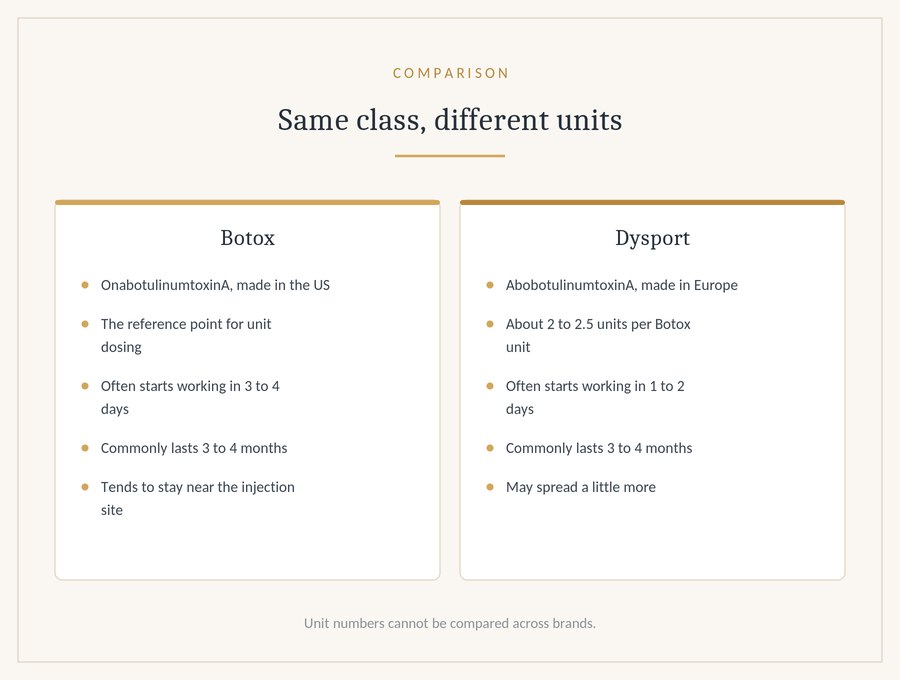
Botox is the brand name of onabotulinumtoxinA, made by Allergan in the United States. Because it was the first to be widely known, “Botox” has become the everyday word for the whole category, which is a source of real confusion.
Dysport is abobotulinumtoxinA, made by Ipsen in Europe. It has been used in medicine and aesthetics for decades and is a mainstream, well-studied product rather than an alternative or budget option.
Other toxins. Several further products exist, including toxins manufactured in South Korea and a German product without the complexing proteins found in the others. When a menu lists “Korean botox”, it refers to one of these different products rather than to the Allergan brand. That is not in itself a problem. What matters is that the exact product is approved for use by the UAE health authorities and that the clinic tells you precisely which one it is.
Why Units Cannot Be Compared Directly
This is the single most misunderstood point, and it is where most price comparisons go wrong.
Each manufacturer measures potency with its own laboratory method, so a “unit” of one product is not the same amount of effect as a “unit” of another. Dysport is dosed in larger numbers of units than Botox for the same result. Published studies have reported conversion ratios from around 2.5 to 1 up to 3 to 1 or higher, and in everyday aesthetic practice the ratio used is commonly around 2 to 2.5 Dysport units for each Botox unit.
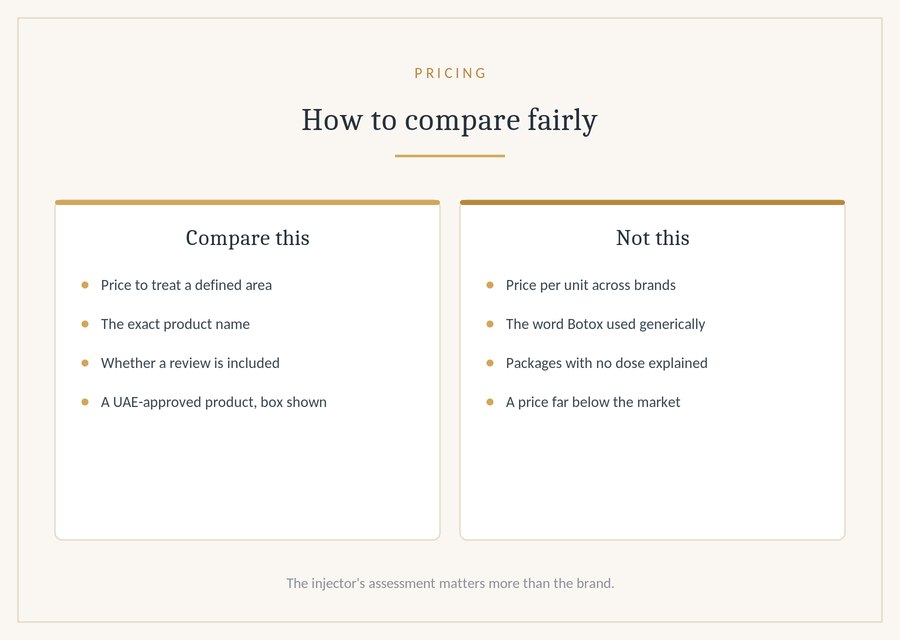
The practical consequence: a clinic quoting “50 units” of Dysport is not offering more treatment than one quoting “20 units” of Botox. Comparing price per unit across brands is meaningless. The only fair comparison is the price for treating a defined area, with the product named.
Why the Conversion Is Not Exact
The ratio varies between studies because the products are not chemically identical and because muscles, doses and injection techniques differ. An experienced injector adjusts dose to the muscle strength in front of them rather than applying a fixed formula, which is why two people treating the same area may use different numbers of units and both be right.
Onset: Which Works Faster
Several studies have found that Dysport tends to begin working slightly sooner — often within one to two days, compared with three to four days for Botox. For most people this is a minor difference, but it can matter if there is an event within the week.
For both products, the full effect should be judged at around two weeks. Assessing the result on day three, before the product has fully taken, leads to unnecessary top-ups.
Spread: Why It Is Discussed So Much
Dysport is often described as spreading slightly more from the injection point. This has two sides.
Across a broad, flat area such as the forehead, a little more spread can produce a smooth, even result with fewer injection points. Close to the eyes and brows, where precision matters and a small drift into the wrong muscle can cause brow heaviness or eyelid droop, less spread is generally preferable.
How much this matters in practice is debated. Dilution, dose, depth and technique influence spread at least as much as the brand, which is why the practitioner’s approach counts for more than the product choice.
Duration: How Long Each Lasts
In aesthetic use, both commonly last around three to four months. Some patients find one product lasts a little longer for them than the other, and some studies in medical indications have reported differences, but the variation between individuals is larger than the variation between brands.
Factors that genuinely affect duration include muscle strength, the dose used, metabolism and how often the area has been treated before. Very active people and those with strong muscles sometimes notice shorter results regardless of product.
Resistance and Switching Products
A small number of people stop responding well to botulinum toxin after repeated treatment, sometimes because they have developed antibodies. It is uncommon, and higher doses given at short intervals are thought to increase the risk.
For someone whose results have become noticeably weaker, a switch to a different product — sometimes one without complexing proteins — is a reasonable step. For everyone else, switching brands in pursuit of a better result rarely changes much. Sensible dosing intervals, rather than repeated top-ups, remain the best protection.
Which Areas Suit Which Product
Forehead. Either works. Dysport’s spread is sometimes favoured for an even result across a wide area, while the forehead must always be balanced against the frown muscles to avoid a heavy brow — discussed in the guide to forehead Botox.
Frown lines and crow’s feet. Either works well. Around the eyes, precise placement is the priority.
Jaw and masseter. Larger muscles need larger doses, and both products are used. The approach is set out in the guide to masseter Botox and jawline slimming.
Underarm sweating. Both are effective for excessive sweating, covered in the guide to Botox for sweating.
Safety and Side Effects
Because they are the same class of medicine, the safety profile is broadly shared. Common effects are temporary: small bumps at injection points, mild bruising and occasionally a headache in the first day or two.
Less common effects relate to the product affecting a neighbouring muscle — a heavy brow, a slight eyelid droop or an uneven smile. These are temporary and usually settle within weeks, but they are the reason careful placement matters.
Treatment is avoided in pregnancy and breastfeeding, in people with certain neuromuscular disorders, and alongside some medications, which is why a full medical history belongs in every consultation. Difficulty swallowing, speaking or breathing after treatment is very rare but requires urgent medical attention.
Product Authenticity
An unusually low price is sometimes explained by unapproved or diverted products. A licensed clinic should be able to show the product box and name the exact toxin being used. Asking is entirely reasonable.
Cost in Dubai
Market rates generally run from around AED 800 to AED 1,800 per treatment area, with full upper-face treatment commonly from around AED 1,500 to AED 3,000. Prices vary with the product, the dose needed and the clinic. The wider picture is set out in the guide to Botox prices in Dubai.
Because units are not comparable between brands, the useful question is always: what will it cost to treat this area, with which product, including the review appointment?
The Short Version
Botox and Dysport are both botulinum toxin type A and produce very similar results. Dysport is dosed in more units, often starts working a day or two sooner and may spread slightly more; duration is broadly similar at around three to four months. Unit numbers cannot be compared across brands, so compare price per area with the product named.
The choice of product matters far less than the injector’s assessment, dose and placement. A clinic that names the exact product, explains the dose and builds in a two-week review is doing the part that actually determines the result.
Questions Worth Asking
Which exact product will you use? “Botox” is often used as a generic word. The answer should be a specific product name, approved in the UAE.
How many units, and why? The dose should relate to your muscle strength and the result you want, not to a fixed package.
Is the price per area or per unit? Per area, with the product named, is the only comparison that means anything.
Is there a review at two weeks? Small adjustments at that point are what produce a balanced result.
Frequently Asked Questions
Is Dysport stronger than Botox?
No. Dysport is dosed in more units because its units are measured differently, not because it is weaker or stronger. At appropriate doses the two produce very similar results, and neither is inherently more powerful.
Why does Dysport need more units?
Each manufacturer measures potency with its own method, so a unit of one product is not equal to a unit of another. In practice around 2 to 2.5 Dysport units are commonly used for each Botox unit, though published studies report a wider range.
Which lasts longer?
In aesthetic use both commonly last around three to four months. Individual variation — muscle strength, dose and metabolism — is usually larger than any difference between the two brands.
Which works faster?
Dysport often begins working within one to two days, compared with three to four days for Botox. The full result for both should be assessed at around two weeks.
Does Dysport spread more?
It is often described as spreading slightly more from the injection point, which can suit broad areas like the forehead and calls for extra care near the eyes. Dilution, dose and technique influence spread at least as much as the product.
What is “Korean botox”?
It usually refers to a botulinum toxin manufactured in South Korea rather than the Allergan brand. What matters is that the specific product is approved for use in the UAE and that the clinic tells you exactly which one it is.
Can I switch between Botox and Dysport?
Yes. Switching is safe, and the dose is adjusted for the different units. It is most useful for the uncommon patient whose response has weakened over time; otherwise the result is usually similar.
Is one safer than the other?
They share the same safety profile. Side effects such as bruising, headache or a temporary heavy brow depend more on dose and placement than on brand.
How do I compare prices fairly?
Compare the price to treat a specific area with a named product, including any review appointment. Price per unit is misleading because units differ between brands.
What does it cost in Dubai?
Market rates generally run from around AED 800 to AED 1,800 per area and from around AED 1,500 to AED 3,000 for the full upper face, depending on product, dose and clinic.
This article is general information about aesthetic and dermatological treatments and is not medical advice, a diagnosis, or a treatment recommendation for any individual. Outcomes vary between patients and no result is guaranteed. Prescription medications and injectable products carry risks and contraindications that must be assessed by a licensed physician during a personal consultation. Dr Soheila Eskandari is licensed by the Dubai Health Authority. Prices quoted are general market ranges for information only and are not an offer.


 English
  Arabic