
Crow’s Feet Botox in Dubai: Softening Smile Lines Without Losing Your Smile
Crow’s Feet Botox in Dubai: Softening Smile Lines Without Losing Your Smile
Crow’s feet Botox softens the fan of lines at the outer corners of the eyes by relaxing part of the muscle that closes the eye when you smile or squint. Treatment takes a few minutes, the first change usually appears within days, the full effect is clear at around two weeks, and the result typically lasts about three to four months. Done with careful dosing, the lines soften while the smile still reaches the eyes.
Crow’s feet are one of the first expression lines many people notice, and in a city with strong sun all year they can appear earlier than expected. This guide explains what causes them, how a physician plans the injection points and dose, what results to expect, how lines that show when smiling differ from lines visible at rest, aftercare, side effects and rare risks, who should avoid treatment, and what it costs in Dubai.
What Causes Crow’s Feet?
The muscle responsible is the orbicularis oculi, a ring-shaped muscle around each eye. Its job is to close the eye, both gently when you blink and forcefully when you squint or laugh. When the outer part of the ring contracts, it gathers the thin skin at the side of the eye into a fan of lines that point towards the temple. Every smile and every squint repeats that fold.
When you are young, the skin springs back as soon as the muscle relaxes. Over time, the skin in this area, which is among the thinnest on the face, loses collagen and elasticity, and sun exposure speeds up that process. The lines that once appeared only with a smile start to remain faintly when the face is still. This is why crow’s feet are a mix of movement and skin quality, and why both need to be considered.
Why the Dubai climate matters
Bright sunlight makes people squint, and squinting is the same movement that creates crow’s feet. Ultraviolet light also damages collagen in the skin around the eyes. Wearing good sunglasses with UV protection, using sunscreen around the eyes and treating dryness caused by long hours in air conditioning all help the skin in this area, whether or not you have treatment.
How Botox Works on Crow’s Feet
Botox is a brand name for onabotulinumtoxinA, a purified prescription medicine that blocks the nerve signal telling a muscle to contract. Injected in small amounts into the outer part of the orbicularis oculi, it reduces how strongly that section of the muscle pulls. The skin is folded less, so the lines soften. The muscle keeps working elsewhere, which means you can still close your eyes fully and blink normally.
Crow’s feet are one of the areas for which onabotulinumtoxinA has regulatory approval. The approved dosing for this area totals 24 units, 12 units per side, divided between three injection points on each side. In practice, physicians adjust the number of points, their position and the dose for each person, depending on the pattern of the lines, the strength of the muscle and how much movement the person wants to keep. Some people with lighter lines need less; others with strong squinting need careful planning rather than simply more product. If you would like a softer approach in general, our guide to baby Botox explains lower-dose treatment.
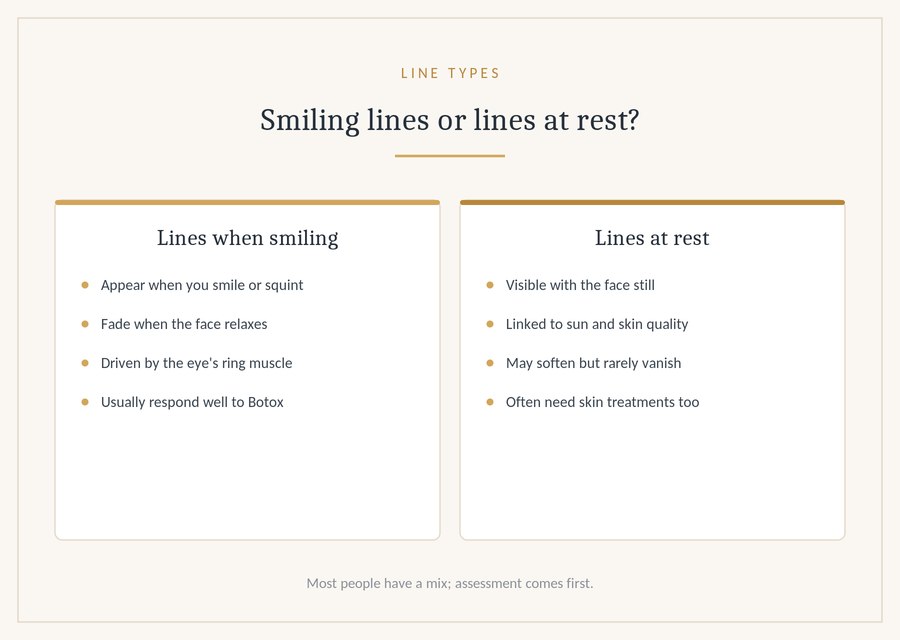
Lines When Smiling Versus Lines at Rest
Lines that appear when you smile
If your crow’s feet appear mainly when you smile, laugh or squint and fade when your face relaxes, they are driven largely by movement. These lines usually respond well to Botox, because reducing the pull of the muscle reduces the folding. Many people are pleased with a result in which the lines are softer when smiling, rather than absent.
Lines that remain at rest
If faint lines are visible even when your face is completely still, part of the problem is the skin itself. Botox can stop these lines from being deepened by daily movement, and they may soften gradually over repeated treatments, but it does not rebuild the skin. Treatments aimed at skin quality, such as medical microneedling, chemical peels or skin boosters, together with sun protection and a good skincare routine, are often considered alongside Botox for these lines.
Lines below the eye
Some lines below the lower eyelid, or creases where the lower lid meets the cheek, are not crow’s feet at all. They may come from thin skin, volume loss or the shape of the under-eye area. Treating them with Botox can be counterproductive, because weakening the lower part of the muscle can affect how the lower lid supports the eye. These concerns are assessed differently, and our article on under-eye filler explains some of the options and their limits.
Keeping a Natural Smile
The aim of crow’s feet treatment is to soften the lines without changing the character of your smile. A smile that reaches the eyes involves the orbicularis oculi, so removing all movement can make a smile look flat or unfamiliar. Many physicians therefore aim to reduce rather than eliminate movement, particularly in people who smile a lot or whose work depends on facial expression.
Placement also matters. The injections are kept to the outer area of the eye and away from the cheek muscles that lift the corners of the mouth. If the product affects those muscles, the smile can become uneven for a few weeks. Careful mapping of the lines while you smile, and a conservative first dose, reduce this risk. A review at around two weeks allows small adjustments if one side moves more than the other.
Why doses differ between people
No two faces move in the same way. Men often have stronger orbicularis muscles and may need a different dose from women to achieve a similar softening. People who laugh a lot or squint outdoors for long periods may notice movement returning sooner. Many faces are also slightly asymmetrical before any treatment, with lines that are deeper on one side, and a careful physician points this out at the consultation and plans each side separately rather than injecting identical amounts by default.
What Happens at the Appointment
The consultation starts with your medical history, including medicines, previous treatments, eye problems such as dryness, and pregnancy or breastfeeding. The physician then looks at your eyes at rest, smiling and squinting, checks the skin quality and the support of the lower eyelids, and discusses what you would like to change and what you would like to keep.
The skin is cleaned and the injection points may be marked. Very fine needles are used, and each injection takes seconds. Most people describe a brief sting rather than significant pain. The whole treatment usually takes a few minutes. Gentle pressure may be applied to reduce bruising. You can usually return to normal activities straight away, with a few precautions for the rest of the day.
Results: Onset, Full Effect and How Long It Lasts
The first change is usually noticed within two to five days. The full effect is normally clear at around two weeks, which is why a review is often planned then. Results typically last about three to four months, after which movement gradually returns and the lines reappear. Some people find the effect lasts a little longer with repeated treatments, while people with strong muscles, high activity levels or a habit of squinting may find it wears off sooner. Repeat treatment is planned when movement returns, rather than on a fixed schedule.
Planning Treatment Over Time
Crow’s feet treatment is most useful as part of a longer plan rather than a one-off. The first treatment is often deliberately conservative, so that you and your physician can see how your muscles respond and how much movement you are comfortable losing. At the two-week review, the result is checked while you smile and squint, and the notes guide the next session: whether to keep the same dose, adjust one side or move an injection point slightly.
Over the following year, many people find a rhythm of treatment every three to four months, while others prefer to let movement return fully between sessions. Neither approach is required. What matters is that each treatment is based on how your face looks at that time, that your records show what was used and where, and that skin quality and sun protection are reviewed alongside the injections, because they influence the lines at rest far more than Botox does.
Aftercare
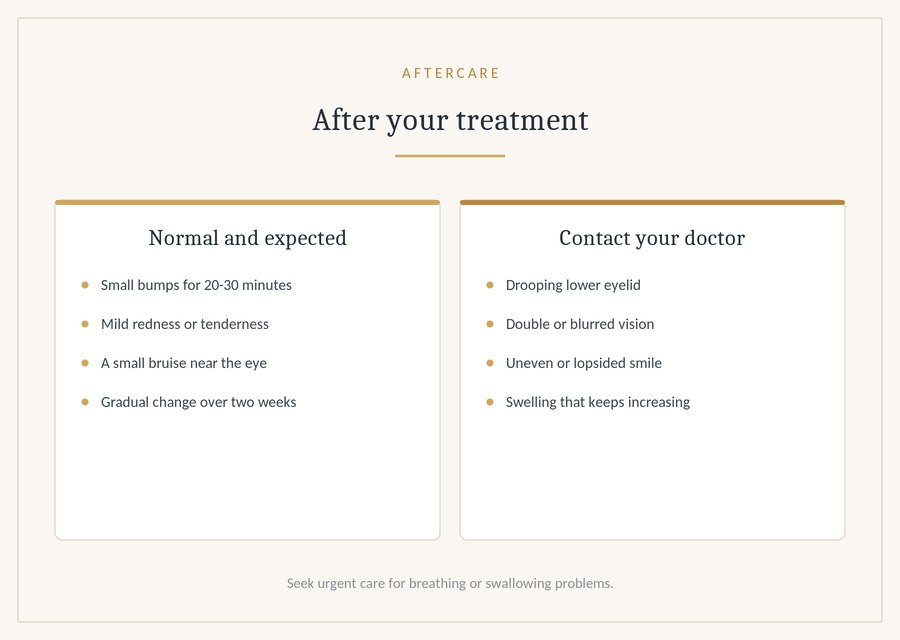
For the first few hours, stay upright, avoid rubbing or pressing the treated area and avoid heavy exercise, saunas and very hot environments for the rest of the day. Make-up can usually be applied gently after a few hours if the skin is not broken. Sunglasses can be worn, but avoid pressing tight frames against the injection points on the first day. If a small bruise appears, it usually fades within a week and can be covered with make-up once the skin has settled. Your physician’s own instructions always take priority.
Side Effects and Rare Risks
The skin around the eyes is thin and has many small blood vessels, so bruising is one of the more common side effects in this area. Small bumps at the injection points, redness, mild swelling and tenderness are common and short-lived. Some people have a mild headache for a day or two.
Less commonly, the effect spreads to nearby muscles. This can cause an uneven or lopsided smile if the cheek muscles are affected, weakness of the lower eyelid, which may contribute to dryness, watering or a slightly lower lid position, or, rarely, double vision if a muscle that moves the eye is affected. These effects are temporary but can last several weeks. Allergic reactions are rare. Anyone who notices drooping of the eyelid, changes in vision, difficulty swallowing or breathing, or marked weakness should contact the clinic urgently or seek emergency care.
Who Should Avoid Crow’s Feet Botox?
Treatment is usually postponed during pregnancy and breastfeeding, when there is an infection or active skin problem near the eyes, and when there is a known allergy to any ingredient. Botox is avoided in people with certain neuromuscular conditions, such as myasthenia gravis, and some medicines, including certain antibiotics, can interact with it. Extra care is needed for people with significant dry eye, laxity of the lower eyelids or previous eyelid surgery, because weakening the muscle can affect how the lids protect the eye. Blood-thinning medicines and supplements increase bruising and should be discussed, but never stopped without the advice of the prescribing doctor.
Treating Crow’s Feet With Other Areas
Crow’s feet are often treated at the same appointment as the forehead and the frown lines between the brows, because the muscles of the upper face work together. Treating one area can change how another moves; for example, relaxing the forehead without considering the brow can leave the eyebrows feeling heavy. A plan that looks at the upper face as a whole usually gives a more balanced result. Our guide to forehead Botox explains why the position of the brow matters when the forehead is treated.
Choosing Who Treats You
Botox is a prescription medicine, and the eye area leaves little room for error, so the person injecting should be a licensed physician whose DHA licence you can verify on the DHA Sheryan portal. Ask about their experience with crow’s feet in particular, whether they examine your eyes while you smile and squint, and whether they check the support of your lower eyelids before treating.
A sound plan includes the product name and dose, a review at around two weeks, written aftercare and a clear way to reach the clinic if something concerns you. The page on Botox and anti-wrinkle treatments gives an overview of the areas treated. At dr-soheila.com, treatments are planned and performed by Dr Soheila Eskandari, a DHA-licensed general practitioner with aesthetic privileges with 20 years of experience in aesthetic medicine.
The Short Version
Crow’s feet come from the ring muscle around the eye folding thin skin each time you smile or squint, with sun and skin ageing adding lines that stay at rest. Botox relaxes the outer part of that muscle, starts working within days, reaches its full effect at around two weeks and typically lasts three to four months. Careful dosing aims to soften the lines while keeping a smile that still reaches the eyes.
Bruising and mild swelling are common; an uneven smile, lower eyelid weakness or, rarely, double vision are less common and temporary. Lines at rest often need skin treatments as well. Treatment is avoided in pregnancy, breastfeeding and certain neuromuscular conditions, and suitability should be confirmed in person by a licensed physician.
Questions Worth Asking
How will you keep my smile natural? The answer should cover dose and placement, not only the product.
Are my lines from movement, skin quality or both? This decides whether Botox alone is enough.
Have you checked my lower eyelids? Lid support affects whether and how this area should be treated.
What happens at my two-week review? A review and any small adjustment should be part of the plan from the start.
Frequently Asked Questions
Does crow’s feet Botox affect my smile?
With careful placement the smile should still look natural, although the lines at the outer eyes will move less; an uneven smile can occur if nearby cheek muscles are affected, and it is temporary.
How many units are used for crow’s feet?
The approved dosing for onabotulinumtoxinA in this area totals 24 units, 12 per side, and physicians adjust the dose and number of points for each person.
How soon will I see results?
Most people notice a change within two to five days, and the full effect is usually clear at around two weeks.
How long does crow’s feet Botox last?
Results typically last about three to four months, after which movement returns gradually and treatment can be repeated if wanted.
Will Botox remove crow’s feet that are visible at rest?
Botox can stop these lines deepening and may soften them over time, but lines etched into the skin often need skin treatments as well.
Can crow’s feet Botox cause bruising?
Yes, the skin around the eyes is thin and has many small vessels, so a small bruise is fairly common and usually fades within a week.
Can I wear sunglasses or make-up after treatment?
Make-up can usually be applied gently after a few hours, and sunglasses can be worn as long as tight frames do not press on the injection points on the first day.
Who should not have crow’s feet Botox?
It is usually avoided in pregnancy, breastfeeding, infection near the eyes, known allergy and certain neuromuscular conditions, and extra care is needed with dry eye or lax lower eyelids.
Can crow’s feet be treated together with the forehead?
Yes, the upper face is often treated as a whole, because the forehead, frown and crow’s feet muscles work together and a balanced plan avoids a heavy or uneven look.
What does crow’s feet Botox cost in Dubai?
Market rates generally run from around AED 800 to AED 1,500 for the crow’s feet area, or about AED 30 to AED 60 per unit, and three-area packages are often quoted between AED 2,000 and AED 4,000; our Botox price guide explains what a fair quote includes.
This article is general information about aesthetic and dermatological treatments and is not medical advice, a diagnosis, or a treatment recommendation for any individual. Outcomes vary between patients and no result is guaranteed. Prescription medications and injectable products carry risks and contraindications that must be assessed by a licensed physician during a personal consultation. Dr Soheila Eskandari is licensed by the Dubai Health Authority. Prices quoted are general market ranges for information only and are not an offer.


 English
 Arabic