
Botox for Frown Lines in Dubai: Dosing, Results, Risks and Deep Lines
Botox for Frown Lines in Dubai: Dosing, Results, Risks and Deep Lines
Botox for frown lines works by relaxing the small muscles that pull the brows together and down, which softens the vertical creases between the eyebrows often called the 11 lines. Lines that appear only when you frown usually respond well, the full effect develops over about two weeks, and it lasts around three to four months before the muscles recover and the treatment needs repeating.
Lines that are already etched into the skin at rest respond more slowly and often need skin treatments as well, and filler is considered only in selected cases. This guide to frown line treatment in Dubai covers the area between the eyebrows only: the muscles involved, how the dose is planned, how men and women differ, what to expect afterwards, the rare risks such as eyelid droop, who should avoid treatment and what can be done about deep lines.
What Causes Frown Lines?
The Muscles Behind the 11 Lines
Frowning is produced by a group of small muscles in the glabella, the area between the eyebrows, which is why the lines are called glabellar lines. The corrugator supercilii muscles attach to the bone at the inner end of each brow and pull the brows together and down, which creates the vertical lines. The procerus, a small muscle over the bridge of the nose, pulls the inner brows down and creates the horizontal crease at the root of the nose. Together they work against the frontalis, the forehead muscle that lifts the brows, which is why the frown muscles and the forehead are planned as a pair, as described in the guide to forehead Botox.
Moving Lines and Etched Lines
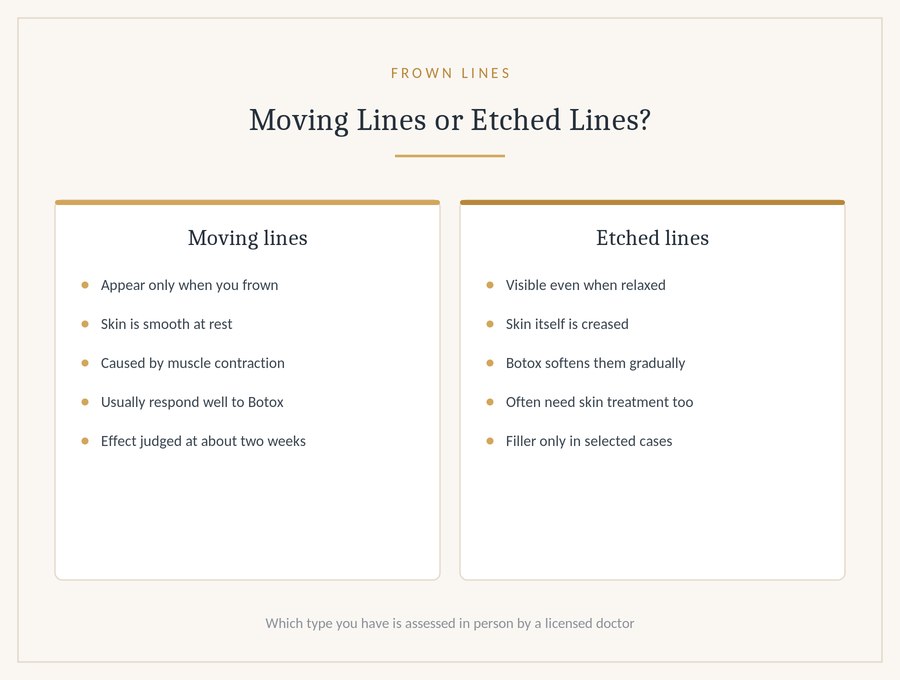
Dynamic lines appear only while the muscles contract and smooth out when the face relaxes. Years of repeated frowning, sun exposure and the natural loss of collagen and elastin can leave the skin creased even at rest. These are static, or etched, lines. Most people have a mixture, and a line that is mostly dynamic at thirty may be partly static at fifty.
Looking at the face relaxed and at full frown shows which type predominates, and that largely decides what Botox can realistically achieve.
How Botox Treats the Frown
Botox is the brand name most people use for botulinum toxin type A, and other approved toxins work in the same way. The toxin blocks the release of the chemical messenger that tells a muscle to contract, so the treated muscle weakens for a few months. With the pull reduced, the skin stops folding in the same place with every expression and the lines soften. Because the muscles that pull the inner brows down are weakened, the brows may also sit slightly higher.
The product label for onabotulinumtoxinA describes five injection points, two in each corrugator and one in the procerus, with 4 units at each point and 20 units in total. An overview of the treatment is on the Botox and anti-wrinkle treatment page.
How the Dose Is Planned
There is no single correct dose. The assessment looks at how strongly you frown, the bulk of the muscles, the height and position of the brows, whether the upper eyelids are heavy and the look you want. Frowns differ: some people pull mostly inwards, others mostly downwards, and ultrasound studies show that the procerus itself varies in shape from person to person. For that reason you are asked to frown and relax while the doctor watches, rather than being given a fixed template.
Thick, strong muscles need more units, and a softer, more natural result is planned with fewer. The label advises placing the outer injections at least a centimetre above the bony ridge over the eye, and volumes are kept small to limit spread towards the eyelid. Units are specific to each product and cannot be converted directly, so a number quoted for one product does not apply to another.
Do Men and Women Need Different Doses?
Generally, yes. Men usually need more toxin than women to achieve the same effect, because their frown muscles are generally larger and stronger. In a dose-ranging trial in men, doses of 40 units and above outperformed the standard 20 units. Clinical practice commonly uses roughly one and a half to two times the usual female dose, so a man may receive around 30 to 40 units of onabotulinumtoxinA where a woman receives about 20. The figure is set by muscle strength rather than a formula.
The aims differ as well. Many women welcome a slight lift at the tail of the brow, while men more often prefer a flatter, lower brow, so the injections are placed to soften the scowl without creating an arch. A higher dose also costs more, which is why men tend to sit towards the upper end of the price range.
What Happens at the Appointment
The consultation covers your medical history, medicines, any previous toxin treatments and what bothers you about the lines. Photographs are taken at rest and at full frown so that the review can be objective. The injection points are marked and a thin needle is used. The treatment takes only a few minutes with brief stinging, and a topical anaesthetic cream or ice can be used for comfort.
Common advice afterwards is to avoid pressing or massaging the area and to skip strenuous exercise, saunas and facials for the rest of the day. The evidence for some of these rules is limited, but they cost little and may lower the chance of unwanted spread.
How Soon Does It Work, and How Long Does It Last?
The toxin begins to act within one to three days, and most people first notice the frown weakening after three to five days. The effect builds through the first week and is usually at its fullest by around two weeks, which is why the review is booked then. At the review, any remaining pull or asymmetry is assessed, and a small additional amount can be added if needed.
The effect typically lasts three to four months. It fades gradually: movement returns first and the lines follow. Some people notice recovery earlier and others later, depending on the dose, the strength of the muscles and individual response. Treating again before the effect has worn off adds dose without benefit and is thought to raise the small risk of developing resistance to the toxin. If treatment is stopped, movement returns over a few months and the lines gradually return towards where they would have been anyway.
Side Effects and Rare Risks
Common and Mild
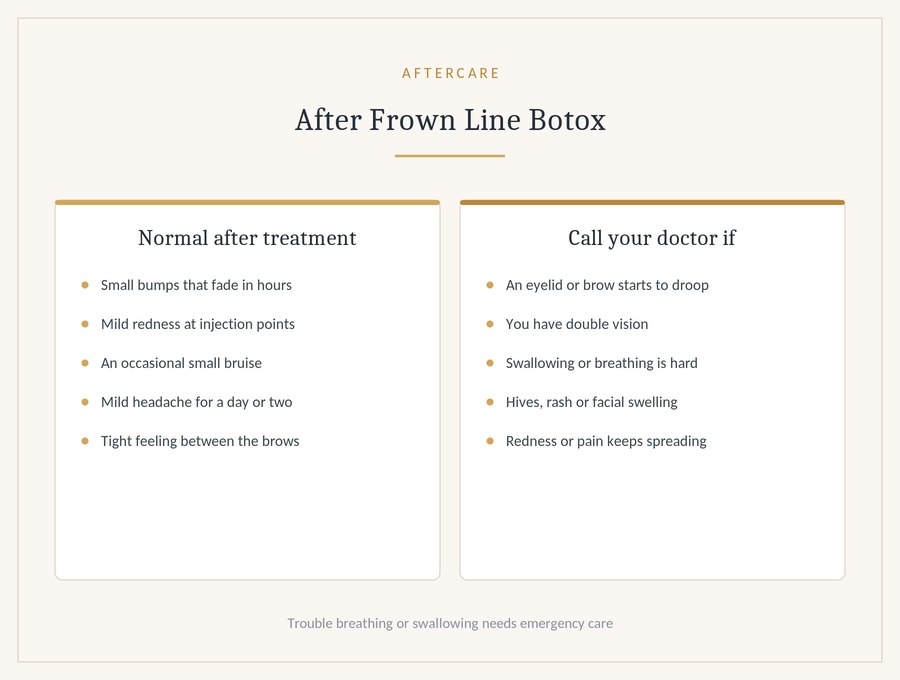
Small raised bumps at the injection points usually flatten within an hour or two. Redness, tenderness, a small bruise or a mild headache over the first day or two are the most common effects, and a feeling of tightness or heaviness between the brows as the muscles weaken is expected.
Eyelid and Brow Droop
The risk that matters most in this area is ptosis, a drooping of the upper eyelid. It happens when a small amount of toxin reaches the muscle that lifts the eyelid. In the trials supporting the product label, eyelid ptosis was reported in about 3 per cent of people treated for frown lines. It usually appears within the first one to two weeks and clears over several weeks as the toxin wears off, and prescription eye drops that stimulate a small accessory lid-lifting muscle can raise the lid slightly in the meantime.
A heavy or lowered brow is a separate problem. It is more likely when the forehead muscle is also weakened, or in people who already rely on that muscle to hold heavy lids open. Both effects are temporary, and careful placement lowers the chance of either.
Rare Spread of the Toxin
Very rarely, botulinum toxin can spread beyond the injection site and cause difficulty swallowing, speaking or breathing, or widespread muscle weakness. This has been reported mainly with the much larger doses used for medical conditions rather than cosmetic doses, but it needs urgent medical attention. Allergic reactions and infection are also rare.
Who Should Avoid Botox for Frown Lines?
Treatment is postponed or avoided in pregnancy and breastfeeding, because there is not enough evidence to support its use at these times. It is also avoided when there is infection or active skin inflammation at the injection points, a known allergy to botulinum toxin or any ingredient in the product, or a neuromuscular condition such as myasthenia gravis, Lambert-Eaton syndrome or motor neurone disease, where even small doses can cause marked weakness.
Medicines matter. Some antibiotics, including the aminoglycoside group, and other drugs that affect nerve and muscle signalling can strengthen the effect of the toxin, and blood thinners increase bruising. People with drooping eyelids, very low or heavy brows, or previous facial nerve weakness need particular assessment, and a different plan, or no treatment, may be advised. Suitability can only be decided by a licensed doctor in person, with your full medical history.
What About Deep Etched Lines?
What Botox Can Do
Botox does not fill or resurface a crease. It stops the repeated folding that deepens it. In studies of repeated treatment, lines at rest have continued to improve over successive sessions, so a line that looks fixed at first can soften with time. A deep line in older or sun-damaged skin, however, often stays visible to some degree, and the realistic aim is a softer line rather than a smooth one.
Skin Treatments
Where creases persist at rest, treatments that improve the skin itself are added once the toxin has taken effect. These include microneedling, chemical peels, laser or radiofrequency resurfacing and polynucleotide skin boosters. They aim to stimulate collagen and improve texture, but the evidence for glabellar lines specifically is modest, they are given as a course, and the change is gradual.
Filler: A More Cautious Option
Filler is occasionally considered for a deep static line, using a small amount of a soft hyaluronic acid product. The glabella, however, is one of the higher-risk areas for filler. Its small arteries are branches of the artery that supplies the eye, and reviews of filler-related skin damage and visual loss have repeatedly identified this region among the most frequent injection sites. Many practitioners therefore avoid it, or use filler there only in very small amounts, with hyaluronidase available to dissolve the product if needed. How toxin and filler differ is set out in the guide to Botox versus fillers.
Cost of Botox for Frown Lines in Dubai
Market rates generally run from around AED 600 to AED 1,800 for the frown area, depending on the number of units, the product used and the clinic. Because the charge usually follows the dose, men and people with strong muscles often sit towards the upper end. The wider picture is set out in the guide to Botox prices in Dubai.
Choosing Who Treats You
Injections between the eyebrows look simple, but the anatomy next to the eye leaves little room for error. Check that the doctor holds a current DHA licence, which you can verify on the DHA Sheryan portal, that they treat this area regularly, and that the consultation includes a proper assessment before any injection: your medical history, your brow and eyelid position, and your frown at rest and at full movement.
Ask what the plan is for review and aftercare, including a check at around two weeks, clear advice on what is normal and a direct way to reach the clinic if something worries you. At dr-soheila.com, treatments are planned and performed by Dr Soheila Eskandari, a DHA-licensed general practitioner with aesthetic privileges with 20 years of experience in aesthetic medicine.
The Short Version
Botox softens frown lines by relaxing the corrugator and procerus muscles that pull the brows together. Lines that appear on movement respond well, the full effect develops over about two weeks, and it lasts around three to four months. The dose is planned from your muscles, frown pattern and brow position, and men generally need more than women.
Deep lines that remain at rest improve gradually with repeated treatment and often need skin treatments as well, while filler in this area is used cautiously because of its particular risks. The main risks are mild bruising and headache and, uncommonly, a temporary drooping eyelid. A licensed doctor must assess you in person, and treatment is avoided in pregnancy, breastfeeding, certain nerve and muscle conditions and alongside some medicines.
Questions Worth Asking
How many units do you plan to use, and why? The answer should relate to your muscle strength, frown pattern and brow position, not to a fixed package.
How do you reduce the risk of an eyelid droop? A clear answer covers injection positions away from the bony ridge, small volumes and what happens if it occurs.
Will I be reviewed at two weeks? The effect should be judged when it is fully developed, with any adjustment made then.
Will Botox be enough for my lines? An honest answer separates moving lines from etched lines and says what each needs.
Frequently Asked Questions
What are the 11 lines between the eyebrows?
They are the vertical creases that form between the eyebrows when you frown, named for their resemblance to the number 11. Doctors call the area the glabella and the lines glabellar lines.
Which muscles does Botox treat for frown lines?
The two corrugator supercilii muscles, which pull the brows together and down, and the procerus, which pulls the inner brows down over the nose. Smaller nearby muscles are sometimes included.
How long does Botox for frown lines take to work?
The first change is usually seen after three to five days. The effect builds over the first week and is fully developed at around two weeks, when a review is normally booked.
How long do the results last?
Commonly around three to four months. Movement returns first and the lines follow, and duration varies with the dose, the strength of the muscles and the individual.
How many units are used for frown lines?
The product label for onabotulinumtoxinA describes 20 units across five injection points. The actual number is individual and higher for strong muscles, and units cannot be compared between different products.
Do men need more Botox than women for frown lines?
Generally, yes. Men’s frown muscles are usually larger, and in a dose-ranging trial in men, 40 units and above outperformed 20 units. Clinical practice commonly uses one and a half to two times the usual female dose.
Can Botox remove deep frown lines?
Not on its own. It relaxes the muscle that creates the fold, so lines at rest can soften gradually with repeated treatment, but a deeply etched line often stays visible to some degree and may need skin treatments or, in selected cases, filler.
Can Botox for frown lines cause a droopy eyelid?
Occasionally. Eyelid ptosis was reported in about 3 per cent of people in the trials supporting the product label. It is temporary, usually appearing within one to two weeks and clearing over several weeks, and careful placement lowers the chance.
Who should not have Botox for frown lines?
People who are pregnant or breastfeeding, have an infection at the injection sites, are allergic to botulinum toxin or its ingredients, or have a neuromuscular condition such as myasthenia gravis. Some medicines and drooping eyelids need assessment first.
What does it cost in Dubai?
Market rates generally run from around AED 600 to AED 1,800 for the frown area, depending on the number of units, the product and the clinic.
This article is general information about aesthetic and dermatological treatments and is not medical advice, a diagnosis, or a treatment recommendation for any individual. Outcomes vary between patients and no result is guaranteed. Prescription medications and injectable products carry risks and contraindications that must be assessed by a licensed physician during a personal consultation. Dr Soheila Eskandari is licensed by the Dubai Health Authority. Prices quoted are general market ranges for information only and are not an offer.


 English
 Arabic