
Stretch Marks Treatment in Dubai: What Can Improve Red and White Marks
Stretch Marks Treatment in Dubai: What Can Improve Red and White Marks
Stretch marks treatment in Dubai can make marks less noticeable, but no option erases them completely, and early red or purple marks respond better than older white ones. The main options are topical tretinoin for early marks (not during pregnancy or breastfeeding), microneedling with or without platelet-rich plasma (PRP), radiofrequency microneedling, and fractional or vascular lasers, which are general options offered at laser or dermatology clinics.
Most people seek help once their marks have faded to white and feel smooth or slightly sunken, which is the hardest stage to improve. This guide covers causes, the evidence for each option, skin of colour, sessions, risks, pregnancy and breastfeeding, and costs in Dubai.
What Are Stretch Marks?
Stretch marks, known medically as striae, are scars in the dermis, the layer that gives skin its strength and elasticity. When skin stretches faster than it can adapt, or hormones weaken the supporting collagen and elastin, that network is disrupted and the skin heals as a thin, lined scar. They are most common on the abdomen, breasts, hips, thighs, buttocks and upper arms, and are usually a cosmetic concern rather than a medical one. They are sometimes confused with cellulite, a different condition covered in our cellulite treatment guide.
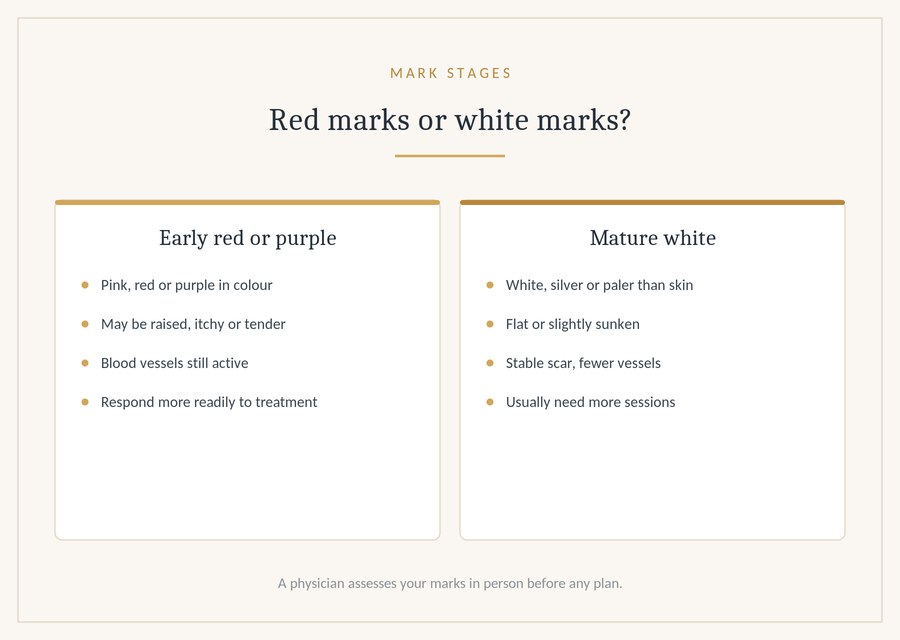
Early red or purple marks (striae rubrae)
New marks look pink, red or purple because the small blood vessels in the damaged area are still active and inflamed. They may be slightly raised, itchy or tender. This early stage responds most readily to treatment.
Mature white marks (striae albae)
Over months to years the inflammation settles and the marks fade to white, silver or a shade paler than the surrounding skin. The surface becomes flat or slightly sunken, with a fine, crinkled texture.
What Causes Stretch Marks?
Pregnancy is the most familiar cause: a Cochrane review reports that 50% to 90% of women develop marks, usually in the later months. Growth spurts in adolescence can mark the thighs, hips, lower back and breasts in girls and boys. Rapid weight gain or loss can have the same effect, as can fast muscle growth in bodybuilding, which tends to mark the shoulders, chest, arms and thighs.
Corticosteroids are another cause. Strong steroid creams used for long periods, steroid tablets and steroid injections thin the skin and weaken collagen, so marks can appear without much stretching. Family history also plays a part, so some people develop marks after modest changes while others never do.
When do unusual stretch marks need a medical check?
Most stretch marks need no tests. See a doctor if wide, deep purple marks come with other symptoms such as weight gain around the middle and face, easy bruising, thin skin, muscle weakness, high blood pressure, excess hair growth or irregular periods, or if marks appear without pregnancy, growth or weight change. This pattern can point to excess cortisol, as in Cushing syndrome, and should be investigated before any cosmetic treatment.
Why Do Early Stretch Marks Respond Better?
Red and purple marks are still in an active, inflammatory phase. The tissue is remodelling and has a rich blood supply, so treatments that calm inflammation, target blood vessels or stimulate collagen have something to work with. Studies of tretinoin, for example, have mostly included marks that were only a few months old.
In white marks the repair process has largely finished. The scar is thin, has fewer blood vessels and may have lost pigment, so improvement is possible but usually needs more sessions and more modest expectations. This is the practical reason to seek advice while marks are still red.
Creams and Topicals: Tretinoin, Hyaluronic Acid and Centella
Tretinoin for early marks
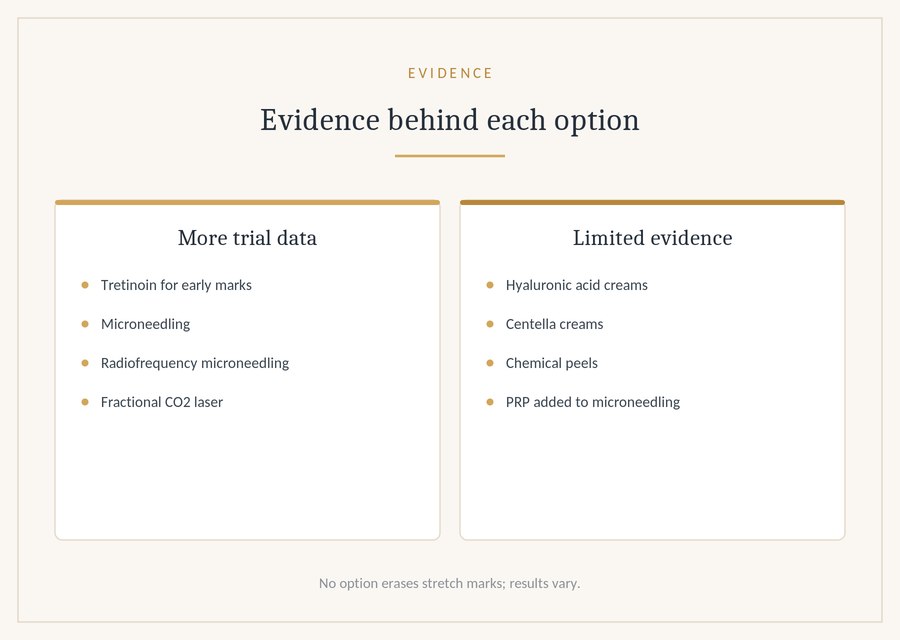
Topical tretinoin, a prescription vitamin A derivative, is one of the few creams studied in existing marks. Small trials found that nightly use for several months modestly reduced the width and length of early red marks, with less benefit in white ones. Redness, peeling, itching and burning are common, and higher strengths cause more of them. Tretinoin is not used during pregnancy or breastfeeding and increases sun sensitivity, so a physician should prescribe it and explain how to use it.
Hyaluronic acid and centella creams
Moisturisers containing hyaluronic acid or centella asiatica are widely sold for stretch marks, and the evidence for them is modest. A Cochrane review of creams and oils used to prevent marks in pregnancy did not support any of them, and its trials were small and often at risk of bias. Gentle massage and regular moisturising can ease dryness, but should not be expected to remove marks that have already formed.
Microneedling, With or Without PRP
Microneedling uses fine needles to make controlled micro-injuries in the skin, which prompt new collagen and elastin. Several small trials report improvement in the texture and appearance of stretch marks, and reviews describe it as cost-efficient and suitable across skin types. Body skin is often treated at deeper settings than the face, so a topical anaesthetic is usually applied and redness and tenderness follow. Our guide to medical microneedling explains the technique.
PRP is made from a small sample of your own blood, spun to concentrate the platelets, and applied or injected during the session in the hope that their growth factors support repair. Small trials of adding PRP to microneedling give mixed results, so it is better seen as an optional extra than a proven step. Our article on microneedling with growth factors explains how such add-ons are used.
Radiofrequency Microneedling
Radiofrequency (RF) microneedling sends radiofrequency energy through the tips of fine needles, heating the deeper dermis while sparing much of the surface. A network meta-analysis of 14 trials with 651 patients ranked bipolar radiofrequency combined with topical tretinoin highest for clinical improvement and satisfaction, although its authors noted imprecise estimates and called for larger trials. Redness and swelling usually settle within a few days, and the risk of pigment change is often considered lower than with some lasers, but it is not zero. Our guide to skin tightening covers wider options.
Lasers for Stretch Marks
Lasers are general options offered at laser or dermatology clinics. Two groups are used.
Vascular lasers for red marks
Pulsed dye and similar vascular lasers target the blood vessels that make early marks red, and studies report reduced redness. Results in white marks are less consistent. In darker skin the energy can also be absorbed by pigment and cause dark patches, so settings and test areas matter.
Fractional lasers for texture
Fractional lasers treat a grid of microscopic columns of skin and leave the tissue between them intact, which speeds healing. Ablative versions such as fractional CO2 remove the columns, while non-ablative versions heat the tissue without removing it. In the network meta-analysis, fractional CO2 ranked above the other lasers, but it needs longer recovery, with crusting and redness for several days, and carries a higher risk of pigment change in darker skin. One study of fractional CO2 in darker-skinned patients with white marks found only minimal improvement, and some reviews suggest fractional erbium lasers, which cause less heat damage, may carry less risk.
Chemical Peels: Why the Evidence Is Limited
Chemical peels use acids such as glycolic or trichloroacetic acid to remove the upper layers of skin. Stretch marks sit in the dermis, deeper than most peels reach, so peels mainly refine surface texture and tone around the marks rather than the scar itself. The few studies are small, so peels are usually an add-on rather than the main treatment. Deeper peels carry a higher risk of pigment change and scarring. Our guide to chemical peels explains the types and their limits.
What Can You Realistically Expect?
Treatment improves colour and texture, but it does not erase stretch marks. Red marks may become paler and less obvious, and white marks may look smoother and closer to the surrounding skin tone, but some trace usually remains. Results depend on the age of the marks, their location, your skin type, the number of sessions completed and how your skin heals. Reviews agree that no single treatment has been proven the most effective and that many trials are small. New stretching from weight change can also create new marks beside treated ones.
Skin of Colour and the Risk of Pigment Change
In darker skin (Fitzpatrick types IV to VI), any treatment that injures or heats the skin can trigger post-inflammatory hyperpigmentation (PIH), where the skin makes extra pigment as it heals and leaves brown or grey patches that can last for months and sometimes up to a year. Lighter patches can also occur. The risk is highest with vascular lasers, ablative lasers, deeper peels and aggressive settings, and lower, though not absent, with microneedling and radiofrequency microneedling.
Physicians reduce the risk with conservative settings, a test area, wider spacing between sessions, no treatment on tanned skin and daily sunscreen before and after. In Dubai, where sun exposure is strong all year, this matters even more. Tell your physician if you tend to get dark marks after spots, cuts or insect bites, because this suggests your skin is prone to PIH.
How Many Sessions Are Needed, and How Far Apart?
Stretch marks are treated as a course, not a single session. Microneedling and radiofrequency microneedling are commonly given as three to six sessions about four to six weeks apart, so the skin can complete a cycle of repair between visits. Fractional lasers follow a similar pattern, and white marks often need the upper end of the range or more. Improvement builds over weeks to months, so results are usually judged a few months after the last session.
Risks and Side Effects
Redness, warmth, swelling, tenderness, dryness and flaking for a few days are common after microneedling, radiofrequency microneedling and lasers, and pinpoint bleeding or bruising can occur. Less common risks include infection, irritant or allergic reactions, dark or light patches, burns if energy settings are wrong, and scarring, including raised scars in people prone to keloids. Contact the clinic promptly for spreading redness, pus, increasing pain, fever, blistering or darkening skin.
Treatment is usually postponed with an active infection, eczema or psoriasis in the area, a tendency to keloid scars, a recent course of isotretinoin, a bleeding disorder, blood-thinning medicine, poorly controlled diabetes, or tanned or sunburned skin. A licensed physician must assess suitability in person, and prescribed medicines should never be stopped without that doctor’s advice.
Pregnancy and Breastfeeding
Treatment is postponed during pregnancy. Tretinoin is not used, and microneedling, radiofrequency devices, lasers, peels and PRP are generally deferred until after delivery because their effects in pregnancy have not been adequately studied and hormonal changes can increase pigment problems. A gentle moisturiser can ease itching and dryness but should not be expected to prevent marks.
After delivery, tretinoin is still avoided while breastfeeding, and some physicians prefer to wait until breastfeeding has ended before energy or injection treatments because data are limited. Pregnancy marks often stay red for some months, so an early assessment helps to plan timing.
Choosing Who Treats You
Stretch mark treatment involves needles, energy devices or prescription medicines, so the person treating you should be a licensed physician whose DHA licence you can verify on the DHA Sheryan portal. Not every clinic offers every option in this guide, so ask which methods are available and why one suits your marks. Also ask about their experience with stretch marks in your skin type, and whether they assess the age and colour of your marks and your pigment risk before choosing a method.
A sound plan includes the method and settings, the number and spacing of sessions, baseline photographs, written aftercare and a clear way to reach the clinic if something concerns you. The page on stretch mark treatment gives an overview of the approach at the clinic. At dr-soheila.com, treatments are planned and performed by Dr Soheila Eskandari, a DHA-licensed general practitioner with aesthetic privileges with 20 years of experience in aesthetic medicine.
The Short Version
Stretch marks are dermal scars that begin red or purple and fade to white, and early marks respond better. The main options are topical tretinoin for early marks, microneedling with or without PRP, radiofrequency microneedling, and fractional or vascular lasers at laser or dermatology clinics. Creams have modest evidence and chemical peels limited evidence.
Treatment improves colour and texture but does not erase marks, and a course of about three to six sessions, four to six weeks apart, is typical. Darker skin has a higher risk of pigment change, and pregnancy and breastfeeding change the plan. Unusually wide purple marks with other symptoms need a medical check, and suitability for any treatment should be confirmed in person by a licensed physician.
Questions Worth Asking
Are my marks early or mature? The answer decides which options are worth trying and what to expect.
What is my risk of pigment change? Skin type, tanning and past scarring should shape the method and the settings.
How many sessions will I need, and what will the whole course cost? The quote should state the sessions, the area and any add-ons.
What happens if my marks do not respond? A review point and an agreed next step should be part of the plan from the start.
Frequently Asked Questions
Can stretch marks be removed completely?
No, treatment can improve colour and texture, but some trace of the marks usually remains, and early red marks respond better than white ones.
Do red stretch marks respond better than white ones?
Yes, early red or purple marks are still active and generally respond better, while white marks are stable scars that need more sessions and more modest expectations.
Do creams, oils or tretinoin help stretch marks?
Tretinoin shows a modest benefit in early marks but is not used in pregnancy or breastfeeding, and a Cochrane review did not support any cream or oil for preventing marks.
Does microneedling help stretch marks?
Several small trials report improvement in texture and appearance, usually after a course of sessions, and PRP is an optional add-on with mixed evidence.
Are lasers an option for stretch marks?
Vascular lasers target redness in early marks and fractional lasers target texture, as general options at laser or dermatology clinics, but the risk of pigment change is higher in darker skin.
How many sessions are needed, and how far apart?
A course of about three to six sessions, spaced four to six weeks apart, is typical, and white marks often need the upper end of that range or more.
Can stretch marks in darker skin be treated?
Yes, with caution, because darker skin is more prone to post-inflammatory hyperpigmentation, so physicians use conservative settings, test areas, wider spacing and daily sun protection.
Can I have treatment during pregnancy or breastfeeding?
Treatment is postponed during pregnancy, tretinoin is avoided in both pregnancy and breastfeeding, and the timing of other treatments after delivery is agreed with your physician.
When should I see a doctor about stretch marks?
See a doctor if wide, deep purple marks come with easy bruising, weight gain around the middle, muscle weakness or high blood pressure, or if marks appear without pregnancy, growth or weight change.
What does stretch mark treatment cost in Dubai?
Market rates generally run from around AED 500 to AED 3,000 per session, depending on the area and device, with microneedling and radiofrequency microneedling usually in the lower to middle part of that range and lasers on large areas often around AED 1,000 to AED 2,000; a full course and any PRP add-on raise the total, so ask for a written quote.
This article is general information about aesthetic and dermatological treatments and is not medical advice, a diagnosis, or a treatment recommendation for any individual. Outcomes vary between patients and no result is guaranteed. Prescription medications and injectable products carry risks and contraindications that must be assessed by a licensed physician during a personal consultation. Dr Soheila Eskandari is licensed by the Dubai Health Authority. Prices quoted are general market ranges for information only and are not an offer.


 English
 Arabic