
Chemical Peels in Dubai: Depth, Skin Type and the Pigmentation Question
Chemical Peels in Dubai: Depth, Skin Type and the Pigmentation Question
Chemical peels have a reputation problem in this region, and it is partly deserved. Used at the wrong depth on the wrong skin type, a peel can leave someone with more pigmentation than they started with — and in Fitzpatrick types III to V, which covers most patients here, that risk is real rather than theoretical.
Used properly, the same treatment is one of the more useful and least expensive tools available for texture, dullness, acne and certain kinds of pigmentation. The difference between those two outcomes is almost entirely depth, preparation and patient selection.
What a Peel Actually Does
A chemical solution is applied to the skin for a controlled period, removing layers in a predictable way. The skin then regenerates, and the regenerated tissue is more even in tone and texture than what was removed.
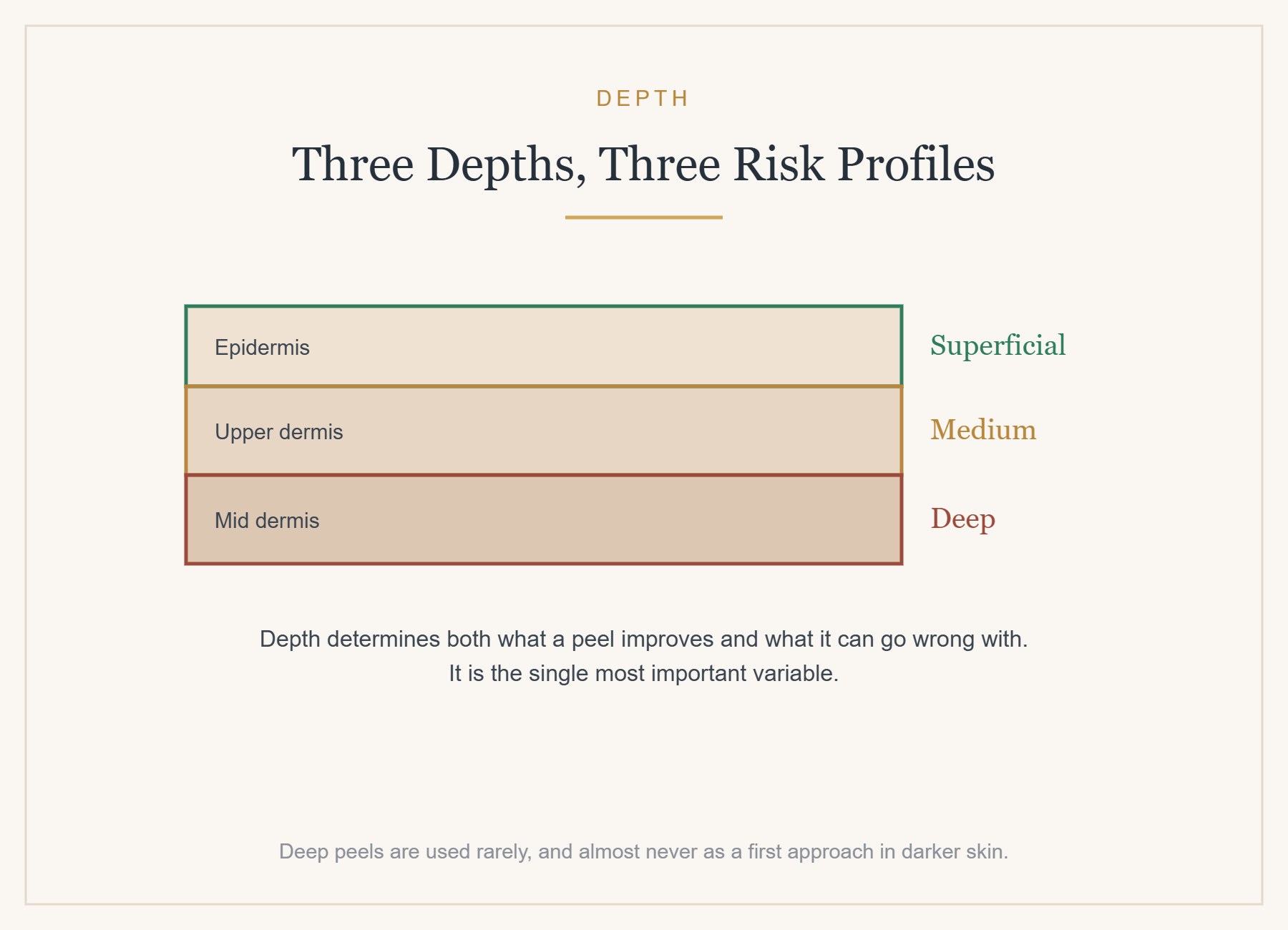
Depth is the variable that matters. It determines what a peel can improve, how long the recovery is, and what can go wrong.
Superficial peels act on the epidermis. Alpha hydroxy acids such as glycolic and mandelic, beta hydroxy acid (salicylic), and low-concentration trichloroacetic acid sit here. They produce light flaking for two to three days and are used in courses.
Medium peels reach into the upper dermis, typically using higher-concentration trichloroacetic acid. Visible peeling runs five to seven days with redness lasting longer. More change per treatment, more risk.
Deep peels reach further into the dermis, produce significant change and carry significant risk and downtime. They are used rarely and selectively, and almost never as a first approach in darker skin.
Why Skin Type Changes Everything Here
Melanocytes in darker skin respond to inflammation by producing more pigment. A peel is a controlled injury, and injury is inflammation. That is the whole problem in one sentence.
Post-inflammatory hyperpigmentation after a peel can take many months to fade, and while it is present it is usually more noticeable than whatever the peel was treating. The patient has traded a texture or tone concern for a pigment one, and the timeline for recovery is measured in months.
This does not rule peels out. It changes how they are used:
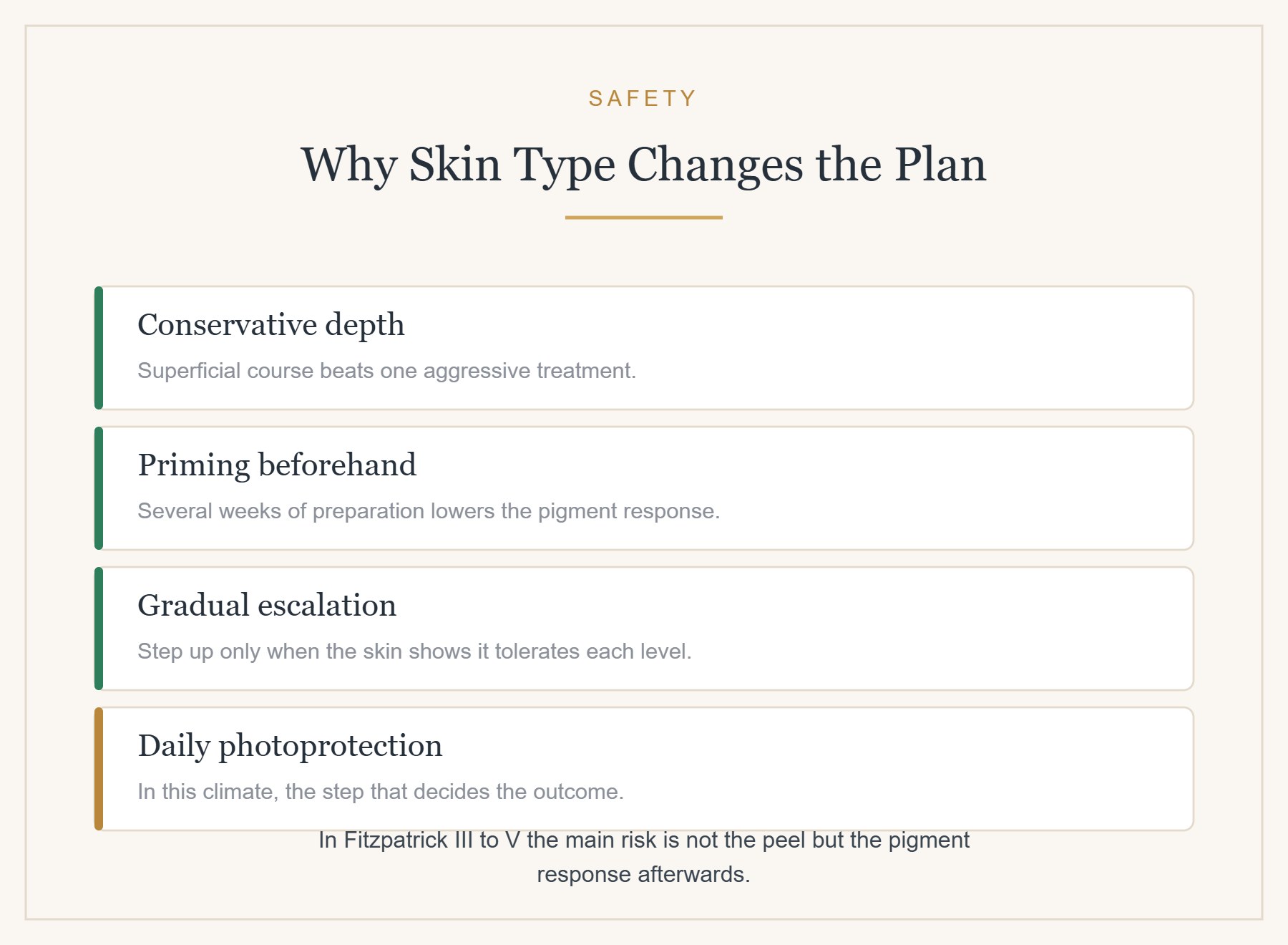
Conservative depth. Superficial peels in a course achieve a great deal with a fraction of the risk. Escalating gradually across sessions is safer than one aggressive treatment.
Preparation. Priming the skin for several weeks beforehand — typically with a tyrosinase-inhibiting agent and often a retinoid — reduces the pigment response. Skipping this step to treat sooner is where problems begin.
Agent choice. Salicylic and mandelic acid are generally better tolerated in pigment-prone skin than aggressive glycolic protocols, and certain combination formulations are designed specifically for this consideration.
Photoprotection afterwards. Not advisory. In a city with high ultraviolet year-round, sun exposure after a peel is the single most reliable way to produce the pigmentation you were trying to avoid.
What Peels Do Well, and What They Do Not
Texture, dullness and general skin quality respond well to a course of superficial peels. This is the most reliable indication and the one with the best risk-to-benefit ratio.
Acne responds to salicylic acid peels, which are lipophilic and penetrate into the follicle. Useful as an adjunct to medical treatment rather than a replacement for it.
Post-inflammatory pigmentation often responds, provided the underlying inflammation has settled and photoprotection is rigorous.
Melasma is more complicated and deserves care. Melasma-prone skin is unusually reactive to inflammation, and an aggressive peel can worsen it. Superficial peels have a role as part of a programme built on photoprotection and appropriate topical therapy — not as a standalone fix. The fuller picture is in the guide to melasma treatment in Dubai.
Fine lines improve modestly with medium-depth treatment. Deep static wrinkles do not.
Atrophic acne scarring is not a peel indication in general, with one exception: focal application of a high-strength acid directly into individual icepick scar tracts, which is a precise technique rather than a resurfacing peel.
Active inflammatory acne, open wounds and active infection are reasons to defer.
Preparation and Aftercare
What happens in the weeks around the peel matters as much as the peel itself.
Before: retinoids, exfoliating acids and scrubs are typically stopped for several days to a week. Waxing, threading and laser hair removal in the area are paused. Recent sun exposure or a tan defers treatment — peeling tanned skin is asking for uneven pigmentation. Anyone with a history of cold sores usually receives antiviral prophylaxis, because peels reactivate herpes simplex reliably.
After: let the skin peel on its own. Picking or pulling at flaking skin is the most common self-inflicted cause of scarring and pigmentation after a peel. Gentle cleansing, bland moisturiser, no actives until the skin has settled, and daily broad-spectrum protection including reapplication.
Patients frequently ask whether they can have a peel in summer here. Technically yes; practically it raises the aftercare burden, and the ultraviolet index in Dubai is high enough year-round that “winter” offers less protection than people assume. The honest answer is that photoprotection discipline matters more than the season.
Peels Versus Lasers
They overlap and are often presented as competitors. The useful distinction is the mechanism.
A peel is chemical, and its depth is governed by the agent, its concentration, and how long it is left on. A laser is thermal, and its effect is governed by wavelength, energy and fractionation.
For superficial pigmentation and texture in pigment-prone skin, a well-chosen peel is frequently the safer starting point — no heat, lower cost, and easier to escalate gradually. For deeper textural change and certain vascular or pigmentary targets, lasers do things peels cannot.
The answer is rarely that one is better. It is which is appropriate for this skin, this concern, and this patient’s tolerance for downtime and risk.
What a Course Looks Like
Superficial peels are usually done as a course of four to six treatments spaced two to four weeks apart, with the strength escalated gradually as the skin demonstrates it tolerates each step.
Medium peels are used far less frequently — often one to three treatments with longer intervals, and with more careful preparation.
The result of a superficial course is cumulative. A single session gives a brief brightening that fades; the change in texture and evenness builds across the course and is best assessed a few weeks after the final treatment.
Costs in Dubai
Market rates generally run from around AED 500 to AED 1,200 for a superficial peel and AED 1,500 to AED 4,000 for a medium-depth peel, varying with the agent and the clinic.
Since superficial peels work as a course, the package price is the meaningful number. Peels are among the least expensive treatments in aesthetic dermatology, which is part of why they are sometimes offered casually in settings without proper assessment — and that, rather than the cost, is the thing worth being careful about.
The Short Version
A chemical peel is a controlled injury, and depth determines both the benefit and the risk. In the skin types most common in Dubai, the risk that matters is the pigment response afterwards, not the peel itself.
Conservative depth, several weeks of priming, gradual escalation across a course, and disciplined sun protection afterwards turn this into one of the most reliable and affordable tools available. Skipping those steps in favour of a faster result is how a treatment intended to even out skin tone ends up doing the opposite.
The Agents, and What Each Is For
The name on the bottle matters less than the depth achieved, but the agents do have distinct characters worth knowing.
Salicylic acid is oil-soluble, so it penetrates into the follicle. That makes it the natural choice for acne and congested skin, and it is generally well tolerated in pigment-prone skin.
Mandelic acid has a large molecule, which means slower and more even penetration. That gentleness is exactly why it is often preferred as a starting point in darker skin types.
Glycolic acid has the smallest molecule of the alpha hydroxy acids and penetrates fastest. Effective for texture and dullness, but the speed of penetration is also why it needs more careful handling and timing in reactive skin.
Lactic acid sits between the two, with a hydrating quality that makes it useful in drier skin.
Trichloroacetic acid spans depths depending on concentration, from superficial at low strengths to medium and beyond. This is the agent where concentration and technique matter most.
Combination formulations pair several acids at lower individual concentrations, often with agents intended to reduce the pigment response. Several are designed specifically with darker skin in mind.
Signs a Peel Is Being Done Carelessly
Because peels are inexpensive and widely offered, standards vary more here than in most treatments. A few things are worth noticing.
No skin assessment and no question about Fitzpatrick type or pigmentation history. No priming period suggested before a medium peel. No discussion of what will happen to the skin over the following week. A recommendation to start at medium depth on a first treatment in darker skin. And no mention of photoprotection afterwards, which in this climate is the single most consequential instruction.
Conversely, a practitioner who suggests starting more conservatively than you hoped, and escalating only if the skin tolerates it, is giving you the better outcome even though it takes longer.
Frequently Asked Questions
What does a chemical peel actually do?
A chemical solution is applied to the skin to remove the outer layers in a controlled way, prompting the skin to regenerate. Depending on depth it can improve surface texture and dullness, acne, fine lines and some forms of pigmentation.
What is the difference between superficial, medium and deep peels?
Superficial peels affect the epidermis and give a light refresh with minimal downtime. Medium peels reach the upper dermis and address texture and pigmentation with a week or so of visible peeling. Deep peels reach further, produce significant change and carry the most risk and downtime.
Are peels safe for darker skin?
Superficial peels generally are, with appropriate preparation. Medium and deep peels carry a meaningfully higher risk of post-inflammatory hyperpigmentation in Fitzpatrick types III to V, which covers most patients in this region. That does not rule them out, but it changes how conservatively they are used.
Will a peel treat my melasma?
Sometimes, as part of a programme rather than on its own. Melasma responds to inflammation by producing more pigment, so an aggressive peel can worsen it. Superficial peels used alongside photoprotection and appropriate topical treatment have a role; a deep peel as a first step usually does not.
How much downtime should I expect?
A superficial peel typically causes mild flaking for two to three days. A medium peel produces visible peeling for five to seven days with redness for longer. Deep peels involve a considerably longer and more demanding recovery that needs planning.
How many sessions will I need?
Superficial peels are usually done as a course of four to six, spaced two to four weeks apart. Medium peels are used less frequently, often one to three treatments with longer intervals. The plan depends on the indication rather than a fixed package.
Can I have a peel in summer here?
It is possible but the aftercare burden is higher. Ultraviolet exposure after a peel is the main driver of post-treatment pigmentation, and Dubai delivers high UV year-round. Rigorous daily photoprotection is not optional afterwards, whatever the season.
What should I avoid before a peel?
Retinoids, exfoliating acids and waxing in the treatment area are typically stopped for several days to a week beforehand, and recent sun exposure or a tan defers treatment. Anyone with a history of cold sores usually receives antiviral prophylaxis.
Is a peel better than laser?
They overlap but are not interchangeable. Peels are chemical and operate on depth of application; lasers are thermal and operate on wavelength and fractionation. For superficial pigmentation and texture in pigment-prone skin, a well-chosen peel is often the safer starting point.
What do peels cost in Dubai?
Market rates generally run from around AED 500 to AED 1,200 for a superficial peel and AED 1,500 to AED 4,000 for a medium-depth peel. Superficial peels are usually priced as a course, which is the more meaningful figure.
This article is general information about aesthetic and dermatological treatments and is not medical advice, a diagnosis, or a treatment recommendation for any individual. Outcomes vary between patients and no result is guaranteed. Prescription medications carry risks and contraindications that must be assessed by a licensed physician during a personal consultation. Dr Soheila Eskandari is licensed by the Dubai Health Authority. Prices quoted are general market ranges for information only and are not an offer.


 English
  Arabic