
Cellulite Treatment in Dubai: What Works, What Does Not
Cellulite Treatment in Dubai: What Works, What Does Not
Cellulite is the most over-treated and most misunderstood concern in aesthetic medicine. It affects the large majority of adult women regardless of weight, fitness, or diet. It is not a disease, it is not caused by “toxins”, and it has almost nothing to do with the things the beauty industry has spent decades blaming.
Dr Soheila’s consultations on this topic usually begin by correcting three assumptions, because everything after that depends on getting the mechanism right. This guide explains what cellulite actually is anatomically, why most treatments fail, what the clinical trial evidence supports, and what a realistic plan looks like in Dubai.
What Cellulite Actually Is
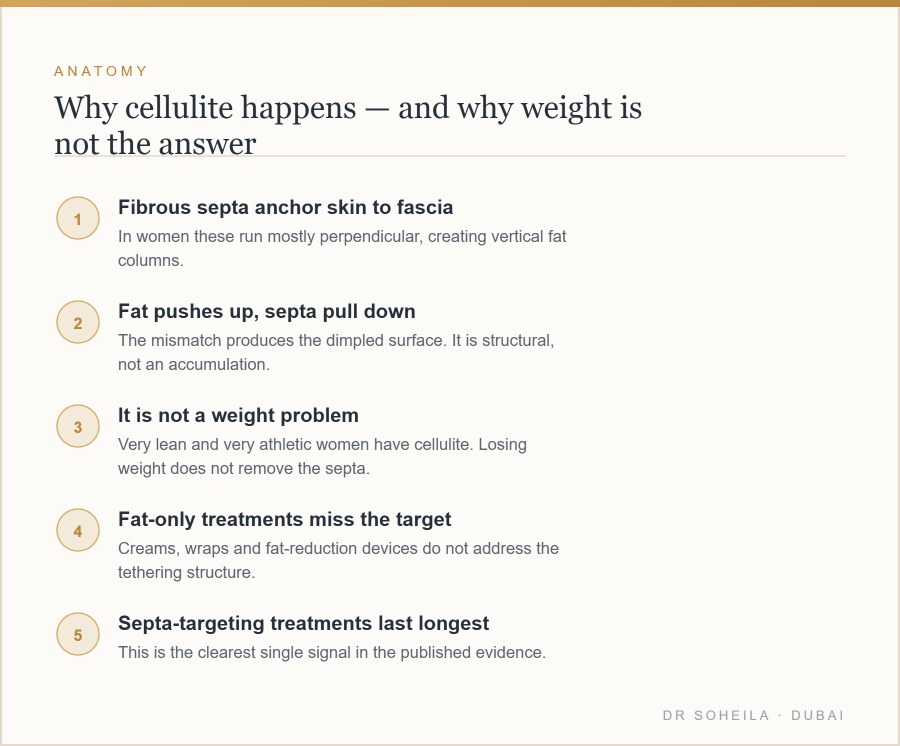
Cellulite is a structural feature of how female subcutaneous tissue is organised — not an accumulation of anything.
Beneath the skin, fat is held in compartments separated by fibrous connective tissue called septa, which anchor the skin down to the underlying fascia. In women, these septa tend to run predominantly perpendicular to the skin surface, creating vertical columns of fat. In men, they more often run at an oblique, criss-crossing angle, forming a lattice.
The consequence is mechanical. In the female arrangement, fat lobules push upward between the tethering septa while the septa themselves pull the skin down at fixed points. The result is the classic dimpled, uneven topography. Add the fact that women’s skin over the thighs and buttocks is thinner and the dermal collagen network is arranged differently, and the appearance is more visible still.
Three consequences follow, and they explain most of the frustration patients bring to a consultation:
- Cellulite is not a weight problem. Very lean and very athletic women have cellulite. Losing weight can reduce it somewhat by reducing the volume of fat pushing upward, but it does not remove the septa doing the tethering.
- Anything that only targets fat is treating the wrong structure. This includes most fat-reduction devices, massage protocols, and topical creams. They may improve contour but they do not address the dimples.
- The durable results in the literature come from treatments that target the septa. This is the single clearest signal in the published evidence.
What the Evidence Says
The most useful summary of the field is a straightforward one: review work in aesthetic surgery journals concludes that treatments targeting the fibrous septa produce more significant and more durable improvement in skin topography and the appearance of cellulite than approaches that do not.
The main septa-targeting approaches are:
Manual and vacuum-assisted subcision
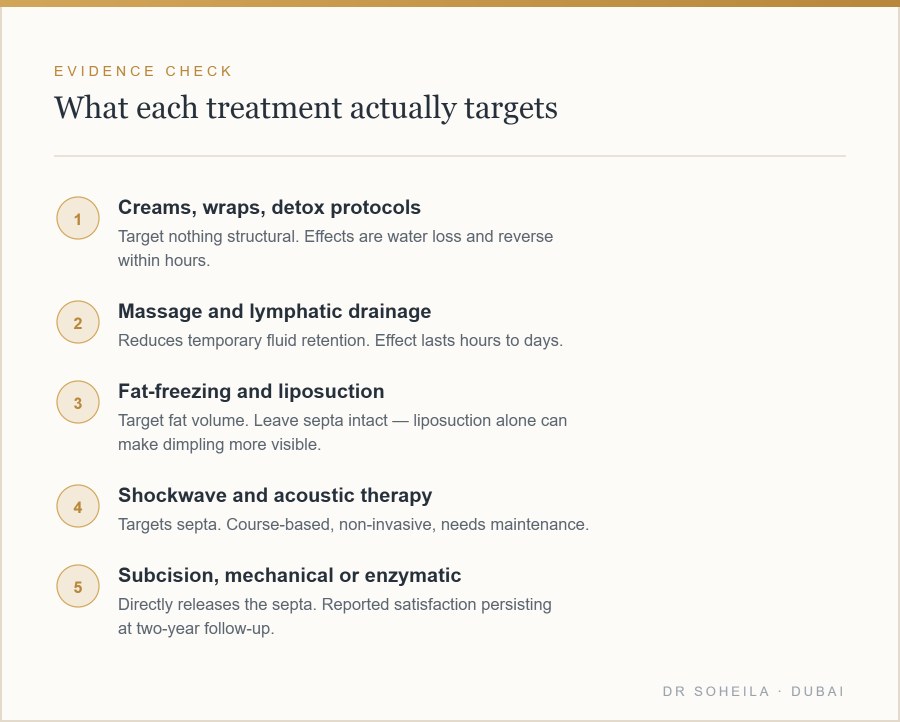
A microblade or needle is used to physically divide the tethering septa beneath each dimple. This is mechanical release of the structure causing the depression. Published data reports that after a single treatment with manual subcision, almost 80% of subjects were satisfied with their results, and that satisfaction persisted at two-year follow-up.
That two-year durability figure is unusually good for anything in this category and is the reason subcision-based approaches dominate the serious literature.
Acoustic subcision (rapid acoustic pulse)
A newer non-invasive approach that uses rapid acoustic pulses to physically shear the fibrous septa without breaking the skin. Histologic evidence from animal studies has shown that these pulses disrupt collagen fibres throughout the adipose septa, effectively resulting in disruption and possible subcision of the septa.
Multicentre clinical trial work has reported improvement in cellulite appearance and skin laxity after a single treatment visit, with long-term findings published from the same trials. Comparative work has looked at two different pulse rates for safety and efficacy.
Enzymatic subcision
Collagenase injected into the septa dissolves the collagen tethering the skin. This is chemical rather than mechanical release of the same structure. It requires multiple treatment visits and typically produces significant bruising.
Acoustic wave / shockwave therapy
A meta-analytic comparison of interventions found shockwave therapy emerging as a standout with a consistent cellulite reduction score of 2.07 ± 0.39 across four studies. It is non-invasive and requires a course of sessions, with maintenance needed to sustain results.
Laser and energy-based subcision
Devices that deliver thermal energy subdermally can achieve thermal subcision of septa and thermal lipolysis of adipocytes simultaneously. These are more invasive, generally performed under local anaesthesia, and have longer recovery.
What Does Not Work — Stated Plainly
This section exists because patients spend a great deal of money here.
| Approach | Why it disappoints |
|---|---|
| Anti-cellulite creams | Cannot reach or alter subcutaneous septa. Caffeine-based products produce brief dehydration of tissue, nothing structural |
| Lymphatic drainage massage | Pleasant and reduces temporary fluid retention. Effect lasts hours to days |
| Body wraps and detox protocols | Water loss. Reverses on rehydration. Cellulite is not a toxin problem |
| Fat-freezing devices | Designed to reduce fat volume, not release septa. May improve contour, minimal effect on dimpling |
| Liposuction alone | Removes fat between septa but leaves the septa intact. Can make dimpling more visible |
| Supplements and “cellulite diets” | No structural mechanism. General health benefits are real; cellulite-specific effect is not established |
Dr Soheila will tell patients directly when a treatment they are considering is unlikely to address their concern. That conversation costs the clinic a sale and saves the patient a course of sessions.
Grading: Why Your Starting Point Determines Your Outcome
Cellulite is graded clinically, and the grade predicts what is achievable.
| Grade | Presentation | Realistic expectation |
|---|---|---|
| 0 | Smooth at rest and on pinch | No treatment indicated |
| 1 | Smooth standing; dimpling on pinch or muscle contraction | Good response; conservative options reasonable |
| 2 | Visible dimpling standing, resolves lying down | Best candidates for septa-targeting treatment |
| 3 | Visible standing and lying, with laxity and deeper depressions | Improvement achievable; usually needs combined approach and laxity addressed separately |
The important variable at grade 3 is skin laxity. Releasing septa under lax skin improves the dimples but can leave the area looking softer. In these cases a tightening component is planned alongside, or the patient is counselled that surgical options may serve them better.
What Happens at Consultation
Dr Soheila assesses standing and lying, in consistent lighting, from multiple angles — this matters because cellulite appearance is highly position and lighting dependent, and casual bathroom-mirror comparisons are unreliable.
The assessment covers: grade, distribution, whether the depressions are discrete dimples or diffuse waviness, skin quality and laxity, subcutaneous fat volume, and weight stability. Standardised photographs are taken in fixed position and lighting so that the comparison at review is honest.
Medical history covers pregnancy plans, hormonal status, medications, bleeding tendency, and any previous body treatments.
The conversation about goals is the most important part. “Smoother” is achievable. “Completely smooth” generally is not, and a clinician who agrees to that target is setting up a disappointed patient.
Realistic Outcomes
Here is what the honest framing looks like:
- Discrete dimples respond best. A defined depression tethered by an identifiable septum is the ideal target for subcision-type treatment.
- Diffuse waviness responds less well. There is no single structure to release.
- Improvement is measured in degree, not elimination. Trial outcomes are reported as improvement in appearance scores, not as clearance.
- Durability varies by approach. Subcision-based results have been reported as persisting at two years. Non-invasive course-based treatments generally require maintenance.
- Weight stability matters. Significant weight gain after treatment will change the result.
Cellulite Treatment Cost in Dubai
Market rates in DHA-licensed clinics vary widely by modality:
- Acoustic wave / shockwave therapy: approximately AED 500 to AED 1,200 per session, with courses of six to twelve sessions typical
- Radiofrequency body contouring: approximately AED 800 to AED 2,000 per session, course-based
- Subcision-based treatment: approximately AED 4,000 to AED 15,000 depending on area size and number of dimples treated, usually as a single or limited number of visits
- Energy-based subdermal treatment: generally AED 10,000 and above, with anaesthesia and recovery costs to factor in
The comparison that matters is total cost of the plan against durability of the result, not per-session price. A course of twelve sessions at a low per-session rate requiring annual maintenance is not obviously cheaper than a single higher-cost treatment with multi-year durability. Dr Soheila will lay both out.
Risks and Recovery
By modality:
- Non-invasive acoustic and radiofrequency: transient redness and warmth, occasional mild bruising. No meaningful downtime.
- Manual or vacuum-assisted subcision: significant bruising for one to three weeks, swelling, tenderness, temporary firmness. Compression garments usually advised. Rare risks include haematoma, infection, and contour irregularity.
- Collagenase injection: bruising is very common and can be extensive. Injection-site pain and swelling expected.
- Energy-based subdermal treatment: the most involved recovery; local anaesthesia, swelling, bruising, and a period of restricted activity.
Contraindications across the category include pregnancy and breastfeeding, active infection at the site, bleeding disorders or anticoagulation without clearance, and unstable weight. Realistic-expectation screening is also a genuine part of candidate selection.
What Actually Helps Between Treatments
None of these remove cellulite. All of them meaningfully affect how it looks.
- Resistance training for glutes and legs. Improved muscle tone under the fat layer changes the surface contour. This is the highest-value non-clinical intervention and it is free.
- Weight stability. Cycling weight worsens both fat volume and skin quality.
- Hydration. Relevant in this climate, where dehydration is easy and affects skin quality.
- Adequate protein. Supports both muscle and dermal collagen.
- Not smoking. Smoking impairs dermal collagen and microcirculation.
- Skin quality treatments. Improving dermal thickness and firmness over the area modestly improves appearance.
Notably absent from that list: dry brushing, cupping, caffeine creams, and detox teas.
Questions to Ask Before You Commit
- What grade is my cellulite, and what does that predict for my result?
- Does this treatment target the fibrous septa, the fat, or the skin? Why is that the right target for me?
- What does the evidence show for durability of this specific approach?
- What is the total cost of the full plan, including any maintenance?
- How much downtime, and how much bruising, realistically?
- Can I see before-and-after images taken in identical position and lighting, standing?
- Is the clinician performing this DHA-licensed for it?
- What happens if I am not satisfied at review?
Treating With Dr Soheila
Dr Soheila Eskandari takes a deliberately conservative and evidence-led position on cellulite, which sometimes means telling a patient that the treatment they came in asking about is unlikely to help them.
The assessment establishes grade, distribution, and laxity first. Where the presentation is discrete dimples in reasonably firm skin, septa-targeting treatment is the evidence-supported route and expectations can be set confidently. Where the presentation is diffuse waviness with laxity, the honest conversation is about partial improvement and about whether the money is better directed at skin quality and muscle tone.
What Dr Soheila will not do is sell a twelve-session course to a patient whose anatomy predicts a poor response. Related reading on this site includes our guides to skin quality treatments and how the Dubai environment affects skin, both of which are relevant to the skin-quality half of the picture.
Frequently Asked Questions
What causes cellulite?
It is a structural feature of subcutaneous anatomy. Fibrous septa that anchor skin to underlying fascia run predominantly perpendicular in women, creating vertical fat columns that bulge between tethering points. It is not caused by toxins, and it is not primarily a weight problem.
Can exercise get rid of cellulite?
Exercise will not remove the septa causing the tethering, so it does not eliminate cellulite. Resistance training for the glutes and legs does improve the underlying muscle contour and often makes cellulite noticeably less visible. It is the highest-value thing you can do outside a clinic.
Which cellulite treatment has the best evidence?
Approaches that target the fibrous septa. Review work concludes these produce the most significant and durable improvement. Manual subcision data reports almost 80% satisfaction after a single treatment persisting at two years, and acoustic subcision trials report improvement after a single visit.
Do anti-cellulite creams work?
No, not structurally. They cannot reach or alter the subcutaneous septa. Caffeine-based products produce a brief tissue dehydration effect that can slightly reduce visibility for a few hours.
Will losing weight get rid of my cellulite?
It can reduce it somewhat by reducing the fat volume pushing between the septa, but it does not remove the tethering. Very lean women commonly still have cellulite. Weight stability is more useful than weight loss for maintaining a treatment result.
Is cellulite treatment painful?
It depends on the modality. Non-invasive acoustic and radiofrequency treatments are generally comfortable. Subcision approaches are performed with local anaesthesia and produce significant bruising for one to three weeks afterwards. Collagenase injections commonly cause extensive bruising.
How long do cellulite treatment results last?
Subcision-based results have been reported as persisting at two-year follow-up. Non-invasive course-based treatments such as shockwave generally require ongoing maintenance to sustain the effect.
Does liposuction remove cellulite?
No, and it can make it look worse. Liposuction removes fat between the septa while leaving the septa intact, which can make the tethering points more visible rather than less.
How much does cellulite treatment cost in Dubai?
It varies widely by modality — roughly AED 500 to AED 1,200 per session for shockwave courses, AED 4,000 to AED 15,000 for subcision-based treatment depending on the area, and AED 10,000 and above for energy-based subdermal approaches. Compare total plan cost against expected durability rather than per-session price.
Can men get cellulite treatment?
Yes, though cellulite is far less common in men because the septa are usually arranged in a criss-cross lattice rather than perpendicular columns. When men do present with it, the same assessment and treatment principles apply.
This article is general information about aesthetic treatments and is not medical advice, a diagnosis, or a treatment recommendation for any individual. Outcomes vary between patients and no result is guaranteed. All procedures carry risks that should be discussed with a licensed physician during a personal consultation. Dr Soheila Eskandari is licensed by the Dubai Health Authority. Prices quoted are general market ranges for information only and are not an offer.


 English
  Arabic