
Dermapen Microneedling in Dubai: Depth, Sessions and Real Results
Dermapen Microneedling in Dubai: Depth, Sessions and Real Results
Microneedling has a credibility problem, and it is not the treatment’s fault. The same word covers a physician-performed medical procedure at 1.5 mm depth and a home roller bought online for the price of a coffee. They are not the same thing, they do not produce the same results, and one of them can genuinely damage your skin.
This guide explains what medical microneedling with a device such as Dermapen actually does, what depth is used and why it matters, how many sessions the evidence supports, what it costs in Dubai, and — importantly for this climate — the specific aftercare that determines whether you get a good result or a pigmentation problem.
What Microneedling Actually Does
Microneedling is described in the dermatology literature as collagen induction therapy. A device drives very fine needles into the skin at a controlled depth and speed, creating thousands of microscopic channels.
The mechanism is a controlled wound-healing response. The micro-injuries trigger an inflammatory phase, which recruits growth factors, which drives fibroblast activity, which produces new collagen and elastin. This is dermal remodelling — the skin repairing itself using its own machinery rather than having a substance added to it.
Two things follow from that mechanism, and both are worth internalising:
- Results are gradual. Collagen remodelling takes weeks to months. The visible improvement after a session at week one is mostly hydration and mild swelling. The real change appears between weeks four and twelve.
- The micro-injuries do not scar. The channels are small enough and shallow enough that they heal without leaving marks — which is precisely why the technique works on scars rather than creating them.
Depth: The Single Most Important Variable
This is where medical microneedling separates from everything else, and where most treatment failures originate.
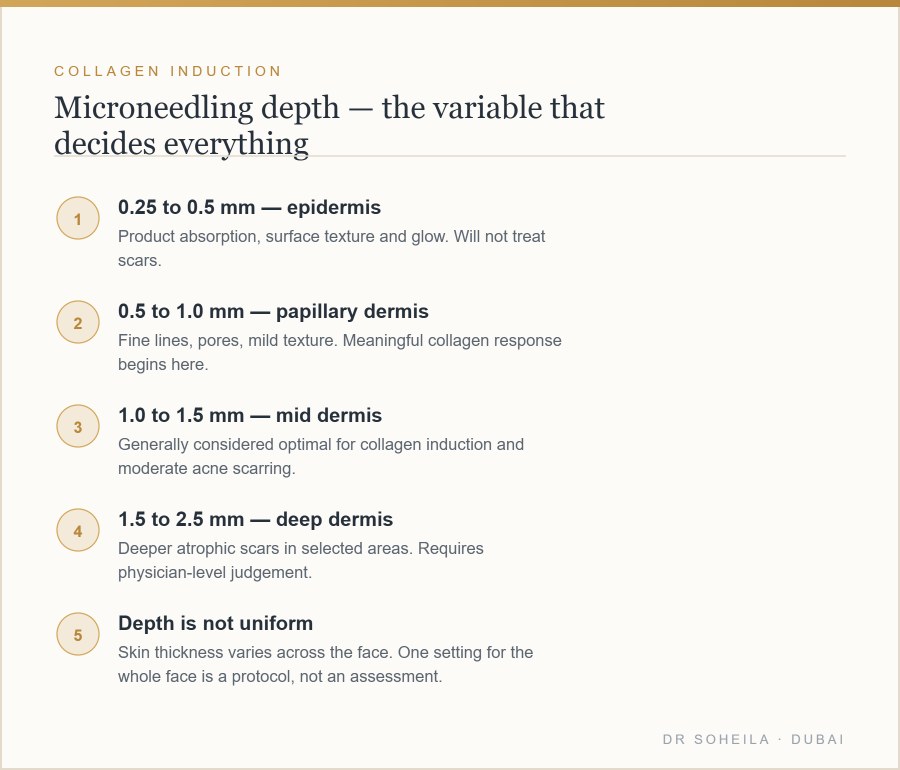
| Depth | Layer reached | What it is used for |
|---|---|---|
| 0.25–0.5 mm | Epidermis | Product absorption, surface texture, glow. Will not treat scars |
| 0.5–1.0 mm | Papillary dermis | Fine lines, pores, mild texture. Meaningful collagen response begins |
| 1.0–1.5 mm | Mid dermis | Considered optimal for collagen induction; moderate acne scarring |
| 1.5–2.5 mm | Deep dermis | Deeper atrophic scars in selected areas. Physician-level judgement required |
Studies have confirmed that needling in the 0.5 to 1.0 mm range produces meaningful collagen growth without the risks of going deeper, and that 1.0 to 1.5 mm is generally considered optimal for collagen induction. A split-face comparative study has specifically evaluated depth of penetration in the management of atrophic acne scars.
Critically, depth is not uniform across the face. Skin thickness varies substantially. Treating the thin skin over the temple or around the eye at the same depth used on a thick, scarred cheek is how you cause problems. Dr Soheila adjusts depth by zone within a single session — this is one of the practical differences between medical treatment and a fixed-setting protocol.
A separate point about home rollers: they use fixed needles that enter at an angle and drag as the roller turns, which tears rather than punctures. They are difficult to sterilise properly. In a climate where post-inflammatory pigmentation is common, the risk-to-benefit ratio is poor.
What Microneedling Treats Well — and What It Does Not
Good indications
- Atrophic acne scarring, particularly rolling and boxcar types. This is the strongest indication
- Enlarged pores and rough texture
- Fine lines, especially early crepiness on cheeks and around the mouth
- Surgical and traumatic scars — a systematic review has examined microneedling for anterior neck surgical scars, though it also identified evidence gaps
- Stretch marks, with realistic expectations
- General skin quality and firmness in patients not yet wanting injectables
Poor or wrong indications
- Ice-pick scars. These are narrow and deep. Microneedling reaches them poorly; techniques such as TCA CROSS or punch excision are more appropriate
- Deep volume loss. Collagen induction does not replace lost fat or bone support. That is a filler conversation
- Active acne. Needling through active inflammatory lesions spreads bacteria and worsens the picture. Control the acne first
- Significant skin laxity. Microneedling improves quality, not lift
- Active melasma. Handle with real caution — see below
The Melasma Warning That Matters in Dubai
Microneedling triggers inflammation by design. In skin that is prone to post-inflammatory hyperpigmentation — which describes a large proportion of the population here — that inflammation can produce exactly the pigment problem the patient was trying to fix.
This does not mean microneedling is off the table in darker skin types. It means:
- Skin should be prepared with topicals and photoprotection before starting
- Depth and pass count should be conservative on the first session
- Sun exposure must be genuinely avoided for at least a week afterwards, not loosely reduced
- Active melasma is usually treated with a different approach first — our guide to pigmentation mesotherapy covers what that looks like
Dr Soheila will frequently sequence treatments rather than run them in parallel: settle the pigment, then remodel the texture. Patients sometimes find this frustrating. It is also why their results hold.
How Many Sessions the Evidence Supports
Published protocols vary, and the honest answer depends on what is being treated.
- Skin quality and fine lines: three to four sessions, four weeks apart, is a common and reasonable course
- Moderate acne scarring: studies have used six sessions at two-week intervals. Three to five monthly or biweekly treatments is another commonly cited protocol
- Deeper scarring: partial improvement is the realistic expectation, and six to eight or more sessions may be needed — often combined with other modalities rather than microneedling alone
The word “partial” is doing important work in that last line. Deep scars respond incompletely to microneedling in the published literature. A clinic that promises full resolution of deep atrophic scarring with a needling package is overselling.
What Happens at the Appointment
Before
Skin is assessed and photographed under consistent lighting. Dr Soheila will ask about isotretinoin use (a course within the last six months usually means waiting), keloid tendency, cold sore history (prophylactic antivirals may be needed for perioral treatment), and current actives. Retinoids and acids are usually paused for several days beforehand.
During
Numbing cream for 30 to 45 minutes — this is a longer wait than most treatments and it makes a real difference to comfort. The skin is cleansed and disinfected thoroughly. The device is passed over each zone in a systematic pattern at the depth chosen for that zone, usually in two directions.
Treatment takes 20 to 40 minutes depending on area. The endpoint is uniform erythema with pinpoint bleeding — a controlled, expected finding, not a complication.
A sterile serum may be applied during or immediately after treatment while channels are open. Hyaluronic acid is the safest and most common choice. What should never be applied is a product not formulated for open channels — regular skincare, essential oils, or anything with fragrance. This is a real risk in non-medical settings.
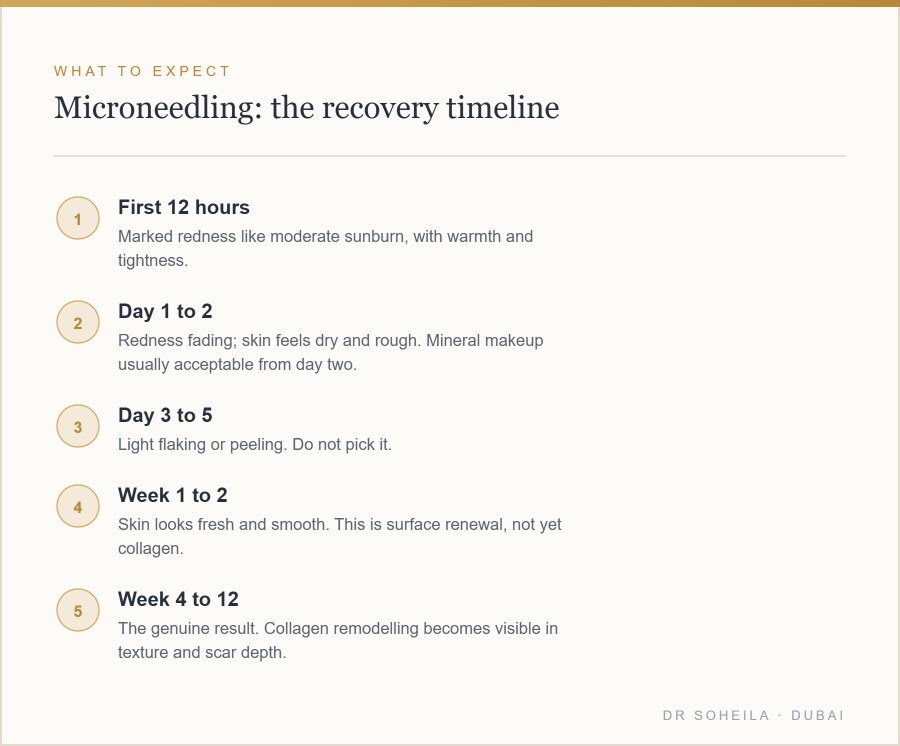
After: the recovery timeline
| Time | What to expect |
|---|---|
| First 12 hours | Marked redness like moderate sunburn; warmth and tightness |
| Day 1–2 | Redness fading; skin feels dry and rough. Mineral makeup usually acceptable from day 2 |
| Day 3–5 | Light flaking or peeling. Do not pick it |
| Week 1–2 | Skin looks fresh and smooth. This is surface renewal, not yet collagen |
| Week 4–12 | The genuine result. Collagen remodelling becomes visible in texture and scar depth |
Aftercare rules
- Zero sun for at least seven days. In Dubai this needs planning — hat, shade, and SPF 50 from day two onwards. This is the single most important rule
- No makeup for 24 hours; mineral makeup only for the first few days
- No retinoids, acids, or vitamin C for five to seven days
- No gym, sauna, steam, hot yoga, or swimming pool for 48 to 72 hours — sweat and chlorine in open channels invite infection
- Cleanse with lukewarm water and a bland cleanser only, for the first 48 hours
- Do not pick or exfoliate flaking skin
- Contact the clinic for spreading redness, pustules, increasing pain, or fever
Microneedling With Radiofrequency, PRP, or Neither
Several variants are offered in Dubai, and the differences are worth understanding before you pay a premium for a name.
- Standard microneedling. Mechanical injury only. Best-studied, lowest cost, shortest downtime, safest in darker skin types.
- Microneedling with PRP. Platelet-rich plasma from your own blood is applied topically or injected. The theoretical case is added growth factors. Evidence is mixed and preparation methods vary widely between clinics, which limits how comparable the studies are.
- Radiofrequency microneedling. Insulated needles deliver RF energy into the dermis. Adds a thermal tightening component and treats laxity better than needling alone. Also carries more heat, which means more caution in pigment-prone skin, and it costs considerably more.
Dr Soheila’s general position is that standard microneedling at a correct depth, performed as a proper course with proper aftercare, outperforms a single session of a premium variant done poorly. The variable that most reliably determines the result is technique and adherence, not the add-on.
Cost in Dubai
Market rates in DHA-licensed clinics generally run:
- Standard microneedling, full face: approximately AED 800 to AED 1,800 per session
- With PRP: approximately AED 1,500 to AED 3,000 per session
- Radiofrequency microneedling: approximately AED 2,500 to AED 5,000 per session
Courses are usually packaged at a reduced per-session rate. Since three to six sessions is the norm, the course price is the number that matters — compare on that basis rather than on a single-session headline.
Things worth confirming before you pay: whether the needle cartridge is single-use and opened in front of you (it should be), who performs the treatment, whether depth is adjusted by facial zone, and whether a review is included. Our article on how aesthetic pricing works in Dubai explains what sits behind the numbers generally.
Risks and Contraindications
Expected: redness, dryness, flaking, temporary sensitivity, occasional pinpoint bruising.
Uncommon: infection (usually related to poor sterility or breaking aftercare rules), prolonged erythema, milia, and post-inflammatory hyperpigmentation.
Avoid or defer treatment with: active acne or skin infection in the area, active eczema or psoriasis at the site, keloid scarring tendency, recent isotretinoin, uncontrolled diabetes, bleeding disorders or anticoagulation without physician clearance, pregnancy, and any undiagnosed changing skin lesion.
A Realistic Decision Guide
- Name your target. Scars, texture, pores, and laxity are different problems with different answers. Microneedling is strong on the first three and weak on the fourth.
- Check your pigment history. If you mark easily after spots or injuries, say so. It changes the protocol.
- Check the calendar. You need a week of genuine sun avoidance after each session. Book accordingly.
- Budget for the course. One session will not do it. If you can only afford one, spend the money on something else.
- Ask about depth. If the answer is a single number for the whole face, ask why.
- Confirm single-use cartridges and DHA licensing.
Treating With Dr Soheila
Dr Soheila Eskandari performs medical microneedling in Dubai under DHA licence, with depth selected per facial zone and per indication rather than by protocol. For patients with acne scarring, the assessment starts with scar type — because if the scars are predominantly ice-pick, needling is not the right primary treatment and saying so is more useful than selling a course.
For patients with pigment-prone skin, treatment is preceded by preparation and photoprotection, and the first session is deliberately conservative. Aftercare is discussed properly rather than handed over as a leaflet, because in this climate the aftercare is not a formality — it is the difference between a good result and a new problem.
Related reading: Profhilo and skin boosters address hydration and skin quality through a different mechanism and are often combined with needling courses, and Rejuran versus Profhilo covers the regenerative injectable options that frequently come up in the same conversation.
Frequently Asked Questions
How many microneedling sessions do I need for acne scars?
Published studies have used six sessions at two-week intervals for atrophic acne scars, and three to five monthly or biweekly treatments is another commonly cited protocol. Deeper scars typically show only partial improvement and may need six to eight or more sessions, often combined with other techniques.
What needle depth is used?
1.0 to 1.5 mm is generally considered optimal for collagen induction. 0.5 to 1.0 mm produces meaningful collagen response with lower risk and suits texture and fine lines. Depth should vary across the face because skin thickness varies — a single setting for the whole face is a sign of a protocol-driven rather than assessment-driven treatment.
Does microneedling hurt?
With 30 to 45 minutes of numbing cream, most patients find it tolerable — a scratching or vibrating sensation rather than sharp pain. Bonier areas such as the forehead and jawline are more uncomfortable than cheeks.
How long is the downtime?
Marked redness for around 12 to 24 hours, fading over two to three days, sometimes with light flaking on days three to five. Most people are comfortable in public from day two with mineral makeup.
When will I see results?
Surface glow appears within a week or two. The genuine collagen-driven improvement in texture and scar depth develops between weeks four and twelve, and continues building across a course.
Is microneedling safe for darker skin tones?
Generally yes, and it avoids the thermal injury that makes some laser treatments risky in higher Fitzpatrick types. But it does cause inflammation, so post-inflammatory hyperpigmentation is a real risk. Preparation, conservative first settings, and strict sun avoidance afterwards are essential.
Can I do microneedling if I have melasma?
With caution and usually not as the first treatment. Melasma is inflammation-sensitive and needling can worsen it. Most protocols settle the pigment first with a different approach and address texture afterwards.
Are home microneedling rollers worth it?
They are a different and riskier proposition. Fixed rollers enter at an angle and drag rather than puncture cleanly, they are hard to sterilise properly, and they do not reach useful depths. In a high-UV climate with pigment-prone skin, the risk-to-benefit ratio is poor.
Can I exercise after microneedling?
Not for 48 to 72 hours. Sweat, heat, and gym surfaces are an infection risk while the micro-channels are still closing, and heat can prolong redness.
How much does microneedling cost in Dubai?
Standard full-face microneedling generally ranges from AED 800 to AED 1,800 per session in DHA-licensed clinics, with PRP variants around AED 1,500 to AED 3,000 and radiofrequency microneedling around AED 2,500 to AED 5,000. Since courses of three to six sessions are standard, compare on total course price.
This article is general information about aesthetic and dermatological treatments and is not medical advice, a diagnosis, or a treatment recommendation for any individual. Outcomes vary between patients and no result is guaranteed. All procedures carry risks that should be discussed with a licensed physician during a personal consultation. Dr Soheila Eskandari is licensed by the Dubai Health Authority. Prices quoted are general market ranges for information only and are not an offer.


 English
  Arabic