
Non-Surgical Skin Tightening in Dubai: What the Devices Can and Cannot Do
Non-Surgical Skin Tightening in Dubai: What the Devices Can and Cannot Do
Non-surgical skin tightening is the treatment patients most often arrive hoping will replace a facelift. It will not, and the gap between that hope and what the devices deliver is where most dissatisfaction in this category comes from.
That is not an argument against the technology. Used in the right patient it produces a genuine, if modest, improvement with almost no downtime. It is an argument for being specific about how much change to expect, and for saying clearly when someone falls outside the range these devices can help.
How the Two Main Families Work
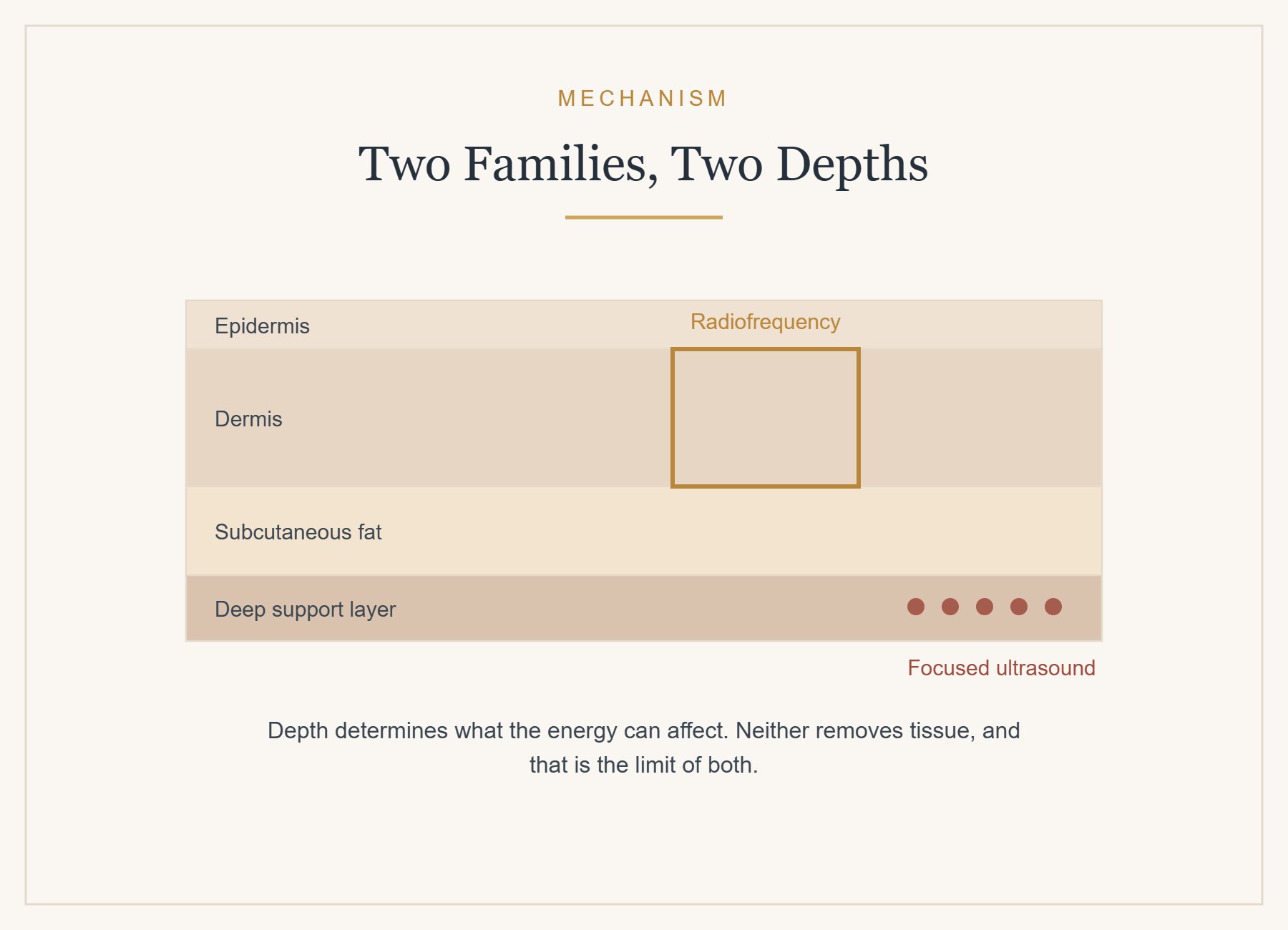
Both work the same way in principle: deliver controlled heat into the dermis, provoke a wound-healing response, and get the body to lay down new collagen over the following months. The difference is depth and precision.
Focused ultrasound concentrates ultrasound energy at a precise depth, creating small discrete points of thermal coagulation. Because the depth is controlled, it can reach the deeper support layer — the same fibromuscular layer a surgeon works with — as well as the dermis. That is its distinguishing claim.
Radiofrequency passes current through tissue, which resists it and heats up. The heating is more diffuse and generally shallower. Microneedling radiofrequency delivers the energy through insulated needles at a set depth, which gives more control than surface radiofrequency.
In practice, focused ultrasound is aimed at structural laxity while radiofrequency works more on skin quality and superficial tightening. Neither removes tissue, and that is the fundamental limit of both.
How Much Change Is Realistic
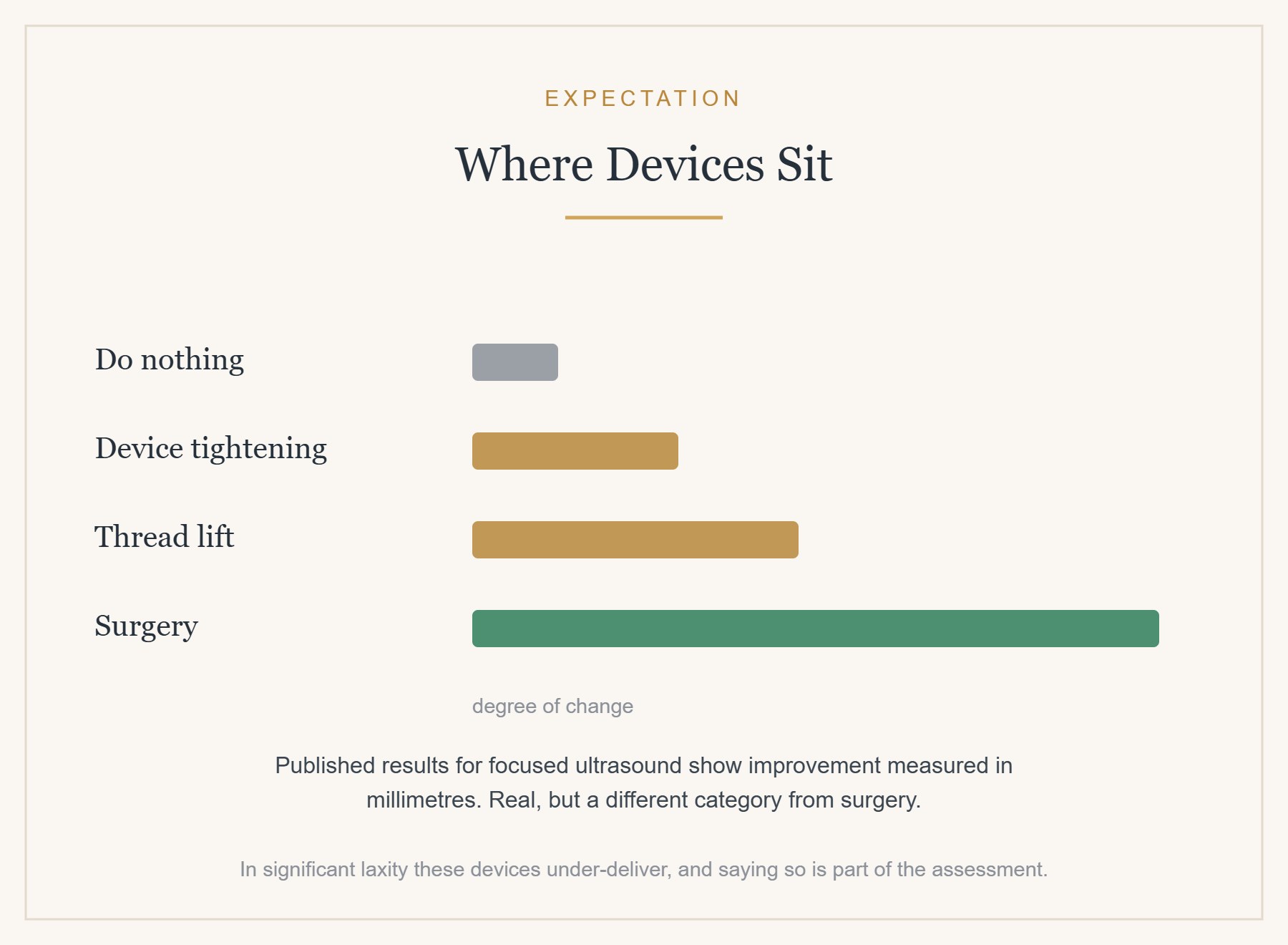
Published work on focused ultrasound reports measurable improvement in brow position and jawline definition — typically on the order of a few millimetres, assessed by standardised photography and blinded reviewers.
A few millimetres is a real effect. It is also considerably less than most patients picture when they hear the word “lift”. The honest framing is that these devices soften early laxity and improve definition slightly; they do not reposition a face.
Set against a facelift, which addresses the deeper layer surgically and removes excess skin, the difference is one of category rather than degree. A patient choosing between them is not choosing between a smaller and a larger version of the same thing.
The Timeline
Because both work through collagen synthesis, nothing much happens immediately. Early improvement appears around six to eight weeks, and the fullest effect at three to six months.
This matters for expectation-setting in a specific way: patients who assess at two weeks conclude it did not work, and patients who book it a fortnight before an event get no benefit for that event.
How Long It Lasts
Roughly a year to eighteen months. The collagen produced is genuine but it ages like the rest, and the underlying process that caused the laxity continues.
That recurring cost belongs in any comparison with surgery. A device treatment repeated annually over five years is a substantial cumulative sum, and for some patients the arithmetic favours a single procedure — a calculation better done at the start than after the third round.
Who It Suits, and Who It Does Not
Good candidates have mild to moderate laxity, reasonable skin thickness, and want a subtle improvement in jawline definition or brow position. They are often in their late thirties to fifties, and they understand the result is gradual and temporary.
It also suits patients who are not ready for surgery and want to slow the trajectory rather than reverse it.
Poor candidates have significant laxity, heavy jowls or substantial excess skin. In that group the change is too small relative to the problem, and money spent annually produces persistent disappointment. Very thin skin and a history of keloid scarring warrant caution.
Being told you are not a good candidate is a sign of a sound assessment. The alternative — being treated anyway — produces a patient who concludes the technology does not work, when in fact it was never the right tool for them.
Laxity Is Not Volume Loss
This confusion is common enough to deserve its own paragraph. As facial fat compartments deflate with age, the overlying skin appears to descend and the face reads as sagging. But the underlying problem is lost support, not a loose envelope.
Tightening the skin over a deflated structure does not restore shape. Volume replacement does. A patient whose real issue is deflation who is treated with a tightening device gets very little, and concludes the device failed.
Distinguishing them is an examination finding, and it is covered further in the guide to non-surgical face contouring.
What Treatment Involves
Focused ultrasound uses a handpiece with different transducers for different depths. The practitioner maps the area and delivers lines of energy across it, often using imaging to confirm depth. A full face and neck typically takes forty-five to ninety minutes.
It is felt — brief deep heat and occasionally a sharp sensation at each line, particularly over bone. Most patients take oral pain relief beforehand and describe it as uncomfortable but manageable. The discomfort ends when the treatment does.
Radiofrequency is generally comfortable, often described as a warm massage. Microneedling radiofrequency sits between the two and uses topical anaesthetic.
Recovery
Minimal for both. Redness and mild swelling for a few hours to a day is usual. After focused ultrasound, tenderness to touch over the treated area commonly persists for one to two weeks, and small areas of numbness or tingling are occasionally reported and settle.
Uncommon but reported effects include temporary nerve irritation producing weakness in a small area of facial movement, which resolves, and — rarely, with poor technique or inappropriate settings — small areas of fat loss where energy was delivered at the wrong depth.
Questions Worth Asking
Because outcomes depend heavily on selection and settings rather than on brand, a few questions are genuinely informative.
Am I a good candidate, and what degree of change should I expect? An answer in specific terms — subtle improvement in jawline definition over three months — is a better sign than an answer about how advanced the device is.
How many lines or passes will be used? Under-treating is a real phenomenon in a market where treatments are discounted. The number of lines delivered is what the cost should reflect.
What would surgery achieve in my case? A practitioner willing to describe that honestly, including when it is the better option, is giving you the information you need.
Deeply discounted device treatments are worth scrutiny. The consumable cost is largely fixed, so a very low price usually means fewer lines delivered — a smaller treatment at a smaller price rather than a bargain.
Costs in Dubai
Market rates vary widely with device and area, generally from around AED 2,500 to AED 8,000 for a full-face session, with face and neck at the upper end. Microneedling radiofrequency is usually sold as a course of three sessions.
Because maintenance is roughly annual, comparing cost per year against the alternatives is more informative than comparing single-session prices.
The Short Version
Non-surgical tightening produces a modest, gradual improvement in mild to moderate laxity that appears over three to six months and lasts around a year to eighteen months. In the right patient that is worthwhile and carries almost no downtime.
It is not a facelift, it does not address volume loss, and in significant laxity it under-delivers. The most useful thing an assessment can tell you is which of those situations you are in — and a practitioner who tells you the device is not right for you is giving you better value than one who books you in.
Where These Devices Fit Alongside Everything Else
Skin tightening is rarely the whole answer, and understanding what it sits next to prevents both over-promising and under-using it.
Against threads. Threads reposition tissue mechanically and immediately; devices stimulate collagen gradually. Threads give a visible change on the day that settles over weeks; devices give nothing on the day and build over months. In mild laxity either can be reasonable, and neither handles significant laxity.
Against filler. These treat different problems and are frequently combined. Restoring volume first and then assessing whether tightening adds anything is usually the better order, because a deflated face treated with tightening alone tends to look tighter but no less hollow.
Against biostimulators. Collagen biostimulators also work by provoking the patient’s own collagen, but they are injected and act diffusely through the treated area rather than at a targeted depth. There is genuine overlap, and the choice often comes down to how much of the concern is laxity versus general skin quality.
Against surgery. The honest comparison is cost per year against degree of change. A device treatment repeated annually for five years against a single procedure lasting a decade is a calculation worth doing with real numbers rather than avoiding.
The Maintenance Question
Because the effect fades over roughly a year to eighteen months, anyone starting this is starting a recurring commitment rather than buying a result.
That is not inherently a problem — it suits patients who want to slow a trajectory without a procedure, and it fits a budget spread over time rather than concentrated. But it should be understood at the outset, not discovered at month fourteen.
A reasonable framing: if maintaining your current jawline definition over the next five years counts as a good outcome, this category can deliver that. If the goal is to look meaningfully different from how you look now, it cannot.
Frequently Asked Questions
How much lift can a device realistically give?
A modest one. Published results for focused ultrasound show measurable but small improvement in brow and jawline position, typically a few millimetres. It is a softening of early laxity rather than a lift, and expectations set against a facelift will not be met.
What is the difference between HIFU and radiofrequency?
Focused ultrasound delivers energy to precise depths including the deeper support layer, producing discrete points of thermal coagulation. Radiofrequency heats the dermis more diffusely. In practice ultrasound targets deeper structural laxity and radiofrequency works more on skin quality and superficial tightening.
When will I see results?
Both work by stimulating collagen, so the change is gradual. Early improvement appears around six to eight weeks, with the fullest effect at three to six months. Anyone expecting a visible difference the same week will be disappointed.
How long does it last?
Typically around a year to eighteen months, because the underlying ageing process continues. Maintenance treatment is usually discussed annually, and that recurring cost belongs in the comparison with a one-off surgical option.
Is it painful?
Focused ultrasound is felt as brief deep heat at each line of treatment and is the more uncomfortable of the two; most patients tolerate it with pain relief taken beforehand. Radiofrequency is generally described as a warm massage and is comfortable.
Is there downtime?
Minimal for both. Redness and mild swelling for a few hours to a day is usual. Tenderness to touch over the treated area can persist for one to two weeks with ultrasound, and occasional small areas of numbness are reported.
Who is not a good candidate?
Anyone with significant laxity, heavy jowls or substantial excess skin. In that group devices deliver a change too small to justify the cost, and a surgical consultation gives a more honest picture. Very thin skin and a history of keloid scarring also warrant caution.
Does it help with volume loss?
No, and confusing the two is common. Deflation of the facial fat compartments makes skin appear to descend, but the underlying problem is lost support. Tightening the envelope over a deflated structure does not restore shape; volume replacement does.
Are the results permanent?
No. The collagen produced in response to treatment is real but it is subject to the same ageing process as the rest, so the effect fades over roughly a year to eighteen months. Permanent change to skin laxity requires removing skin, which is surgery.
What does it cost in Dubai?
Market rates vary widely with the device and the area, generally from around AED 2,500 to AED 8,000 for a full-face session. Because maintenance is roughly annual, comparing cost per year against alternatives is more informative than comparing single-session prices.
This article is general information about aesthetic and dermatological treatments and is not medical advice, a diagnosis, or a treatment recommendation for any individual. Outcomes vary between patients and no result is guaranteed. Prescription medications carry risks and contraindications that must be assessed by a licensed physician during a personal consultation. Dr Soheila Eskandari is licensed by the Dubai Health Authority. Prices quoted are general market ranges for information only and are not an offer.


 English
  Arabic