
Baby Botox in Dubai: Softer Results, Natural Movement and the Trade-Offs
Baby Botox in Dubai: Softer Results, Natural Movement and the Trade-Offs
“Baby Botox” has become one of the most searched terms in aesthetic medicine, usually by people who want to look fresher without looking treated. The name suggests a special product. It is not one: it describes a way of using an ordinary botulinum toxin, with smaller doses spread more carefully, so that the face keeps more of its natural movement.
Done well, it produces exactly the soft, rested result many people are hoping for. It also comes with trade-offs that are rarely mentioned in the marketing, and it suits some faces far better than others.
What Baby Botox Actually Means
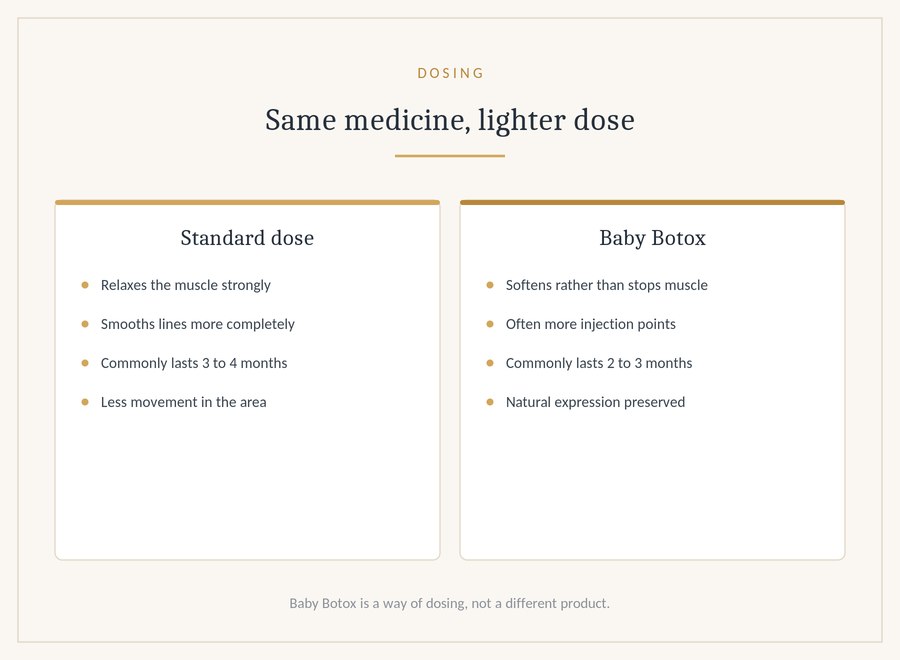
A standard treatment uses a dose designed to relax the targeted muscle strongly, which smooths lines well but can reduce expression noticeably. Baby Botox uses a lower dose, often spread across more injection points, so the muscle is softened rather than stopped.
The product is the same botulinum toxin used in any treatment — Botox, Dysport or another approved toxin. The differences between those products are set out in the guide to Botox versus Dysport. What changes in baby Botox is the dose and the pattern, not the medicine.
There is no fixed definition. Some practitioners use roughly half to two-thirds of their usual dose; others adjust area by area. The principle is the same: less effect, more movement.
Not the Same as Micro-Botox
Micro-Botox — sometimes called micro-tox or skin Botox — is a different technique. Very diluted toxin is injected as tiny droplets into the skin itself rather than the muscle, aiming to reduce oil, pore visibility and fine crepey texture. It is sometimes confused with baby Botox, but its goal and method are different.
Who It Suits
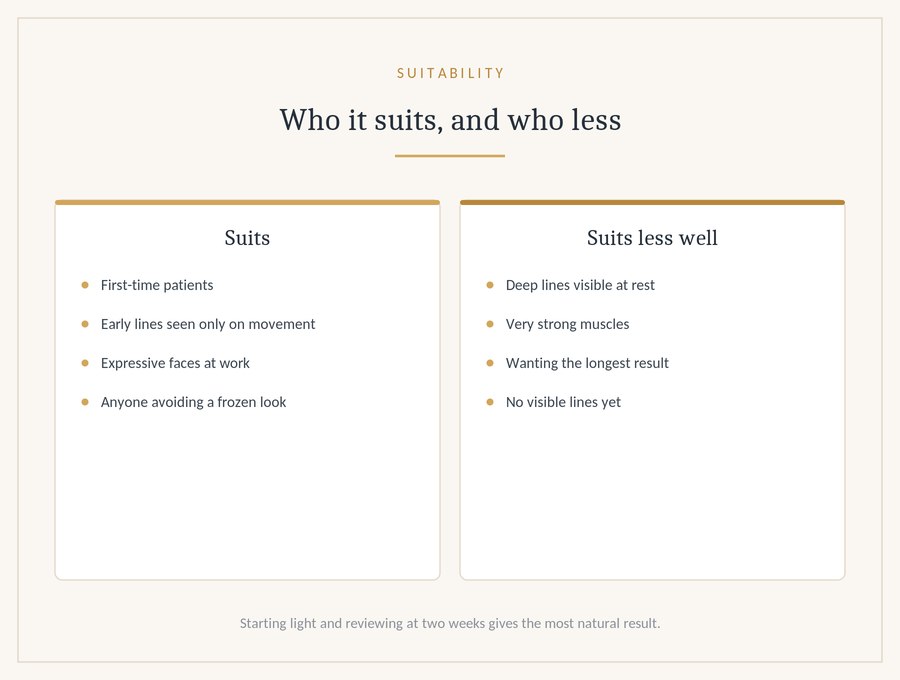
First-time patients. A lighter first treatment lets someone see how their face responds before committing to a stronger dose.
People with early, fine expression lines. Lines that appear only when the face moves respond well to a softer dose.
People who rely on expression. Presenters, performers and anyone whose work depends on an expressive face often prefer the trade-off of more movement.
People who dislike a “frozen” look. For many patients, keeping some movement matters more than erasing every line.
Who It Suits Less Well
Deep lines visible at rest. Lines etched into the skin even when the face is relaxed need more than a light dose, and often need skin treatments or filler as well.
Strong muscles. A powerful frown or forehead muscle may barely respond to a small dose.
Someone wanting the longest possible result. Lower doses generally wear off sooner, as discussed below.
The Trade-Offs
Shorter duration. A lighter dose tends to wear off sooner — commonly after two to three months rather than three to four — so treatments may be more frequent.
Lines may still show on strong expressions. That is the intention, but it surprises people who expected a completely smooth result.
Cost is not necessarily lower. Because the injector’s time and skill are the main part of the price, baby Botox often costs about the same per area as a standard treatment, and more frequent sessions can make it more expensive over a year.
Top-ups are more common. Starting light means some people need a small addition at the two-week review — which is often the most reliable route to a natural result.
Does “Preventative” Botox Work?
Baby Botox is often marketed to people in their twenties as a way to prevent wrinkles forming. The theory is reasonable: lines that form from repeated folding may deepen less if the folding is reduced. Some small studies and long-term observations are consistent with this.
The evidence, however, is limited, and nobody needs to start treatment early to avoid future lines. Sun protection, not smoking and good skincare do more for long-term skin ageing than early toxin. For a young person with no visible lines, the honest answer is often that treatment is not needed yet.
Common Areas
Forehead. The most common area for a light touch, balanced carefully against the frown muscles to avoid a heavy brow. The area is covered in detail in the guide to forehead Botox.
Frown lines. A lighter dose softens the scowl while keeping some expression.
Crow’s feet. Softening the outer eye lines while preserving a natural smile.
Brow lift. Small doses at specific points can lift the tail of the brow slightly.
Lip flip. A very small dose that lets the upper lip roll out subtly, discussed in the guide to the lip flip.
Safety and Side Effects
The risks are the same as for any botulinum toxin treatment: small bumps and redness at injection points, bruising, occasionally a headache, and less commonly a heavy brow, eyelid droop or asymmetry if the product affects a nearby muscle. Lower doses may reduce the chance of heaviness, but they do not remove the need for careful placement.
Treatment is avoided in pregnancy and breastfeeding, in certain neuromuscular conditions, and alongside some medications. A full medical history is part of every consultation.
What to Expect From the Appointment
A consultation assesses how your face moves, which lines are dynamic and which are visible at rest, and what you want to keep. The injections take only minutes. Effects begin within a few days and are judged at around two weeks, when a small top-up can be added if needed.
Planning the next appointment around your own response — rather than a fixed calendar — keeps the dose as light as possible while maintaining the result you like.
Cost in Dubai
Market rates generally run from around AED 600 to AED 1,500 per area, often similar to standard treatment. Because results may last a little less, the yearly cost can be comparable or higher. The broader pricing picture is set out in the guide to Botox prices in Dubai.
Planning a First Treatment
A first baby Botox appointment is best treated as a test of how your face responds. Starting light, reviewing at two weeks and adding a small amount only if needed gives a far better sense of the right dose than trying to guess it perfectly the first time.
It helps to arrive with a clear idea of what bothers you. Some people are troubled by frown lines that make them look cross; others by forehead lines in photographs; others by crow’s feet when they smile. Treating the lines that genuinely bother you, rather than every possible area, keeps the result natural and the cost sensible.
Photographs taken before treatment and at the review make comparison objective. Memory is unreliable, and it is common to forget how strong a line looked before treatment.
Keeping the Result Natural Over Time
Allow the effect to fade before retreating. Repeating treatment before the previous dose has worn off can gradually build a stronger effect than intended, and short intervals are thought to increase the small risk of developing resistance.
Keep a record of doses and areas. Knowing exactly what was used last time — the product, the units and the points — makes each treatment more precise.
Reassess rather than repeat. Faces change with time. The dose that suited you two years ago may not be the right one now.
Signs the Dose Needs Adjusting
If lines are still clearly visible on normal expressions at the two-week review, the dose may have been too light for your muscles. If the brow feels heavy, the forehead feels tight or expressions feel limited, the dose or placement may have been too strong. Both are useful information for next time, and a light starting dose makes the second situation much less likely.
Combining It With Skin Treatments
A light toxin dose softens movement, but it does nothing for skin quality. Fine lines that remain at rest, dullness and uneven texture respond to skin treatments instead — skin boosters, gentle peels or microneedling — and combining the two often produces a fresher result than a stronger toxin dose would.
The treatments are usually spaced a week or two apart rather than given on the same day, so that any swelling from skin treatment does not affect where the toxin settles, and so that the effect of each can be judged separately. Daily sun protection supports both, and is the single most effective step for keeping fine lines from deepening.
The Short Version
Baby Botox is a lighter way of using an ordinary toxin: lower doses, often more injection points, and a softer result that keeps natural movement. It suits first-timers, early expression lines and anyone who dislikes a frozen look. It tends to wear off sooner, lines may still show on strong expressions, and it is not usually cheaper.
Claims that it prevents future wrinkles have limited evidence. A good result depends on assessing how your face moves and adjusting at a two-week review rather than on the label.
Questions Worth Asking
How will you adjust the dose for my face? The answer should relate to your muscles and goals.
How long should I expect it to last? A realistic answer mentions that lighter doses may wear off sooner.
Is there a review at two weeks? Starting light and adjusting is the safest route to a natural result.
Do I actually need treatment yet? A practitioner willing to say no is giving good advice.
Frequently Asked Questions
What is baby Botox?
A technique that uses lower doses of an ordinary botulinum toxin, often across more injection points, to soften muscles rather than stop them. It is a way of dosing, not a different product.
How is it different from regular Botox?
The medicine is the same; the dose and pattern differ. Baby Botox aims to keep more natural movement, while a standard dose relaxes the muscle more strongly and smooths lines more completely.
How long does baby Botox last?
Commonly around two to three months, often a little shorter than a standard dose. Duration varies with muscle strength and the dose used.
Is baby Botox cheaper?
Not usually. Pricing is often similar per area, and because results may wear off sooner, the yearly cost can be comparable or higher.
Does it prevent wrinkles?
The idea is plausible and some evidence is consistent with it, but it is limited. Sun protection and good skincare do more for long-term ageing, and nobody needs to start early to avoid future lines.
Will I still be able to move my face?
Yes, that is the purpose. Expression is softened rather than removed, so some lines may still show on strong expressions.
What age is suitable?
It depends on the skin rather than the age. People with early lines that appear only on movement often suit it; for someone with no visible lines, treatment may not be needed yet.
Is micro-Botox the same thing?
No. Micro-Botox injects very diluted toxin into the skin itself to reduce oil and pore visibility, rather than into the muscle.
Are the side effects different?
They are the same as any toxin treatment — bumps, bruising, occasional headache and, less commonly, heaviness or asymmetry. Lower doses may reduce heaviness but careful placement still matters.
What does it cost in Dubai?
Market rates generally run from around AED 600 to AED 1,500 per area, often similar to standard treatment.
This article is general information about aesthetic and dermatological treatments and is not medical advice, a diagnosis, or a treatment recommendation for any individual. Outcomes vary between patients and no result is guaranteed. Prescription medications and injectable products carry risks and contraindications that must be assessed by a licensed physician during a personal consultation. Dr Soheila Eskandari is licensed by the Dubai Health Authority. Prices quoted are general market ranges for information only and are not an offer.


 English
  Arabic