
Vitamin C IV Drip in Dubai: What It Does, What It Does Not, and the Safety Checks
Vitamin C IV Drip in Dubai: What It Does, What It Does Not, and the Safety Checks
Vitamin C drips are among the most requested wellness treatments in Dubai, usually under names that promise glow, radiance or brightness. The appeal is easy to understand: vitamin C is genuinely important for skin, and a drip sounds like a faster and stronger way to get it.
The honest picture is more nuanced. Vitamin C matters for skin, and an infusion does reach blood levels that tablets cannot. What remains uncertain is how much that extra vitamin C changes the skin of someone who is not deficient. This article sets out what is known, what is not, and the safety checks that should come before any infusion.
What Vitamin C Does in the Skin
Vitamin C, or ascorbic acid, has several well-established roles.
Collagen production. The enzymes that build and stabilise collagen need vitamin C to work. This is why severe deficiency causes fragile skin, poor wound healing and easy bruising.
Antioxidant protection. It neutralises some of the reactive molecules produced by sun exposure and pollution, which contribute to skin ageing.
Pigment regulation. It can interfere with one of the steps in melanin production, which is the basis of its use in brightening skincare.
Most of the strong evidence for skin benefit comes from topical vitamin C — serums applied to the skin — where studies show improvement in sun damage, fine lines and uneven tone. Evidence for intravenous vitamin C improving the skin of healthy people is far thinner.
Why an Infusion Rather Than Tablets
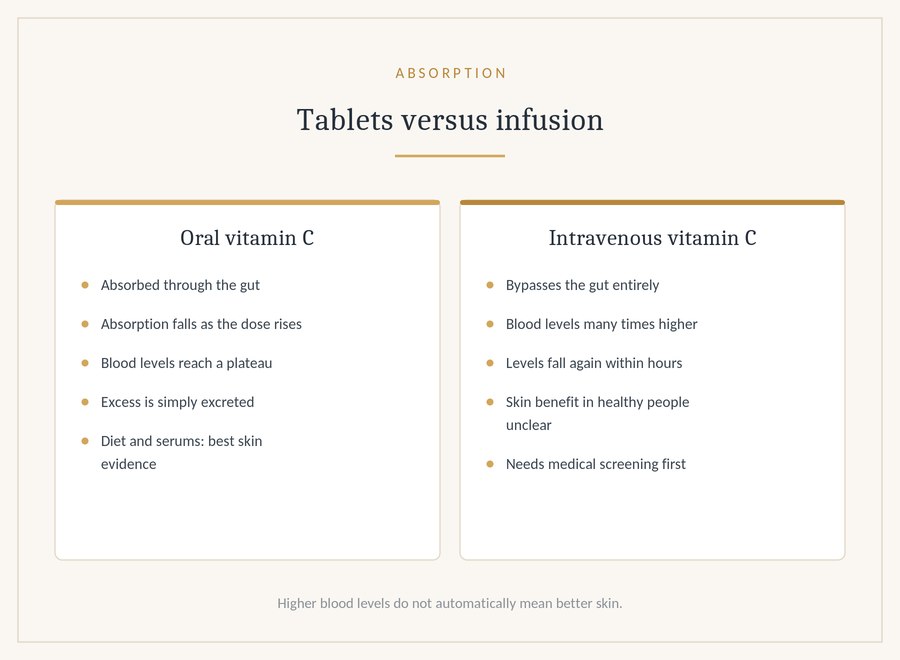
The body tightly controls how much vitamin C it absorbs from the gut. As the oral dose increases, the proportion absorbed falls, and blood levels reach a plateau that cannot be pushed much higher by taking more tablets. The excess is simply excreted.
An intravenous infusion bypasses the gut and produces blood levels many times higher than any oral dose can achieve. Those levels are temporary; the kidneys clear the excess within hours.
That difference is real and measurable. The open question is whether briefly very high blood levels translate into visible skin change in someone whose levels were already normal. For people who eat fruit and vegetables regularly, the tissues may already be close to saturated, and the evidence that more produces a meaningful glow is limited and largely anecdotal.
Who Is Genuinely Low in Vitamin C
True deficiency is uncommon but does occur, particularly with very restricted diets, heavy smoking, some digestive conditions that affect absorption, and certain medical treatments. In those situations correcting a deficiency is worthwhile, and a blood test can establish it. For most healthy people, however, diet and topical products do more for the skin than an occasional infusion.
What It Can and Cannot Be Expected to Do
What people report. Many describe feeling refreshed and notice their skin looking brighter for a period after a course. Some of this may be hydration from the infusion fluid itself, and some may reflect genuine improvement in people who were running low.
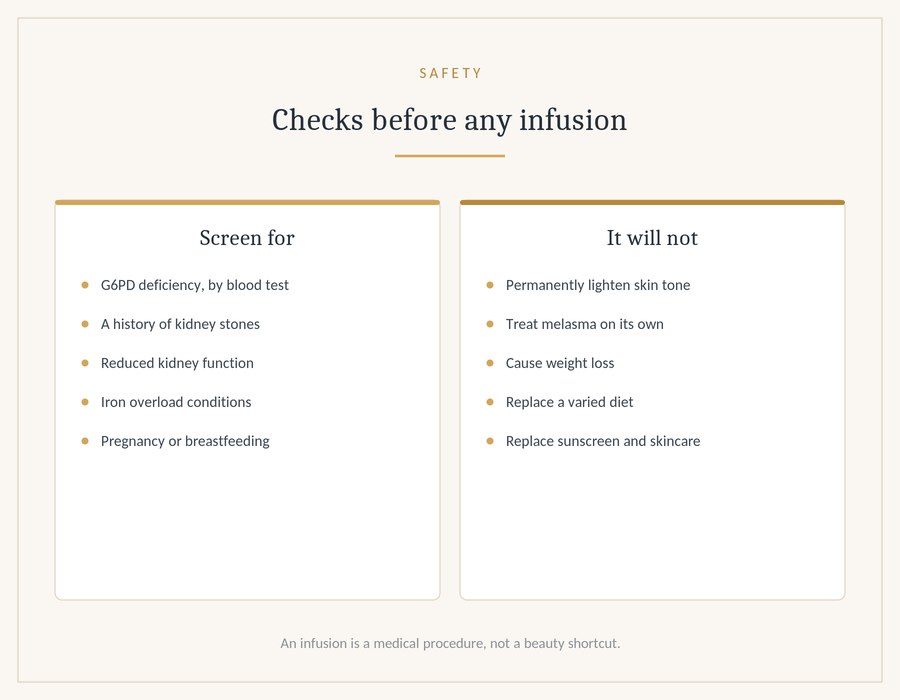
What it does not do. It does not permanently lighten skin tone, and it should never be sold as skin whitening. It does not treat melasma on its own — that condition needs a medical plan built around sun protection, discussed in the guide to melasma treatment. It does not cause weight loss, and it is not a substitute for a varied diet.
Immunity claims. Vitamin C is involved in immune function, but for healthy people who are not deficient there is no strong evidence that infusions prevent illness. High-dose intravenous vitamin C is studied in hospital settings for serious conditions, and those protocols are a different matter from wellness drips.
The Safety Checks That Should Come First
An infusion is a medical procedure, and the checks before it are what separate a responsible service from a risky one.
G6PD deficiency. This inherited enzyme condition is relatively common in people of Middle Eastern, Mediterranean, African and South Asian background, and many people who have it do not know. In someone with G6PD deficiency, high doses of intravenous vitamin C can break down red blood cells, a serious reaction called haemolysis. A simple blood test identifies it, and screening before higher-dose infusions is standard good practice.
Kidney stones and kidney function. The body converts part of vitamin C into oxalate, a component of the most common type of kidney stone. People with a history of kidney stones or reduced kidney function are at higher risk and may need to avoid infusions altogether.
Iron overload. Vitamin C increases iron absorption and can be unsuitable for people with conditions that cause iron build-up.
Diabetes. High blood levels of vitamin C can interfere with some fingerstick glucose meters and produce falsely high readings for a period after an infusion. Anyone monitoring their blood sugar should know this in advance.
Pregnancy and breastfeeding. Elective wellness infusions are generally avoided.
What the Treatment Involves
A consultation comes first, covering medical history, medications and the checks above. The infusion itself is given through a small cannula in the arm and usually takes thirty to sixty minutes, with the patient seated and observed.
Common, minor effects include a cold sensation in the arm, mild discomfort at the cannula site and occasionally a small bruise. Feeling light-headed or unwell during the infusion should be reported immediately so the rate can be slowed or the infusion stopped.
The setting matters. Infusions should be given in a licensed medical facility, by trained staff, with the ability to manage a reaction. Mobile or at-home drip services vary widely in how thoroughly they screen.
Combining With Other Infusions and Treatments
Vitamin C is sometimes combined with other ingredients. The evidence and limitations of glutathione drips are set out in the guide to glutathione IV, and those of vitamin B12 in the guide to vitamin B12 injections. In both cases the strongest indication is a documented deficiency rather than a general wish for better skin.
For skin tone and texture specifically, treatments that act on the skin itself — a daily vitamin C serum, strict sun protection, peels or skin boosters — generally have better evidence than an infusion. A drip can sit alongside a skin plan but should not replace one.
How Often, and What It Costs
Clinics commonly suggest a short course followed by occasional maintenance, but there is no agreed schedule, because there is no strong evidence defining an optimal frequency for skin. More frequent infusions add cost and cumulative risk without clear additional benefit.
Market rates in Dubai generally run from around AED 400 to AED 1,200 per session, depending on the dose, any added ingredients and the setting. The clinic’s details for this service are on the vitamin C infusion page.
The Better-Evidenced Routes: Diet and Topical Vitamin C
For most people, the most reliable way to support the skin with vitamin C is less dramatic than a drip.
Diet. Citrus fruit, berries, kiwi, peppers, broccoli and leafy greens provide vitamin C daily, in the steady amounts the body is designed to absorb. Because the body does not store much vitamin C, a regular intake matters more than an occasional large dose.
Topical serums. Vitamin C applied directly to the skin has the strongest evidence for visible benefit, including improvement in sun-related pigmentation, fine lines and brightness. The most studied form, L-ascorbic acid, is typically used at concentrations of around 10 to 20 percent. It is unstable and oxidises with light and air, which is why good products come in opaque, airtight packaging, and why a serum that has turned dark orange or brown has lost much of its effect.
Sun protection. Vitamin C serum works best alongside a daily broad-spectrum sunscreen; it complements sunscreen rather than replacing it. In Dubai’s sun, consistent sunscreen use does more to prevent dullness and uneven tone than any vitamin, however it is delivered.
Used together, these three steps are inexpensive, low-risk and supported by better evidence than infusions for the goal most people have in mind.
The Short Version
Vitamin C is essential for collagen and has antioxidant and pigment-regulating effects. An infusion reaches blood levels that tablets cannot, but for healthy people who are not deficient, evidence that this produces lasting skin improvement is limited. Topical vitamin C and sun protection have stronger evidence for skin.
If you choose an infusion, the safety checks matter most: screening for G6PD deficiency, a history of kidney stones or kidney disease, and any condition affecting iron. A drip should never be sold as skin whitening or as a replacement for a proper skin plan.
Questions Worth Asking
Will you test for G6PD deficiency first? For higher-dose infusions the answer should be yes.
What exactly is in the bag, and what dose? You are entitled to know every ingredient.
What result is realistic for my skin? An honest answer mentions the limited evidence rather than promising a glow.
Is there a better treatment for my specific concern? For pigmentation or texture, often there is.
Frequently Asked Questions
Does a vitamin C drip make skin glow?
Many people report brighter-looking skin afterwards, but evidence that infusions produce lasting skin improvement in people who are not deficient is limited. Topical vitamin C serums and daily sun protection have stronger evidence for skin brightness.
Is IV vitamin C better than tablets?
It produces much higher blood levels, because the gut limits how much vitamin C is absorbed from tablets. Whether those temporary high levels improve skin in healthy people is not well established.
Is it safe?
For suitable, screened patients it has a good safety record. Risks include haemolysis in people with G6PD deficiency and kidney stones in those predisposed, which is why a medical assessment and screening come first.
What is G6PD deficiency and why does it matter?
It is an inherited enzyme condition, relatively common in people of Middle Eastern, Mediterranean, African and South Asian background. In affected people, high-dose intravenous vitamin C can destroy red blood cells. A simple blood test identifies it.
Will it lighten my skin?
It should not be expected to lighten skin tone, and it should never be marketed as whitening. It is not a treatment for melasma or other pigmentation conditions on its own.
Can it boost my immunity?
Vitamin C supports immune function, but for healthy people who are not deficient there is no strong evidence that infusions prevent illness.
How long does a session take?
Usually thirty to sixty minutes through a small cannula in the arm, after a consultation covering medical history, medications and screening.
Who should avoid it?
People with G6PD deficiency, a history of kidney stones, reduced kidney function or iron overload conditions, and those who are pregnant or breastfeeding. People with diabetes should know it can falsely raise some glucose meter readings.
How often should I have it?
There is no evidence-based schedule for skin benefit. Clinics often suggest a short course and occasional maintenance, but more frequent infusions add cost and cumulative risk without clear extra benefit.
What does it cost in Dubai?
Market rates generally run from around AED 400 to AED 1,200 per session, depending on dose, added ingredients and setting.
This article is general information about aesthetic and wellness treatments and is not medical advice, a diagnosis, or a treatment recommendation for any individual. Outcomes vary between patients and no result is guaranteed. Intravenous treatments carry risks and contraindications that must be assessed by a licensed physician during a personal consultation. Dr Soheila Eskandari is licensed by the Dubai Health Authority. Prices quoted are general market ranges for information only and are not an offer.


 English
  Arabic