
Vitamin B12 Injection in Dubai: Test First, Then Treat
Vitamin B12 Injection in Dubai: Test First, Then Treat
Vitamin B12 injections occupy an odd space in Dubai. They are simultaneously a legitimate medical treatment for a genuine deficiency and a heavily marketed wellness product sold as an energy boost. Both descriptions are true, and confusing them costs people money and occasionally delays a real diagnosis.
This guide separates the two. It covers what B12 does, who genuinely becomes deficient, what the evidence says about injections versus oral supplementation, what testing you should have before anyone injects you, and what it costs in Dubai. Dr Soheila’s position on this treatment is straightforward: test first, treat the cause, and be honest about what a vitamin cannot fix.
What Vitamin B12 Does
Cobalamin — vitamin B12 — is required for several processes that matter a great deal:
- Red blood cell production. Deficiency produces megaloblastic anaemia, where cells are large, immature, and carry oxygen poorly. This is where the fatigue comes from.
- Myelin synthesis. B12 is essential for maintaining the sheath around nerve fibres. Prolonged deficiency causes neurological damage that can become irreversible.
- DNA synthesis. Required for cell division throughout the body.
- Homocysteine metabolism. B12 helps convert homocysteine to methionine; deficiency raises homocysteine levels.
The body cannot make it. It comes from animal-derived food — meat, fish, eggs, dairy — or from supplementation. And absorption is unusually complicated: dietary B12 must be released from food protein by stomach acid, bound to intrinsic factor produced by gastric parietal cells, and then absorbed in the terminal ileum. A problem at any of those three points causes deficiency regardless of how much B12 you eat.
That absorption pathway is the entire reason injections exist. Intramuscular B12 bypasses the gut completely.
Who Actually Becomes Deficient
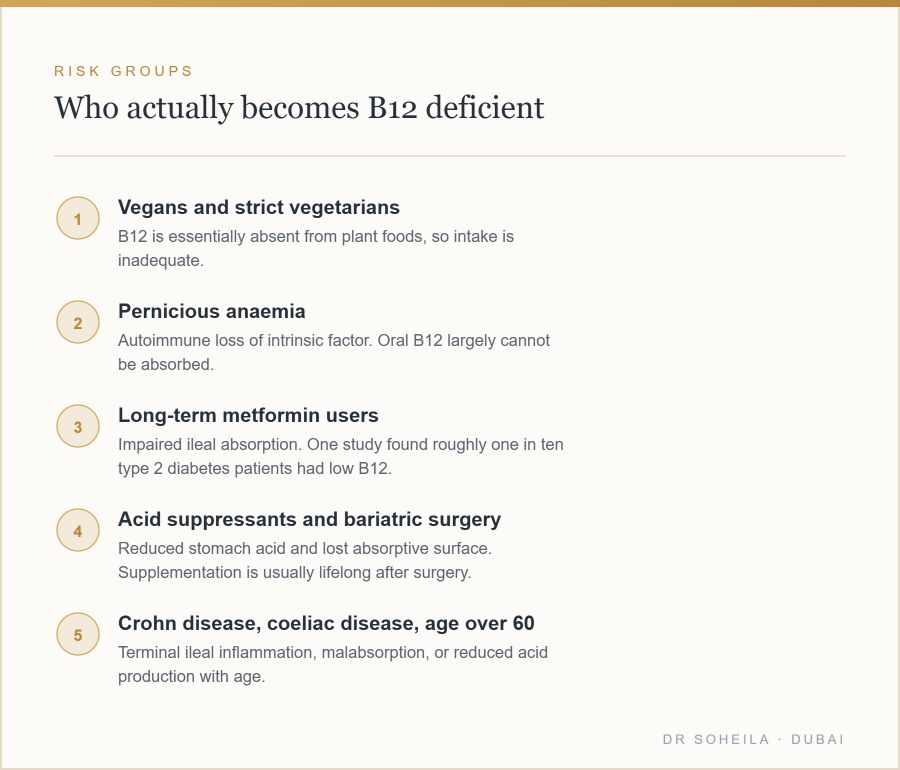
Several groups are at genuine risk, and some of them are well represented in Dubai’s population.
| Group | Mechanism |
|---|---|
| Vegans and strict vegetarians | Inadequate dietary intake — B12 is essentially absent from plant foods |
| People with pernicious anaemia | Autoimmune destruction of intrinsic factor. Oral B12 largely cannot be absorbed |
| Long-term metformin users | Impaired ileal absorption. One study found roughly one in ten type 2 diabetes patients had low B12 |
| Long-term acid-suppressant users | Reduced stomach acid impairs release of B12 from food protein |
| Post bariatric surgery | Anatomical loss of acid production and absorptive surface. Lifelong supplementation is standard |
| Crohn’s disease and coeliac disease | Terminal ileal inflammation or malabsorption |
| Adults over 60 | Reduced stomach acid production with age |
| Heavy alcohol use | Both intake and absorption affected |
Dubai has a large South Asian population where vegetarian diets are common, a large population on long-term metformin, and a substantial number of people who have had bariatric surgery. B12 deficiency here is not a marketing invention — it is genuinely prevalent in identifiable groups.
What Deficiency Actually Feels Like
Symptoms develop slowly and are easy to attribute to something else:
- Persistent fatigue that rest does not fix
- Pins and needles, numbness, or burning in hands and feet — this is the neurological warning sign and should not be ignored
- Cognitive symptoms: poor concentration, word-finding difficulty, memory lapses, described by patients as brain fog
- Mood change, low mood, irritability
- Pale or slightly jaundiced skin, breathlessness on mild exertion, palpitations
- Sore, smooth, red tongue (glossitis), mouth ulcers
- Balance problems in more advanced deficiency
The critical clinical point: neurological symptoms can occur before anaemia appears, and can become permanent if deficiency persists. This is why numbness and tingling warrant prompt testing rather than a wait-and-see approach.
Get Tested First — This Is Not Optional
The most important sentence in this article: do not have B12 injections without a blood test first.
There are three reasons, and they are all substantial.
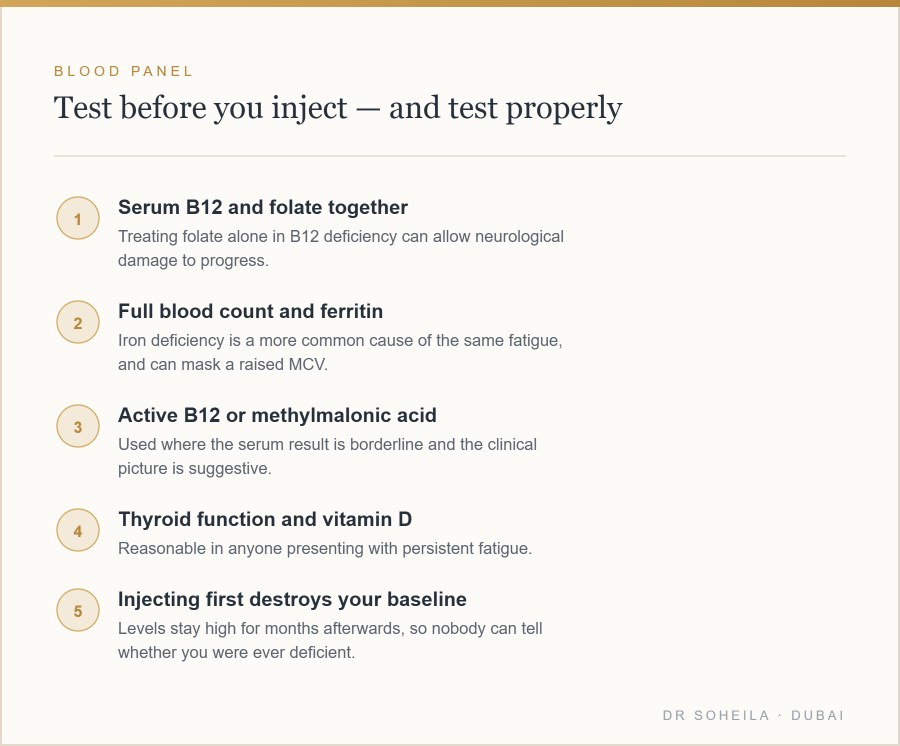
First, most fatigue is not B12 deficiency. Iron deficiency, thyroid disease, vitamin D deficiency, poor sleep, undiagnosed sleep apnoea, depression, and uncontrolled diabetes are all far more common causes. Injecting B12 into someone with iron-deficiency anaemia does nothing for them except delay the correct diagnosis.
Second, injecting first makes subsequent testing uninterpretable. Once you have had B12, serum levels are high for months. If you later develop the same symptoms, nobody can tell whether you were ever deficient. You have destroyed your own baseline.
Third, B12 and folate deficiency interact. Treating with folate alone in the presence of B12 deficiency can correct the anaemia while allowing neurological damage to progress. The two must be assessed together.
What testing should include
- Serum B12 — the starting point, though it has known limitations. Total B12 includes an inactive fraction, so borderline results need interpretation rather than a simple threshold
- Serum folate — always alongside B12
- Full blood count — mean cell volume is often raised in B12 deficiency
- Ferritin — because iron deficiency is the more common cause of the same symptoms, and coexisting iron deficiency can mask the raised MCV
- Active B12 (holotranscobalamin) or methylmalonic acid — where the serum result is borderline and the clinical picture is suggestive
- Intrinsic factor antibodies — where pernicious anaemia is suspected, because it changes treatment to lifelong
- Thyroid function and vitamin D — reasonable in anyone presenting with fatigue
Dr Soheila will arrange appropriate testing before treating, and will look at the whole panel rather than a single number. A patient whose real problem is hypothyroidism deserves to have that found.
Injection Versus Oral: What the Evidence Shows
This is a genuinely debated area and the answer depends on why you are deficient.
The case for injections
Clinical guidance in several health systems emphasises that true cobalamin deficiency — particularly where absorption is compromised — requires systematic intramuscular replacement, because oral supplementation is often insufficient in individuals with compromised gastrointestinal absorption. Review work notes that there is currently no evidence to support that oral or sublingual supplementation can safely and effectively replace injections in that population.
Clinical experience described in the literature also suggests that up to half of individuals require individualised injection regimens — ranging from daily to every two to four weeks — to remain symptom-free, which is a wider range than standard protocols assume.
The case for oral treatment
In some malabsorptive conditions, high-dose oral treatment does work, because a small percentage of B12 is absorbed by passive diffusion independent of intrinsic factor. In a study of Crohn’s disease patients with B12 deficiency, 94.7% normalised their cobalamin levels with oral treatment, and the oral route was effective as maintenance in 81.7% of patients over three years of follow-up.
The practical summary
| Situation | Usual approach |
|---|---|
| Pernicious anaemia | Injections, lifelong |
| Neurological symptoms present | Injections, loading regimen, urgently |
| Post bariatric surgery | Injections usually preferred; lifelong monitoring |
| Dietary deficiency, vegan diet | Oral usually sufficient; injections to correct a significant deficit quickly |
| Metformin or acid-suppressant related | Oral often adequate; monitor and reassess |
| Normal B12, symptoms of fatigue | Investigate other causes. B12 is not the answer |
What Treatment Looks Like
Typical regimens for confirmed deficiency involve a loading phase — a series of injections over the first weeks — followed by maintenance at intervals from monthly to every three months, adjusted to the individual and to the underlying cause.
The injection itself is intramuscular, usually into the deltoid or gluteal muscle. It takes seconds. Most patients describe it as a brief sting followed by mild soreness for a day.
What improves, and when
- Days to weeks: energy and mood often improve first. Blood counts begin correcting within days
- Weeks to months: anaemia resolves; tongue soreness and mouth symptoms settle
- Months: neurological symptoms improve slowly, and improvement can continue for six to twelve months
- Possibly not at all: long-standing neurological damage may be permanent. This is precisely why early testing matters
The Honest Part: B12 Is Not an Energy Boost
Marketing across the region positions B12 injections as a general wellness treatment for tiredness, and this deserves a direct response.
If you are deficient, correcting it can be genuinely transformative. Patients frequently describe it as getting their life back, and that is not exaggeration.
If your B12 is normal, an injection will not increase your energy. There is no mechanism by which supraphysiological B12 improves function in a replete person. Excess is excreted. Any effect experienced is not attributable to a pharmacological action of the vitamin.
This distinction matters beyond the money. A person with untreated hypothyroidism, iron deficiency, or sleep apnoea who is buying monthly B12 injections for fatigue is not getting the treatment they need. Dr Soheila’s approach to fatigue is diagnostic first — appropriate testing, then treatment directed at what the results actually show.
Vitamin B12 Injection Cost in Dubai
Market rates in DHA-licensed clinics generally run:
- Single B12 injection: approximately AED 150 to AED 450
- Course of loading injections: approximately AED 600 to AED 1,800
- Blood panel (B12, folate, ferritin, full blood count, thyroid, vitamin D): approximately AED 400 to AED 1,200
- Consultation: approximately AED 300 to AED 800, often credited against treatment
Two notes on cost. First, some health insurance policies in the UAE cover investigation and treatment of a diagnosed deficiency but not wellness injections — the diagnosis and documentation matter. Second, if your deficiency is dietary rather than absorptive, high-dose oral B12 is inexpensive and may be entirely adequate. A clinic that never mentions this option is worth questioning.
Safety
B12 is water-soluble and has a wide safety margin; excess is excreted rather than stored to toxicity. Injections are well tolerated.
Possible effects: injection-site pain, redness or bruising; mild diarrhoea; itching or rash. Genuine allergic reaction to cobalamin is rare but reported.
Cautions: hypokalaemia can occur early in treatment of severe deficiency as red cell production accelerates, which is monitored in significant cases. Leber’s hereditary optic neuropathy is a specific contraindication to cyanocobalamin. Anyone with a cobalt allergy should mention it. Pregnancy is not a contraindication where deficiency is confirmed, but treatment should be physician-directed.
Questions to Ask Before You Book
- Will you test my B12 before treating me — and will you test folate, ferritin, full blood count, and thyroid too?
- What was my actual result, and what is the reference range?
- Why do you think I am deficient? What is the underlying cause?
- Should I be tested for intrinsic factor antibodies?
- Would high-dose oral treatment work for my particular cause?
- How long will I need treatment — is this temporary or lifelong?
- When will you retest me?
- Is the injection given by a licensed medical professional?
A clinic that offers injections without a prior blood test is selling a product rather than providing care. That is the clearest single filter you can apply.
Treating With Dr Soheila
Dr Soheila Eskandari practises in Dubai under DHA licence and treats vitamin B12 as a medical question rather than a wellness menu item. That means appropriate testing before treatment, interpreting results in the context of the full picture rather than a single number, identifying why a deficiency exists rather than simply topping it up, and being direct with patients whose fatigue has another cause.
Patients sometimes arrive expecting to be sold a course and leave with a blood test request and a follow-up appointment instead. In the cases where deficiency is confirmed, treatment is straightforward and the response is often excellent. In the cases where it is not, they leave knowing what to investigate next — which is more valuable than an injection.
Frequently Asked Questions
Do I need a blood test before a B12 injection?
Yes. Most fatigue is not caused by B12 deficiency, injecting first makes future testing uninterpretable for months, and B12 must be assessed alongside folate because treating folate alone in B12 deficiency can allow neurological damage to progress. A clinic offering injections without testing is selling a product, not providing care.
Are B12 injections better than tablets?
It depends on the cause. Where absorption is compromised — pernicious anaemia, post-bariatric surgery, neurological symptoms — injections are the standard, and current guidance holds that oral supplementation cannot reliably replace them. Where deficiency is dietary, high-dose oral treatment is usually adequate. In Crohn’s disease, one study found 94.7% of patients normalised on oral treatment.
How quickly will I feel better?
Energy and mood often improve within days to weeks and blood counts begin correcting early. Anaemia resolves over weeks to months. Neurological symptoms improve slowly over months and may not fully recover if the deficiency was long-standing.
Will B12 injections give me more energy if my levels are normal?
No. There is no mechanism by which extra B12 improves function in someone who is already replete — the excess is simply excreted. If you are tired and your B12 is normal, the cause is elsewhere and worth investigating.
How often do I need injections?
Typically a loading course over the first weeks, then maintenance from monthly to every three months depending on the cause. Clinical experience described in the literature suggests up to half of patients need an individualised interval to stay symptom-free. Pernicious anaemia generally requires lifelong treatment.
Am I at risk of B12 deficiency?
Higher-risk groups include vegans and strict vegetarians, people with pernicious anaemia, long-term metformin or acid-suppressant users, people who have had bariatric surgery, those with Crohn’s or coeliac disease, adults over 60, and heavy alcohol users. Several of these are well represented in Dubai.
Can you overdose on vitamin B12?
B12 is water-soluble with a wide safety margin and excess is excreted rather than accumulating to toxic levels. That said, injections should still be given for a reason, by a licensed professional, and monitored.
Does B12 deficiency cause hair loss?
Deficiency states including B12, iron, and vitamin D can contribute to diffuse hair shedding, so it is reasonable to include in a hair-loss workup. It is rarely the sole cause. Our guide to hair loss treatment in Dubai covers the full assessment.
Is it safe during pregnancy?
Confirmed B12 deficiency should be treated in pregnancy, and treatment is not contraindicated. It should be directed by a physician alongside your obstetric care rather than obtained from a wellness clinic.
How much does a B12 injection cost in Dubai?
Market rates in DHA-licensed clinics generally range from AED 150 to AED 450 per injection, with loading courses around AED 600 to AED 1,800 and a relevant blood panel around AED 400 to AED 1,200. Insurance sometimes covers investigation and treatment of diagnosed deficiency but not wellness injections.
This article is general health information and is not medical advice, a diagnosis, or a treatment recommendation for any individual. Vitamin B12 deficiency requires diagnosis by blood testing and treatment directed by a licensed physician. Persistent fatigue, numbness, tingling, or cognitive change should be medically assessed rather than self-treated. Dr Soheila Eskandari is licensed by the Dubai Health Authority. Prices quoted are general market ranges for information only and are not an offer.


 English
  Arabic