
Glutathione IV Drip in Dubai: What the Evidence Actually Supports
Glutathione IV Drip in Dubai: What the Evidence Actually Supports
Glutathione drips are marketed in Dubai with two very different promises attached. One is modest and defensible: antioxidant support, a sense of recovery, better-looking skin. The other is not: several shades lighter, permanently, in a course of six sessions.
Those two claims involve the same molecule and the same infusion, and the gap between them is where most of the confusion — and most of the disappointment — lives. This guide explains what glutathione is, what an intravenous infusion can and cannot reasonably be expected to do, what the regulators have actually said about skin-lightening claims, and what safe administration looks like.
What Glutathione Actually Is
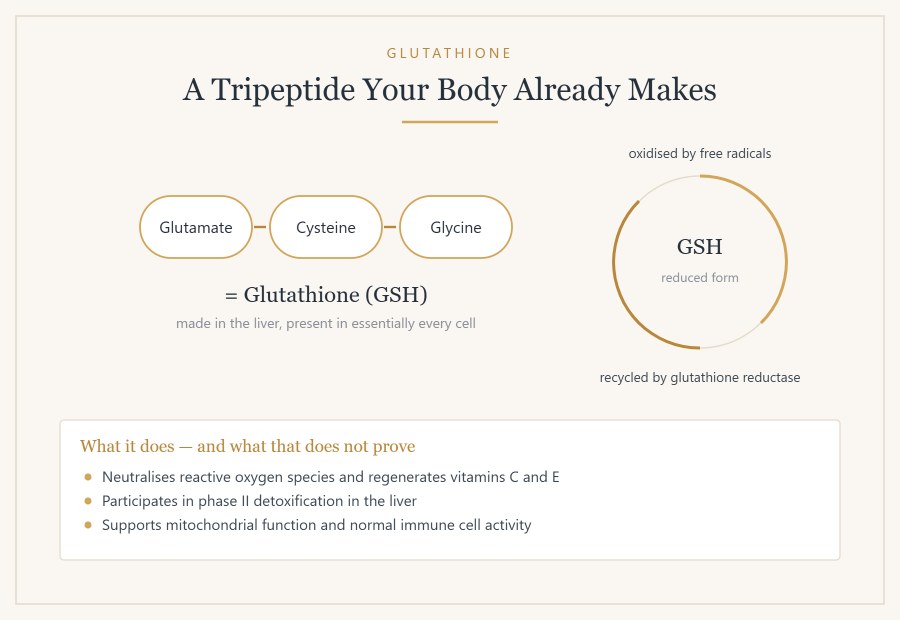
Glutathione is a tripeptide — three amino acids, glutamate, cysteine and glycine, linked together. Your body makes it, principally in the liver, and it is present in essentially every cell. It is not an exotic import; it is one of the most abundant molecules in human physiology.
Its main job is redox balance. Cells generate reactive oxygen species as a by-product of normal metabolism, and more of them under physiological stress — illness, intense exercise, poor sleep, alcohol, pollution, ultraviolet exposure. Left unchecked, these species damage lipids, proteins and DNA. Glutathione neutralises them, and in doing so is itself oxidised, then recycled back to its active form by an enzyme system that depends on adequate nutrition.
It has other roles. It participates in phase II detoxification in the liver, where it conjugates to certain compounds to make them water-soluble and excretable. It regenerates vitamins C and E after they have done antioxidant work of their own. It supports mitochondrial function and contributes to normal immune cell activity.
Glutathione levels fall with age, and are lower in a number of chronic disease states. That observation is the honest basis for interest in supplementation. It is not, by itself, evidence that raising levels by infusion produces any particular cosmetic outcome.
Why Intravenous Rather Than Oral
The pharmacological argument for the drip is real. Glutathione taken by mouth is largely broken down in the gastrointestinal tract before it reaches the circulation — peptidases in the gut wall cleave it into its constituent amino acids, so what is absorbed is not intact glutathione. Studies of conventional oral glutathione have repeatedly struggled to demonstrate meaningful increases in circulating levels.
Liposomal and sublingual formulations perform better than plain oral capsules, and precursor strategies such as N-acetylcysteine raise glutathione indirectly by supplying the rate-limiting amino acid. But intravenous administration bypasses the gut entirely and produces the highest plasma concentrations, which is why it exists as a route.
The corollary is worth stating plainly: higher plasma concentration is a pharmacokinetic fact, not a clinical outcome. Getting more of a molecule into the blood is only useful if there is good evidence that more of it in the blood produces the effect you want.
The Skin-Lightening Claim, Examined Honestly
What the Mechanism Suggests
The theory is coherent. Human melanin comes in two broad forms: eumelanin, which is brown-black, and pheomelanin, which is red-yellow and lighter. Both are produced from the same precursor pathway, and the branch point is influenced by the availability of thiol compounds — sulphur-containing molecules, of which glutathione is one. In laboratory conditions, glutathione inhibits tyrosinase, the key enzyme in melanin synthesis, and shifts production towards pheomelanin.
So there is a plausible route by which raising glutathione could shift pigment production. That is the strongest version of the argument, and it is genuinely the reason the treatment became popular.
What the Evidence Actually Shows
The clinical evidence is considerably thinner than the marketing. Most of the human studies showing skin-lightening effects have used oral or topical glutathione, were small, ran for short periods, and measured modest changes in melanin index rather than the dramatic transformations depicted in advertising. Systematic reviews of the area consistently note limited sample sizes, short follow-up and inconsistent methodology.
For the intravenous route specifically — the one most heavily marketed — high-quality controlled data is scarce. Reviews examining intravenous glutathione for skin lightening have generally concluded that the evidence does not support the claims made for it, and that the safety profile of repeated high-dose infusions for a cosmetic indication has not been adequately characterised.
There is also a practical point that gets lost. Any pigment effect that does occur is not permanent. Melanocytes continue to function, sun exposure continues to stimulate them, and the skin returns towards baseline once infusions stop. A treatment that requires indefinite repetition to maintain an effect that was modest to begin with is a different proposition from the one usually presented.
What Regulators Have Said
Several national medicines regulators have issued formal advisories about intravenous glutathione used for skin whitening. The concerns raised have included serious cutaneous adverse reactions — Stevens-Johnson syndrome and toxic epidermal necrolysis have both been reported — as well as thyroid dysfunction, renal dysfunction, abdominal pain, and the infection risk associated with unsterile administration. Intravenous glutathione is not approved as a skin-lightening agent by major regulators, and products compounded for that purpose have been flagged in more than one jurisdiction.
This does not make glutathione a dangerous substance. It makes unregulated high-dose intravenous administration for a cosmetic indication a different risk calculation from an antioxidant infusion given under medical supervision for a defined reason.
What an IV Glutathione Drip Can Reasonably Offer
Stripped of the whitening claims, there is a narrower and more defensible position.
Glutathione is a genuine antioxidant and the rationale for supporting antioxidant capacity in states of high oxidative stress is sound. Patients commonly report improved skin clarity and a less dull, tired appearance — the kind of change that reads as “you look well” rather than “you look different”. Some report improved energy and quicker recovery after illness or periods of poor sleep. There is interest in glutathione in the context of several medical conditions where oxidative stress is a feature, though that is a separate clinical setting from a wellness clinic drip.
Two caveats belong with that. First, these reported benefits are largely subjective, and infusions are typically given alongside hydration and other vitamins, which makes attribution difficult. Second, “you look better rested” is a legitimate outcome to want, but it is not the same as the claim on the poster.
The Vitamin C Question — and Why G6PD Matters Here
Glutathione is frequently combined with high-dose intravenous vitamin C. The rationale is that vitamin C regenerates glutathione and contributes independently to antioxidant capacity, and the two are often marketed together as a brightening protocol.
High-dose intravenous vitamin C carries a specific and serious contraindication that deserves emphasis in this region: glucose-6-phosphate dehydrogenase deficiency. G6PD deficiency is an inherited enzyme disorder that is markedly more common in populations from the Middle East, the Mediterranean, Africa and South and Southeast Asia than in Northern European populations. In someone with G6PD deficiency, high-dose intravenous vitamin C can precipitate acute haemolysis — destruction of red blood cells — which can be severe.
Anyone being offered a high-dose vitamin C infusion should be screened for G6PD deficiency beforehand. This is not optional caution; it is the standard of care. A clinic that offers high-dose vitamin C without asking about it, or without testing, is skipping the single most important safety step in that protocol.
High-dose vitamin C also increases urinary oxalate and carries a theoretical stone risk in patients with a history of oxalate kidney stones or significant renal impairment, which is another reason a proper history matters.

Who Should Not Have Intravenous Glutathione
Intravenous glutathione is not suitable for everyone, and a proper consultation exists to establish that. Considerations include pregnancy and breastfeeding, where safety data is inadequate; significant renal or hepatic impairment; asthma, where sulphur-containing compounds have been associated with bronchospasm in sensitive individuals; known hypersensitivity to any component of the preparation; and active infection.
Any previous severe cutaneous drug reaction is a reason for particular caution, given the reports associating serious skin reactions with this treatment. A history of thyroid disease warrants discussion, as thyroid dysfunction has been reported in association with repeated high-dose infusions.
What Safe Administration Looks Like
An intravenous infusion is a medical procedure, not a spa service. Practically, that means the following should all be true.
The clinic is licensed by the Dubai Health Authority for intravenous therapy. A physician takes a history, examines you, and prescribes the infusion — the drip is not selected from a menu without medical involvement. Baseline bloods are taken where indicated, including G6PD screening before any high-dose vitamin C. Cannulation is performed by a qualified nurse or doctor using sterile technique with single-use equipment. The infusion runs at an appropriate rate, typically over thirty to sixty minutes, with the patient observed. Resuscitation equipment and anaphylaxis protocols are on site, because any intravenous product can provoke a reaction. A record is kept of what was given, at what dose, and how you responded.
Home and hotel-room infusion services vary widely in how many of these boxes they tick. The convenience is genuine; so is the reduced margin for error if something goes wrong.
Glutathione IV Drip Cost in Dubai
Figures below are general market ranges observed across DHA-licensed clinics in Dubai and are provided for orientation only. They are not an offer or a quotation, and pricing depends on formulation, dose and whether medical assessment and bloods are included.
- Medical consultation and assessment: AED 300 – 700
- Glutathione IV infusion (single session): AED 500 – 1,500
- Combined glutathione and vitamin C infusion: AED 700 – 2,000
- Course of six to ten sessions: AED 3,000 – 12,000
- Baseline blood panel including G6PD: AED 250 – 700
Wide ranges here usually reflect real differences — dose of active, whether a physician is involved, whether screening bloods are done, and the quality and provenance of the product being infused. The cheapest option in a category where sterility and product quality are the main safety variables is not usually the sensible one.
Questions Worth Asking Before You Book
Who will assess me before the infusion, and are they a licensed physician? What exactly is in the bag, at what dose, and where is the product sourced from? Will I be screened for G6PD deficiency if vitamin C is included? What outcome should I realistically expect, and by when? What happens if I have a reaction during the infusion? Is the clinic DHA-licensed for intravenous therapy?
A clinic that answers these directly is a clinic worth using. A clinic that responds by describing shade changes is telling you what it thinks you want to hear.
Treating With Dr Soheila
Dr Soheila Eskandari is licensed by the Dubai Health Authority and practises at Riviera Clinic on Al Wasl Road, Umm Suqeim 1. Intravenous therapy is prescribed after a medical consultation that establishes whether it is appropriate, what the realistic objective is, and whether any screening is required first. You can read more about glutathione IV therapy, high-dose vitamin C and vitamin injections, or book an appointment.
Frequently Asked Questions
Does an IV glutathione drip whiten skin?
The evidence does not support the claims commonly made for it. Most human studies showing a lightening effect used oral or topical glutathione, were small and short, and measured modest changes. High-quality controlled data for the intravenous route specifically is scarce, and several regulators have issued advisories about intravenous glutathione marketed for skin whitening.
How many sessions would I need?
Protocols commonly run to six to ten sessions given weekly or twice weekly, but that reflects clinic convention rather than a well-established evidence-based schedule. Any effect on pigment is not permanent, so maintenance would be required indefinitely — which is worth factoring into the decision.
Is IV glutathione safe?
Given by a licensed physician, in a licensed facility, at a reasonable dose, after proper assessment, it is generally well tolerated. Reported adverse effects associated with repeated high-dose cosmetic use include serious skin reactions, thyroid dysfunction, renal dysfunction and abdominal pain, and unsterile administration carries infection risk. The setting matters as much as the substance.
Why not just take glutathione tablets?
Conventional oral glutathione is largely broken down in the gut before absorption, so it raises circulating levels poorly. Liposomal and sublingual forms perform better, and N-acetylcysteine raises glutathione indirectly by supplying a precursor. These are reasonable alternatives to discuss if the goal is antioxidant support rather than a cosmetic claim.
Why do I need a G6PD test before a vitamin C drip?
Because high-dose intravenous vitamin C can trigger acute destruction of red blood cells in people with glucose-6-phosphate dehydrogenase deficiency, an inherited enzyme disorder that is considerably more common in Middle Eastern, Mediterranean, African and South Asian populations. Screening before the first infusion is the standard of care, not an optional extra.
Can I have a glutathione drip while pregnant or breastfeeding?
It is not recommended. Safety data for intravenous glutathione in pregnancy and breastfeeding is inadequate, and elective cosmetic infusions are not appropriate in that setting.
Will it help my melasma?
It is not a melasma treatment. Melasma is a chronic condition driven by ultraviolet and visible light, heat and hormonal factors, and it is managed with photoprotection, specific topical agents and, where appropriate, oral tranexamic acid and carefully selected in-clinic procedures. A glutathione infusion does not address those drivers.
How long does an infusion take?
Typically thirty to sixty minutes for the infusion itself, plus time for assessment, cannulation and a period of observation afterwards. Rushing the infusion rate offers no advantage and increases the chance of side effects.
Is a home or hotel IV service acceptable?
It can be, provided the same standards apply — a licensed physician assessing you, a licensed provider, sterile single-use equipment, a properly sourced product, and anaphylaxis management immediately available. The convenience is genuine, but so is the reduced margin for error if you react.
What results should I realistically expect?
The defensible expectation is antioxidant support and, for some patients, skin that looks clearer and less tired. Reported benefits of this kind are largely subjective and infusions usually include hydration and other vitamins, which makes attribution difficult. Expecting a change in skin tone measured in shades is expecting something the evidence does not support.
This article is general information about aesthetic and wellness treatments and is not medical advice, a diagnosis, or a treatment recommendation for any individual. Outcomes vary between patients and no result is guaranteed. Intravenous therapy carries risks and contraindications that must be assessed by a licensed physician during a personal consultation. Dr Soheila Eskandari is licensed by the Dubai Health Authority. Prices quoted are general market ranges for information only and are not an offer.


 English
  Arabic