
Melasma Treatment in Dubai: Why It Comes Back, and What Actually Works
Melasma Treatment in Dubai: Why It Comes Back, and What Actually Works
Melasma is the pigmentation problem that most reliably defeats good intentions. Patients arrive having spent two years and a considerable amount of money on brightening serums, facials and at least one laser package, and the patches on their cheeks are the same or slightly worse. That history is not a sign of bad luck or poor discipline. It is what happens when a condition that behaves like a chronic inflammatory disorder is treated as though it were a stain.
This guide sets out what melasma actually is, why Dubai is one of the harder places in the world to control it, which treatments have real evidence behind them, and — the part most articles skip — which popular treatments make it worse.
What Melasma Actually Is
Melasma is an acquired disorder of pigmentation that produces symmetrical brown to grey-brown patches, almost always on sun-exposed areas of the face. It affects women far more often than men, and people with Fitzpatrick skin types III to V — the range that covers most of the Middle East, South Asia and East Asia — far more often than lighter skin types. In a city where a large share of residents fall into exactly that range, it is one of the most common reasons for a dermatology consultation.
The older model of melasma was straightforward: melanocytes in the affected patches produce too much pigment, so suppress the melanocytes and the patches fade. That model explains why so much melasma treatment fails.
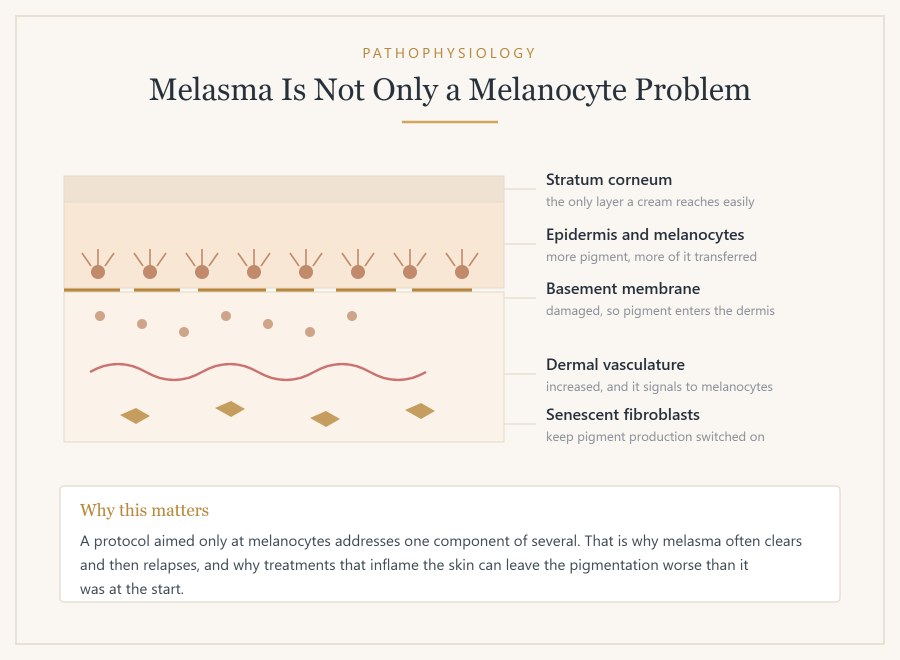
Melasma is not confined to the pigment cells. Research over the past decade has shown that affected skin differs from adjacent normal skin in several ways at once. The basement membrane separating epidermis from dermis is damaged, which allows pigment to drop into the dermis where topical agents cannot easily reach it. There are more blood vessels in melasma skin, and those vessels signal to melanocytes through vascular endothelial growth factor. Mast cells are increased. Fibroblasts in the underlying dermis show features of cellular senescence and secrete factors that stimulate pigment production. Sebaceous glands appear to participate too.
The practical translation: melasma is better understood as a localised photoageing disorder involving the whole skin unit, not a pigment problem sitting on the surface. A treatment that only addresses melanocytes is addressing one component of several.
The Three Patterns
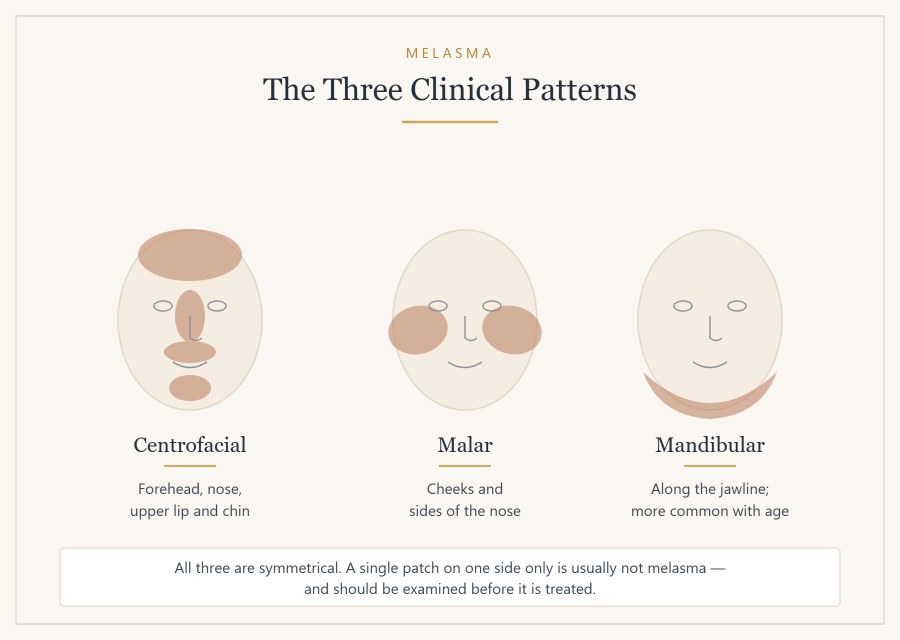
Melasma is conventionally described by distribution. The centrofacial pattern involves the forehead, upper lip, nose and chin. The malar pattern is confined to the cheeks and nose. The mandibular pattern sits along the jawline and is more common in older patients, where it overlaps with other causes of pigmentation and is often misdiagnosed.
You may also be told your melasma is “epidermal”, “dermal” or “mixed”, usually after examination with a Wood’s lamp. This classification was traditionally used to predict response — epidermal good, dermal poor. Current thinking is more sceptical. Histological studies find that most melasma contains both epidermal and dermal pigment, and Wood’s lamp appearance correlates less reliably with depth than was assumed. It remains a useful clinical observation. It is not a verdict.
Why Dubai Makes Melasma Harder
Every driver of melasma is amplified here, and it is worth being specific rather than simply saying “the sun”.
Ultraviolet radiation is high year-round. The UV index in Dubai regularly reaches very high or extreme levels for much of the year, not only in summer. There is no season in which photoprotection can safely lapse.
Visible light matters, and most people are unprotected against it. This is the point that surprises patients. Melasma in darker skin types is provoked not only by UV but by high-energy visible light — the blue-violet end of the visible spectrum. Conventional transparent sunscreens filter UVA and UVB and do essentially nothing against visible light. Studies comparing tinted sunscreens containing iron oxides against non-tinted sunscreens with equivalent SPF have found better melasma control with the tinted formulations, because iron oxides absorb visible light. If your sunscreen goes on clear, it is only doing part of the job.
Heat is an independent trigger. Infrared radiation and ambient heat stimulate melanogenesis through pathways separate from UV. A Dubai summer delivers both in quantity, and the effect is not neutralised by sunscreen.
Car windows are a false sense of security. Standard laminated windscreens block most UVB and a good proportion of UVA. Side windows typically do not. A long daily commute is meaningful cumulative exposure on the driver’s side of the face, which is why asymmetry sometimes appears in otherwise symmetrical melasma.
Hormonal triggers are common and often unrecognised. Pregnancy is the classic one — melasma of pregnancy is common enough to have its own name. Combined oral contraceptives and hormone replacement therapy are also implicated. Some thyroid disorders are associated. None of these are reasons to stop a medication without discussing it with the prescribing doctor, but they belong in the conversation, because treating the skin while an ongoing hormonal driver is untouched sets a ceiling on what is achievable.
The One Thing That Decides Whether Anything Else Works
Photoprotection is not the boring preamble to melasma treatment. It is the treatment. Every clinical protocol that works is built on it, and every protocol that fails usually fails here.
Practically, that means a broad-spectrum sunscreen of SPF 50 or higher, tinted with iron oxides, applied in an adequate quantity — most people apply between a quarter and a half of what is tested — and reapplied every two to three hours during daylight hours, indoors near windows included. It means a wide-brimmed hat rather than a cap. It means recognising that a shaded terrace still delivers substantial scattered UV.
Patients often find this disproportionate to a cosmetic concern. The honest framing is that melasma responds to treatment and then relapses on exposure, so the question is not whether photoprotection is worth the effort but whether the treatment is worth doing without it.
Topical Treatment: What Has Evidence
Triple Combination Therapy
The best-supported topical treatment for melasma remains a triple combination cream containing hydroquinone, a retinoid and a mild corticosteroid — commonly hydroquinone 4%, tretinoin 0.05% and fluocinolone acetonide 0.01%. Each component contributes: hydroquinone inhibits tyrosinase and reduces melanin synthesis, the retinoid increases epidermal turnover and enhances penetration, and the corticosteroid reduces the irritation the other two would otherwise cause and independently suppresses melanocyte activity.
It is used in cycles rather than indefinitely. Prolonged uninterrupted hydroquinone carries a risk of exogenous ochronosis — a paradoxical blue-grey discolouration that is considerably harder to treat than the melasma was. The steroid component carries the usual risks of skin thinning and telangiectasia with unsupervised long-term use. This is a prescription treatment that requires medical review, not a product to be refilled indefinitely from a pharmacy.
Options Without Hydroquinone
Several agents are used where hydroquinone is unsuitable, not tolerated, or as maintenance between cycles. Azelaic acid at 20% inhibits tyrosinase and is safe in pregnancy. Topical tranexamic acid reduces pigment through effects on the plasminogen pathway. Cysteamine, thiamidol, kojic acid, alpha-arbutin, niacinamide and stabilised vitamin C all have supporting data of varying strength.
None of them match triple combination therapy for speed. Their value is that they can be continued for long periods, which matters in a condition where maintenance determines the long-term result more than the initial clearance does.
Oral Tranexamic Acid
Oral tranexamic acid has become one of the more significant additions to melasma management. It is an antifibrinolytic drug — its licensed use is to reduce bleeding — and its effect on pigmentation was discovered incidentally. It works by inhibiting the plasminogen–plasmin pathway in keratinocytes, which reduces arachidonic acid and prostaglandin production and therefore reduces melanocyte stimulation. It also appears to reduce the increased vascularity found in melasma skin.
Typical dosing in the published literature is 250 mg twice daily for around eight to twelve weeks, often combined with topical treatment. Response is usually visible from around week four to eight.
It is not appropriate for everyone. Personal or family history of thrombosis, current use of combined hormonal contraception, pregnancy, smoking in combination with other risk factors, and certain clotting disorders all require careful assessment, and some are absolute contraindications. This is a prescription medication that should be started only after a proper history and, where indicated, screening. Buying it online because it worked for someone on social media is a genuinely dangerous idea.
In-Clinic Treatment
Chemical Peels
Superficial peels — glycolic acid, salicylic-mandelic combinations, Jessner’s solution, low-concentration trichloroacetic acid — accelerate removal of pigmented epidermal cells and improve penetration of topical agents. They are adjuncts rather than standalone treatments.
In skin types IV and above they must be conservative. Aggressive peeling provokes post-inflammatory hyperpigmentation, and post-inflammatory hyperpigmentation on top of melasma is a difficult situation to unwind. Depth should be increased gradually across sessions rather than assumed at the outset.
Microneedling With Tranexamic Acid
Microneedling creates controlled micro-channels that allow delivery of tranexamic acid into the dermis, where topical application alone penetrates poorly. Trials comparing microneedling plus tranexamic acid against topical treatment alone have generally favoured the combination, with the added benefit that microneedling also stimulates repair of the damaged basement membrane — one of the structural abnormalities that allows pigment to drop into the dermis in the first place.
Depth discipline matters. Melasma protocols use shallower settings than scar protocols; excessive depth means excessive inflammation, and inflammation is the enemy here.
Mesotherapy
Injectable delivery of tranexamic acid, vitamin C, glutathione and related agents directly into the affected skin is widely offered in the region. The rationale is sound — bypass the stratum corneum, deliver the active where it acts. The evidence base is smaller and more variable than for the treatments above, and outcomes depend heavily on protocol, so it is reasonable to regard it as a useful adjunct rather than a foundation.
Lasers, and Why They Are Not First Line
This is where the most damage is done. Melasma looks like a pigment problem, lasers remove pigment, so the logic seems obvious. It is not.
Melasma skin is inflamed and hypervascular, and its melanocytes are hyper-responsive to injury. Laser energy is injury. The common pattern is a good result at four weeks, relapse at three months, and pigmentation worse than baseline at six — sometimes with a stubborn rebound that is harder to treat than the original condition.
Low-fluence 1064 nm Q-switched Nd:YAG “laser toning” and picosecond devices are used in melasma by experienced practitioners, at conservative settings, in patients whose pigment is already stable on topical therapy and photoprotection. They are a late step in a sequence, not an opening move. Intense pulsed light in darker skin types carries a meaningful risk of making things worse and should be approached with caution.
If a clinic proposes a laser package as the first thing you do about melasma, ask what will be in place to prevent relapse. If there is no answer beyond further sessions, that tells you something.
What to Avoid
Unregulated skin-lightening products are a real problem regionally. Creams containing mercury, high-potency corticosteroids or excessive hydroquinone concentrations circulate through informal channels and cause steroid-induced rosacea, skin atrophy, ochronosis and — with mercury — systemic toxicity affecting the kidneys and nervous system. If a product has no proper labelling, no listed ingredients, or was bought from an unlicensed source, it does not belong on your face.
Intravenous glutathione marketed for whole-body skin lightening is a separate concern. It is not an approved indication, the evidence for it is weak, and safety data for repeated high-dose infusions is limited. That is not the same as its legitimate uses, and it is not a melasma treatment.
Aggressive scrubs, high-strength home peels and any routine that leaves the skin visibly irritated are counterproductive for the same reason lasers are: melasma responds to inflammation with more pigment.
Melasma Treatment Cost in Dubai
Figures below are general market ranges observed across DHA-licensed clinics in Dubai and are given for orientation only. They are not an offer or a quotation, and individual pricing depends on assessment.
- Dermatology consultation: AED 300 – 700
- Prescription topical regimen (per cycle): AED 200 – 600
- Superficial chemical peel (per session): AED 500 – 1,200
- Microneedling with tranexamic acid (per session): AED 900 – 2,000
- Pigmentation mesotherapy (per session): AED 800 – 1,800
- Low-fluence laser toning (per session): AED 800 – 2,000
In-clinic treatments are typically delivered as a course of four to six sessions spaced two to four weeks apart, so the meaningful comparison between clinics is the total programme cost including topical therapy and review appointments, not the price of a single session.
A Realistic Timeline
Melasma does not clear in a fortnight. A reasonable expectation on a well-constructed programme is early softening of the darkest areas at four to six weeks, clearly visible improvement at eight to twelve weeks, and the best result somewhere between three and six months.
After that, the objective changes. Melasma is a chronic, relapsing condition. It is controlled rather than cured, and the maintenance phase — continued photoprotection, a tolerable long-term topical, periodic review — is what determines whether the result you achieved at month four is still there at month eighteen. Patients who stop everything once the skin looks good are the ones who return the following summer with the same patches.
When to See a Doctor Rather Than a Facialist
Book a medical consultation if the pigmentation appeared suddenly, is asymmetrical, is confined to one patch, is raised or changing in texture, is associated with itching or scaling, or has failed to respond to a properly conducted course of treatment. Not every brown patch on a face is melasma — post-inflammatory hyperpigmentation, lichen planus pigmentosus, drug-induced pigmentation, solar lentigines and, rarely, more serious lesions can look similar to an untrained eye, and they are managed differently.
Treating With Dr Soheila
Dr Soheila Eskandari is licensed by the Dubai Health Authority and practises at Riviera Clinic on Al Wasl Road, Umm Suqeim 1. Pigmentation consultations begin with an examination to establish what the pigmentation actually is, a history covering hormonal and medication triggers, and a discussion of what is realistically achievable before any treatment is proposed. You can read more about hyperpigmentation and melasma, pigmentation mesotherapy and how mesotherapy is used for pigmentation, or book an appointment.
Frequently Asked Questions
Can melasma be cured permanently?
No. Melasma is a chronic, relapsing condition that is controlled rather than cured. Well-managed melasma can look clear for long periods, but the underlying tendency remains and returns on sufficient sun exposure or hormonal change. Any clinic promising permanent clearance is overstating what is possible.
How long does melasma treatment take to work?
Early softening of the darkest areas is usually visible at four to six weeks. Clear improvement typically appears between eight and twelve weeks, with the best result somewhere between three and six months on a properly maintained programme.
Is laser a good treatment for melasma?
Not as a first step. Melasma melanocytes are hyper-responsive to injury, and laser energy is injury — the common pattern is improvement at one month followed by relapse or rebound pigmentation at three to six months. Low-fluence devices have a role in patients already stable on topical therapy and rigorous photoprotection, applied conservatively by an experienced practitioner.
Why does my melasma get worse every summer?
Because ultraviolet radiation, visible light and ambient heat all independently stimulate melanocytes, and Dubai delivers all three in quantity. A tinted sunscreen containing iron oxides addresses visible light in a way that conventional transparent sunscreen does not, which is why it is specifically recommended in melasma.
Does sunscreen alone help melasma?
Photoprotection alone will not clear established melasma, but no other treatment works reliably without it. It is the foundation of every effective protocol rather than an optional addition, and treatments that succeed and then relapse have usually relapsed here.
Is oral tranexamic acid safe for melasma?
It has a reasonable safety record in appropriately selected patients at the doses used in melasma, but it is a prescription medication with real contraindications — personal or family history of thrombosis, combined hormonal contraception, pregnancy and certain clotting disorders among them. It requires medical assessment before starting, not an online purchase.
Can I treat melasma while pregnant?
Options are limited during pregnancy and breastfeeding. Retinoids, hydroquinone and oral tranexamic acid are generally avoided. Rigorous photoprotection and azelaic acid are the usual approach, with more active treatment deferred. Melasma of pregnancy often improves on its own in the months after delivery.
Why did my pigmentation get darker after a facial or peel?
Most likely post-inflammatory hyperpigmentation. Melasma-prone skin responds to inflammation by producing more pigment, so a treatment that leaves the skin visibly irritated can worsen the appearance even when it was intended to improve it. Conservative depth and gradual escalation matter more here than in other skin conditions.
Are skin-whitening injections a treatment for melasma?
No. Intravenous glutathione marketed for skin lightening is not an approved treatment for melasma, the evidence supporting it is weak, and safety data for repeated high-dose infusions is limited. It should not be confused with the evidence-based options described above.
What is the difference between melasma and sun spots?
Melasma produces symmetrical, diffuse patches with irregular borders, typically on the cheeks, forehead and upper lip, and is driven by hormonal and light-related factors. Solar lentigines — sun spots — are discrete, sharply defined, usually asymmetrical marks caused by cumulative ultraviolet damage. They respond well to treatments that make melasma worse, which is why the distinction matters before anything is started.
This article is general information about aesthetic and dermatological treatments and is not medical advice, a diagnosis, or a treatment recommendation for any individual. Outcomes vary between patients and no result is guaranteed. Prescription medications carry risks and contraindications that must be assessed by a licensed physician during a personal consultation. Dr Soheila Eskandari is licensed by the Dubai Health Authority. Prices quoted are general market ranges for information only and are not an offer.


 English
 Arabic