
Sun & Water Damage: The Dubai Skin Guide
Sun & Water Damage: The Dubai Skin Guide
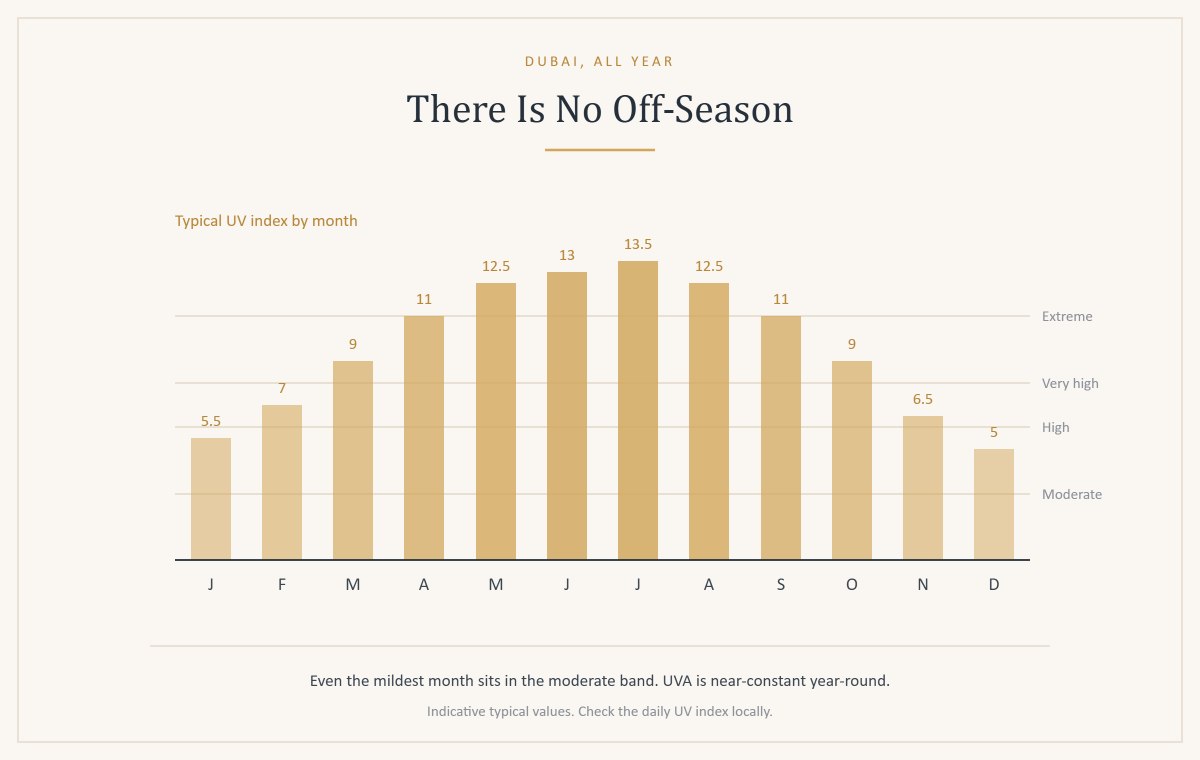
Most skincare advice is written for temperate climates. Dubai is not one. Here the ultraviolet index sits in the high-risk band for the majority of the year and peaks around 13 in July — a level at which unprotected skin sustains measurable damage in minutes. Add persistent air conditioning, and a lifestyle that involves genuinely a lot of water — pools, the sea, hotel beaches — and you have a specific combination of stressors that behaves differently from anything a European routine was designed for.
This guide, prepared with Dr. Soheila Eskandari at her Dubai clinic, explains what the sun and the water are actually doing to your skin here, how to tell photoageing from simple dryness, what genuinely protects you, and which clinical treatments help once damage has accumulated.
What Dubai’s Sunlight Is Actually Doing to Your Skin
Ultraviolet radiation damages skin through two mechanisms that operate at different depths.
UVB is the shorter wavelength. It reaches the epidermis, causes sunburn, and damages DNA directly. It is strongest in the middle of the day and in the summer months. UVA is the longer wavelength and the more insidious one. It penetrates to the dermis, generates free radicals, and progressively breaks down the collagen and elastin that keep skin firm. It is present at effectively constant intensity from morning to evening, all year, and it passes through window glass and cloud.
This is why the winter here is not a safe period. Dubai’s UV index typically sits between 8 and 9 through the spring and summer — categorised as very high risk — and even the cooler months rarely drop to a level where protection is optional. Residents accumulate exposure at a rate that most people significantly underestimate, because the damage from a normal day outdoors is invisible for years.
The visible consequences accumulate in a recognisable order: pigmentation and uneven tone, then a coarsening of skin texture, then fine lines converting into permanent creases as the collagen scaffolding beneath them degrades. Along with these come the practical concerns — DNA damage and the elevated skin cancer risk that comes with chronic high UV exposure, which is a matter for a dermatologist rather than an aesthetic clinic and which any responsible practitioner will refer.
The Water Nobody Warns You About
Chlorinated pools and sea water both damage the skin barrier, by slightly different routes and to a similar end.
The barrier is the outermost layer of your skin — a structure of cells and lipids whose job is to hold water in and keep irritants out. Chlorine strips those lipids. Salt water draws water out osmotically and leaves a fine abrasive residue as it dries. Both produce the same result: increased water loss through the skin, tightness, flaking, itching, and heightened sensitivity. In people with eczema, psoriasis or rosacea, both are reliable triggers.
The compounding factor is that a damaged barrier is a less effective shield against ultraviolet damage — and both swimming and towel-drying physically remove sunscreen. The pool and the sun are not two separate problems. They are one problem that makes itself worse.
| What you notice | Likely cause | What actually helps |
|---|---|---|
| Brown patches, uneven tone | UV-driven pigmentation, melasma | Strict SPF, pigment-directed treatment |
| Tightness, flaking after swimming | Barrier disruption from chlorine or salt | Rinse immediately, barrier repair moisturiser |
| Dull, grey, rough texture | Accumulated photodamage | Skin boosters, microneedling, resurfacing |
| Crepey skin, loss of firmness | Collagen and elastin degradation | Bioremodelling, biostimulators |
| Lines that stay at rest | Static lines on a damaged dermis | Combination — skin quality plus injectables |
What Actually Protects You Here
Prevention is unglamorous and it outperforms every treatment in this article. The following is the short list that matters in this climate.
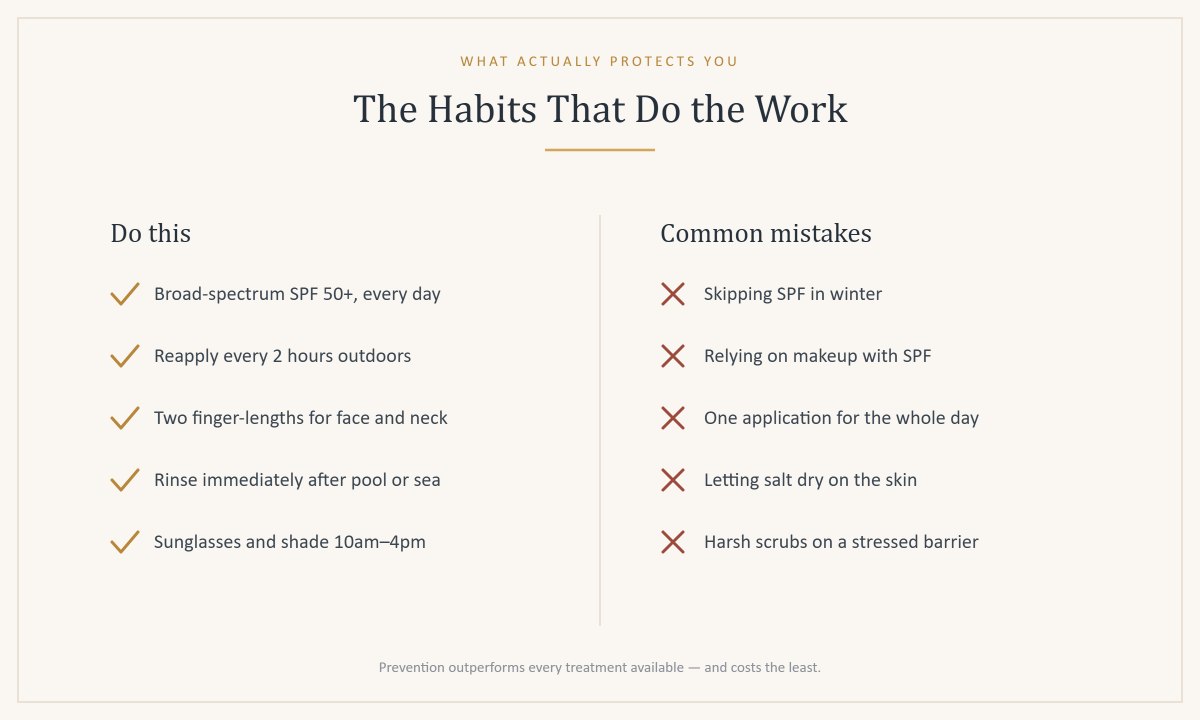
Broad-spectrum SPF 50+, every day, all year
“Broad-spectrum” is the operative word — an SPF number alone describes UVB protection. UVA is what degrades your collagen, and it does not take the winter off. Daily application, including on cloudy days and days spent largely indoors near windows.
Reapplication is where almost everyone fails
Every two hours outdoors, and immediately after swimming or towelling dry. A single morning application is close to worthless by mid-afternoon in a Dubai summer. If reapplication over makeup is the obstacle, a powder or spray formulation solves it.
Quantity — most people use a third of what they need
Roughly two finger-lengths of product for the face and neck. Applying a thin layer of SPF 50 delivers protection closer to SPF 15.
Rinse straight after the pool or the sea
Fresh water, immediately, before the chlorine or salt dries onto the skin. Then a proper barrier-repair moisturiser — ceramides, glycerin, fatty acids — onto damp skin. This one habit prevents most swimming-related skin complaints.
Sunglasses, and shade between 10am and 4pm
Sunglasses do two jobs: they protect the thin periorbital skin, and they stop you squinting — which is a genuine driver of crow’s feet in this glare.
Antioxidants in the morning, retinoid at night
A vitamin C serum in the morning helps neutralise free radicals that sunscreen does not stop. A retinoid at night supports collagen repair. Introduce a retinoid slowly here — with a compromised barrier and high UV exposure, aggressive use causes more problems than it solves.
Choosing a Sunscreen That You Will Actually Wear
The best sunscreen is the one you apply generously and reapply without resenting it. In this climate that usually rules out heavy, occlusive formulations, because nobody reapplies something that feels like a mask at 42 degrees.
- Mineral filters (zinc oxide, titanium dioxide) sit on the surface and are generally better tolerated by sensitive, reactive or post-procedure skin. Modern formulations have largely solved the white cast problem, though deeper skin tones should still test before committing.
- Chemical filters absorb ultraviolet light and tend to feel lighter and more cosmetically elegant, which in practice often means they get reapplied more honestly.
- For oily or acne-prone skin, look for gel or fluid textures labelled non-comedogenic. Fear of breakouts is one of the commonest reasons people skip sunscreen entirely — which is a far worse outcome.
- For swimming, water-resistant formulations, reapplied immediately after every swim and after towelling. “Water-resistant” describes a time limit, not immunity.
- Do not rely on makeup with SPF. The stated protection assumes a quantity of foundation nobody actually applies.
Melasma Deserves Its Own Warning
Melasma — symmetrical brown or grey-brown patches, typically across the cheeks, forehead and upper lip — is common in this region and behaves differently from ordinary sun spots. It is driven by a combination of ultraviolet exposure, visible light, heat and hormonal factors, which is why it flares in pregnancy, with some contraceptives, and reliably every Dubai summer.
Three things are worth knowing before treating it. First, it is a condition to be managed rather than cured, and relapse without strict daily sun protection is close to inevitable. Second, visible light and heat contribute — which means a conventional UV-only sunscreen is not enough, and tinted formulations containing iron oxides offer meaningful additional protection. Third, aggressive treatment frequently makes melasma worse: over-enthusiastic lasers, strong peels or harsh actives can provoke rebound pigmentation that is harder to treat than the original.
Patience and consistency outperform intensity here, which is not what most patients want to hear. See hyperpigmentation and melasma.
Clinical Options Once Damage Has Accumulated
Prevention stops further damage. It does not reverse what is already there. Where photodamage has accumulated, treatment is chosen according to which layer of the problem is dominant.
- For pigmentation and uneven tone — pigment-directed mesotherapy and a structured plan for hyperpigmentation and melasma. Melasma in particular is a long-term management problem rather than a one-session fix.
- For texture and dullness — microneedling, which triggers collagen induction, or NCTF to deliver vitamins and antioxidants into the dermis directly.
- For repair of damaged skin — Rejuran and polynucleotide treatments, which act on cellular repair pathways and are particularly relevant where the damage is chronic and UV-driven. See Rejuran versus Profhilo.
- For laxity and loss of firmness — Profhilo bioremodelling or biostimulators such as Sculptra and Radiesse, which rebuild collagen over months. Compare in our Profhilo versus skin boosters guide.
- For thin, damaged under-eye skin — a specific case covered in our guide to under-eye filler in Dubai.
- For lines that remain at rest — a combination. Botulinum toxin addresses the movement component; skin-quality treatment addresses the damaged dermis underneath. See Botox versus fillers and forehead Botox in Dubai.
All of these carry potential risks alongside their potential benefits, and all are discussed in detail before treatment. None of them work well on a patient who is not protecting the result afterwards — which is the single most consistent observation in Dr. Soheila Eskandari’s practice in this city.
A Realistic Weekly Rhythm for Dubai
- Every morning: gentle cleanse, antioxidant serum, moisturiser, broad-spectrum SPF 50+. Reapply through the day.
- Every evening: cleanse thoroughly — sunscreen and sweat need removing properly — then a barrier-supporting moisturiser. Retinoid on the nights your skin tolerates it.
- After every swim: rinse with fresh water immediately, moisturise onto damp skin.
- Weekly: gentle exfoliation at most. Aggressive scrubbing on a barrier already stressed by chlorine and sun makes things worse.
- Twice a year: a professional skin assessment — and any new, changing or asymmetric lesion checked promptly by a dermatologist, without waiting.
Frequently Asked Questions
Do I really need sunscreen in a Dubai winter?
Yes. The UV index here remains meaningful year-round, and UVA — the wavelength that degrades collagen — is present at near-constant intensity through the day and the seasons, and passes through glass.
Is the pool or the sea worse for skin?
Both disrupt the skin barrier — chlorine by stripping lipids, salt water by drawing moisture out and leaving residue. The determining factor is not which one, but whether you rinse and moisturise immediately afterwards.
Can sun damage be reversed?
Partly. Pigmentation, texture and collagen loss can all be improved with appropriate treatment. Accumulated DNA damage cannot be undone, which is why prevention outperforms every treatment available.
Why does my skin feel dry when it is 40 degrees outside?
Because you spend most of the day in air conditioning, which strips humidity from the air and from your skin. Ambient heat and skin hydration are unrelated.
Is a higher SPF number always better?
Beyond SPF 50 the incremental gain is small. Broad-spectrum coverage, adequate quantity and honest reapplication matter far more than the number on the bottle.
Will treatments work if I do not change my sun habits?
They will work, and the result will fade faster. Ultraviolet exposure degrades collagen, elastin and hyaluronic acid — including the hyaluronic acid you have paid to have injected. Sun protection is part of the treatment plan, not an accessory to it.
Does sitting by a window count as sun exposure?
For UVA, yes. Standard glass blocks most UVB but transmits a significant proportion of UVA — the wavelength responsible for collagen breakdown and much of the pigmentation. A desk beside a window, or a long drive, both contribute more than most people assume.
Is my skin darker or is that damage?
Overall deepening of tone with sun exposure is a normal protective response. Uneven patches, a mottled appearance, or discolouration that is markedly worse on the sun-exposed side of the face are photodamage rather than a tan, and they will not fade on their own once established.
I have a mark that has changed shape or colour. What should I do?
Have it assessed by a dermatologist promptly. Any new, changing, asymmetric or bleeding lesion is a medical question, not a cosmetic one, and it should not wait for an aesthetic appointment.
Have your skin assessed properly for this climate
Dr. Soheila Eskandari, DHA-licensed physician, will assess your pigmentation, texture, barrier condition and degree of photodamage, and build a plan that fits how you actually live in Dubai — including the parts that cost nothing.
Pigmentation & melasma · Book a consultation · WhatsApp +971 50 514 5129
Medically reviewed by Dr. Soheila Eskandari, DHA-licensed physician (Licence No. 00216960-005), Riviera Clinic, Umm Suqeim 1, Dubai. This article is general education and not medical advice. It does not address the diagnosis of skin cancer — any new, changing or concerning skin lesion should be assessed by a dermatologist without delay. All medical and aesthetic procedures carry potential risks and benefits, which are discussed during consultation. Individual results vary and no outcome is guaranteed. Last updated August 2026.


 English
  Arabic