
Profhilo vs Skin Boosters: What’s the Actual Difference?
Profhilo vs Skin Boosters: What’s the Actual Difference?
If your skin looks dull, crepey or simply tired — but you have no interest in changing the shape of your face — you have almost certainly been offered both Profhilo and “skin boosters.” They are frequently presented as the same treatment at two price points. They are not.
Both are injectable hyaluronic acid. Neither adds volume or alters contour. But they are placed differently, they behave differently in the tissue, and they are aiming at two different problems. Choosing the wrong one is rarely harmful — it is simply money spent on an outcome you were not actually after.
This guide, prepared with Dr. Soheila Eskandari at her Dubai clinic, sets out the real difference: how each works, what each genuinely improves, how many sessions you should expect, what they cost in the Dubai market, and how to tell which one your skin is asking for.
The Short Answer
Skin boosters hydrate. Profhilo remodels.
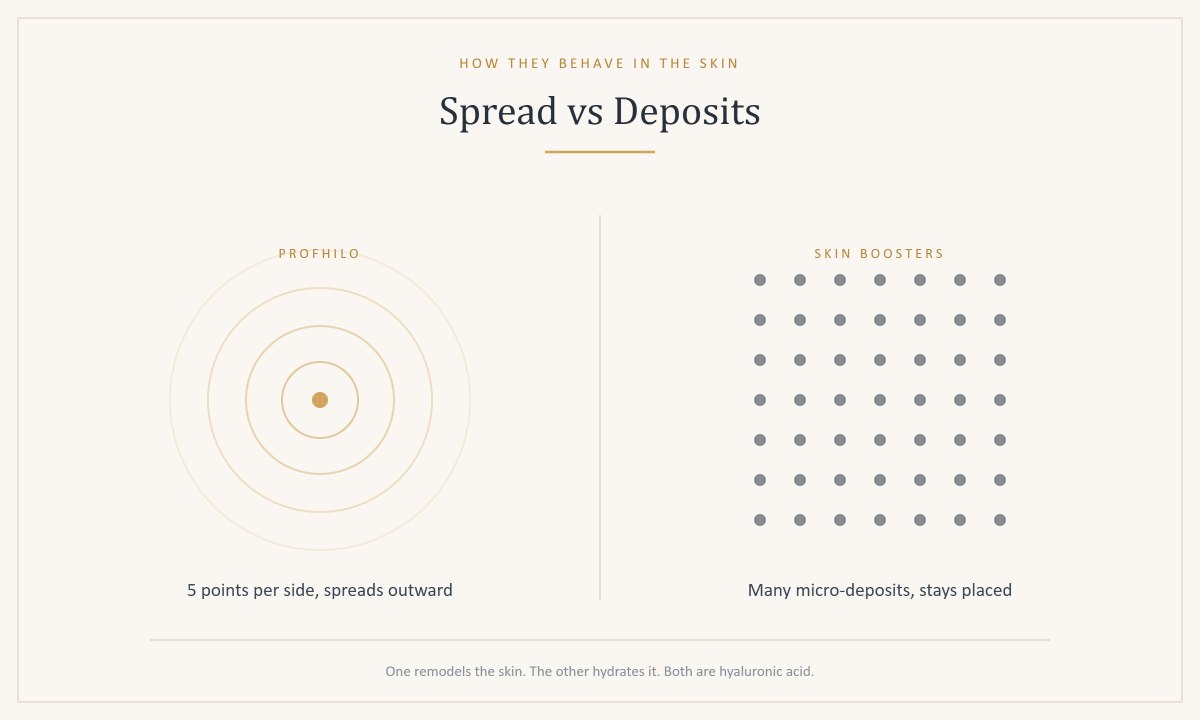
A skin booster is hyaluronic acid delivered into the dermis in many small deposits across an area. The gel holds water where it is placed, which improves hydration, softens fine lines and produces the “glass skin” glow people describe. It works locally, where each droplet sits.
Profhilo is a very high concentration of hyaluronic acid — 64 mg in 2 ml — manufactured with a technology that binds high and low molecular weight chains together without chemical cross-linking agents. It is injected at only five points on each side of the face and then spreads through the tissue plane rather than staying where the needle went. That slow spread is the point: it stimulates the skin to produce its own collagen and elastin. It is classified as a bioremodelling treatment rather than a filler or a hydrator.
Put simply: a skin booster improves the water content of your skin. Profhilo attempts to improve the skin itself.
Side by Side
| Skin Boosters | Profhilo | |
|---|---|---|
| Primary aim | Hydration, glow, fine lines | Skin laxity, firmness, quality |
| Injection pattern | Many micro-deposits in a grid | Five points per side (BAP technique) |
| Behaviour in tissue | Stays broadly where placed | Spreads through the plane |
| Mechanism | Water binding, some collagen signalling | Bioremodelling — collagen and elastin stimulation |
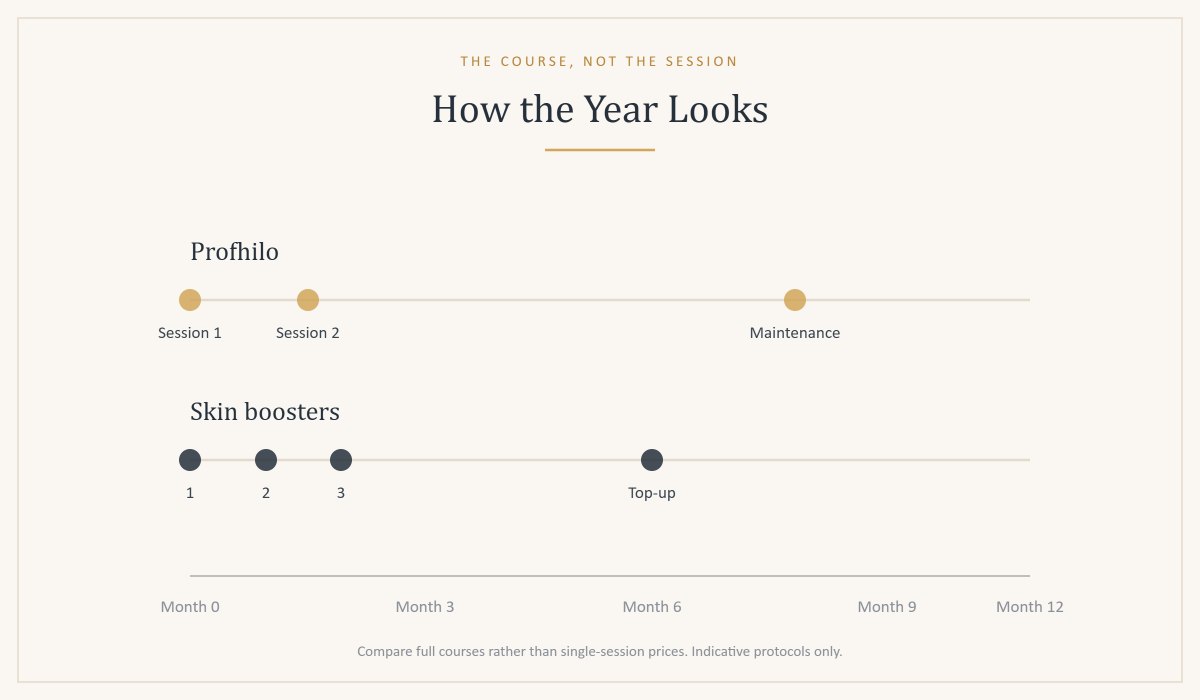
| Typical course | 3 sessions, 2–4 weeks apart | 2 sessions, 4 weeks apart |
| Maintenance | Every 4–6 months | Every 6 months |
| Visible change begins | Often after the first session | Usually after the second |
| Best suited to | Late 20s to 40s, dehydrated or dull skin | Late 30s upward, early laxity |
Where Skin Boosters Genuinely Win
“Skin booster” is a category, not a product, and the differences within it matter more than most patients are told.
Sunekos
Combines hyaluronic acid with a specific blend of six amino acids — the raw materials the skin uses to build its own collagen and elastin. It is frequently the choice around the eyes, where the skin is thin and the goal is texture rather than volume. See Sunekos.
NCTF
A mesotherapy-style cocktail of hyaluronic acid plus vitamins, minerals, amino acids, nucleic acids and antioxidants. It behaves less like a single-ingredient injectable and more like feeding the skin. Useful where the complaint is dullness and grey tone rather than laxity. See NCTF.
Jalupro
Amino acid dominant, often used where skin has become thin and crepey — the neck, the décolletage, the area under the eyes. See Jalupro.
Published work on injectable hyaluronic acid boosters reports improvements in skin hydration and elasticity of over 30% within about twelve weeks. That is a meaningful change in skin quality — but it is a change in quality, not in structure. A skin booster will not lift a jawline and should not be sold as if it might.
Where Profhilo Genuinely Wins
Profhilo’s argument is not hydration. It is the early, subtle laxity that appears in the late thirties and forties — the point at which skin has not sagged, but has stopped springing back. Cheeks that look slightly deflated. A jawline that has softened without blurring. Skin on the neck that has begun to look loose in photographs before it looks loose in the mirror.
Because it spreads rather than sitting in deposits, it treats a broad area from a small number of entry points, and because it stimulates rather than fills, the change appears gradually — typically over the weeks following the second session rather than immediately. Patients expecting a next-day result are frequently disappointed at week one and pleased at week eight.
It is also used off the face: the neck, the décolletage and the hands are common sites, and the hands in particular respond well because the complaint there is nearly always skin quality rather than shape. Read more on our Profhilo page.
The Honest Answer: Often You Want Both, Sequenced
In practice Dr. Soheila Eskandari does not treat this as a binary. A common pattern for a patient in her forties presenting with dull, slightly lax skin is bioremodelling first to address the structural quality of the dermis, then a hydrating booster later in the year to maintain surface glow. Running both at once is possible but makes it impossible to know which produced what — and that matters when you are deciding what to repeat next year.
Equally common is the opposite conversation: a patient in her early thirties who has read about Profhilo and does not need it. If the skin has no laxity, bioremodelling has little to remodel. Hydration, sun protection and possibly microneedling will do more, for less.
Neither of Them Is a Filler — and That Matters
This is the single most common misunderstanding in the consultation room. Patients arrive having seen photographs of restored cheeks and assume a skin booster will do it. It will not.
- Volume loss — hollow temples, flattened cheekbones, a receded chin — is a dermal filler or biostimulator conversation.
- Expression lines that appear on movement are a botulinum toxin conversation. Our guide to Botox versus fillers explains how to tell.
- Skin quality — texture, hydration, laxity, dullness — is where boosters and Profhilo belong.
Confusing these three is how people end up over-filled: they treat a skin-quality problem with volume, do not get the result they wanted, and add more.
The Dubai Factor
Both treatments have to work harder here than they would in Europe. Dubai’s UV index sits in the high-risk band for most of the year and peaks around 13 in July. Ultraviolet exposure degrades collagen, elastin and hyaluronic acid directly. Add year-round air conditioning, long summers indoors and frequent pool or sea swimming — chlorine and salt both strip the skin’s barrier lipids and increase water loss through the skin — and you have an environment that works against exactly what these injectables are trying to build.
The practical consequence is not that the treatments do not work. It is that daily broad-spectrum SPF is not an upsell here, it is part of the treatment. A patient who commits to bioremodelling but not to sun protection is paying to rebuild something they are actively dismantling. Rinsing after swimming and restoring the barrier with a proper moisturiser are the other two unglamorous habits that protect the investment. Our guide to sun and water damage in Dubai covers this in detail.
A Rough Guide by Decade
Age is a crude proxy for skin condition and there are plenty of exceptions, but the pattern below reflects what actually walks through the door.
- Late twenties to early thirties. Skin is usually structurally sound. The complaint is dullness, dehydration and the first fine lines, often driven by climate and lifestyle rather than ageing. A hydrating booster course, good sun protection and possibly microneedling do more here than bioremodelling. Profhilo at this age is generally treating a problem that has not arrived yet.
- Mid thirties to early forties. The transitional decade, and the one where the two treatments genuinely compete. Skin quality has started to change but laxity may be minimal. This is where a proper assessment earns its keep — pinch the cheek gently and watch how quickly it returns. Slow return points towards bioremodelling; a dull but springy cheek points towards hydration.
- Mid forties onward. Laxity is usually the dominant complaint and Profhilo is more often the right starting point, frequently alongside a biostimulator if volume has also been lost. Hydrating boosters become a maintenance layer rather than the main event.
- Any age, after significant sun exposure. Photodamaged skin sometimes needs repair before remodelling — see Rejuran versus Profhilo for where polynucleotides fit.
What They Cost in Dubai
Across the Dubai market, a single Profhilo session commonly falls in the region of AED 2,000 to AED 3,500, and the standard protocol is two sessions four weeks apart. Skin booster sessions are typically quoted lower per session — often somewhere between AED 1,200 and AED 2,500 depending on the product — but the usual course is three sessions rather than two.
These are general market ranges observed across Dubai clinics, not a price list for this clinic. Two points are worth making before you compare quotes. First, compare the course, not the session — two sessions of one treatment against three of another is not the comparison the headline price suggests. Second, ask which specific product is being used and to see the packaging; “skin booster” on an invoice tells you nothing about what is in the syringe.
What to Expect on the Day
- Time: 20–30 minutes including numbing.
- Immediately after: Profhilo leaves five small raised blebs per side which settle within roughly 24 hours. Skin boosters leave a pattern of small bumps that typically settle within 24–48 hours.
- Bruising: possible with either, more likely with boosters simply because there are more entry points.
- First 24 hours: no makeup, no touching, no heat — meaning no sauna, hammam, hot yoga or intense exercise.
- Back to normal: most patients are presentable the following day.
Risks
All medical and aesthetic procedures carry potential risks alongside their potential benefits. For both treatments the common effects are injection-site swelling, redness, small bumps and occasional bruising, all temporary. Less commonly: nodules, prolonged swelling or infection. As with any injectable, vascular events are rare but serious, which is why anatomical knowledge and appropriate technique matter more than the price on the invoice.
Neither treatment is suitable during pregnancy or breastfeeding, or over active skin infection in the treatment area. An honest medical history — including autoimmune conditions, medication and previous injectables — is part of the consultation, not a formality.
Frequently Asked Questions
Is Profhilo a skin booster?
It is often grouped with them commercially, but clinically it sits in its own category. Skin boosters primarily hydrate where they are placed; Profhilo spreads through the tissue and works by stimulating collagen and elastin production. Different mechanism, different indication.
Which gives faster results?
Skin boosters. Many patients notice improved glow after the first session. Profhilo’s effect is gradual and is usually judged four to eight weeks after the second session.
Can I have both?
Yes, but sequencing them across the year is generally more informative than combining them in one appointment, because you can tell which is producing what.
Will either make my face look bigger?
No. Neither adds meaningful volume. Both are intended to improve the quality of the skin, not its shape. If you want a fuller cheek, that is a different treatment.
How long do results last?
Broadly six months for Profhilo and four to six months for skin boosters, with maintenance sessions rather than a full course thereafter. Individual results vary with age, skin condition, sun exposure and lifestyle.
Is there any downtime?
Minimal. Small bumps for 24–48 hours and occasional bruising. Most patients treat on a Thursday and are unremarkable by the weekend.
Which one should I have if I can only afford one?
If your complaint is dullness and dehydration, a booster. If it is early looseness and loss of firmness, Profhilo. If you are unsure which of those two describes you, that is exactly what an assessment is for — and it is a question that a photograph and a two-minute look cannot answer.
Not sure whether your skin needs hydration or remodelling?
Dr. Soheila Eskandari will assess your skin quality, thickness and degree of laxity, and recommend the treatment that matches what is actually bothering you — including the option of neither.
Skin boosters · Book a consultation · WhatsApp +971 50 514 5129
Medically reviewed by Dr. Soheila Eskandari, DHA-licensed physician (Licence No. 00216960-005), Riviera Clinic, Umm Suqeim 1, Dubai. This article is general education and not medical advice. All medical and aesthetic procedures carry potential risks and benefits, which are discussed during consultation. Individual results vary and no outcome is guaranteed. Prices quoted are general Dubai market ranges observed at the time of writing and are not a quotation. Last updated August 2026.


 English
  Arabic