
Jawline Filler in Dubai: Who It Suits, Who It Does Not
Jawline Filler in Dubai: Who It Suits, Who It Does Not
Jawline filler has become the treatment patients ask for by name. They arrive with a photograph — sometimes their own from ten years ago, sometimes someone else’s — and a clear idea that a syringe or two will produce the sharp mandibular line in the image. Occasionally that is exactly what happens. Often the honest answer is that filler is the wrong tool for the problem in front of me, and saying so is the most useful thing a consultation can do.
This guide sets out how a jawline is actually assessed, who gets a good result, who does not, what the anatomy demands in terms of safety, and what the treatment realistically costs and lasts.
What Jawline Filler Actually Does
Jawline filler restores or augments the bony framework of the lower face. A firm hyaluronic acid gel is placed along the mandibular border, at the angle of the jaw, and often at the chin, to create a defined line separating face from neck.
The word “restores” is doing important work in that sentence. The mandible resorbs with age. Bone at the jaw angle and along the chin is lost gradually from the fourth decade onwards, and as the underlying scaffold shrinks, the soft tissue draped over it has less to sit on. The jawline blurs, the chin recedes slightly, and the transition to the neck softens. In that situation, filler is genuinely replacing something that has gone.
In a younger patient the goal is different. There has been no resorption, and the request is augmentation — creating more definition than the person was born with. That is a legitimate aesthetic goal, but it is a different conversation, and it has a different ceiling.
The Products Used Here Are Not the Products Used Elsewhere
Fillers vary considerably in how firm they are and how much they resist deformation. A soft, flexible gel appropriate for lips would disappear into the tissue along a jawline and produce nothing but vague fullness. Jawline work uses high-cohesivity, high-elasticity products chosen specifically for their ability to hold a defined edge against the weight of the tissue above them.
This is one reason jawline treatment costs more than people expect. The volumes are larger and the products are at the more expensive end of the range.
The Assessment That Decides Everything
The single most important question is not how much filler, but whether filler is the right answer at all. Three findings drive that decision.
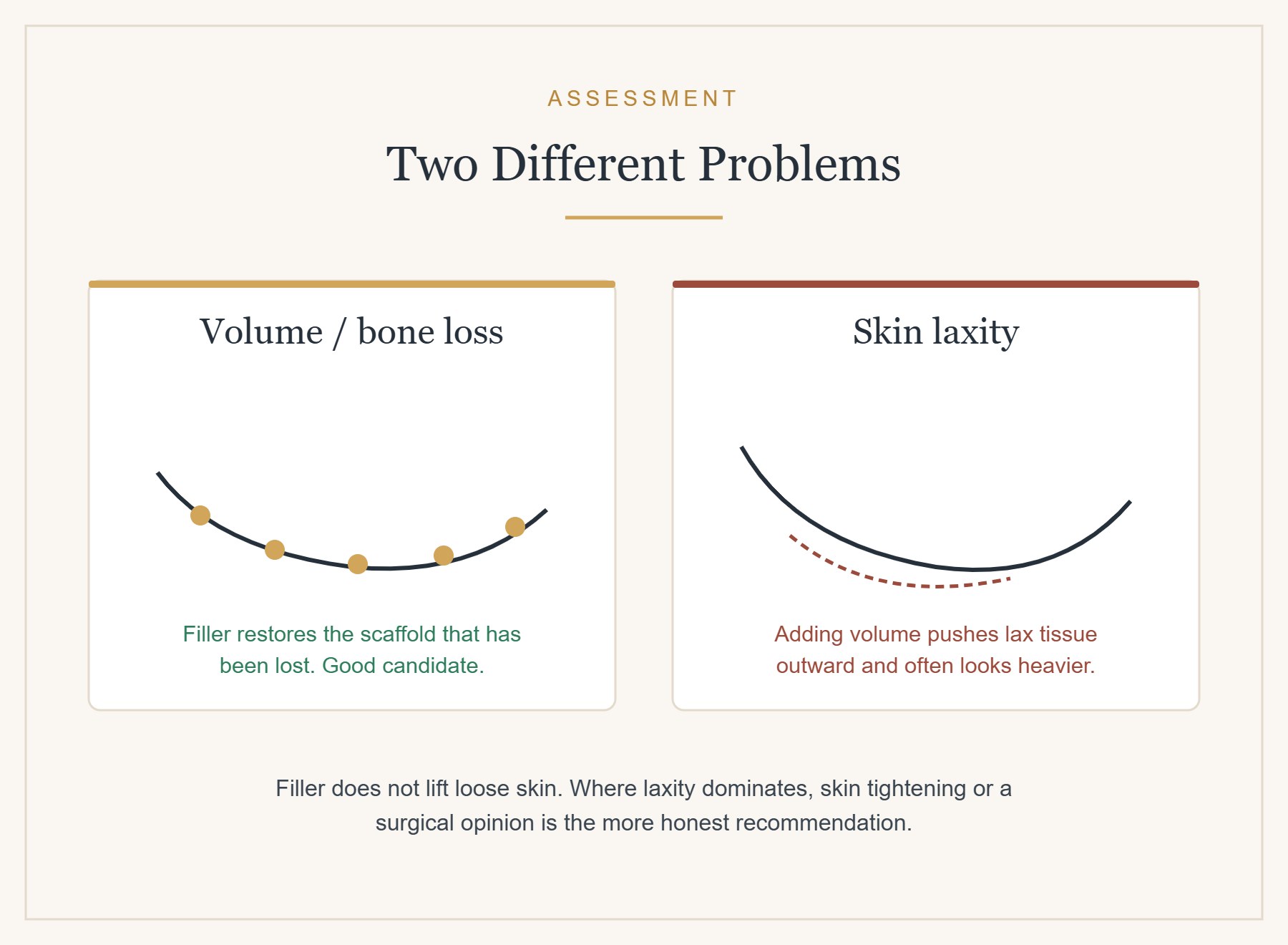
Skin laxity. This is the one that most often changes the recommendation. Pinch the skin along the jawline and release it. In skin with good elasticity it snaps back. Where it returns slowly or sits in a fold, adding volume underneath will not tighten it. It will push lax tissue outward and, in many cases, make the heaviness more obvious rather than less. A patient with significant laxity who is given four syringes of firm filler frequently looks heavier afterwards, not sharper.
Where the heaviness actually comes from. A blurred jawline can be caused by bone loss, by fat sitting below the jaw, by lax skin, by a prominent submandibular gland, or by the position of the hyoid bone in the neck. Filler addresses the first of these. It does nothing for the others. Patients who want a sharper jawline but whose issue is submental fat need a different treatment entirely, and I have written separately about fat dissolving injections for a double chin.
Facial proportion and width. A jaw that is already wide at the angle does not need lateral projection. Adding it produces a squarer, heavier lower face — a result that reads as masculinised in many female patients and is one of the more common reasons people ask to have jawline filler dissolved. In a wide face the work usually belongs at the chin and along the anterior border rather than at the angle.
Who Tends to Do Well
The best candidates have reasonable skin quality, mild to moderate loss of definition, a jaw that is not already wide, and realistic expectations about the degree of change. In that group, jawline filler is one of the more satisfying treatments in aesthetic medicine, because the change is structural and photographs well.
Who Tends to Be Disappointed
Patients with marked laxity, a heavy neck, or a mental image drawn from a heavily edited photograph. In the last group the issue is not anatomy but the reference point — the jawlines circulating on social media are frequently the product of camera angle, lighting and editing rather than injectable treatment, and no quantity of filler reproduces them.
The Anatomy That Makes This a Physician-Level Treatment
The jawline is not a low-risk area, and it is worth understanding why before choosing where to have it treated.
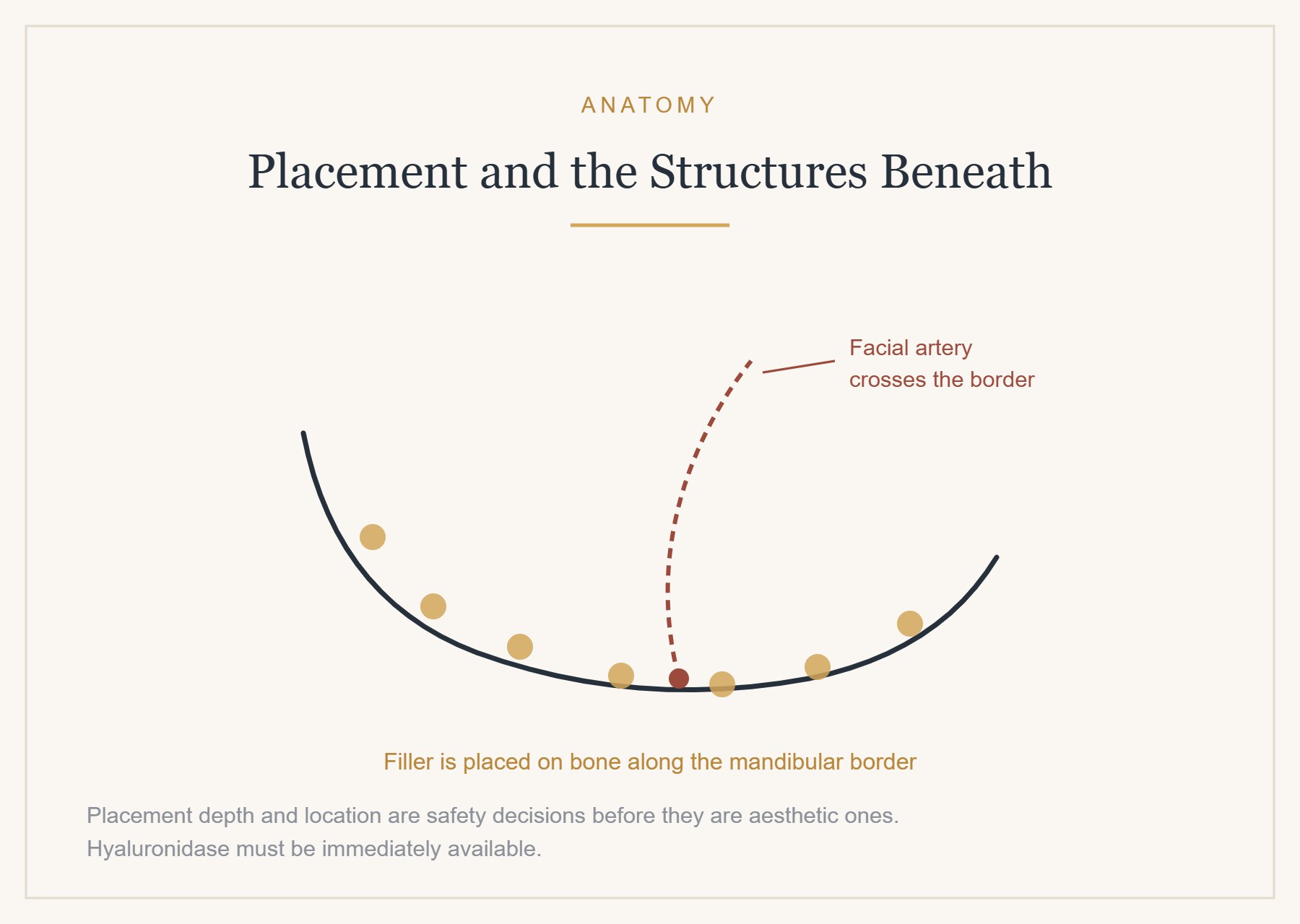
The facial artery crosses the lower border of the mandible at the anterior edge of the masseter muscle, then runs upward and forward across the face. Its branches supply the chin and lower lip. The mental neurovascular bundle emerges from the mental foramen below the second premolar. Accidental injection into an artery can obstruct blood supply to the tissue it feeds, and the consequence is tissue death in the affected area — an uncommon but serious complication.
The practical safeguards are anatomical rather than technological. Placement directly on bone in the areas where the vessels run superficially, careful aspiration, slow injection with low pressure, cannula rather than needle in the higher-risk zones, and above all an injector who knows where the vessels are rather than one who has learned a fixed pattern of injection points.
Hyaluronidase, the enzyme that dissolves hyaluronic acid filler, must be immediately available in the treatment room. If a vascular occlusion occurs, the time to treatment determines the outcome. A clinic that does not stock it, or that would need to send someone to fetch it, is not equipped for this treatment.
What the Treatment Involves
A first appointment should begin with assessment rather than product. That means examining the jawline from the front, in profile and in three-quarter view, palpating the bony border to establish where support has been lost, assessing skin quality by pinch test, and identifying whether submental fat or masseter bulk is contributing to the appearance. Photographs are taken before anything is injected.
Medical history matters here as much as anatomy. Anticoagulant medication increases bruising risk. A history of previous filler complications or biofilm, planned dental work, active infection in the area, and pregnancy or breastfeeding all affect whether and when treatment should proceed. Any previous filler needs to be established, since layering onto product of unknown extent is how gradual overfilling occurs.
Topical anaesthetic is applied for around twenty minutes. The jawline is marked while the patient is upright, since tissue position changes when lying flat. Injection takes fifteen to thirty minutes depending on the number of areas treated.
Most jawlines require between two and four syringes to produce a visible, natural result. Wider or heavier faces sometimes need more, and a chin that also needs projection adds to the total. A quote for a single syringe covering a full jawline is describing a subtle refinement, not the defined line most patients are imagining, and it is worth clarifying which of the two is on offer.
Recovery
Swelling and some bruising for three to seven days is normal. Most people return to work the following day. Firmness along the jaw as the product integrates can persist for around two weeks, and the final shape should not be judged before then — a point worth remembering before booking treatment close to an event.
Longevity and Maintenance
The firm products used along the jawline typically last twelve to eighteen months, longer than filler placed in mobile areas such as the lips. Metabolism, product choice and the amount placed all shift that range.
An important caution concerns repeat treatment. Filler in this area does not always fully resolve before the next appointment, and layering new product onto residual old product across several years is how faces gradually become heavier without any single treatment appearing excessive. Periodic assessment of what is already present — and occasionally a period without treatment — is part of doing this well.
How Jawline Filler Sits Alongside Other Treatments
Jawline definition is rarely a single-treatment question, and understanding what each option does prevents money being spent on the wrong one.
Botulinum toxin to the masseter narrows the lower face by reducing the bulk of the chewing muscle. In a patient whose lower face is wide because of masseter hypertrophy, this is the treatment that changes the shape — and adding filler to the angle in that person would make the width worse. The two treatments pull in opposite directions, so establishing which problem is present comes first.
Skin tightening devices address mild laxity by heating the dermis to stimulate collagen. Results are gradual and modest, but in a patient with early laxity, tightening before filler often produces a better platform for subsequent structural work.
Fat reduction under the chin addresses submental fullness. Where the jawline is obscured by fat rather than blurred by bone loss, this is the relevant intervention.
Surgery — whether a neck lift or a chin implant — remains the correct answer for significant laxity or substantial skeletal deficiency. An implant provides permanent projection that no quantity of filler reproduces, and for a young patient with a markedly recessive chin it is often the more economical decision over a lifetime.
The Sequencing Question
When several of these apply, order matters. Muscle reduction and fat reduction change the shape of the area, so placing filler first means placing it against a framework that is about to alter. In practice, structural problems are usually addressed before refinement: reduce what is excessive, then add where there is deficiency.
Judging the Result Honestly
Two habits make a substantial difference to satisfaction.
The first is standardised photography — the same distance, the same angle, the same lighting, before treatment and at two weeks. Memory for one’s own face is unreliable, and patients routinely either forget how the jawline looked beforehand or judge the result against a mental image that was never accurate.
The second is assessing in profile and three-quarter view rather than only from the front. Jawline definition is substantially a profile characteristic, and the front-on mirror view under bathroom lighting is the least informative angle available.
Costs in Dubai
Market pricing for jawline filler generally runs from roughly AED 1,800 to AED 3,500 per syringe, depending on the product used and the experience of the injector. A typical jawline treatment therefore falls somewhere between AED 4,000 and AED 12,000.
Unusually low per-syringe pricing warrants questions rather than enthusiasm. The cost of a genuine, well-sourced product is largely fixed, and price is also covering the assessment, the injector’s training, and whether the clinic is equipped to manage a vascular complication.
Frequently Asked Questions
How much filler does a jawline need?
Most jawlines take somewhere between two and four syringes for a visible, natural result, with heavier or wider faces sometimes requiring more. Anyone quoting a single syringe for a full jawline is usually describing a subtle refinement rather than genuine definition.
How long does jawline filler last?
Typically twelve to eighteen months for the firmer hyaluronic acid products used along the mandible, which are chosen for their ability to hold shape. Movement, metabolism and product choice all shift that range.
Does jawline filler help a double chin?
No, and this is the most common misunderstanding. A double chin is submental fat sitting below the jawline, while filler works on the bony border above it. Adding filler to a heavy neck can sharpen the boundary slightly but does not remove fat.
Is jawline filler safe?
In trained hands it has a good safety record, but the jawline is not a low-risk area. The facial artery crosses the mandibular border and accidental intravascular injection can cause tissue loss. This is a treatment for a physician who knows the anatomy and keeps hyaluronidase immediately available.
Will jawline filler make my face look wider?
It can if it is overdone or placed too laterally, particularly in a face that is already wide at the angle. A well-planned result follows your existing bone structure rather than adding width to it.
Can jawline filler be dissolved?
Yes. Hyaluronic acid fillers can be dissolved with hyaluronidase, usually within a few days of an appointment. This is one reason hyaluronic acid is preferred over permanent products in this area.
Does it hurt?
Most patients describe pressure rather than sharp pain. Topical anaesthetic is standard, the products contain lidocaine, and treatment along the bone is generally better tolerated than superficial injection.
What is the recovery like?
Swelling and some bruising for three to seven days is normal. Most people return to work the next day. Firm swelling along the jaw can take two weeks to settle fully, so the final shape should not be judged before then.
Am I too young or too old for jawline filler?
Age matters less than skin quality and proportion. In a younger patient with good skin tone, filler defines structure well. Where there is significant laxity, filler alone tends to disappoint, and skin tightening or a surgical opinion is the more honest recommendation.
How much does jawline filler cost in Dubai?
Market pricing generally runs from roughly AED 1,800 to AED 3,500 per syringe depending on the product and the injector, so a typical jawline treatment falls somewhere between AED 4,000 and AED 12,000. Price varies with product choice and the amount genuinely required.
This article is general information about aesthetic and dermatological treatments and is not medical advice, a diagnosis, or a treatment recommendation for any individual. Outcomes vary between patients and no result is guaranteed. Prescription medications carry risks and contraindications that must be assessed by a licensed physician during a personal consultation. Dr Soheila Eskandari is licensed by the Dubai Health Authority. Prices quoted are general market ranges for information only and are not an offer.


 English
 Arabic