
Nasolabial Fold Filler in Dubai: Why the Cheek Usually Comes First
Nasolabial Fold Filler in Dubai: Why the Cheek Usually Comes First
The nasolabial fold is the most requested and most frequently mistreated area in facial aesthetics. Patients point at the lines running from the nose to the corners of the mouth and ask for them to be filled. It is an entirely reasonable request — and following it literally is, in a great many cases, both the least effective and the most dangerous way to treat the concern.
This guide explains what actually causes the nasolabial fold to deepen, why treating the cause usually beats treating the line, what the anatomical research says about the vascular risk in this specific area, and how to judge a proposed plan. Dr Soheila’s approach to this request is often to treat somewhere else entirely, and the reasoning is worth understanding before you book anywhere.
What the Nasolabial Fold Actually Is
The nasolabial fold is a normal anatomical structure. It is the boundary between the cheek and the upper lip, and it exists in every face at every age — babies have them. It is not a wrinkle and it is not a sign of damage.
What changes with age is its depth, and the reasons are structural rather than superficial:
- The deep midface deflates. Anatomical work links diminished volume of the deep medial fat compartment — which sits on the maxilla and abuts the pyriform membrane beside the nose — directly to an excess skin envelope and, in the published wording, the illusion of a more prominent nasolabial fold.
- Superficial fat descends. The superficial cheek pads become ptotic and slide downward, stacking soft tissue above the fold and deepening the crease from the other side.
- Volume loss accelerates with age. Quantitative anatomical study found that volume loss after the age of 75 in the deep compartments is roughly twice that of the superficial ones.
- Repeated animation from smiling and speech reinforces the crease over decades.
Read that list again and notice what is absent: nothing about the fold itself. Every mechanism listed happens above the fold, in the cheek. The fold is where the consequence becomes visible.

Why Injecting the Fold Is Often the Wrong Answer
If the cause of the deepened fold is a deflated deep midface, then filling the fold treats the symptom while leaving the cause untouched. Three things follow:
- The correction is incomplete. You can soften the crease, but the flattened, heavy midface that produced it is still flat and heavy.
- It can look wrong on animation. Product placed in a mobile, expression-heavy area distorts when you smile. A face that looks acceptable in a still photo and odd in conversation is a common result of this approach.
- It tends to escalate. Because the underlying cause persists, the fold deepens again and more product is added. Over several rounds this produces the heavy, over-projected upper lip and puffy nasolabial region that is instantly recognisable as filler.
The alternative is straightforward: restore the deep midface, and let the fold soften as a consequence. Research using a “smiling cadaver” model — mapping how fat compartments behave during facial animation — found that filler placed in the deep fat compartments produces natural projection both at rest and during expression, with product behaviour governed by the biomechanical stability of the compartment boundaries.
In practice, this means many patients who present asking about nasolabial folds are treated in the cheek. Our guide to cheek filler covers that treatment in detail, and it is the more relevant article for a substantial proportion of people reading this one.
When the Fold Itself Should Be Treated
Direct treatment is legitimate and appropriate in specific circumstances:
- As a finishing step after midface correction. Restore the cheek first, reassess, and treat any residual crease with a small, conservative volume. This is the most common correct use.
- A genuinely deep, etched crease that persists at rest even in a well-supported midface — often in patients with a naturally deep fold rather than an age-related one.
- Marked asymmetry where one side is structurally deeper.
- Patients for whom midface treatment is unsuitable, where a limited, well-explained direct correction is a reasonable compromise.
What should raise concern is a clinic that goes straight to injecting the fold without ever examining the midface. That is a treatment decision made without a diagnosis.
The Vascular Risk — Stated Plainly
This section is the most important in the article, and it is the part that clinics tend to compress into a sentence.
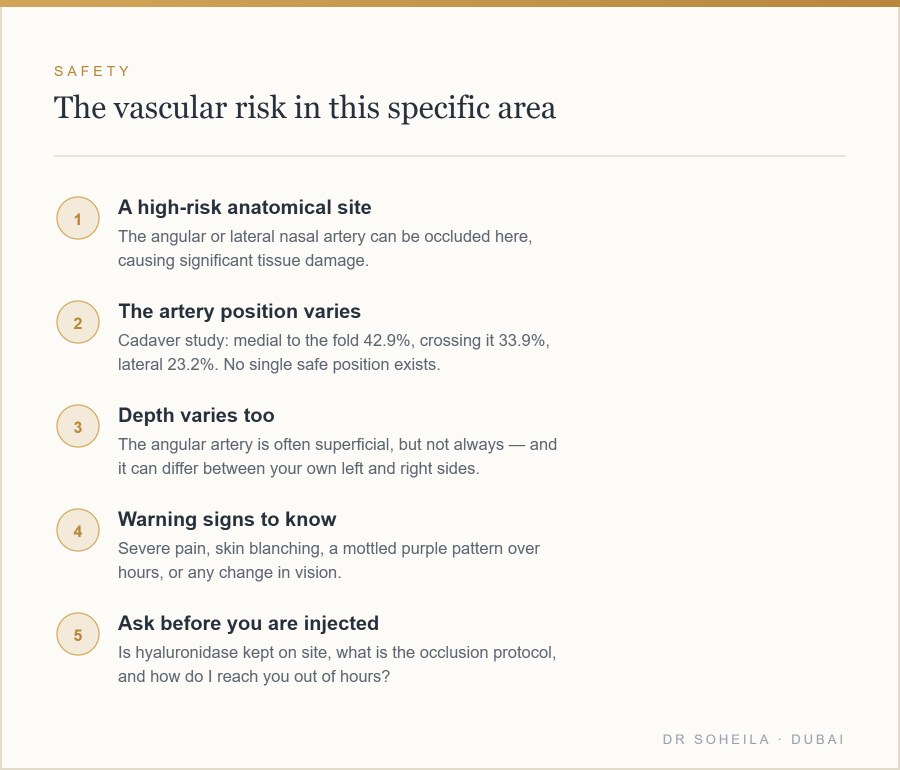
The nasolabial fold is described in the clinical literature as an anatomically high-risk site, where the angular artery or the lateral nasal artery can be occluded. Arterial compromise of the angular artery and part of the facial artery can occur during hyaluronic acid injection into the nasolabial folds, resulting in significant tissue damage.
The reason this area is dangerous is anatomical variability. Cadaveric study of the facial artery’s course relative to the fold found it runs:
| Course of the facial artery | Frequency |
|---|---|
| Medial to the fold | 42.9% |
| Crossing the fold | 33.9% |
| Lateral to the fold | 23.2% |
In other words, there is no single “safe” position that holds for everyone. The artery branches into the inferior alar and lateral nasal arteries before continuing as the angular artery, and depth is as variable as course: the angular artery is often quite superficial — which means injecting deep onto bone may be safer — but in some people it runs deep, so no plane is universally safe. Location and depth can also differ between the left and right side of the same patient.
These vessels connect to the ophthalmic circulation. Retrospective case series have documented cerebral and ocular vascular complications following cosmetic facial filler injection. This is rare, but it is the reason this area demands a physician who knows the anatomy, injects slowly with low pressure, aspirates or uses a cannula where appropriate, and has a treatment protocol ready.
Warning signs you must know before you are injected
- Severe pain disproportionate to the procedure, either during or shortly after
- Blanching — the skin turning white — during or immediately after injection
- A mottled, net-like purple pattern developing over the following hours
- Any change in vision, however brief. This is an emergency
Early intervention materially changes the outcome. Ask before treatment: do you keep hyaluronidase on site, what is your occlusion protocol, and how do I contact you out of hours? A clinic that cannot answer crisply should not be injecting this area.
How Treatment Is Actually Done
Assessment
Dr Soheila assesses the midface first — which compartment has lost volume, the degree of superficial descent, skin quality and laxity — then the fold itself: depth at rest, depth on animation, symmetry, and whether the crease is etched into the skin or purely a soft-tissue shadow. Photographs are taken in fixed lighting, frontal, three-quarter and profile, at rest and smiling.
The plan follows from that. Frequently it begins in the cheek.
Technique
Where the fold is treated directly, technique is conservative:
- Cannula is generally preferred in this region. A blunt-tipped cannula introduced through a single distant entry point tends to push vessels aside rather than pierce them — a meaningful advantage given the documented variability of arterial course
- Small volumes, slowly, with low pressure. High-pressure delivery is a recognised risk factor for intravascular events
- Appropriate plane for the individual anatomy, chosen deliberately rather than by habit
- Softer gel than would be used for structural midface work, because this is a mobile area
- Deliberate under-correction, with reassessment at two weeks rather than chasing complete flattening in one sitting
Where available, high-frequency ultrasound offers real-time, radiation-free visualisation of facial vasculature and is increasingly used to map vessels before injection in high-risk areas. Best-practice guidance recommends scanning both sides, since anatomy differs between them.
Recovery
| Time | What to expect |
|---|---|
| First 48 hours | Swelling and possible bruising at the entry point |
| Days 3–7 | Swelling settles; bruising fades |
| Week 2 | Result assessable; refinement made here if needed |
| 9–18 months | Gradual degradation. Shorter than static areas because this region moves constantly |
Aftercare
- No pressure or massage on the area for 48 hours
- No strenuous exercise, sauna or steam for 24 to 48 hours
- No alcohol for 24 hours
- Sleep on your back for two nights
- Avoid non-urgent dental work for two weeks and mention the filler to your dentist
- Report any of the warning signs above immediately, not at the next appointment
What Else Contributes — and What Else Helps
Filler is not the only lever, and in some patients it is not the main one:
- Skin quality. A crease etched into thin, sun-damaged skin persists even when the underlying volume is corrected. Collagen-stimulating treatments and biorevitalisation address that component — see our guides to amino acid skin boosters and medical microneedling
- Photoprotection. UV degrades dermal collagen and deepens etched lines. In this climate, daily SPF 50 is a structural intervention, not a cosmetic one — see our guide to sun and water damage in Dubai
- Weight stability. Significant weight loss disproportionately deflates the deep midface compartments, which is why faces can look drawn after successful weight loss
- Not smoking. Smoking impairs dermal collagen and microcirculation and measurably worsens perioral and nasolabial ageing
Cost in Dubai
Pricing is per syringe. Market rates in DHA-licensed clinics generally sit around AED 1,800 to AED 3,500 per syringe.
Direct nasolabial treatment often uses only part of a syringe when done conservatively as a finishing step. Midface-first treatment typically uses two syringes for a first session — which sounds more expensive but frequently produces a better and longer-lasting result for the same concern, and reduces the escalating top-up cycle that direct fold filling tends to create.
Ask specifically whether a two-week review is included, which product will be used and why, and whether the quote covers the cheek or only the fold. Our article on aesthetic pricing in Dubai covers what sits behind a quoted number.
Questions to Ask Before You Book
- Have you assessed my midface, or only the fold?
- Do you think my fold is deep because of volume loss above it, or for another reason?
- Would treating my cheek address this better than treating the crease?
- Will you use a needle or a cannula here, and why?
- What plane will you inject in, given the variability of the artery in this area?
- Do you keep hyaluronidase on site, and what is your vascular occlusion protocol?
- How do I reach you out of hours if something looks wrong?
- Is a two-week review included?
- Are you and the clinic currently DHA-licensed for this treatment?
Treating With Dr Soheila
Dr Soheila Eskandari treats the nasolabial fold as a downstream sign rather than a target in itself. In practice that means a meaningful proportion of patients who arrive asking about these lines are treated in the cheek — and are shown at the two-week review that the fold has softened without anything having been injected into it.
Where direct treatment is appropriate, it is done conservatively: cannula where indicated, small volumes delivered slowly at low pressure, deliberate under-correction, and a review before adding anything further. The vascular anatomy of this region is discussed with the patient rather than glossed over, because a patient who knows what blanching and mottling look like is a patient who calls early — and early intervention is what determines the outcome in the rare event that something goes wrong.
Patients seeking dramatic flattening of a deeply etched fold in a single session are told honestly that this is not achievable safely, and what a staged plan across several months would look like instead.
Frequently Asked Questions
Should I fill my nasolabial folds directly?
Often not as the first step. Anatomical research links loss of volume in the deep medial fat compartment of the cheek to an excess skin envelope and the illusion of a more prominent nasolabial fold. Restoring midface support treats the cause; filling the crease treats the symptom and tends to escalate over repeated sessions.
Why is the nasolabial fold considered high-risk?
Because the facial and angular arteries run through the region with highly variable anatomy. Cadaveric study found the facial artery runs medial to the fold 42.9% of the time, crossing it 33.9%, and lateral 23.2% — and depth varies too, sometimes differing between a patient’s own left and right sides.
Is a cannula safer than a needle here?
A blunt-tipped cannula tends to push vessels aside rather than pierce them, which is a meaningful advantage given the documented variability of arterial course in this area. It is not a guarantee of safety, and technique, injection pressure and plane selection all matter alongside the instrument.
What are the warning signs of a vascular problem?
Severe pain disproportionate to the procedure, blanching of the skin, a mottled net-like purple pattern developing over hours, and any change in vision. Any of these requires immediate contact with your clinic. Early intervention materially changes the outcome.
How long does nasolabial filler last?
Typically 9 to 18 months. This is shorter than static areas such as the deep midface or chin, because the region moves constantly with speech and expression and mechanical stress accelerates breakdown.
Will filling my nasolabial folds make my face look puffy?
It can, if the underlying cause is not addressed and product is repeatedly added to a mobile area. The recognisable over-filled perioral appearance usually results from several rounds of direct fold filling without midface correction.
Can nasolabial filler be reversed?
Yes, if hyaluronic acid is used. Hyaluronidase dissolves it, generally within a day or two. This reversibility is one reason hyaluronic acid remains the standard choice in this high-risk area.
What if my folds are deep but my cheeks look full?
Then direct treatment may well be appropriate — some people have a naturally deep fold rather than an age-related one. The point is that this should be a conclusion reached after assessing the midface, not an assumption made before.
Does anything non-injectable help?
Skin quality treatments help the etched component of the crease, and daily photoprotection slows its progression. Weight stability matters because significant weight loss disproportionately deflates the deep midface. None of these replace volume correction where volume is genuinely lost.
How much does nasolabial filler cost in Dubai?
Market rates in DHA-licensed clinics generally run AED 1,800 to AED 3,500 per syringe. Conservative direct treatment often uses part of a syringe; midface-first treatment typically uses two but frequently gives a better and longer-lasting result for the same concern.
This article is general information about aesthetic treatments and is not medical advice, a diagnosis, or a treatment recommendation for any individual. Outcomes vary between patients and no result is guaranteed. Dermal filler injection carries a rare but serious risk of vascular complication that should be discussed in full with a licensed physician during a personal consultation. Dr Soheila Eskandari is licensed by the Dubai Health Authority. Prices quoted are general market ranges for information only and are not an offer.


 English
  Arabic