
Masseter Botox vs Jawline Filler in Dubai: Slimming or Defining the Lower Face
Masseter Botox vs Jawline Filler in Dubai: Slimming or Defining the Lower Face
People who ask for a “better jawline” are often asking for opposite things. Some want a narrower, softer lower face. Others want a sharper, more defined one. Masseter Botox and jawline filler are both requested under that one heading, yet they pull in opposite directions: one reduces width by relaxing a muscle, the other adds structure with a gel.
That is why the wrong choice can leave a face looking worse than it started. Gel placed along a jaw that is already wide from muscle adds to its width, and a muscle relaxant given to a face that lacked structure can leave it flatter. Neither treatment is better in general. The right one depends on what is shaping your lower face, which is a question for an examination before it is a question of product.
Two Treatments With Opposite Goals
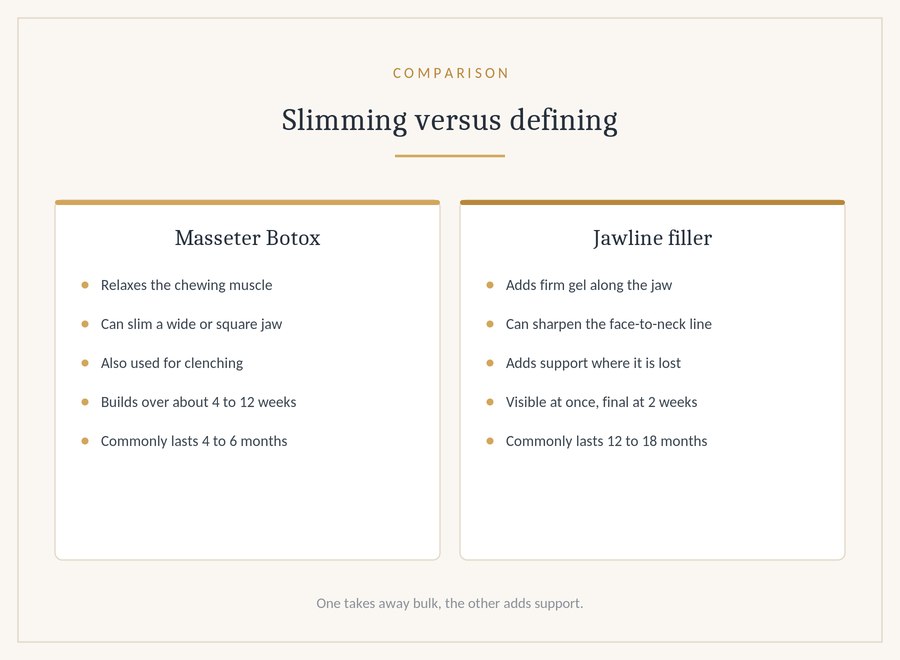
Masseter Botox. Botulinum toxin is injected into the masseter, the thick chewing muscle that runs from the cheekbone to the angle of the jaw. It weakens the muscle, so clenching is less forceful, and a muscle that works less gradually becomes smaller. The aim is to narrow a wide or square lower face. It is also used for clenching and night-time grinding. The guide to masseter Botox and jawline slimming covers it in more detail.
Jawline filler. A firm hyaluronic acid gel is placed deep along the edge of the jawbone, at its angle and often at the chin. It adds volume where support has been lost or was never strong, which sharpens the line between face and neck. The aim is definition, not narrowing. Its planning is covered in the guide to jawline filler.
Put simply, masseter Botox takes away what is excessive, and jawline filler adds what is missing.
Start With the Cause, Not the Treatment
The outline of the lower face is set by the jaw bone, the chewing muscle, the fat over them and the quality of the skin. Each treatment addresses only one of these, so working out which is responsible comes first.
Muscle Bulk
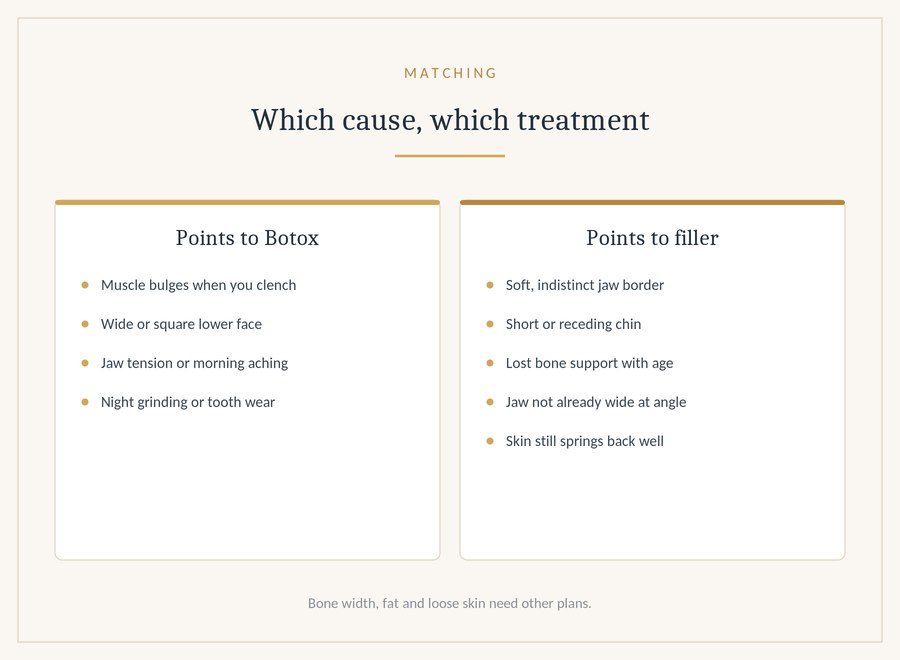
If a firm block of muscle bulges at the angle of the jaw when you clench, an enlarged masseter is probably adding to the width. Clenching, grinding, gum chewing and genetics can all enlarge it. This is the case for masseter Botox, whereas filler would only add more width.
Bone Structure
A wide or squared jaw can be skeletal. If nothing bulges on clenching, the width comes from bone or soft tissue, and toxin will change very little. Filler cannot narrow bone either, so the realistic choices are to accept the shape or to take a surgical opinion.
Fat
Fullness in the lower cheeks, along the jowls or under the chin can pass for a wide or soft jaw. Toxin does not act on fat, and filler can make fullness more obvious.
Skin Laxity and Jowls
When skin and soft tissue slacken, the border of the jaw blurs and jowls form. Neither treatment tightens skin: gel under loose tissue can add weight rather than definition, and shrinking a muscle beneath loose skin can make the looseness more visible.
An examination settles the question. The physician watches you clench, feels the muscle, checks how quickly the skin springs back and studies your face from the front and the side. Ultrasound can measure muscle thickness if needed. Many faces involve more than one cause, so combined plans are common, as discussed in the guide to face contouring.
How Each One Works
Masseter Botox
Botulinum toxin blocks the nerve signal that tells the muscle to contract. The muscle weakens, and because it is used less, it slowly loses bulk. Doses are individual and well above those for a single wrinkle area. Trials of one widely studied product compared totals of 48 and 72 units with placebo, but no consensus dose has been agreed. Injections go into the lower part of the muscle, within a defined zone, so that the toxin stays away from the muscles that move the mouth. How this use is licensed differs between countries, and the physician should explain it.
Jawline Filler
A firm, cohesive hyaluronic acid gel is placed deep, on or close to the bone, at chosen points along the jaw and often at the chin. Plans commonly use two to four syringes, sometimes more, and may include a small adjustment after a few weeks. The gel can be dissolved with an enzyme, hyaluronidase, which is one reason it is used here. The comparison of chin and jawline filler explains how the two areas are planned together.
When Results Show and How Long They Last
Masseter Botox builds slowly. Clenching force begins to fall within a week or two. The change in shape comes later, as the muscle shrinks: some difference is usually visible by about a month, and the effect peaks around three months. In a phase 3 placebo-controlled trial, mostly in Asian adults with marked masseter prominence, lower face width fell by about 5 mm on average at three months, and benefit was still present at six months. The muscle-relaxing effect fades over roughly three to four months, and the slimming commonly lasts a little longer, around four to six months. If treatment is discontinued, the muscle gradually regains its size.
Jawline filler shows at once. The new shape is visible straight away, though swelling hides the final result for about two weeks. Firm gels in this region commonly last twelve to eighteen months. In a randomised trial of a gel designed for the jawline, most participants still rated their jawline as improved at twelve months. The gel then softens gradually as the body absorbs it.
Neither usually needs time off work, though bruising is possible and strenuous exercise is avoided for the first day or two.
Who Suits Which
Where Masseter Botox Fits
A masseter that bulges on clenching. A wide or square lower face with a firm block of muscle at the angle is a clear fit.
Clenching and grinding. Jaw tension, morning aching and tooth wear are further reasons, alongside a dentist’s advice on a night guard.
Where Jawline Filler Fits
A soft, indistinct border. Loss of bone support with age, or a jaw that was never strongly defined, can respond well when the skin is still elastic and the jaw is not already wide at the angle.
A short or receding chin. A chin that sits behind the lips weakens the profile of the lower face and is judged from the side. Treating it first often reduces the amount needed along the jaw. The guide to chin filler describes how projection is planned.
Where Neither Fits Well
Width that is mainly bone or fat, and marked skin laxity, suit neither treatment. A very slim face suits toxin poorly, because reducing the muscle can leave it gaunt. Expectations drawn from heavily edited photographs are rarely met by either. Jaw pain, clicking or locking calls for a dental or maxillofacial opinion before any injection.
Using Both Together, and in What Order
Combining makes sense when a face has two separate problems: a bulky masseter that widens the lower face, and a short or soft chin and front of the jaw. Toxin narrows the angle, and filler then supports the chin and the area in front of the jowl, so the lower face reads as tapered rather than simply smaller. Adding volume at the angle of a jaw that is also being slimmed rarely makes sense, because the two work against each other.
Order matters. A common approach is to treat the muscle first and review after eight to twelve weeks, once the contour has settled, because filler is easier to judge against the new outline. If both are given at one visit, consensus guidance is that filler goes in first and the toxin follows, with the filler aftercare applied.
Men and Women: Different Starting Points
Goals vary between individuals, and these are tendencies rather than rules. Many women ask for a tapered, smooth lower face, so slimming and support at the chin are common requests, with care taken not to add width at the angle. Many men ask for a strong, angular outline, so filler along the jaw and at the chin is common, and a large masseter may be treated lightly or left alone.
Side Effects and Risks
Risks of Masseter Botox
Tenderness, small bruises and chewing tiredness, especially with tough food, are common in the first weeks and usually settle. Less often, toxin spreads to the muscles that lift the mouth, and the smile becomes uneven or limited. Paradoxical bulging, where part of the muscle bulges more on clenching, is uncommon, affecting around 2 in 100 treated adults in one phase 3 trial. It is treated with a small additional dose or settles as the effect wears off. Repeated high doses, or treatment of a slim face, can hollow the cheeks. Studies disagree on whether repeated injections affect the jaw bone, which is a reason to use the lowest effective dose. Very rarely, toxin affects muscles beyond the treated area; difficulty swallowing, speaking or breathing needs urgent medical attention.
Risks of Jawline Filler
Swelling, tenderness, bruising and small lumps are expected and usually settle within about two weeks. Less commonly, lumps persist, the two sides differ, the gel migrates from where it was placed or looks overfilled, or an inflammatory reaction appears weeks later. The rare serious risk is vascular occlusion: the facial artery crosses the lower border of the jaw, and gel that blocks or compresses a vessel can damage the skin it supplies. Severe or increasing pain, skin that turns pale, dusky or mottled, or any change in vision needs same-day medical attention, and hyaluronidase should be on site.
Who Should Avoid Treatment
Both treatments are postponed in pregnancy and breastfeeding, because there is too little evidence about their effects. They are also postponed during infection or inflammation in the area, including a dental infection. Both are avoided with a known allergy to an ingredient, and both are intended for adults whose facial growth is complete.
For toxin, neuromuscular conditions such as myasthenia gravis, and some medicines, including certain antibiotics, change the response and need a physician’s review. For filler, bleeding disorders and blood-thinning medicines increase bruising, and a history of severe allergy, active autoimmune disease or earlier non-absorbable filler in the jaw needs careful assessment. Only a licensed physician examining you in person can judge whether either treatment is suitable.
Cost in Dubai
Market rates generally run from around AED 1,500 to AED 3,500 per masseter Botox treatment, depending on the product and the number of units needed, and from around AED 1,800 to AED 3,500 per syringe of firm jawline filler. A full jawline often takes two to four syringes, so a complete plan commonly falls between AED 4,000 and AED 12,000.
Toxin costs less per visit but is repeated more often, so compare the total across a year. A single flat price for masseter treatment, with no mention of units or assessment, is worth questioning.
The Short Version
Masseter Botox relaxes the chewing muscle so that a wide or square lower face slims gradually over weeks, with an effect that lasts a few months and needs repeating. Jawline filler adds firm gel along the jaw to build definition at once, and commonly lasts twelve to eighteen months. One removes bulk and the other adds support, so using the wrong one can make the problem worse.
The choice follows the cause: muscle, bone, fat or loose skin. Many faces suit a sequence, with the muscle treated first and the chin or jaw supported afterwards. A licensed physician needs to examine you, in profile and on clenching, before either is recommended.
Questions Worth Asking
Is my width coming from muscle, bone, fat or loose skin? The answer should follow an examination, including watching you clench, not a photograph alone.
How many units or syringes are planned, and when is the review? Both should relate to your anatomy, with a review built in from the start.
What happens if I do not like the result? Filler can be dissolved with an enzyme, whereas toxin fades over months, so a conservative start matters.
What are the warning signs, and who do I call? A clinic should explain its plan for complications, including keeping hyaluronidase on site.
Frequently Asked Questions
Which is better, masseter Botox or jawline filler?
Neither in general, because they do opposite things. Masseter Botox narrows a lower face that is wide from muscle, and jawline filler adds definition to a jaw that lacks support. An examination of the cause decides which suits you.
How do I know whether my wide jaw is muscle?
Clench your teeth and feel the angle of the jaw. A firm block that bulges suggests muscle, while nothing bulging suggests bone or soft tissue. A physician needs to examine you to be sure.
How long does masseter Botox take to work?
Clenching force begins to fall within a week or two, and the slimming builds as the muscle shrinks, with some change by about a month and a peak around three months. The effect commonly lasts four to six months.
How long does jawline filler last?
Firm gels in this area commonly last twelve to eighteen months, then soften gradually as the body absorbs them. The shape is visible at once, though swelling means the final result is judged at about two weeks.
Can I have both treatments?
Yes, when a face has both a bulky masseter and a soft chin or jaw border. The muscle is often treated first, with a review after eight to twelve weeks. Filler at the angle of a jaw being slimmed rarely makes sense.
Can jawline filler make my face look wider?
It can, if too much is used or it is placed too far out at the angle, especially in a face already wide from muscle or bone. In a wide face the work usually belongs at the chin and in front of the jowl.
Does masseter Botox help with teeth grinding?
It lowers the force of the bite and can ease jaw tension, but the evidence that it reduces how often grinding happens is weaker. It does not remove the habit, so a dentist’s advice on a night guard still matters.
What are the main risks of each?
For toxin: chewing tiredness, an uneven smile, paradoxical bulging and, with repeated high doses, hollowing. For filler: swelling, lumps, asymmetry, migrating gel and, rarely, vascular occlusion. The gel can be dissolved if needed, whereas toxin can only wear off.
Who should avoid these treatments?
Both are postponed in pregnancy, breastfeeding and infection in the area. Toxin needs particular care with neuromuscular conditions and some antibiotics, and filler with bleeding disorders and severe allergy. A licensed physician must assess suitability in person.
What does it cost in Dubai?
Market rates generally run from around AED 1,500 to AED 3,500 per masseter Botox treatment and from around AED 1,800 to AED 3,500 per syringe of jawline filler, depending on product, dose and clinic.
This article is general information about aesthetic and dermatological treatments and is not medical advice, a diagnosis, or a treatment recommendation for any individual. Outcomes vary between patients and no result is guaranteed. Prescription medications and injectable products carry risks and contraindications that must be assessed by a licensed physician during a personal consultation. Dr Soheila Eskandari is licensed by the Dubai Health Authority. Prices quoted are general market ranges for information only and are not an offer.


 English
 Arabic