
Chin Filler vs Jawline Filler in Dubai: Which One Your Profile Needs
Chin Filler vs Jawline Filler in Dubai: Which One Your Profile Needs
Chin filler and jawline filler are often discussed as one treatment for one problem — the lower face. In practice they do different jobs, and treating one when the other was needed is the most common reason a result looks adequate from the front and wrong from the side.
The two are frequently combined, and often should be. But the decision about which does the heavy lifting is made on the profile view, not the mirror.
What Each One Changes
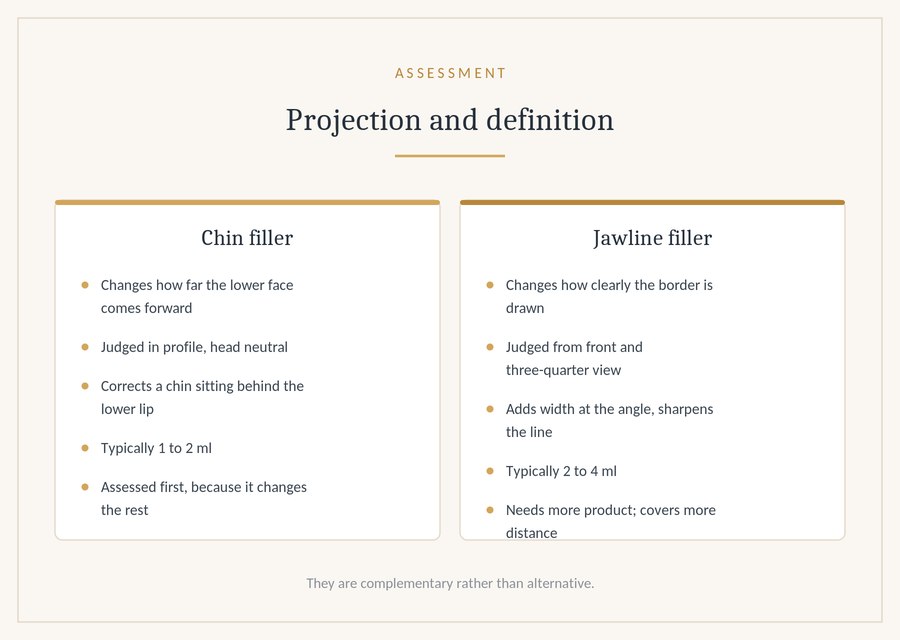
Chin filler works on projection and length. Placed at the point of the chin and along the front of the jaw, it brings the chin forward, lengthens a short lower third, or corrects a chin that recedes relative to the lips and nose. Its effect is most visible in profile.
Jawline filler works on the border. Placed along the mandibular body and at the angle, it sharpens the line between face and neck, adds width at the angle, and restores definition that has softened. Its effect is most visible from three-quarter and front views.
Put simply: the chin changes how far the lower face comes forward; the jawline changes how clearly it is outlined.
How the Right One Is Chosen
The assessment that matters takes place in profile, with the head in a neutral position.
A chin that sits noticeably behind the lower lip suggests the projection is the primary problem, and treating the jawline alone will not fix the impression of a weak lower face. Conversely, a chin with adequate projection but a soft, indistinct border suggests the jawline is where the work belongs.
In many faces both are true to some degree, and the sequence matters: establishing chin projection first changes how much jawline product is needed, and often reduces it.
The Trap of Treating the Symptom
A softened jawline is frequently the visible consequence of something else. Loss of bone support with age, descent of the fat compartments, or simple skin laxity all blur that border, and filler placed along the jaw treats the appearance rather than the cause.
Where the underlying problem is laxity, adding filler makes the lower face heavier without making it sharper — and heaviness pulls down. That distinction is an examination finding and is worth insisting on before any product is opened. The alternatives when laxity is the real issue are covered in the guide to non-surgical skin tightening.
Product, Quantity and Technique
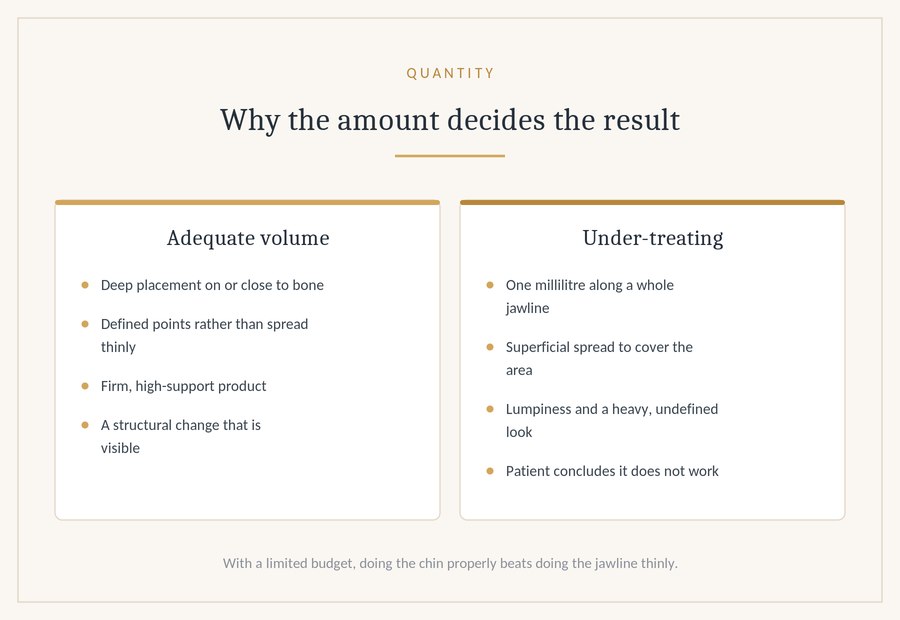
Both areas need a firm, high-support filler rather than the soft products used in lips. Structural correction requires a product that holds its shape against the weight of tissue above it.
Typical quantities are 1 to 2 ml for the chin and 2 to 4 ml across the jawline, though these vary widely with anatomy and starting point. The jawline reliably needs more, because it covers a longer distance on both sides.
Placement is deep, on or close to bone, at defined points rather than spread superficially. Superficial placement in this area produces lumpiness and a heavy, undefined look, and it is also less safe.
Why the Quantity Conversation Matters
Under-treating is common where price is the constraint. One millilitre spread thinly along an entire jawline produces almost nothing visible, and the patient concludes the treatment does not work.
The honest version of that conversation is that the area needs a certain amount of product to produce a structural change, and if that is beyond budget, doing the chin properly is a better use of the money than doing the jawline inadequately.
What to Expect Afterwards
Swelling in both areas is normal for three to five days and is often asymmetrical in the first forty-eight hours, which alarms people unnecessarily. Bruising is common along the jawline because of the vessels in the area.
The final shape should not be judged before two weeks. A review appointment at two to four weeks is the point at which a considered adjustment can be made, and building that into the plan from the start is better than deciding on day three that more is needed.
Both are reversible. Hyaluronic acid filler can be dissolved with an enzyme if the result is unsatisfactory, which is a genuine safety advantage of this category — though reversal is a medical procedure, not a routine step.
Longevity and Cost
Filler in these areas generally lasts longer than in mobile regions such as the lips, commonly twelve to eighteen months, because there is less movement to break it down.
Market rates in Dubai generally run from around AED 1,800 to AED 3,500 per millilitre for the firm products used here. Because the jawline needs more product, the cost difference between the two treatments is substantial, and a full jawline correction is often two to three times the cost of chin projection alone.
Who Is Not a Good Candidate
Significant skin laxity, as above — filler will add weight without definition.
A markedly receded chin with a dental or skeletal cause. Where the discrepancy is large, filler can soften the appearance but an orthodontic or surgical opinion gives a more honest picture of what is achievable.
Anyone whose expectation is drawn from a heavily edited image. The jawlines that circulate online frequently belong to different bone structure, and no quantity of filler produces them in a face built differently.
The Short Version
Chin filler changes projection and is judged in profile. Jawline filler changes definition and is judged from the front and three-quarter view. They are complementary rather than alternative, and the chin is usually assessed first because it changes what the jawline needs.
Both require firm product placed deep in adequate quantity, both take two weeks to judge, and neither is the right answer when the real problem is loose skin.
Questions Worth Asking
Looking at my profile, is the issue projection or definition? A practitioner who answers this specifically has done the assessment that matters.
How much product, and what happens if that is more than I want to spend? The honest answer is a smaller, well-executed correction rather than the same plan with less product.
Is any of what I am seeing caused by laxity? If the answer is yes, filler is at best part of the plan.
What is the review appointment for? A clinic that builds in a two-to-four-week review is planning for a considered result rather than a single-visit outcome.
What Else Shapes the Lower Face
Filler is one tool among several in this region, and in a number of faces it is not the first one.
Masseter treatment. Where the lower face looks wide because the chewing muscles are enlarged — often from clenching or grinding — botulinum toxin into the masseter narrows the lower face over several weeks. Adding filler to a jaw that is wide from muscle bulk makes the problem worse rather than better, and this is a distinction that should be made before any syringe is opened.
Fat under the chin. Fullness in the submental area blurs the jaw border from the side. Filler along the jaw does not remove it. Where the fullness is a discrete pocket of fat in someone with reasonable skin elasticity, a different approach applies, set out in the guide to fat-dissolving injections for a double chin.
Skin quality. Crepey skin along the jaw and upper neck reads as ageing regardless of how well the border is defined. Skin boosters and collagen-stimulating treatments address this, and they combine well with structural filler because they work on different layers.
Doing nothing. Worth stating plainly. A lower face that is simply built the way it is built — a naturally softer jaw angle, a shorter chin in proportion with the rest — is not a problem requiring correction. The reference images that drive many of these requests belong to different skeletons.
Sequencing When Several Apply
Where more than one factor is present, the order that usually works is: address muscle bulk first if it is contributing, then establish chin projection, then define the jawline, and treat skin quality alongside or afterwards.
Working in that order means each step is assessed on what remains after the previous one, and it consistently results in less total product than treating everything at once. It also spreads the cost, which for most people is the practical constraint.
Frequently Asked Questions
What is the difference between chin filler and jawline filler?
Chin filler changes projection and length, and its effect is seen in profile. Jawline filler sharpens the border between face and neck and adds definition at the angle, and its effect is seen from the front and three-quarter view. They address different aspects of the same region.
Which should I have first?
Usually the chin, because establishing projection changes how the jawline reads and often reduces the amount of product needed along it. Treating the jawline first can lead to over-filling an area that would have needed less.
How much filler is needed?
Typically 1 to 2 ml for the chin and 2 to 4 ml across the jawline, varying with anatomy. The jawline reliably needs more because it covers a longer distance on both sides, and spreading a single millilitre along it produces almost no visible change.
How long does it last?
Generally twelve to eighteen months in both areas, longer than in mobile regions such as the lips because there is less movement to break the product down. Maintenance intervals are planned around that.
Is it reversible?
Yes, when hyaluronic acid filler is used. It can be dissolved with an enzyme if the result is unsatisfactory. This is a genuine safety advantage, though reversal is a medical procedure rather than a routine adjustment.
Will it help a double chin?
Not directly. Fullness under the chin is usually fat, laxity or both, and adding filler to the jaw does not remove it. Improving the border can make the area look tidier, but the underlying fullness needs a different approach.
What is the downtime?
Swelling for three to five days is normal and often uneven in the first two days. Bruising along the jawline is common because of the vessels there. Most people are presentable within a few days, but the final shape should not be judged before two weeks.
Can filler fix a very receded chin?
It can improve the appearance, but where the discrepancy has a skeletal or dental cause there is a limit to what filler achieves. In that situation an orthodontic or surgical opinion gives a more accurate picture of what is possible.
Why does my jawline look heavier rather than sharper?
Usually because the underlying problem was skin laxity rather than volume loss, or because product was placed too superficially. Filler adds weight, and in lax tissue that weight makes the area look fuller without making the border clearer.
What does it cost in Dubai?
Market rates generally run from around AED 1,800 to AED 3,500 per millilitre for the firm products used in this region. Because the jawline requires more product, a full jawline correction commonly costs two to three times a chin correction.
This article is general information about aesthetic and dermatological treatments and is not medical advice, a diagnosis, or a treatment recommendation for any individual. Outcomes vary between patients and no result is guaranteed. Prescription medications and injectable products carry risks and contraindications that must be assessed by a licensed physician during a personal consultation. Dr Soheila Eskandari is licensed by the Dubai Health Authority. Prices quoted are general market ranges for information only and are not an offer.


 English
  Arabic