
Non-Surgical Face Contouring in Dubai: What Each Tool Actually Changes
Non-Surgical Face Contouring in Dubai: What Each Tool Actually Changes
“Face contouring” is one of the least useful phrases in aesthetic medicine, because it names a goal rather than a treatment. Two patients can walk in using the same words, wanting the same thing — a more defined face — and need almost opposite interventions. One needs volume added. The other needs volume removed.
Getting that distinction right is the entire consultation. Get it wrong and the patient pays for a treatment that makes the thing they dislike more obvious. This guide sets out the four problems that present as loss of definition, what each one actually responds to, why the order of treatment matters, and where surgery is the honest answer.
Four Different Problems, One Complaint
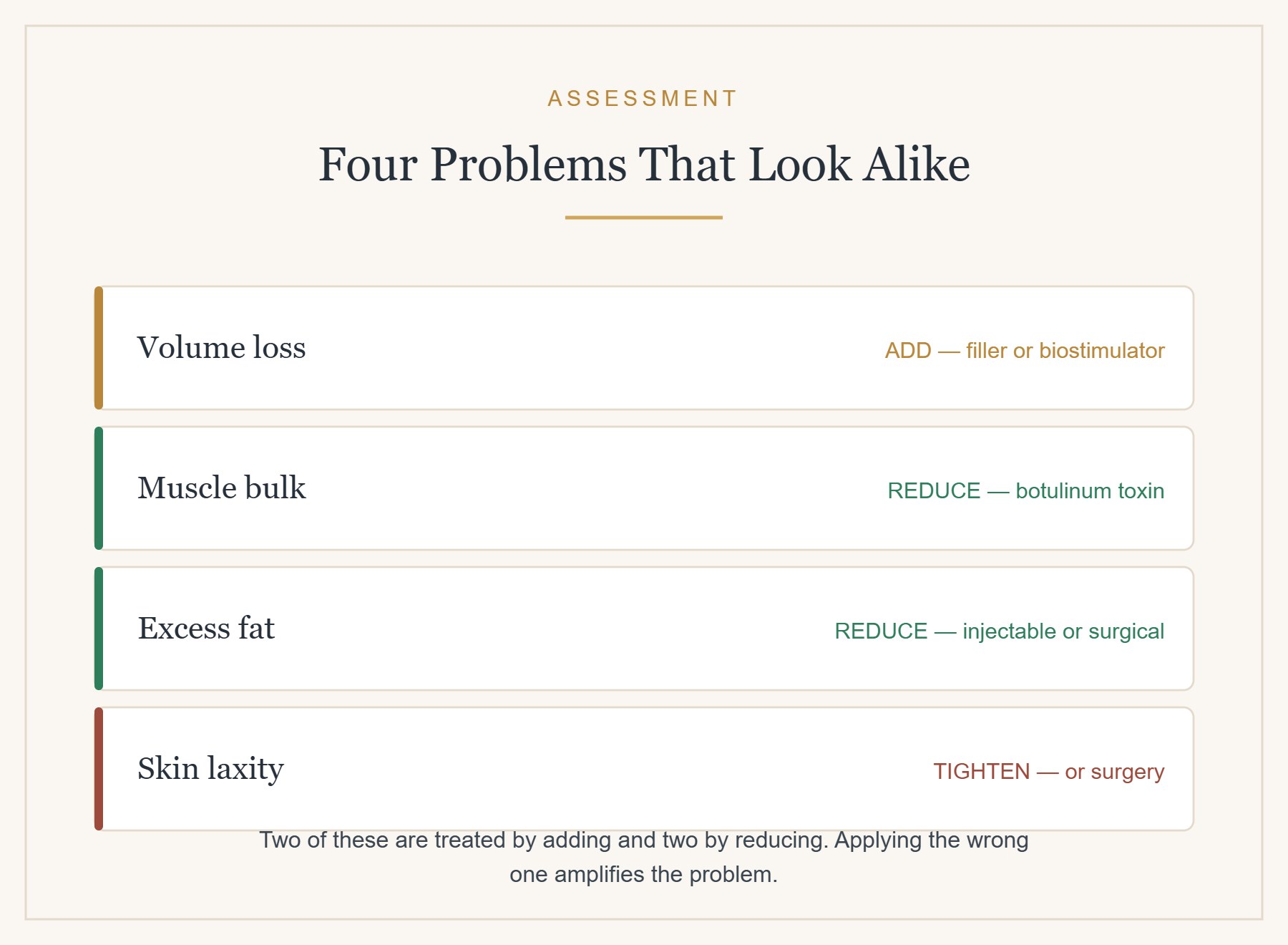
When someone says their face has lost definition, the cause is almost always one — or a combination — of the following.
Volume loss. The facial fat compartments deflate with age and the underlying bone resorbs, particularly at the jaw angle, the chin and around the eye socket. The soft tissue draped over that shrinking scaffold has less to sit on. The face reads as flatter and the jawline blurs.
Muscle bulk. The masseter, the main chewing muscle, can be genuinely enlarged — from genetics, from clenching or grinding, or from chewing habits. This widens the lower face at the angle and produces a squarer outline.
Excess fat. Fat sitting below the jawline in the submental area obscures the border between face and neck. The jaw itself may be perfectly well defined underneath it.
Skin laxity. Elasticity declines and the skin envelope becomes loose. Tissue descends, jowls form, and the jawline softens from above rather than from below.
The reason this matters so much: volume loss is treated by adding, muscle bulk and excess fat by reducing, and laxity by tightening or removing skin. Apply the wrong one and you amplify the problem.
What Each One Responds To
Volume loss
Filler restores the structure that has gone. Firm, high-elasticity products are placed along the mandibular border, at the jaw angle, at the chin and over the cheekbone, depending on where support has been lost.
Collagen biostimulators are the alternative where a more gradual, diffuse restoration suits the face better. They work by provoking the patient’s own collagen production over months rather than by placing a gel.
The practical limit: this works when skin quality is reasonable. Adding volume beneath lax skin pushes it outward and usually makes heaviness more obvious. I have covered the assessment for the lower face specifically in the guide to jawline filler in Dubai.
Muscle bulk
Botulinum toxin injected into the masseter reduces its activity, and the muscle gradually reduces in bulk over the following weeks. The lower face narrows and the outline softens from square toward oval.
The effect builds over four to six weeks and lasts roughly three to six months initially, often longer with repeated treatment as the muscle stays reduced. In patients who clench or grind, there is a functional benefit alongside the aesthetic one.
This is the treatment most commonly confused with its opposite. A patient with masseter hypertrophy who receives jawline filler at the angle gets a wider, heavier lower face — the exact result they were trying to avoid.
Excess fat
Injectable deoxycholic acid destroys fat cells in the submental area across several sessions. Submental liposuction removes a larger volume in a single procedure. Device-based cryolipolysis offers a third route.
Which is appropriate depends on volume of fat and skin quality — and critically, on establishing that the fullness really is fat rather than a low-set hyoid bone, an enlarged salivary gland or a lax platysma muscle, none of which respond. The distinctions are covered in the guide to fat dissolving injections for a double chin.
Skin laxity
Energy-based tightening — focused ultrasound or radiofrequency — produces a modest gradual improvement in mild to moderate laxity. Thread lifts reposition tissue mechanically for around nine to eighteen months in suitable candidates.
Both under-deliver where laxity is significant. That is not a failure of the technology; it is a limit of what any non-surgical approach can do to an envelope that has genuinely become too large for its contents.
Why Sequence Matters
Most patients over forty have more than one of these. That is where planning becomes more important than product selection.
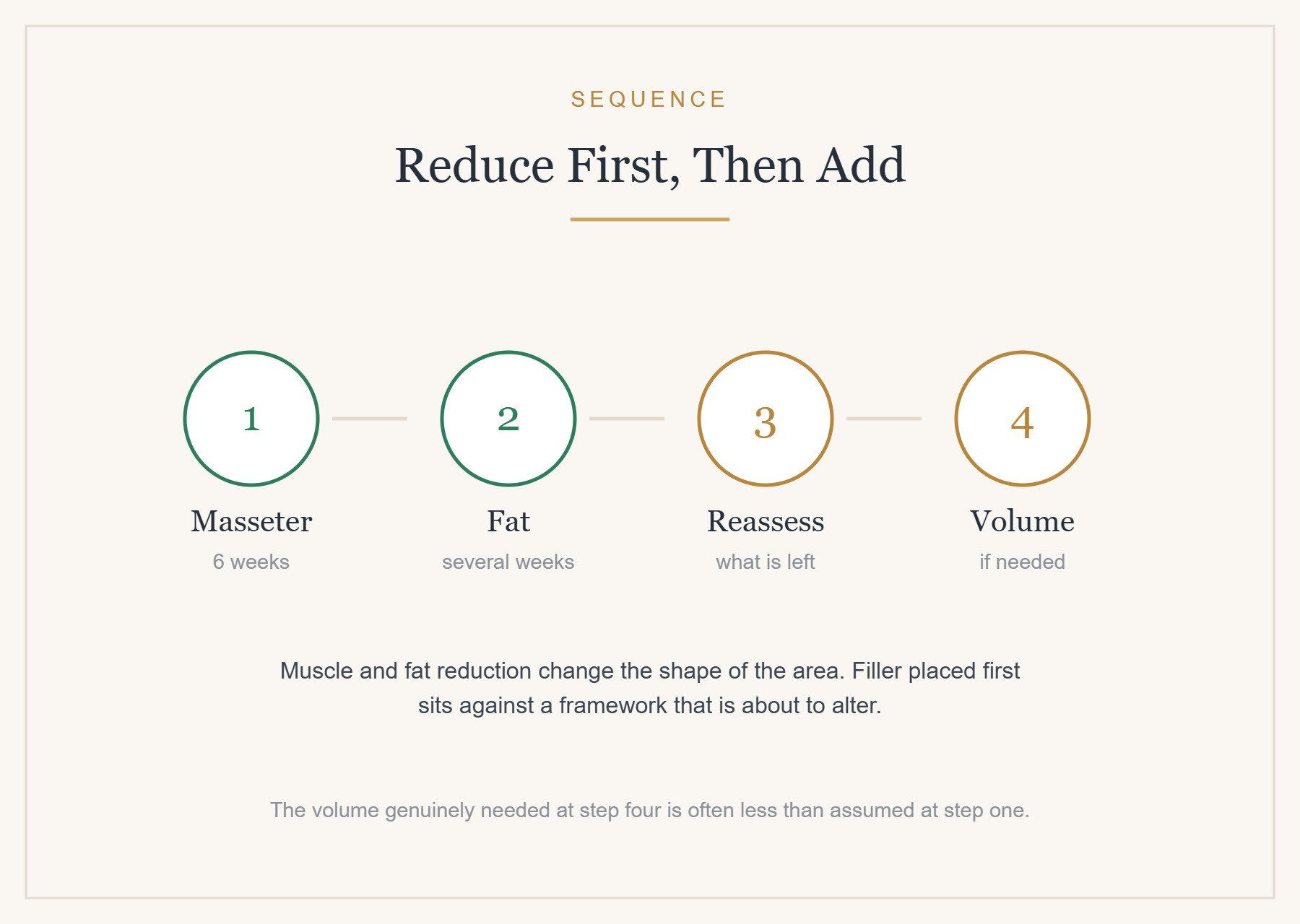
The principle is straightforward: reduce what is excessive before adding where there is deficiency.
Muscle reduction changes the width of the lower face over six weeks. Fat reduction changes the contour under the jaw over several sessions and weeks of swelling. If filler is placed first, it is being placed against a framework that is about to change shape — and the amount that looked right in week one may look wrong in week eight.
A reasonable sequence for a patient with masseter bulk, submental fat and some volume loss would be: treat the masseter first, begin fat reduction, allow both to settle, then reassess what volume is genuinely needed. Frequently it is less than was assumed at the first consultation, which is a saving rather than a disappointment.
Proportion and the Question of Whose Face
Two points about aesthetic goals deserve stating plainly.
Male and female contouring differ. A male jaw is typically wider at the angle with a flatter cheek and a more projected, squarer chin. A female contour more often follows a softer curve with the widest point higher on the face. Applying one template to the other produces results that read as wrong even when the technique was competent.
Ethnic variation is real and should be respected. In a city as diverse as Dubai, applying a single template across very different facial structures produces homogenised results. The aim is a more defined version of the patient’s own face, not conversion toward a standard.
A useful warning sign in a practitioner’s before-and-after gallery: if the after photographs across very different starting faces all converge on the same shape, a formula is being applied rather than an assessment.
Where Non-Surgical Reaches Its Limit
Three situations where an honest answer is that injectables are not the right tool.
Significant skin laxity. Devices and threads produce millimetres. A neck lift or facelift produces centimetres and lasts years. A patient with substantial laxity who spends on annual non-surgical treatment often spends more over five years than a single procedure would have cost, with a smaller result throughout.
Skeletal proportion. A markedly recessive chin or a genuinely narrow jaw is a bone issue. Filler can camouflage a degree of it; an implant or orthognathic assessment addresses it. For a young patient this comparison is worth having early rather than after several years of filler.
A large submental fat pad. Extended courses of injectable fat reduction become expensive and slow. Liposuction handles it in one stage.
Saying this costs the clinic the immediate sale. It is also the difference between a patient who trusts the advice and one who eventually works out they were sold a series.
Judging the Result
Standardised photography before treatment — same distance, same angle, same lighting — is the single most useful habit. Contouring changes are structural and gradual, and memory for one’s own face is unreliable in both directions.
Assess in profile and three-quarter view, not only from the front. Jawline and chin definition are substantially profile characteristics, and the front-on bathroom mirror is the least informative angle available.
And judge at the right time: two weeks after filler, six weeks after muscle reduction, and after the full course for fat reduction. Assessing too early produces requests for more product that would not have been made a fortnight later.
Costs in Dubai
As market ranges, and varying considerably by clinic and product:
Jawline or cheek filler generally runs from around AED 1,800 to AED 3,500 per syringe, with most treatments needing two to four. Masseter botulinum toxin typically runs AED 1,200 to AED 2,500 per session. Injectable submental fat reduction runs around AED 1,500 to AED 3,000 per session across two to four sessions. Energy-based tightening varies widely, commonly AED 2,500 to AED 8,000 for a full-face treatment.
A staged plan should be quoted per stage rather than as a single package figure, precisely because the later stages should depend on how the earlier ones settle.
The Short Version
Face contouring is not a treatment. It is a goal reached through at least four different interventions, two of which add and two of which reduce. The consultation that establishes which of them you actually need is worth more than any individual product.
If a practitioner proposes a contouring plan without examining skin elasticity, palpating the masseter, and distinguishing submental fat from the other causes of fullness, they are selling from a menu rather than assessing a face.
The Areas, and What Each Contributes
Contouring is usually discussed as a whole-face plan, but the individual areas contribute differently and are worth understanding separately.
The cheekbone and mid-face. Support here lifts the whole middle third visually. Restoring projection over the zygomatic arch is often what makes a face read as contoured rather than simply filled, and it is frequently the area that delivers the most change for the least product.
The chin. Underrated and often the highest-value single area. Projection at the chin lengthens the lower face, sharpens the profile and improves the appearance of the jawline without touching the jawline itself. In a patient with a recessive chin, treating the jaw angle before addressing the chin usually produces a wider face rather than a more defined one.
The jaw angle. Adds width and squareness. Appropriate in a narrow lower face, counterproductive in a face already wide at the angle — which is why masseter assessment precedes any decision here.
The temples. Hollowing at the temples narrows the upper third and makes the face read as top-heavy in reverse. Modest restoration here improves overall proportion and is frequently overlooked.
The submental area. Not a contouring site in the additive sense, but the single area where reduction most changes the perceived definition of the jaw.
Longevity and the Cumulative Problem
Each treatment in this category has its own duration, and mixing them creates a maintenance schedule rather than a one-off.
There is a specific risk worth naming. Filler placed in the deep structural planes does not always resolve fully before the next appointment. Repeating on a fixed calendar rather than on assessment means product accumulates, and because the change is gradual neither patient nor practitioner necessarily notices. Faces become progressively heavier over several years without any single treatment appearing excessive.
The safeguard is simple and rarely applied: assess what is already present before adding, and be willing to take a period without treatment. A practitioner who books the next appointment automatically at a fixed interval is running a schedule, not a plan.
Frequently Asked Questions
What does non-surgical face contouring actually involve?
It is a category rather than a single treatment. Depending on what is causing the loss of definition it can mean filler to restore structure, botulinum toxin to reduce muscle bulk, injectable or device-based fat reduction, skin tightening, or a combination planned in sequence.
How do I know which one I need?
By establishing what is actually causing the appearance. Bone and fat pad loss needs volume. A wide lower face from masseter bulk needs muscle reduction. Submental fullness needs fat reduction. Lax skin needs tightening or surgery. These are distinguishable on examination and pull in different directions.
Can filler alone contour a face?
In a patient whose issue is genuine volume loss with reasonable skin quality, yes. Where laxity or excess fat dominates, adding volume tends to make the face look heavier rather than more defined, which is the most common reason people are unhappy with a contouring result.
How long do the results last?
It depends on the tool. Firm fillers along the jaw and cheek typically last twelve to eighteen months, masseter botulinum toxin three to six months, injectable fat reduction is permanent for the cells destroyed, and device-based tightening produces gradual change that fades over one to two years.
Is there a risk of looking overdone?
Yes, and it usually comes from treating every area at once, repeating treatment before previous product has resolved, or adding volume to a face that needed reduction. Treating in stages and reassessing at two weeks is the practical safeguard.
How much does a full contouring plan cost in Dubai?
It varies enormously with what is required. As market ranges, jawline or cheek filler generally runs AED 1,800 to AED 3,500 per syringe, masseter botulinum toxin AED 1,200 to AED 2,500, and injectable fat reduction AED 1,500 to AED 3,000 per session. A staged plan is quoted per stage rather than as one figure.
Does it work as well for men?
It works equally well, but the aesthetic goals differ. Male contouring typically aims for a wider, more angular jaw and a flatter cheek, whereas female contouring more often follows a softer curve. Applying one template to both produces results that read as wrong.
What is the recovery?
Filler and muscle relaxant involve swelling and possible bruising for three to seven days. Injectable fat reduction produces marked swelling for several days and firmness for weeks. Device tightening is generally the shortest recovery. The plan should be timed around commitments.
When is surgery the better answer?
Where skin laxity is significant, where there is a large volume of fat, or where the skeletal proportion itself is the issue. Non-surgical contouring in those situations delivers a modest change at a recurring cost, and an honest comparison of cost per year often favours a single procedure.
Can I combine treatments in one appointment?
Some combinations are routine and some are better staged. Muscle reduction and fat reduction change the shape of the area, so placing filler in the same session means placing it against a framework that is about to alter. Sequencing is a clinical judgement rather than a scheduling convenience.
This article is general information about aesthetic and dermatological treatments and is not medical advice, a diagnosis, or a treatment recommendation for any individual. Outcomes vary between patients and no result is guaranteed. Prescription medications carry risks and contraindications that must be assessed by a licensed physician during a personal consultation. Dr Soheila Eskandari is licensed by the Dubai Health Authority. Prices quoted are general market ranges for information only and are not an offer.


 English
 Arabic