
Marionette Lines Treatment in Dubai: Why Filling the Line Alone Often Falls Short
Marionette Lines Treatment in Dubai: Why Filling the Line Alone Often Falls Short
Marionette lines are the lines that run down from the corners of the mouth towards the chin. They can make a face look tired or stern when the person feels neither, which is why they are such a common concern in aesthetic consultations. Many people describe them as a wrinkle that needs filling. They are closer to the visible edge of several changes happening at once.
That distinction decides what works and what looks unnatural. This guide explains why the lines form, why treating only the line often disappoints, what each non-surgical option can and cannot do, where surgery becomes the more honest answer, and what the risks, recovery and costs look like in Dubai.
Why Marionette Lines Form
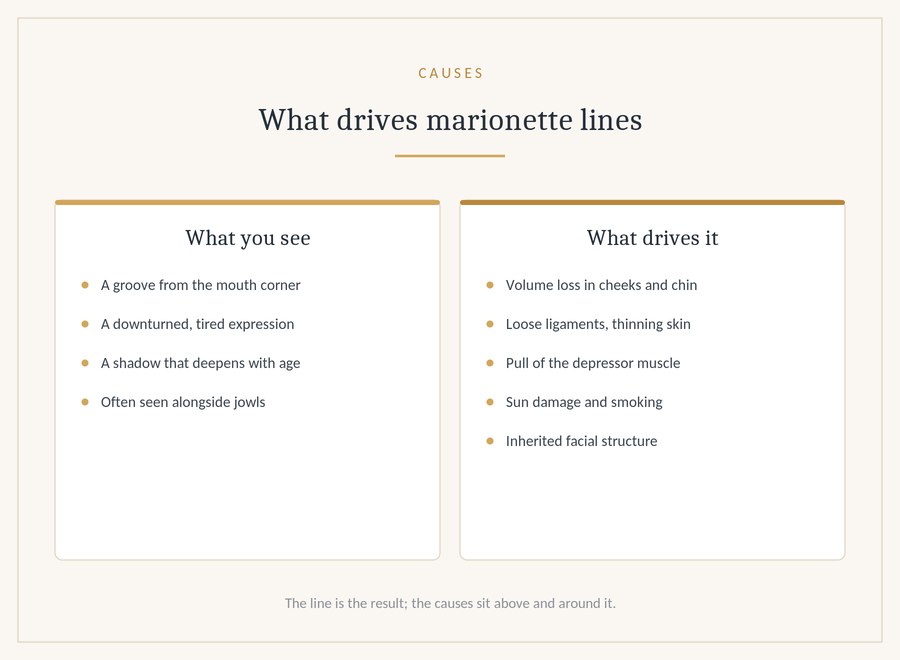
Marionette lines, also called melomental folds, rarely have a single cause. Several layers of the lower face change together, usually over many years.
Volume Loss
Fat and bone change with age. The cheek fat pads thin and descend, the chin and jawbone lose some projection, and the tissue beside the mouth flattens. On the cheek side of the line, descending tissue gathers as the jowl. On the chin side, fat thins and the area becomes flat or hollow. The groove between the two is the marionette line, which behaves more like a boundary than a crease. Significant weight loss can bring this on sooner by reducing facial fat.
Ligaments and Skin
Ligaments anchor the skin to deeper structures and loosen with age. The skin itself loses collagen and elastin, so it recoils less after the thousands of movements the mouth makes each day. A ligament along the jawline holds the skin firmly in place at the base of the line, which keeps the boundary sharp.
The Pull of the Depressor Anguli Oris
The depressor anguli oris is a small muscle that runs from the lower jaw to the corner of the mouth and pulls the corner downward. In some people it is naturally strong, and its repeated pull can deepen the line and give the mouth a downturned shape even at rest.
Sun, Smoking and Genetics
Sun exposure breaks down collagen and thins the skin, and smoking is linked with an older-looking face. In a well-known study of identical twins, more sun exposure and longer smoking were each associated with a more aged appearance. Genetics sets the framework, including bone structure, where fat sits and how strong the muscles are, which is why some people develop these lines earlier than others.
Why Treating Only the Line Often Looks Unnatural
The line is the result of these changes, not their cause. Filler placed in the groove adds volume to one side of the boundary but does not replace the support lost above, lift the tissue that has descended or ease the pull of the muscle. Too much product there can leave a heavy, puffy look around the mouth, a ridge along the fold, or a fuller lower face that makes the jowl more prominent.
A recent anatomical review described marionette lines as multifactorial and concluded that they benefit from a combined approach, using filler together with a muscle-relaxing toxin. That means assessing the whole lower face: the mouth corners, the chin, the area in front of the jowl, the jawline, the cheeks and the quality of the skin. Sometimes only a small amount of filler belongs in the line itself.
Cheek support is often part of the plan, but its effect is easy to overstate. A photographic study of cheek filling found no pull on the skin towards the nasolabial fold and no visible change in the fold, and concluded that the apparent improvement most likely comes from restored cheek contour. The same limit applies to the mouth corners. The neighbouring folds have their own causes, covered in the guide to nasolabial fold filler.
Treatment Options
No single treatment addresses every part of the problem. Most plans combine two or three options, often across more than one visit.
Hyaluronic Acid Filler
This is the most commonly used option because it can be adjusted and, if needed, dissolved. It is usually placed deep rather than just under the skin, often with a blunt-tipped cannula, to rebuild support at the mouth corner and along the line rather than to fill a crease. Amounts are modest, commonly around half a millilitre to one millilitre per side, and the treatment is often combined with support for the chin, the jawline or the cheeks, as described in the guide to cheek filler.
The evidence is encouraging but modest. A 12-month open-label study of one filler, supported by its manufacturer and without a control group, found that about seven in ten participants improved by at least one grade on a validated scale at one month, when the volume improvement was also greatest.
A Small Dose of Botulinum Toxin
A very small dose of botulinum toxin, such as Botox or Dysport, placed in the depressor anguli oris weakens its downward pull, so the muscles that lift the mouth corner meet less opposition. Published doses are a few units per side, and units differ between brands. Effects begin within days, are judged at around two weeks and last about three to four months.
Toxin does not fill a groove or tighten skin, so it helps mainly when downward pull is a large part of the picture. In a randomised study of 90 women, toxin combined with hyaluronic acid filler improved the lower face more than either treatment alone.
The main risk is specific to this area. If toxin reaches a neighbouring muscle, the result can be an uneven smile, a lower lip that moves differently or difficulty sipping water. It is temporary, but it is why placement and dosing need to be conservative.
Collagen Biostimulators
Poly-L-lactic acid and calcium hydroxylapatite stimulate the skin’s own collagen over weeks to months. Because they are avoided in thin, highly mobile areas, they are used to improve support and skin quality across the cheeks and lower face rather than to fill the line itself. Results build gradually, often last a year or more, and cannot be dissolved. The wider family is described in the guide to collagen biostimulators.
Skin-Quality Treatments
Microneedling, skin boosters, gentle peels and, in suitable skin, fractional laser improve texture and the fine creases around the lines, but they do not fill a groove. Radiofrequency and microfocused ultrasound aim to tighten skin modestly. Systematic reviews report benefit in mild to moderate laxity, shrinking as laxity increases. In deeper skin tones, lasers and strong peels carry a higher risk of pigmentation changes, and daily sun protection remains the foundation of skin care here.
Threads
Absorbable threads support tissue and stimulate collagen. Smooth threads placed along the line give mild support but cannot lift, while barbed threads can reposition tissue modestly across the cheek and jowl. They suit mild to moderate laxity with good skin quality and are a poor choice for heavy jowls. Long-term evidence is limited, and swelling, bruising and dimpling are common. The approach is covered in the guide to thread lifts.
What Can and Cannot Be Achieved Without Surgery
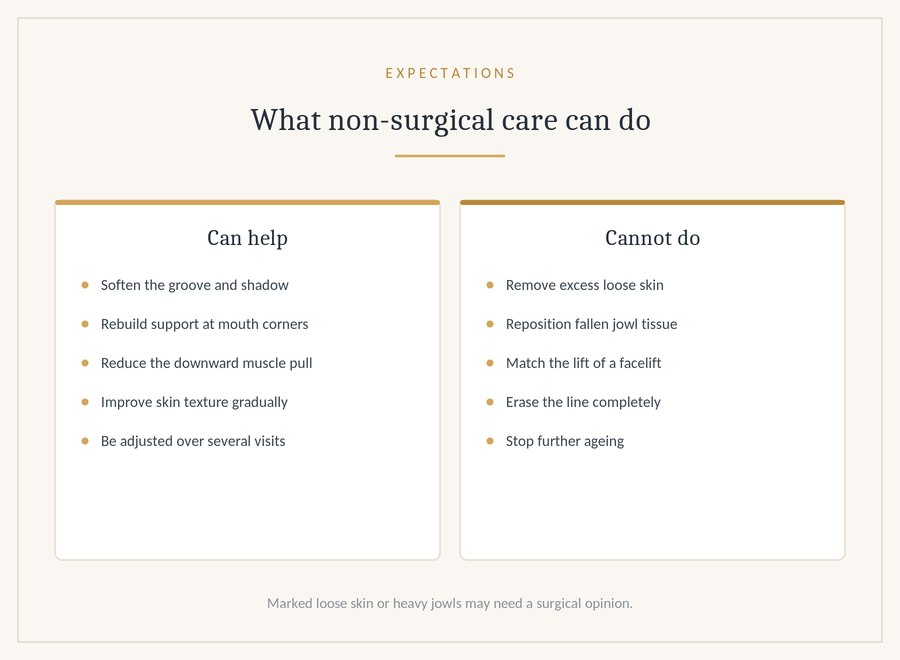
Non-surgical treatment can soften the groove, rebuild some support, reduce the pull of the muscle and improve skin quality. For many people that is enough to look more rested while keeping natural movement. The aim is a softer line, not an erased one.
It cannot remove excess skin, reposition fat that has descended into the jowl or match a facelift. With marked loose skin or heavy jowling, filler can make the lower face look heavier, and an honest assessment will say so and suggest a surgical opinion. Surgery has its own risks, recovery and cost, and many people reasonably prefer a gradual route, but the choice should be an informed one.
Risks and Side Effects
Common effects. Tenderness, swelling, bruising and small lumps are common after filler, toxin or threads, and usually settle within days to a couple of weeks.
Filler. Lumps, a heavy look from too much product and asymmetry can occur. Hyaluronic acid can be dissolved with hyaluronidase, an enzyme that breaks it down, as explained in the guide to dissolving filler. Injections near the mouth can trigger cold sores in people prone to them, and antiviral medication may be advised.
Toxin, biostimulators and threads. Toxin can cause a temporary uneven smile. Biostimulators can cause delayed nodules that cannot be dissolved. Threads can cause dimpling, visible threads, infection and, uncommonly, numbness of the lip or chin.
Rare but serious: vascular occlusion. Filler can block or compress a blood vessel and reduce blood flow to the skin. The mouth region contains branches of the facial artery, so anatomical knowledge and careful technique matter. Warning signs are severe or increasing pain, skin that turns pale and then dusky or mottled, and any change in vision. They need same-day medical attention, and treatment includes prompt hyaluronidase, so a clinic should keep it on site.
Who Should Avoid Treatment
Treatment is postponed in pregnancy and breastfeeding, because safety has not been established, and when there is an active infection, a cold sore, inflamed acne or a dental infection near the area.
Bleeding disorders, blood-thinning medication, allergy to lidocaine or other ingredients, neuromuscular conditions such as myasthenia gravis (a concern for toxin), autoimmune conditions, a tendency to keloid scarring and recent isotretinoin use all need individual assessment, as does any non-absorbable filler previously placed in the area. A licensed physician must assess suitability in a personal consultation, with a full medical history.
Recovery and How Long Results Last
Recovery. After filler, swelling is most noticeable for two to three days and bruising can take a week or two to fade. Strenuous exercise, saunas, alcohol and pressing on the area are usually avoided for a day or two, and many practitioners advise postponing routine dental work for about two weeks. A review at around two weeks allows small adjustments. Toxin leaves small bumps that settle within hours, with the effect judged at two weeks. Biostimulators and threads bring several days of swelling and tightness, with specific instructions on massage, sleeping position and facial movement.
Duration. Hyaluronic acid filler lasts roughly six to eighteen months, usually towards the shorter end in a mobile area such as the mouth corner. Toxin lasts about three to four months, biostimulators often a year or more and threads around a year. No option stops ageing, so the realistic aim is a slower, softer progression.
Cost in Dubai
Market rates generally run from around AED 1,800 to AED 3,500 per syringe of hyaluronic acid filler, with one to two syringes common for this area, and from around AED 600 to AED 1,800 per area for toxin. Biostimulators generally run from around AED 2,000 to AED 5,500 per vial or syringe, skin-quality treatments from around AED 500 to AED 2,500 per session, energy-based tightening from around AED 2,500 to AED 8,000 per session and threads from around AED 5,000 to AED 15,000.
Compare like with like: the named product, the volume, the areas included and whether a review visit is part of the price.
The Short Version
Marionette lines are the visible result of volume loss, ligament and skin laxity and the pull of the depressor anguli oris, shaped by sun, smoking and genetics. Filling only the line often looks heavy. A more natural plan treats the whole lower face, usually with modest filler, support elsewhere and sometimes a small dose of toxin.
Biostimulators, skin treatments and threads suit particular situations, and none replaces surgery when there is marked excess skin. Expect softening rather than erasure, results measured in months rather than years for most injectables, and an in-person assessment by a licensed physician before anything is chosen.
Questions Worth Asking
Is the line itself the problem, or something around it? A sound assessment looks at the cheeks, chin, jawline, mouth corners and skin, not only the groove.
How much product do you expect to use, and where? Modest amounts built up gradually usually look more natural than one large treatment of the line.
What happens if something goes wrong? The answer should include recognising a blocked blood vessel and keeping hyaluronidase on site.
Should I be considering surgery instead? An honest assessment will raise it when there is marked loose skin or heavy jowling.
Frequently Asked Questions
What causes marionette lines?
A combination of volume loss in the cheeks, chin and mouth area, loosening ligaments and skin, the downward pull of the depressor anguli oris, sun damage and smoking, and inherited facial structure. The line is the visible boundary between these changes rather than a simple wrinkle.
Can filler remove marionette lines completely?
Not reliably. Filler can soften the groove and rebuild support, but response varies, and marked loose skin or heavy jowls cannot be corrected with filler alone. The realistic aim is a softer line, with surgery as the alternative when laxity is significant.
Why is filling only the line often not enough?
The line is the result of changes above and around it. Product placed only in the groove can look heavy or puffy and may emphasise the jowl. Assessing the cheeks, chin, jawline, muscle pull and skin usually gives a more natural result.
Does botulinum toxin help marionette lines?
It can, when the depressor anguli oris is pulling the mouth corners down. A very small dose weakens that pull, lasts about three to four months and works well alongside filler. Imprecise placement can cause an uneven smile, so careful technique matters.
How long do marionette line treatments last?
Hyaluronic acid filler lasts roughly six to eighteen months, often towards the shorter end in this mobile area. Toxin lasts about three to four months, biostimulators often a year or more, and thread effects around a year.
How do biostimulators and threads compare with filler?
They do different jobs. Biostimulators build support and skin quality gradually and cannot be dissolved. Threads suit mild to moderate laxity and have limited long-term evidence. Filler is usually the more adjustable option, and many plans combine them.
Can marionette line filler be dissolved?
Hyaluronic acid filler can be dissolved with hyaluronidase, an enzyme that breaks it down, which also treats the rare complication of a blocked blood vessel. Biostimulators cannot be dissolved, and a misplaced thread may need to be removed.
Does treatment hurt, and is there downtime?
Most people feel pinching and pressure, and numbing cream and the lidocaine in many fillers reduce discomfort. Swelling lasts a few days and bruising up to a couple of weeks. Threads usually need more careful aftercare than filler or toxin.
Who should avoid treatment?
Anyone who is pregnant or breastfeeding, or who has an active infection, cold sore or dental infection near the area. Bleeding disorders, blood thinners, neuromuscular conditions, allergies and autoimmune conditions need individual assessment by a licensed physician.
What does it cost in Dubai?
Market rates generally run from around AED 1,800 to AED 3,500 per syringe of hyaluronic acid filler, with one to two syringes common for this area, and from around AED 600 to AED 1,800 per area for toxin. Biostimulators and threads cost more.
This article is general information about aesthetic and dermatological treatments and is not medical advice, a diagnosis, or a treatment recommendation for any individual. Outcomes vary between patients and no result is guaranteed. Prescription medications and injectable products carry risks and contraindications that must be assessed by a licensed physician during a personal consultation. Dr Soheila Eskandari is licensed by the Dubai Health Authority. Prices quoted are general market ranges for information only and are not an offer.


 English
 Arabic