
Thread Lifts in Dubai: An Honest Assessment of What They Deliver
Thread Lifts in Dubai: An Honest Assessment of What They Deliver
Thread lifts are the most oversold treatment in aesthetic medicine. That is a strong statement, and it is not an argument against the treatment — used in the right patient it produces a genuine, if modest, improvement. It is an argument against the way it is marketed, which routinely promises the result of a facelift with the downtime of a facial.
This guide sets out what threads physically do, how long the effect genuinely lasts, who is a poor candidate, what the complications actually are, and how the treatment compares with the alternatives.
What a Thread Lift Is
A thread lift uses absorbable sutures inserted beneath the skin to reposition soft tissue and stimulate collagen formation. The threads are introduced through small entry points using a needle or cannula, passed through the subcutaneous plane, and — in the case of barbed threads — anchored to lift the tissue along a planned vector.
Most threads used today are made of polydioxanone, a material long used in surgical sutures, which absorbs over roughly six to eight months. Poly-L-lactic acid and polycaprolactone threads are also used and absorb more slowly.
The Distinction Marketing Usually Omits
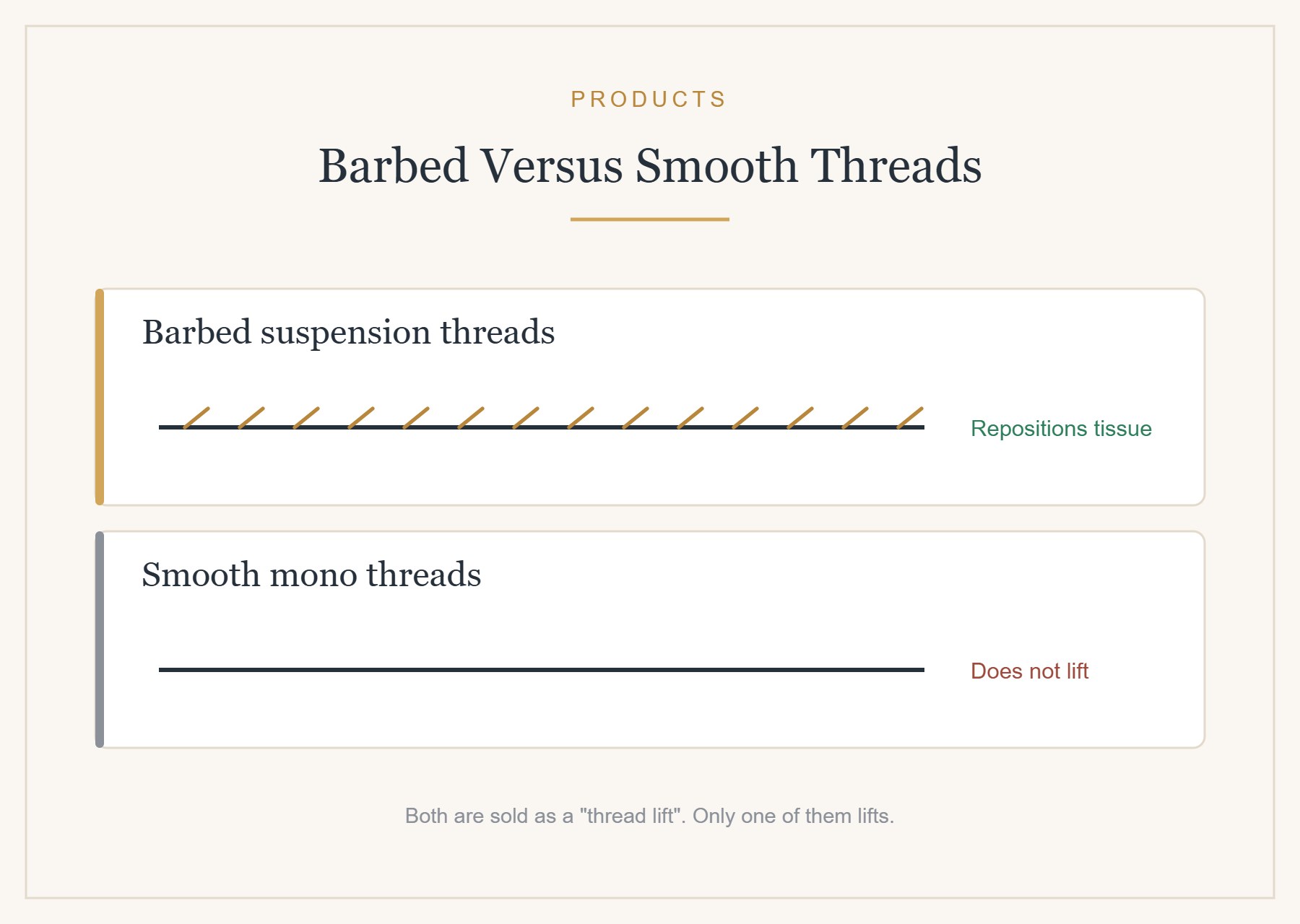
Two quite different products are sold under the heading “thread lift”.
Barbed suspension threads have cogs, barbs or cones along their length that grip tissue. These are the only threads capable of physically repositioning tissue — of lifting.
Smooth mono threads have no barbs. They cannot lift anything. They act as a collagen stimulus, producing gradual textural improvement and mild firming over months. This is a legitimate treatment with a legitimate purpose, but it is not a lift.
Both are frequently advertised using the same before-and-after imagery and the same language. If you are being offered a thread lift, it is entirely reasonable to ask which type is being used and what each is expected to achieve.
How Long It Really Lasts
The honest answer is nine to eighteen months for the lifting effect.
The mechanism explains the range. The threads themselves absorb over six to eight months, so the mechanical suspension is temporary by design. What persists afterwards is the fibrous tissue and collagen laid down in response to the thread — a real effect, but a weaker one than the initial suspension.
Claims of two to three years appear regularly in advertising and are not consistent with the published evidence or with what patients report. Where such a claim is made, it is worth asking what it is based on.
Who Is a Good Candidate — and Who Is Not
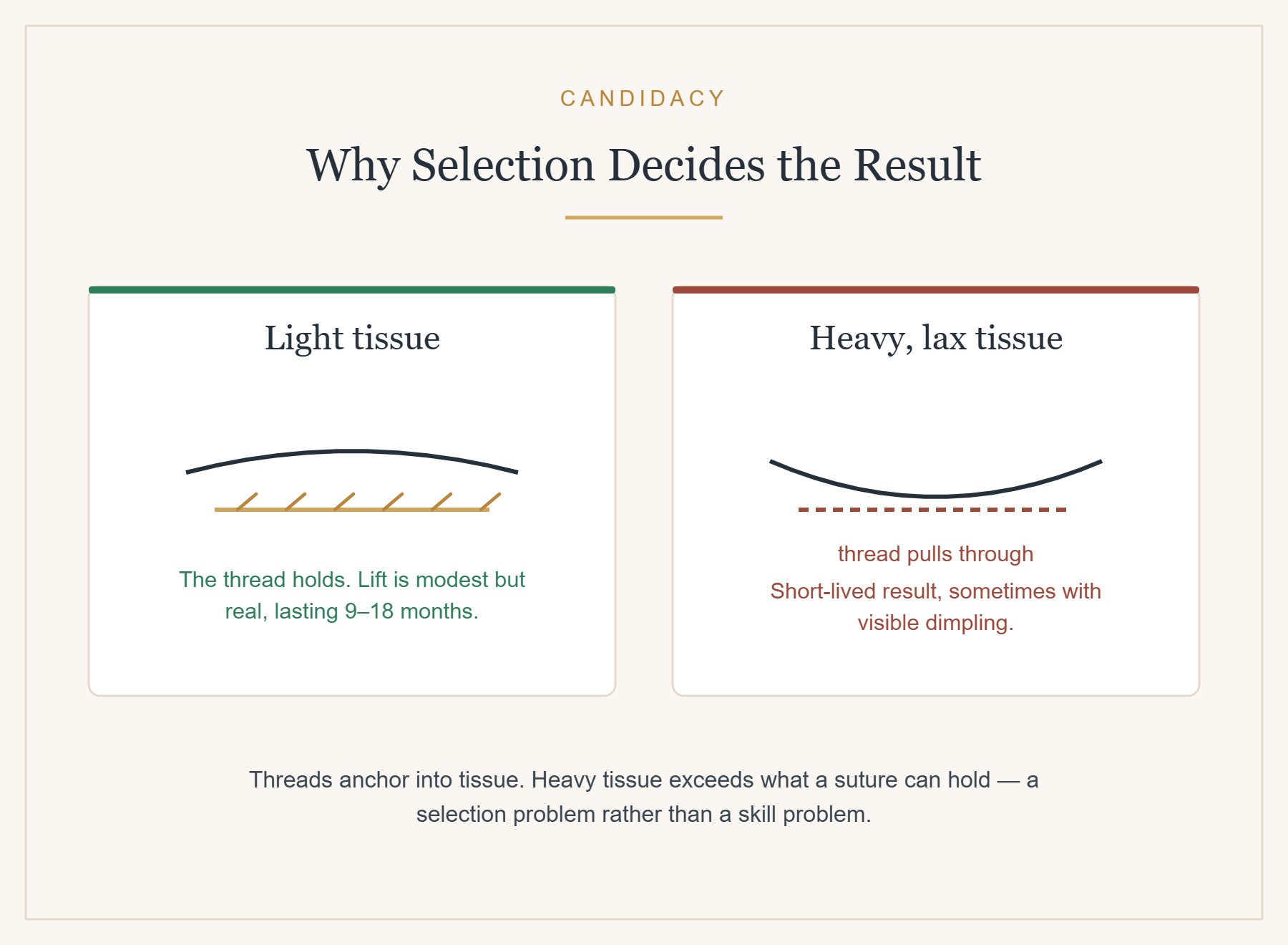
Candidacy determines the outcome more than technique does, and this is the point at which most disappointing results are decided.
A thread is a suture anchored in soft tissue. It can hold a certain amount of weight. If the tissue is heavy — significant jowling, marked laxity, substantial volume loss — the thread does not hold it. It pulls through the tissue, producing a result that fades within weeks, sometimes with visible dimpling where the barbs have dragged.
Good candidates typically have mild to moderate laxity, reasonable skin thickness and quality, and are often in their late thirties to early fifties. They want a subtle improvement in the jawline, mid-face or brow, and understand it is temporary.
Poor candidates have significant skin laxity, heavy jowls, substantial volume loss, or very thin skin where threads may become visible or palpable. Being told you are not a suitable candidate is a sign of a sound assessment, not a lost opportunity — the alternative is paying a substantial sum for a result that disappears in two months.
Threads Are Not a Substitute for Volume
A frequent error is treating volume loss as though it were sagging. As facial fat compartments deflate with age, the overlying skin appears to descend, and the face reads as sagging when the underlying problem is loss of support.
Pulling deflated tissue upward with threads in that situation produces a stretched, hollow appearance rather than a rejuvenated one. The appropriate treatment is volume replacement, and many patients benefit from a combination — restoring volume first, then assessing whether any repositioning is still needed.
Where Threads Are Placed, and What Each Area Achieves
Different areas produce different degrees of benefit, and the distinction is worth understanding before agreeing to a full-face treatment.
Mid-face and cheeks. Threads placed to elevate the malar fat pad address early flattening of the cheek. This is among the more reliable applications in a suitable candidate, though volume replacement often achieves more where deflation is the main issue.
Jawline and jowls. The most requested area, and the one where candidacy matters most. Early jowling in reasonably firm tissue responds. Established jowls in heavy tissue do not, and this is where the majority of disappointing results occur.
Neck. Modest tightening in mild laxity only. Significant neck laxity is a surgical problem, and threads offered as a neck lift substitute are unlikely to satisfy.
Brow. Small elevation of the tail of the brow, sometimes combined with botulinum toxin. The degree of change is limited but can be worthwhile in the right patient.
What Happens During the Procedure
Understanding the sequence helps set expectations, since a thread lift is a minor surgical procedure rather than an injectable appointment.
Planning is done with the patient upright, because tissue position changes when lying down and vectors marked on a reclined patient will not lift in the intended direction. The vector — the direction of pull — is the central decision, and it should follow the natural lines of tissue descent rather than pulling straight upward, which produces an unnatural appearance around the mouth and cheeks.
The area is cleaned and local anaesthetic infiltrated along the planned thread paths. Entry points are made, usually near the hairline or temple, and the threads passed through the subcutaneous plane using a needle or cannula. Once positioned, tension is applied to reposition the tissue, and the practitioner checks symmetry with the patient sitting up before trimming the thread ends.
The procedure typically takes forty-five to ninety minutes depending on the number of threads. Patients are usually aware of pulling and pressure but not sharp pain.
One point deserves mention because it surprises people: the immediate post-procedure appearance is usually over-corrected. Swelling and the initial tension make the lift look greater than the settled result. Judging the outcome in the mirror on the day, or in the first week, gives a misleading impression in both directions — first too tight, then, as swelling resolves, seemingly too little. The realistic assessment point is four to six weeks.
The Complications, Stated Plainly
Reported complication rates for thread lifts are higher than the marketing implies, and most are not serious but are visible and unwelcome.
Bruising and swelling are expected in essentially everyone, for three to seven days.
Dimpling or puckering at entry points or along the thread is common early and usually settles within two to three weeks. Persistent dimpling may need release.
Visible or palpable threads occur more often in thin skin or where threads have been placed too superficially. Patients frequently report being able to feel the threads for several weeks.
Asymmetry from uneven tension or differing tissue response, sometimes requiring adjustment.
Thread extrusion, where a thread end works its way to the surface, requiring removal.
Infection, uncommon but significant when it occurs, since it involves implanted foreign material that may need to be removed before the infection will settle.
Prolonged discomfort on movement — soreness on chewing, yawning or wide mouth opening for one to two weeks is normal, and patients are usually advised to avoid dental appointments and facial massage for two to three weeks.
How It Compares
Against a facelift, there is no meaningful comparison in degree. Surgery addresses the deeper structural layer and removes excess skin, producing a change measured in centimetres that lasts many years. A thread lift produces millimetres and lasts around a year. It is not a smaller version of the same operation; it is a different intervention with a different ceiling.
Against energy-based skin tightening, threads act mechanically and immediately while devices work by heating tissue to stimulate collagen over months. Neither addresses significant laxity well.
Against filler, the two treat different problems — volume loss versus tissue position — and the assessment should establish which is actually present.
The Consultation That Prevents Disappointment
Because the outcome is decided largely at the point of patient selection, the quality of the consultation is a reasonable proxy for the quality of the result.
A sound consultation examines skin quality and tissue weight directly, discusses volume status alongside laxity, explains what degree of lift is realistic in your specific tissue, states the expected duration without inflation, covers the complication list rather than mentioning bruising alone, and describes what happens if the result is unsatisfactory.
Certain signals in the opposite direction are worth taking seriously: a promise of facelift-comparable results, a claim of two to three years’ duration, before-and-after photographs where the lighting and head position differ between images, pressure to decide during a limited-time offer, or reluctance to discuss complications. Any of these suggests the treatment is being sold rather than recommended.
A Reasonable Way to Decide
If you have mild laxity, good tissue quality, and want a subtle improvement while understanding it lasts around a year, a thread lift in experienced hands is a defensible choice.
If you have significant laxity, or if you would be disappointed by anything less than a substantial change, the more useful step is a surgical consultation — even if you have no intention of proceeding with surgery. Knowing what an operation would achieve makes it far easier to judge whether a non-surgical alternative is worth its cost.
Costs in Dubai
Market pricing generally runs from roughly AED 5,000 to AED 15,000, varying with the number and type of threads and the areas treated.
Because the result lasts around a year, the honest comparison is cost per year rather than the headline figure. A thread lift repeated annually over five years represents a substantial cumulative cost, and for some patients that arithmetic makes a surgical consultation the more sensible path — a calculation worth doing before starting rather than after the third round.
The Short Version
Thread lifts produce a genuine but modest repositioning of tissue lasting around nine to eighteen months. In a patient with mild laxity, decent skin quality and realistic expectations, that can be a worthwhile treatment.
They are not a non-surgical facelift, they do not last two to three years, and in heavy or very lax tissue they largely fail. The most valuable thing a consultation can produce is an honest assessment of which group you fall into — including being told that this is not the right treatment for you.
Frequently Asked Questions
How long does a thread lift last?
Realistically nine to eighteen months for the lifting effect, with polydioxanone threads absorbing over roughly six to eight months and the collagen response outlasting the threads themselves. Claims of two to three years are not consistent with the published evidence.
Is a thread lift a replacement for a facelift?
No, and this is the single most oversold point in the field. A thread lift produces a modest repositioning measured in millimetres. A facelift addresses deeper structures and removes excess skin. Threads suit mild to moderate laxity in someone not ready for surgery.
Who is a poor candidate?
Anyone with significant skin laxity, heavy jowls, substantial volume loss or very thin skin. In heavy tissue the threads pull through, producing a short-lived result and sometimes visible irregularity. Being told you are not a good candidate is a sign of sound assessment.
What are the risks?
Bruising and swelling are expected. More specific complications include visible or palpable threads, dimpling at insertion points, asymmetry, thread extrusion and infection. Most are manageable, and reported rates are higher than the marketing suggests.
How long is the recovery?
Most people take three to seven days for swelling and bruising, though tightness and mild irregularity can persist for two to three weeks. Wide mouth opening, dental work and facial massage are usually restricted for two to three weeks.
Does it hurt?
Local anaesthetic is used, so the procedure itself is tolerable, with pulling sensations rather than sharp pain. Soreness on chewing and yawning for one to two weeks afterwards is common.
Can threads be removed if I dislike the result?
Early removal is possible in experienced hands, particularly if a thread is visible or causing dimpling. Once absorption is underway removal becomes impractical, and the realistic answer is usually waiting for resolution.
Are threads better than filler for sagging?
They address different problems. Filler restores lost volume, threads reposition tissue. Sagging with good volume may suit threads; hollowing that reads as sagging is better treated with filler. Many patients need a combination, and the assessment should distinguish these.
Will it look obvious that I have had something done?
A well-executed thread lift in a suitable candidate is subtle. Obvious results usually reflect over-tightening, poor vector planning or an unsuitable candidate — where the visible sign is distortion rather than lift.
What does a thread lift cost in Dubai?
Market pricing generally runs from roughly AED 5,000 to AED 15,000 depending on the number and type of threads. Given the limited duration, the honest comparison is cost per year against alternatives rather than the headline price.
This article is general information about aesthetic and dermatological treatments and is not medical advice, a diagnosis, or a treatment recommendation for any individual. Outcomes vary between patients and no result is guaranteed. Prescription medications carry risks and contraindications that must be assessed by a licensed physician during a personal consultation. Dr Soheila Eskandari is licensed by the Dubai Health Authority. Prices quoted are general market ranges for information only and are not an offer.


 English
 Arabic