
How Long Does Botox Last? What Changes It and When to Re-treat in Dubai
How Long Does Botox Last? What Changes It and When to Re-treat in Dubai
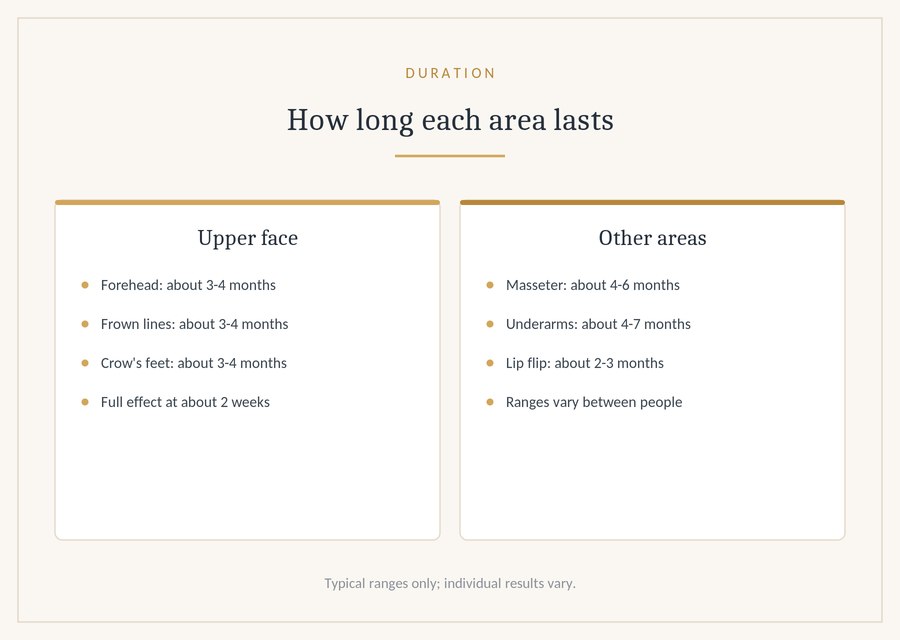
How long does Botox last? In the forehead, frown lines and crow’s feet it typically lasts about three to four months, around four to six months in the masseter, roughly four to seven months for underarm sweating, and often only two to three months after a lip flip. The first change usually appears within days and the full effect at around two weeks. The result then fades gradually as the treated nerve endings recover, so repeat treatment is planned when movement returns and generally not sooner than about three months.
In practice, duration depends on the dose, the strength of the muscle, the area treated, the product and how many times you have been treated, so it can differ between people and between sessions. This guide covers typical duration by area, why Botox wears off, what changes it, why extra units are a poor way to stretch it, antibody resistance, when to re-treat, and the risks, aftercare and Dubai costs.
How Long Does Botox Last in Each Area?
Forehead, Frown Lines and Crow’s Feet
Product information for the frown lines describes an effect lasting about three to four months, and the forehead and crow’s feet usually follow a similar pattern. Movement returns gradually rather than all at once, and some people keep a little effect beyond four months while others find it fades closer to three. These are typical ranges, and individual results vary.
Masseter
The masseter is a large chewing muscle, so the dose is higher and the change in the jawline takes longer to appear. Reviews place the peak effect at around three months and describe a benefit lasting several months, commonly four to six, with some reports of longer benefit after repeated courses. Our guide to masseter Botox for jawline slimming explains how the contour changes.
Underarm Sweating
For excessive underarm sweating, the labelled dose is 50 units per underarm, injected into the skin rather than the muscle. A European regulatory document reports an average benefit of about 30 weeks at that dose, while a retrospective series of 101 patients reported a median of four to five months. Our article on Botox for underarm sweating covers who it suits.
Lip Flip
A lip flip uses a small dose around the mouth to relax the upper lip so that it rolls slightly outwards. Peer-reviewed data on duration are limited, and the commonly quoted two to three months comes mainly from clinical experience. It tends to fade sooner than other areas, which is usually put down to the small dose and the constant movement of the lips.
When Does Botox Start Working, and Why Does It Wear Off?
Onset and Full Effect
Most people notice the first change within two to five days, and the full effect is usually clear at around two weeks, which is why a review is often planned then. In larger muscles such as the masseter, the visible change builds more slowly over several weeks. The effect then holds for a period before it begins to fade.
What Happens as It Fades
Botox is the common name for botulinum toxin type A. It acts at the neuromuscular junction, the contact point between a nerve ending and a muscle fibre, where it cuts a protein called SNAP-25 that the nerve needs to release acetylcholine, the chemical signal that makes the muscle contract. The nerve itself is not destroyed.
Over the following weeks, the nerve ending grows tiny new branches, called sprouts, that form new contacts with the muscle and begin passing signals again. Later, the original nerve ending recovers its ability to release acetylcholine and the sprouts regress. This natural repair is why the effect is temporary and why movement returns gradually.
What Changes How Long Botox Lasts?
Several factors influence duration, and some are better supported by evidence than others.
Dose and Units
A unit is a measure of biological activity, and units are not interchangeable between brands. The labelled doses are 20 units for the frown lines, 24 units for the crow’s feet (12 per side) and 40 units when the forehead is treated together with the frown lines. Within the range studied, a higher dose tends to last longer, but the gain is limited and comes with more risk of side effects. Lower-dose approaches such as baby Botox may wear off sooner for the same reason.
Muscle Strength and Sex
A dose that suits a slender muscle may be spread too thinly across a powerful one, so movement can return sooner. Men usually have stronger facial muscles and often need higher doses than women. Whether sex changes duration independently of dose and muscle size is not clearly established.
Metabolism and Exercise
A fast metabolism and regular exercise are often blamed when Botox fades early. Botox does not behave like a tablet cleared by the liver; it acts locally at the nerve ending, and its effect ends when the nerve recovers. There is no good evidence that metabolic rate changes duration, and well-designed studies showing that regular training shortens the effect are lacking. Strenuous exercise is avoided for the rest of the treatment day to limit bruising and the theoretical chance of the product spreading, not because it burns the Botox off.
Product Differences
Botox, Dysport and other type A products each have their own unit scale, so 20 units of one is not the same dose as 20 of another. When doses are matched, comparisons in the upper face generally find broadly similar durations. Our comparison of Botox and Dysport explains how they differ.
First Treatment Compared With Repeat Treatments
A first treatment is often deliberately conservative, so it may fade sooner than later sessions, which are adjusted after review. Some people find the effect lasts a little longer after several treatments, possibly because treated muscles are used less and become slightly thinner, but this does not happen for everyone. Our guide to first-time Botox explains why a cautious start is usual.
Why Taking More Units to Make Botox Last Longer Is a Poor Idea
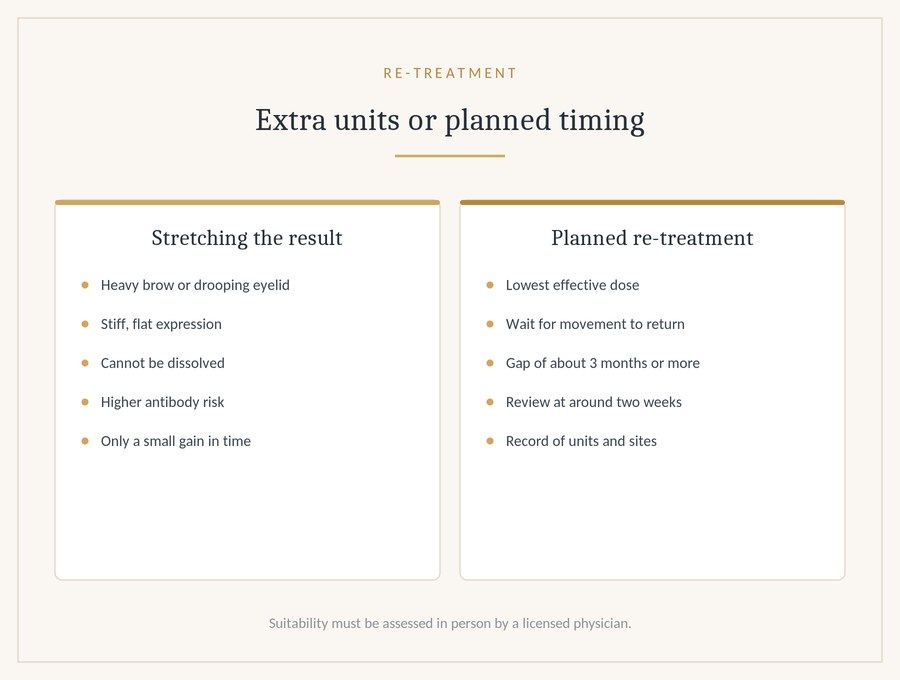
It is tempting to ask for extra units to stretch the result, but the trade is poor. The gain in duration is limited, while the risks rise with dose: the product can spread to neighbouring muscles, causing a heavy brow, a drooping eyelid, an uneven smile or a stiff, expressionless look. Unlike hyaluronic acid filler, Botox cannot be dissolved, so an excessive dose has to be waited out. Higher cumulative doses also raise the chance of antibody formation, and more units cost more. A physician aims for the lowest dose that achieves the agreed result.
Can You Become Resistant to Botox?
Some people stop responding because the immune system makes neutralising antibodies against the toxin protein. Reviews describe this as uncommon, particularly at the lower doses used in cosmetic treatment, but the risk rises with a higher cumulative dose and more frequent injections, such as repeated touch-ups given close together. Product composition has also been proposed as a factor, although how much it matters in cosmetic practice is still debated.
Antibodies are only one reason for a reduced response, so a physician checks the more common explanations first. Prevention is straightforward: use the lowest effective dose, keep gaps of at least about three months and avoid unnecessary touch-ups. If resistance is suspected, the physician may review the product and the treatment history and discuss other options.
When Should You Have Botox Again?
How Re-treatment Is Timed
Re-treatment is usually planned when movement has returned, which for the upper face is often at around three to four months. The product information notes that dosing more often than every three months has not been clinically evaluated, so intervals under about three months are generally avoided. Treating while the previous dose is still working adds exposure without adding benefit. Some people wait until movement has fully returned; others re-treat when it is partly back. Either is reasonable if the gap stays beyond about three months.
The exception is a small adjustment at the two-week review. In Dubai, where many people travel in summer, it helps to schedule treatment at least two weeks before an event or trip so the full effect and any adjustment are in place.
What to Do If It Seems to Wear Off Early
First, check the timeline, because the full effect takes about two weeks. Then compare your records: a lower dose, different injection points or a different product from last time can explain a shorter result. Lines that remain at rest can also feel like early wear-off, since Botox softens movement lines but does not remove lines already etched into the skin.
Contact the clinic that treated you for a review rather than booking a touch-up elsewhere. The physician can reassess the muscle, check the dose and product, and adjust. Poor storage or handling can reduce a product’s effect, which is one reason to ask what was used. If the response falls repeatedly despite adequate doses and sensible gaps, antibody resistance becomes more likely and the plan should change.
Aftercare, Side Effects and Who Should Avoid Botox
For the rest of the treatment day, avoid rubbing or pressing the area, strenuous exercise, saunas and very hot environments, and follow your physician’s own instructions. Small bumps, redness, tenderness, bruising and mild headache are common and short-lived. Less commonly, the product affects nearby muscles, causing a heavy brow, a drooping eyelid or an uneven smile, and these effects can last several weeks. Allergic reactions are rare. Difficulty swallowing or breathing, marked weakness or vision changes need urgent medical attention.
Treatment is usually avoided or postponed during pregnancy and breastfeeding, when there is infection at the injection site, with a known allergy to an ingredient, and in neuromuscular conditions such as myasthenia gravis. Some medicines, including certain antibiotics, can interact with Botox, and blood thinners increase bruising, so tell your physician everything you take and never stop a prescribed medicine without their advice. Suitability must be assessed in person by a licensed physician.
What Does Botox Cost in Dubai?
Market rates generally run from around AED 800 to AED 1,500 for each upper-face area (forehead, frown lines or crow’s feet), or about AED 30 to AED 60 per unit, with three-area packages often quoted between AED 2,000 and AED 4,000. Masseter and underarm treatments use many more units and are usually quoted per unit after assessment. At the same rates, every 10 units adds roughly AED 300 to AED 600, and the 100 units in the labelled dose for both underarms come to roughly AED 3,000 to AED 6,000 unless a package price applies. A lip flip uses far fewer units than a facial area, so on a per-unit basis it costs a fraction of an area price.
Because upper-face results last about three to four months, maintaining them usually means three to four sessions a year, so the cost per month of effect is more informative than the price of one session. A much lower quote can mean fewer units, and fewer units can mean a shorter result.
Choosing Who Treats You
Botox is a prescription medicine, so the person injecting should be a licensed physician whose DHA licence you can verify on the DHA Sheryan portal. Ask about their experience with the specific area you want treated, because the masseter and underarms are planned differently from the forehead, and expect a proper assessment of your history, medicines and muscle movement before any injection.
A sound plan includes a written record of the product, the units used in each area and the injection points, which lets you compare how long each session lasts. It also includes a review at around two weeks, written aftercare and a clear way to reach the clinic. The page on Botox and anti-wrinkle treatments gives an overview of the areas treated. At dr-soheila.com, treatments are planned and performed by Dr Soheila Eskandari, a DHA-licensed general practitioner with aesthetic privileges with 20 years of experience in aesthetic medicine.
The Short Version
Botox typically lasts about three to four months in the upper face, around four to six months in the masseter, roughly four to seven months for underarm sweating and often two to three months after a lip flip. It wears off as the nerve endings sprout and recover, so duration depends mainly on dose, muscle strength and area, while the evidence that metabolism or exercise shortens it is weak.
Extra units are a poor way to extend the result, because they add risk and cumulative exposure without much extra time. Antibody resistance is uncommon but linked to frequent touch-ups and high doses, so re-treatment follows returning movement and is generally not repeated sooner than about three months. Bruising and temporary asymmetry are the commonest side effects, and a licensed physician must confirm suitability in person.
Questions Worth Asking
Which product and how many units will you use in each area? A written record lets you compare how long each session lasts.
When should I plan my next treatment? The answer should follow returning movement, with a gap of about three months or more.
What is the plan if it wears off early? A review of dose, product and expectations should come before any touch-up.
Does anything in my health or medicines change the plan? Pregnancy, breastfeeding, neuromuscular conditions and some medicines do.
Frequently Asked Questions
How long does Botox last?
Typically about three to four months in the forehead, frown lines and crow’s feet, around four to six months in the masseter, roughly four to seven months for underarm sweating and about two to three months for a lip flip.
How soon does Botox start to work?
Most people notice a change within two to five days, and the full effect is usually clear at around two weeks.
Why does Botox wear off?
The treated nerve endings grow tiny new branches, and the original endings gradually recover their ability to release the signal that contracts the muscle, so movement returns.
Does exercise make Botox wear off faster?
There is no good evidence that it does; strenuous exercise is avoided for the rest of the treatment day to limit bruising and the chance of the product spreading.
Does Botox last longer the more often you have it?
Some people find the effect lasts a little longer after several treatments, but this varies, and a session that seems shorter than the last is common.
Can I have Botox again before three months?
It is generally avoided, because the product information notes that dosing more often than every three months has not been clinically evaluated, and frequent touch-ups are linked to antibody formation.
Can you become resistant to Botox?
Yes, but it is uncommon in cosmetic use; antibodies are linked to high cumulative doses and frequent injections, and a physician checks other causes of reduced response first.
What should I do if my Botox wears off early?
Check that two weeks have passed, compare the dose and product with your records, and contact the treating clinic for a review rather than booking a touch-up elsewhere.
Who should avoid Botox?
Treatment is usually avoided in pregnancy, breastfeeding, infection at the injection site, known allergy and neuromuscular conditions such as myasthenia gravis, and suitability must be assessed in person by a licensed physician.
What does it cost in Dubai?
Market rates generally run from around AED 800 to AED 1,500 per upper-face area, or about AED 30 to AED 60 per unit, with three-area packages often quoted between AED 2,000 and AED 4,000; our Botox price guide explains what a fair quote includes.
This article is general information about aesthetic and dermatological treatments and is not medical advice, a diagnosis, or a treatment recommendation for any individual. Outcomes vary between patients and no result is guaranteed. Prescription medications and injectable products carry risks and contraindications that must be assessed by a licensed physician during a personal consultation. Dr Soheila Eskandari is licensed by the Dubai Health Authority. Prices quoted are general market ranges for information only and are not an offer.


 English
 Arabic