
Botox for Excessive Sweating in Dubai: What the Trials Show
Botox for Excessive Sweating in Dubai: What the Trials Show
Excessive underarm sweating is a medical condition, not a grooming failure — and in Dubai it is both more common and more disabling than most people admit. Patients describe planning their wardrobe around it, keeping spare shirts at the office, avoiding handshakes and greetings, and declining social invitations. Most have tried every antiperspirant on the shelf before they mention it to a doctor.
Botulinum toxin for axillary hyperhidrosis has some of the best trial evidence of any aesthetic-adjacent treatment, and the numbers are worth knowing precisely. This guide covers what the randomised data shows, how long it genuinely lasts, what it costs in Dubai, and what should be assessed before treatment. Dr Soheila treats this as a medical condition with a well-evidenced intervention, which is exactly what it is.
What Hyperhidrosis Actually Is
Hyperhidrosis means sweating beyond what is required for thermoregulation. It is divided into two categories, and the distinction determines the whole approach:
- Primary focal hyperhidrosis. Excessive sweating in specific areas — underarms, palms, soles, face — with no underlying medical cause. It typically begins in adolescence or early adulthood, is usually symmetrical, often runs in families, and characteristically stops during sleep.
- Secondary generalised hyperhidrosis. Sweating caused by something else: thyroid disease, diabetes, menopause, infection, certain medications, and less commonly more serious conditions. It tends to be generalised rather than focal, can occur at night, and often begins later in life.
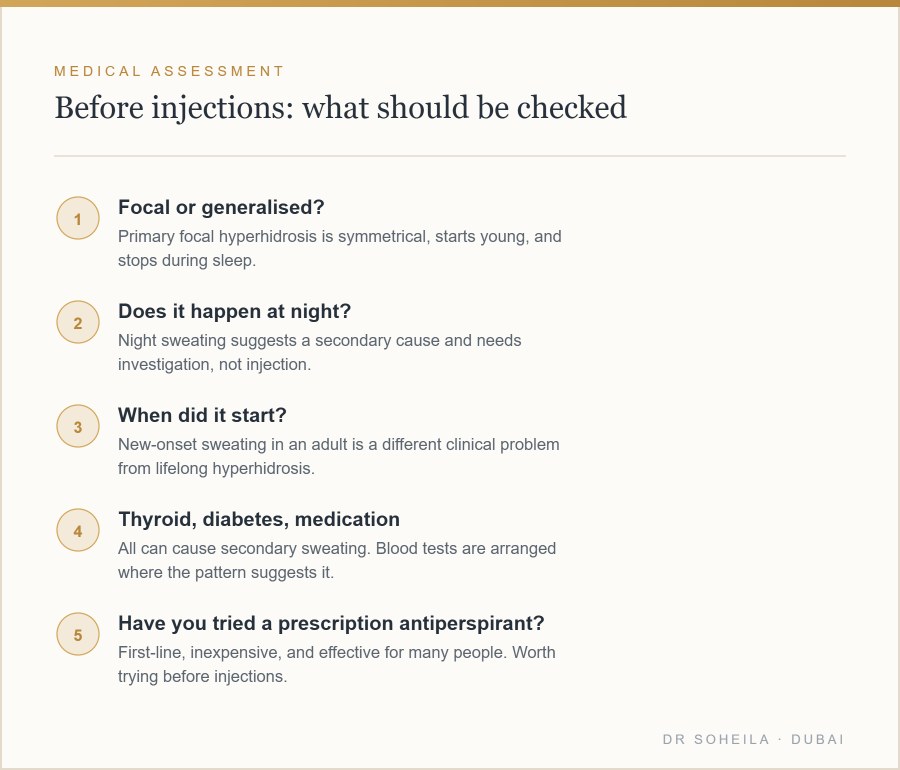
That last distinction matters clinically. Night sweating and new-onset generalised sweating in an adult warrant medical investigation before any cosmetic treatment. A clinic that offers you injections without asking these questions is skipping a step that exists for your protection.
Severity — the scale clinicians use
The Hyperhidrosis Disease Severity Scale (HDSS) is the standard measure and is worth knowing because trial results are reported against it:
| Score | Description |
|---|---|
| 1 | Sweating is never noticeable and never interferes with daily activity |
| 2 | Sweating is tolerable but sometimes interferes |
| 3 | Sweating is barely tolerable and frequently interferes |
| 4 | Sweating is intolerable and always interferes |
Scores of 3 or 4 generally indicate treatment is appropriate. The scale is also how improvement is measured, which makes the trial data directly interpretable for patients.
How the Treatment Works
Sweat glands are activated by acetylcholine released from sympathetic nerve endings. Botulinum toxin blocks that release at the neuromuscular and neuroglandular junction, so the glands stop receiving the signal to produce sweat.
Three things follow from this mechanism:
- It is local, not systemic. Only the injected area is affected. Your body’s ability to thermoregulate elsewhere is unchanged — a common and understandable worry that the mechanism itself answers.
- It is temporary. Nerve terminals regenerate over months, and function returns. This is why treatment is repeated rather than curative.
- The injection is intradermal, not intramuscular. Sweat glands sit in the dermis. This is a different technique from cosmetic facial injection, and it is delivered as a grid of many small, very superficial deposits.
What the Randomised Evidence Actually Shows
This is one of the better-evidenced indications in the field, and the figures are specific enough to be useful.
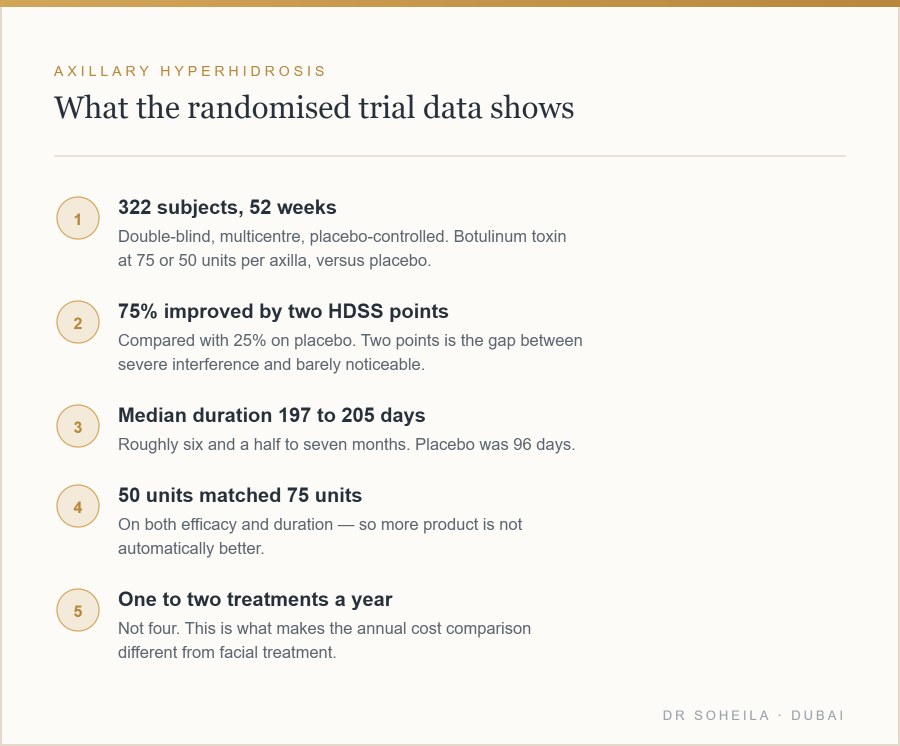
A 52-week multicentre, double-blind, randomised, placebo-controlled study enrolled 322 subjects, randomised to botulinum toxin type A at 75 units per axilla, 50 units per axilla, or placebo.
Efficacy
A two-point improvement on the four-point HDSS was reported in 75% of subjects in both the 75-unit and 50-unit groups, compared with 25% in the placebo group. Treatment significantly reduced limitations on daily activity by four weeks after injection.
Two points are worth drawing out. First, a two-point HDSS improvement is a large clinical change — it is the difference between “barely tolerable, frequently interferes” and “never noticeable”. Second, 50 units performed as well as 75 units, which argues against the assumption that more product means a better result.
Duration
Median duration of effect in the same study was 197 days for the 75-unit group and 205 days for the 50-unit group, versus 96 days for placebo. That is roughly six and a half to seven months.
Broader review of the literature reports average efficacy of six to nine months, with individual results ranging from four months to over twelve. A separate prospective study followed patients over 16 months and found treatment safe and effective across that period, and another followed patients for 24 months after intradermal injection.
The practical implication: most people need one to two treatments per year, not one every three months as with facial cosmetic injection. That is a meaningful difference in both cost and inconvenience, and it is often the fact that changes patients’ minds about whether to proceed.
What Happens at the Appointment
Assessment
Dr Soheila will take a proper history: when the sweating started, whether it is focal or generalised, whether it occurs during sleep, whether there is family history, what has already been tried, current medications, and any symptoms suggesting a secondary cause. HDSS is scored. Where secondary hyperhidrosis is a possibility, blood tests including thyroid function are arranged before treatment.
This is not paperwork. Sweating that has recently started, is generalised, or occurs at night is a different clinical problem and treating it cosmetically without investigation would be poor practice.
Mapping
Some clinicians use a starch-iodine test — iodine solution applied to the skin, then starch powder dusted over it, turning dark where sweat is present. It maps the active area precisely so injection is targeted rather than approximated. It is not always necessary but it is useful in asymmetric or unclear cases.
The injection
Topical anaesthetic is applied, typically for 30 to 45 minutes. The area is cleaned. Product is delivered as a grid of small intradermal injections spaced roughly 1 to 2 cm apart across the affected area — commonly 15 to 20 injection points per underarm.
The whole procedure takes 15 to 20 minutes. Most patients describe it as a series of small stings rather than significant pain. Underarm skin is more sensitive than facial skin, and adequate numbing time makes a real difference.
Afterwards
| Time | What to expect |
|---|---|
| Same day | Small raised bumps at injection points, settling within hours. Mild tenderness |
| Days 2–4 | Sweating begins to reduce |
| Days 7–14 | Full effect. This is when the result should be judged |
| Months 6–7 | Median duration reported in trial data; sweating gradually returns |
| Repeat | Typically once or twice a year, guided by symptoms rather than the calendar |
Aftercare
- No strenuous exercise, sauna or steam for 24 hours
- Avoid shaving the area for 24 to 48 hours
- Avoid antiperspirant for 24 hours; deodorant is usually fine after 12
- No massage or firm pressure on the treated area for 24 hours
- Contact the clinic for spreading redness, increasing pain, pustules or fever
Why This Matters More in Dubai
The environment here makes primary hyperhidrosis considerably more disabling than the same condition in a temperate climate:
- Ambient temperature. Summer conditions push everyone’s baseline sweating up, so someone with hyperhidrosis is operating from a much higher starting point
- Humidity. Coastal humidity means sweat evaporates poorly, so clothing marks more visibly and stays wet longer
- The transition problem. Repeated shifts between heavily air-conditioned interiors and outdoor heat trigger repeated sweating episodes throughout the day
- Professional and social context. Business and social conventions here involve close greeting, and formal dress in hot conditions is normal. Visible sweat marks carry real social cost
- Fabric. Light-coloured formal shirts and abayas both show marks readily
These are not trivial points. In the trial data, the outcome that improved alongside sweat reduction was limitation of daily activity — and that is precisely the burden patients describe.
Other Areas, and Other Options
Underarms are the best-evidenced site. Palms, soles, scalp and face can also be treated, though palms require nerve block or strong anaesthesia and carry a small risk of temporary grip weakness, which must be discussed beforehand.
Alternatives worth knowing about:
- Prescription-strength aluminium chloride antiperspirants. First-line, inexpensive, and effective for many. Irritation limits use for some
- Iontophoresis. Mainly for palms and soles; requires regular home sessions
- Oral anticholinergic medication. Effective but with systemic side effects — dry mouth, blurred vision, constipation — that many find limiting
- Microwave thermolysis. A device-based option offering longer-term reduction; a randomised controlled trial has compared it directly against botulinum toxin
- Fractional microneedle radiofrequency. A randomised controlled trial has compared long-term efficacy against botulinum toxin type A in primary axillary hyperhidrosis
- Surgery. Sympathectomy is a last resort with a significant risk of compensatory sweating elsewhere
The reasonable sequence for most people is prescription antiperspirant first, then botulinum toxin if that fails or is not tolerated, with device-based or systemic options considered where injections are unsuitable or the patient wants something longer-lasting.
Cost in Dubai
Market rates in DHA-licensed clinics generally sit around AED 2,000 to AED 4,500 for both underarms per treatment, varying with the number of units used, the toxin brand, and the clinic.
Two points on value that are frequently missed:
- Compare on annual cost. With a median duration of roughly six to seven months, most people need one or two treatments a year — not four. Priced annually, this treatment compares far more favourably against ongoing purchases of clinical antiperspirants and replacement clothing than the headline figure suggests.
- Ask about insurance. Some UAE health policies cover treatment of diagnosed primary hyperhidrosis as a medical rather than cosmetic indication, particularly with a documented HDSS score. This is worth checking before assuming you are paying out of pocket.
Our article on how aesthetic pricing works in Dubai explains what sits behind a quoted number generally, and botox versus fillers covers how the toxin product category differs from fillers.
Safety and Contraindications
Expected: mild tenderness, small bumps at injection sites for a few hours, occasional pinpoint bruising.
Uncommon: compensatory sweating elsewhere (much less common than after surgery), temporary muscle weakness if product diffuses beyond the intradermal plane, headache, and injection-site infection.
Not appropriate for: pregnancy and breastfeeding; known hypersensitivity to botulinum toxin or its components; neuromuscular disorders such as myasthenia gravis, Lambert-Eaton syndrome, or ALS; active infection at the injection site; and patients on aminoglycoside antibiotics without physician review.
As above, undiagnosed secondary hyperhidrosis should be investigated rather than injected.
Questions Worth Asking
- Have you assessed whether my sweating could have an underlying medical cause?
- What is my HDSS score, and does it support treatment?
- How many units will you use per underarm, and why that number?
- Which toxin brand, and how is it stored and reconstituted?
- Will you map the active area before injecting?
- How long should I realistically expect the effect to last for me?
- Is a review appointment included?
- Might my insurance cover this as a medical indication?
- Are you and the clinic currently DHA-licensed for this treatment?
Treating With Dr Soheila
Dr Soheila Eskandari treats axillary hyperhidrosis as the medical condition it is. That means history and severity scoring before treatment, investigation where the pattern suggests a secondary cause, and an honest conversation about duration — because a patient who expects permanent resolution and gets seven months will feel let down by an outcome that is actually in line with the published evidence.
It also means dose is matched to the mapped area rather than to a package. The trial data is clear that 50 units per axilla performed as well as 75, and there is no clinical argument for using more product than the area requires.
Patients who have not yet tried a prescription-strength antiperspirant are usually advised to do that first. It is cheaper, it works for a meaningful proportion of people, and recommending it costs the clinic a treatment.
Frequently Asked Questions
How effective is botox for underarm sweating?
In a 52-week randomised placebo-controlled study of 322 subjects, 75% of those treated at either 50 or 75 units per axilla achieved a two-point improvement on the four-point Hyperhidrosis Disease Severity Scale, versus 25% on placebo. That is a large clinical change.
How long does it last?
Median duration in that study was 197 days at 75 units and 205 days at 50 units — roughly six and a half to seven months. Broader literature reports an average of six to nine months, with individual results ranging from around four months to over twelve.
How many treatments will I need per year?
Most people need one or two per year rather than the three or four typical of facial cosmetic injection. Timing should be guided by returning symptoms rather than a fixed calendar.
Does it hurt?
It involves a grid of many small, very superficial injections — commonly 15 to 20 points per underarm. With 30 to 45 minutes of topical anaesthetic most patients describe small stings rather than significant pain. The procedure takes 15 to 20 minutes.
Will I sweat more somewhere else?
Compensatory sweating elsewhere is uncommon after botulinum toxin, and much less frequent than after surgical sympathectomy. The treatment is local and does not affect your body’s ability to thermoregulate elsewhere.
Is more product better?
The trial data suggests not. Fifty units per axilla performed as well as 75 units on both efficacy and duration. Dose should be matched to the mapped active area rather than maximised.
Can palms and face be treated too?
Yes, though underarms have the strongest evidence. Palms require nerve block or strong anaesthesia and carry a small risk of temporary grip weakness, which should be discussed in advance. Scalp and face can also be treated in selected cases.
When should sweating be medically investigated instead?
If it started recently in adulthood, is generalised rather than focal, occurs during sleep, or comes with weight loss, fever or other systemic symptoms. These suggest a secondary cause requiring investigation before any cosmetic treatment.
What should I try before injections?
Prescription-strength aluminium chloride antiperspirant is first-line, inexpensive, and effective for many people. Iontophoresis is useful for palms and soles. Injections are a reasonable next step if these fail or are not tolerated.
How much does it cost in Dubai?
Market rates in DHA-licensed clinics generally run AED 2,000 to AED 4,500 for both underarms per treatment. Because the effect lasts around six to seven months, compare on annual cost. Some UAE insurance policies cover treatment for diagnosed primary hyperhidrosis as a medical indication.
This article is general health information and is not medical advice, a diagnosis, or a treatment recommendation for any individual. Excessive sweating that begins in adulthood, is generalised, or occurs during sleep requires medical assessment before cosmetic treatment. Outcomes vary between patients and no result is guaranteed. Dr Soheila Eskandari is licensed by the Dubai Health Authority. Prices quoted are general market ranges for information only and are not an offer.


 English
 Arabic