
First-Time Botox in Dubai: What to Expect From Consultation to Review
First-Time Botox in Dubai: What to Expect From Consultation to Review
If you are having Botox for the first time in Dubai, the appointment follows a clear sequence: a consultation and facial assessment, a few minutes of small injections into specific muscles, and little or no downtime. The first changes appear within days, the full effect is usually clear at around two weeks, and the result lasts roughly three to four months before movement gradually returns.
Botox is a brand name for onabotulinumtoxinA, a purified protein that temporarily relaxes the muscles that crease the skin when you frown, raise your brows or squint. This guide is written for someone who has never had it. It covers who Botox suits, the consultation, the injections, aftercare, side effects, who should avoid it and the review that follows. A licensed physician must assess suitability in person; nothing here replaces that.
What Does Botox Do, and Who Is It For?
Botox blocks the signal that tells a muscle to contract. A small amount placed in a muscle weakens it for a few months, so the skin above it creases less. The effect is temporary because the nerve endings gradually recover.
It treats expression lines, the ones that form when the face moves: the vertical lines between the brows, the horizontal lines across the forehead and the lines fanning out from the corners of the eyes, known as crow’s feet. The forehead needs careful balance against the frown muscles, covered in the guide to forehead Botox.
Who It Suits
It suits adults whose lines show mainly when they frown, raise their brows or squint, and who want them softened without changing how their face looks. It also suits people who are comfortable with a temporary treatment repeated a few times a year and who prefer to start gently and adjust. A lighter first approach is described in the guide to baby Botox.
Who It Suits Less Well
Lines that stay visible when the face is relaxed are etched into the skin, and relaxing a muscle only softens them. Hollowing, lost volume, sagging skin, uneven texture and pigmentation are outside what Botox can do, a distinction explained in Botox versus fillers. Very low or heavy brows also need careful assessment, because relaxing the forehead can make them feel heavier.
What Happens at the Consultation?
The consultation comes before any needle and is the most important part of the appointment. The physician takes a medical history: previous toxin treatments, allergies, medical conditions, medicines and supplements, and whether you are pregnant, breastfeeding or planning a pregnancy.
The facial assessment follows. You are asked to frown, raise your eyebrows, squint and smile while the face is observed at rest and in movement. The physician notes where each line forms, how strong each muscle is, the height and shape of the brows, the position of the eyelids and any natural asymmetry. Baseline photographs are usually taken so that the two-week review can be compared objectively.
A plan then follows: which areas to treat, roughly how many units, what to expect and what could go wrong. Consent comes after that discussion, not before, and the consultation can end without treatment if Botox is not the right option for the concern you describe. Because units depend on your muscles, a reliable quote follows the assessment, and the guide to Botox prices in Dubai explains how quotes are built.
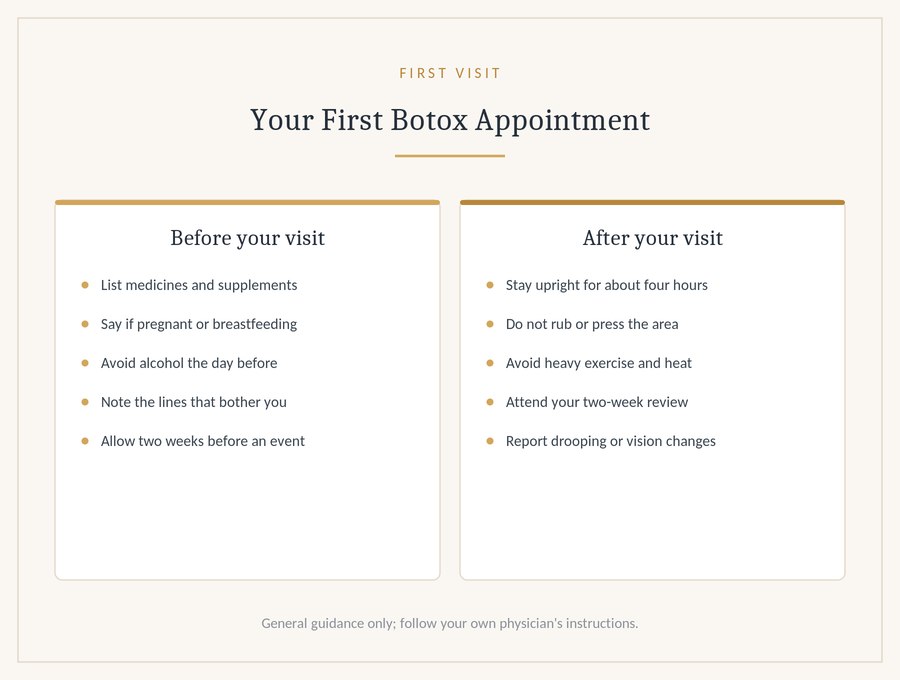
Before you arrive. Note which lines bother you and bring a list of your medicines and supplements. Mention blood thinners, aspirin, anti-inflammatory painkillers, fish oil and vitamin E, which can make bruising more likely, but do not stop a prescribed medicine without medical advice. Avoid alcohol the day before, and allow at least two weeks before an important event.
How Are the Injections Done, and What Do They Feel Like?
The skin is cleaned and the injection points may be marked. A numbing cream or ice pack can be offered, although many people do not need one. The toxin is placed into the muscle through a very fine needle at carefully chosen points. The US prescribing information for onabotulinumtoxinA describes five points for frown lines, five for the forehead and three on each side beside the eyes, with standard totals of 20 units for frown lines, 20 for the forehead and 24 for the outer eye area. Real doses are individual, and units cannot be converted between brands, so a number only means something when you know the product.
Most people describe a brief pinch or sting at each point, then mild pressure. Small raised bumps can appear and usually fade within an hour or so. Discomfort varies, and people who dislike needles sometimes feel light-headed, in which case the physician pauses and lets you lie down. The injections take only a few minutes, and you can usually resume normal activities straight away, with a few precautions for the first day.
When Will I See Results, and How Long Does It Last?
Onset. Botox does not work on the day. The first softening can start one to two days after injection, builds through the first week and is usually fully visible at around two weeks. That is why the first review is booked at about two weeks.
Duration. A standard dose for frown lines lasts about three to four months. The effect fades gradually as the muscle recovers rather than stopping suddenly, and the length varies with the person, the muscle and the dose. Your first treatment gives a useful guide to how long your own result lasts, which helps you time the next one.
Repeat treatment. Most people who keep the result up have three to four sessions a year. The prescribing information notes that dosing more often than every three months has not been clinically evaluated, so the next treatment is timed to when movement returns, not to a fixed date.
What Should I Do After Treatment?
Aftercare advice rests on common practice and consensus rather than strong trial evidence, but it costs little to follow.
The first few hours. Stay upright for around four hours and avoid lying flat. Do not rub, press or massage the treated areas, since pressure may move the toxin away from the intended muscle. Light make-up can go on once the injection points have settled, if your physician agrees.
The first 24 hours. Avoid strenuous exercise, saunas, steam rooms, hot baths and long spells in strong sun, because heat can increase bruising and swelling. Avoid alcohol and facial treatments that day. Paracetamol is the usual choice for a headache; ask before taking anti-inflammatory painkillers.
The following days. Small marks at the injection points may bruise before they fade. Keep the review appointment rather than judging the result before day fourteen, and use the warning signs below to decide when to call.
What Side Effects and Risks Should I Know About?
Common and Usually Mild
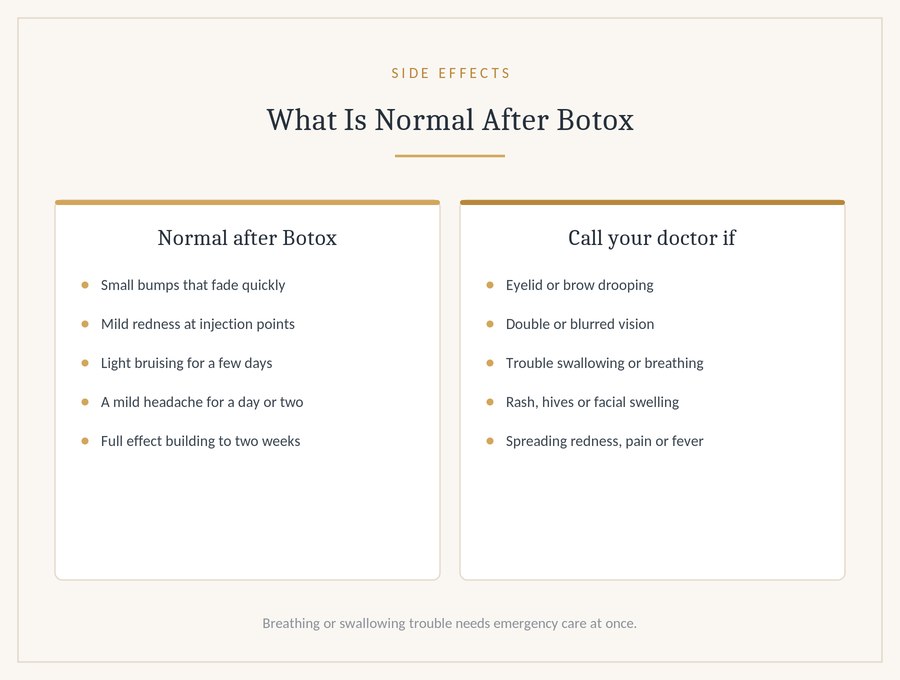
Redness, small bumps, tenderness and bruising at the injection points are common, as are a headache in the first day or two and a feeling of tightness in the treated area. In the controlled trials behind the US prescribing information, headache was reported by 9% of people treated for forehead lines, compared with 5% of those given placebo.
Less Common
Eyelid droop (ptosis) happens when the toxin affects the muscle that lifts the upper eyelid. Brow droop or heaviness happens when the forehead is relaxed too much or not balanced against the frown muscles. In those trials, eyelid droop was reported in about 3% of people treated for frown lines, and brow droop in about 2% of those treated for forehead lines. Uneven brows, dry or watery eyes and eyelid swelling also occur. These effects are temporary but last until the toxin wears off, which can take weeks, and no enzyme reverses Botox the way hyaluronidase dissolves hyaluronic acid filler. Eye drops that lift the lid slightly are sometimes offered in the meantime.
Rare but Serious
Serious allergic reactions have been reported with botulinum toxins. The effect can also, rarely, spread beyond the injected area and cause generalised weakness, double vision, drooping eyelids, or difficulty swallowing, speaking or breathing. The prescribing information carries a boxed warning about this that applies to all botulinum toxin products, while noting that no definitive serious reports of it have been described at the doses used for facial lines. Swallowing, speech or breathing difficulty needs immediate medical attention.
Who Should Avoid Botox?
A physician decides this in person, but several situations mean treatment is postponed or avoided.
Pregnancy and breastfeeding. There are no adequate data on its use in pregnancy or breastfeeding, so treatment is postponed. Say so if you are trying to conceive.
Neuromuscular conditions. Myasthenia gravis, Lambert-Eaton syndrome, motor neurone disease and similar conditions raise the risk of significant weakness.
Allergy or infection. A known allergy to any botulinum toxin product or its ingredients rules treatment out, as does infection or inflammation of the skin where the injections would go.
Medicines and other conditions. Aminoglycoside antibiotics, muscle relaxants and other medicines that affect nerve-to-muscle signals can strengthen the toxin’s effect. Extra caution applies with swallowing or breathing problems, heart disease, an existing droopy eyelid, bleeding disorders and blood-thinning treatment. Cosmetic Botox is for adults only.
What Is a Realistic First Result?
A natural first result is subtle. Lines soften rather than disappear, the forehead and brows still move, and people tend to notice that you look rested rather than treated. Lines already etched at rest improve less and may need skin treatments or filler in addition. Some first-timers find the effect lighter than expected, which is why a small adjustment at the two-week review is routine rather than a failure. For a first treatment, it is reasonable to treat only the one or two areas that bother you most and review before adding more, which keeps the result natural and the cost proportionate.
No outcome can be promised. When the effect wears off, movement returns gradually, and there is no good evidence that stopping treatment leaves lines worse than they would otherwise have been.
How Should I Plan the First Review?
Book the review for about two weeks after treatment, when the full effect is visible. The physician checks symmetry, brow position and how strongly each muscle has responded, compares with the baseline photographs and decides whether a small adjustment is needed. Starting with a measured dose and adding a little at this stage is a more reliable route to a natural result than trying to guess the exact dose in advance.
Ask for a written record of the product, units and areas treated, so the next session can build on it. Plan that session for when movement has clearly returned, usually after three to four months and not before three months. Contact the clinic sooner if you notice drooping, marked asymmetry or any symptom on the warning list.
Choosing Who Treats You
Botox is a prescription medicine, so the person injecting should be a licensed physician whose DHA licence you can verify on the DHA Sheryan portal. Ask about their experience with this specific treatment, whether they examine your face at rest and in movement before injecting, and whether they will name the product, the units and the risks before you consent.
A sound plan also includes a review at about two weeks, written aftercare and a clear way to reach the clinic if something concerns you. Be cautious about treatment offered at home, in a salon or at an event, and about prices quoted before anyone has examined your face. The page on Botox and anti-wrinkle treatments gives an overview of the areas treated. At dr-soheila.com, treatments are planned and performed by Dr Soheila Eskandari, a DHA-licensed general practitioner with aesthetic privileges with 20 years of experience in aesthetic medicine.
The Short Version
A first Botox treatment in Dubai begins with a consultation and facial assessment, takes only minutes to inject and involves little downtime. The first changes show within days, the full effect at around two weeks, and the result lasts about three to four months. Redness, small bumps, bruising and headache are common; eyelid or brow droop and asymmetry are less common and temporary.
Botox suits expression lines, not lost volume or lines etched at rest, and it is avoided in pregnancy, breastfeeding and certain neuromuscular conditions. A natural first result is subtle, adjusted at a two-week review, and confirmed as suitable in person by a licensed physician.
Questions Worth Asking
Which product, how many units and where? You should hear the product name, the dose and the injection areas, ideally in writing.
What will happen at my two-week review? Assessment and any small adjustment should be part of the plan from the start.
What are the risks for my face specifically? The answer should cover eyelid and brow droop and how it would be managed, not only bruising.
Is Botox the right treatment for this concern? A physician willing to say that filler or skin treatment suits a concern better is giving sound advice.
Frequently Asked Questions
How long does a first Botox appointment take?
Most of the time goes on the consultation and assessment. The injections themselves take only a few minutes, and there is little or no downtime, although a few precautions apply for the first day.
Does Botox hurt?
Most people describe a brief pinch or sting at each point, and discomfort varies from person to person. A numbing cream or ice pack can be offered, and the injections are over within minutes.
When will I see the results?
The first softening can begin one to two days after injection, builds through the first week and is usually fully visible at around two weeks, which is when the review takes place.
How long does Botox last?
About three to four months for frown lines, fading gradually as the muscle recovers. Most people who keep the result up have three to four sessions a year.
Can Botox be reversed if I do not like the result?
No enzyme reverses it, unlike hyaluronic acid filler. An unwanted effect is managed by waiting while it wears off over weeks, which is why a measured first dose and a two-week review matter.
What should I avoid after Botox?
Avoid rubbing or pressing the area, lying flat for about four hours, and strenuous exercise, heat, alcohol and facial treatments for 24 hours. These precautions are standard practice rather than proven requirements.
What are the side effects of Botox?
Redness, small bumps, bruising and headache are common. Eyelid or brow droop, asymmetry and dry eyes are less common and temporary. Allergic reactions and spread of the effect are rare but need urgent attention.
Who should not have Botox?
People who are pregnant or breastfeeding, have a neuromuscular condition such as myasthenia gravis, are allergic to botulinum toxin or have a skin infection at the injection sites are usually not treated. Some antibiotics and muscle relaxants also need review. A physician must assess suitability in person.
Will I look frozen after my first treatment?
Not if the dose and placement are planned to keep movement. A natural first result softens lines while expressions remain, and any adjustment is made at the two-week review.
What does it cost in Dubai?
Market rates generally run from around AED 30 to AED 60 per unit, or around AED 800 to AED 1,500 per treated area, with three upper-face areas commonly between AED 2,000 and AED 4,000. The final figure depends on the units your muscles need.
This article is general information about aesthetic and dermatological treatments and is not medical advice, a diagnosis, or a treatment recommendation for any individual. Outcomes vary between patients and no result is guaranteed. Prescription medications and injectable products carry risks and contraindications that must be assessed by a licensed physician during a personal consultation. Dr Soheila Eskandari is licensed by the Dubai Health Authority. Prices quoted are general market ranges for information only and are not an offer.


 English
 Arabic