
Hair Loss Treatment in Dubai: Diagnosis Before Protocol
Hair Loss Treatment in Dubai: Diagnosis Before Protocol
Hair loss is the concern patients delay longest and where delay costs the most. Unlike most aesthetic issues, hair loss has a window. Follicles that have miniaturised can often be recovered; follicles that have been dormant for years generally cannot. The people who do best are the ones who came in early, and the people who regret most are the ones who spent two years on shampoos.
This guide covers what actually causes hair loss, why proper diagnosis changes everything, what the meta-analytic evidence supports for each treatment, and what a realistic plan looks like in Dubai. Dr Soheila’s approach starts with diagnosis, because the single most common reason treatment fails is that the wrong condition was being treated.
Diagnosis First — This Is Not a Formality
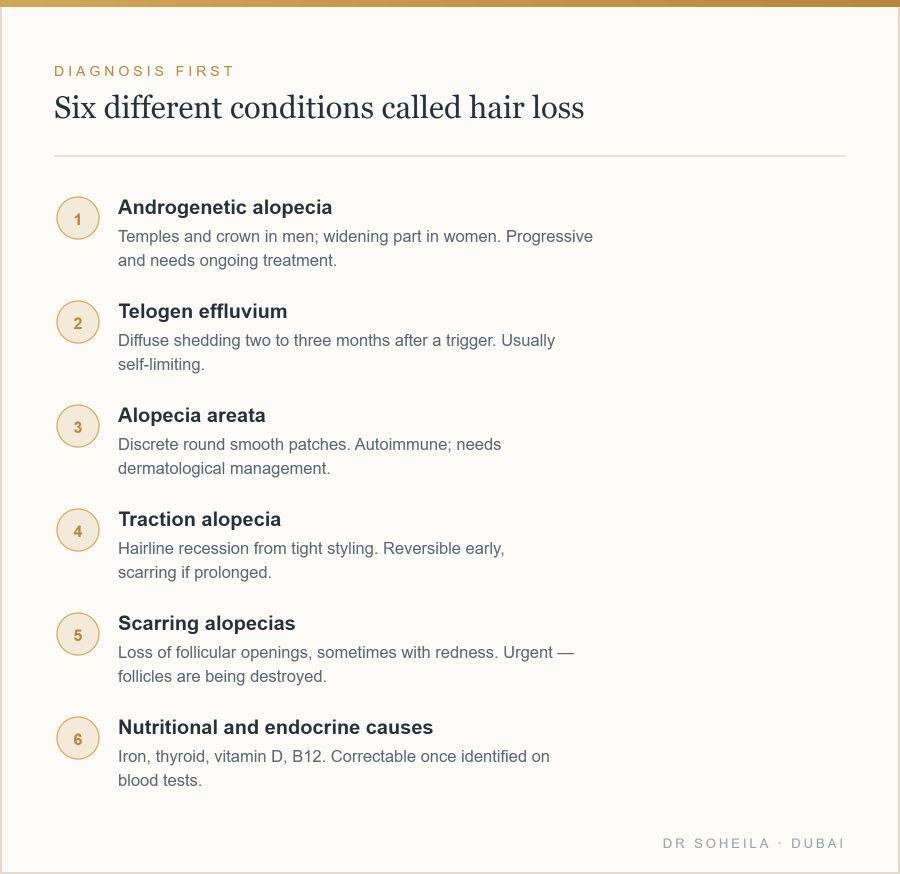
“Hair loss” describes at least six distinct conditions with different mechanisms and opposite treatment logic. Applying an androgenetic alopecia protocol to a patient with telogen effluvium wastes months.
| Condition | Pattern | Key point |
|---|---|---|
| Androgenetic alopecia | Temples and crown in men; widening part with preserved hairline in women | Progressive and genetic. Requires ongoing treatment |
| Telogen effluvium | Diffuse shedding across the whole scalp, often dramatic | Follows a trigger by 2–3 months. Usually self-limiting once the trigger resolves |
| Alopecia areata | Discrete round smooth patches | Autoimmune. Needs dermatological management, not cosmetic treatment |
| Traction alopecia | Recession at the hairline and temples | Caused by tension from tight styling. Reversible early, scarring if prolonged |
| Scarring alopecias | Loss of follicular openings, sometimes with redness or scale | Urgent. Follicles are being permanently destroyed. Needs specialist care immediately |
| Nutritional and endocrine | Diffuse thinning with other systemic signs | Iron, thyroid, vitamin D, B12. Correctable if identified |
Dr Soheila’s assessment includes history and timeline, pattern examination, a pull test, dermoscopy of the scalp to look at follicular openings and hair shaft calibre, and a blood panel. That panel typically covers ferritin, full blood count, thyroid function, vitamin D, vitamin B12, and — where clinically indicated in women — androgen levels to screen for PCOS.
Ferritin deserves special mention. Hair follicles are sensitive to iron status well before anaemia develops. A woman with a ferritin of 15 and a normal haemoglobin can shed significantly, and no injectable treatment will fix that until the iron is corrected. Our guide to B12 and nutritional testing covers the wider panel.
Androgenetic Alopecia: What the Evidence Supports
This is the most common cause and the one with the best-studied treatments. It is worth being precise about what each option actually does.
Topical minoxidil
Minoxidil is one of only two treatments with regulatory approval for androgenetic alopecia. It has gained widespread acceptance for its ease of use, good results, and minimal local side effects. It works by extending the growth phase of the hair cycle and improving follicular blood supply.
The critical thing patients need to know: minoxidil causes a shedding phase in the first four to eight weeks. This is expected — the drug pushes follicles out of the resting phase, so old hairs are released before new ones grow. A large number of people stop the treatment at exactly this point, convinced it is making things worse. It is the drug working. Continuing through it is the whole game.
Meaningful assessment happens at four to six months, not before.
Finasteride
The second regulatory-approved treatment. It inhibits 5-alpha reductase, reducing conversion of testosterone to dihydrotestosterone, the androgen that drives follicular miniaturisation.
A 2025 systematic review and meta-analysis of seven randomised controlled trials found that a topical minoxidil-finasteride combination was superior to monotherapy in male androgenetic alopecia, with clinically meaningful improvements in hair density, hair diameter, and global photographic assessment.
Oral finasteride is prescription-only, is not appropriate for women of childbearing potential, and carries a side-effect profile that must be discussed properly before starting. Topical formulations reduce but do not eliminate systemic exposure. This is a physician conversation, not a clinic upsell.
Platelet-rich plasma (PRP)
PRP involves drawing your blood, centrifuging it to concentrate platelets, and injecting the concentrate into the scalp. Platelets carry growth factors that are proposed to stimulate follicular activity.
The evidence is real but should be described accurately. A meta-analysis of PRP combined with minoxidil demonstrated a significant increase in hair density and hair diameter in the combination group compared with minoxidil alone, at one month, three months, and five to six months of follow-up.
The same body of work is candid about its limitations: the certainty of evidence on GRADE assessment was rated low to very low, with a small number of studies, high risk of bias, and — importantly — substantial heterogeneity in how PRP is prepared between studies.
That last point matters commercially. “PRP” is not a standardised product. Centrifugation protocol, spin speed, platelet concentration, and whether activation is used all vary between clinics. Two treatments called PRP can differ considerably. When comparing prices, ask what system and protocol are used.
The honest summary: PRP is a reasonable adjunct with supportive but low-certainty evidence, best used alongside minoxidil rather than instead of it. A clinic positioning PRP as a standalone replacement for the approved treatments is not following the evidence.
Other options
- Low-level laser therapy. Device-based, home or in-clinic. Modest evidence, low risk, requires consistent long-term use.
- Microneedling of the scalp. Some evidence for enhancing minoxidil response, likely via improved delivery and a wound-healing stimulus. Our guide to medical microneedling explains the underlying mechanism.
- Hair transplant. The definitive option for established loss with a good donor area. It relocates follicles rather than treating the process, so medical treatment usually continues afterwards to protect non-transplanted hair.
- Nutraceuticals. Useful where a deficiency is documented. Of limited value where nutritional status is already normal.
Why Combination Treatment Wins
The clearest pattern in the literature is that combinations outperform monotherapy. Minoxidil plus finasteride beats minoxidil alone. PRP plus minoxidil beats minoxidil alone. This is not surprising — the treatments act on different parts of the same process.
A typical evidence-led plan for androgenetic alopecia therefore looks like:
- Correct any deficiency found on bloods. Iron, thyroid, vitamin D. Non-negotiable and often overlooked
- Establish a daily topical. Minoxidil, with or without finasteride depending on sex, plans for pregnancy, and preference after a proper discussion
- Add an in-clinic component such as PRP, typically monthly for three to four sessions then maintenance
- Photograph at fixed intervals in standardised lighting and position — this is the only reliable way to judge progress
- Reassess at four to six months and adjust
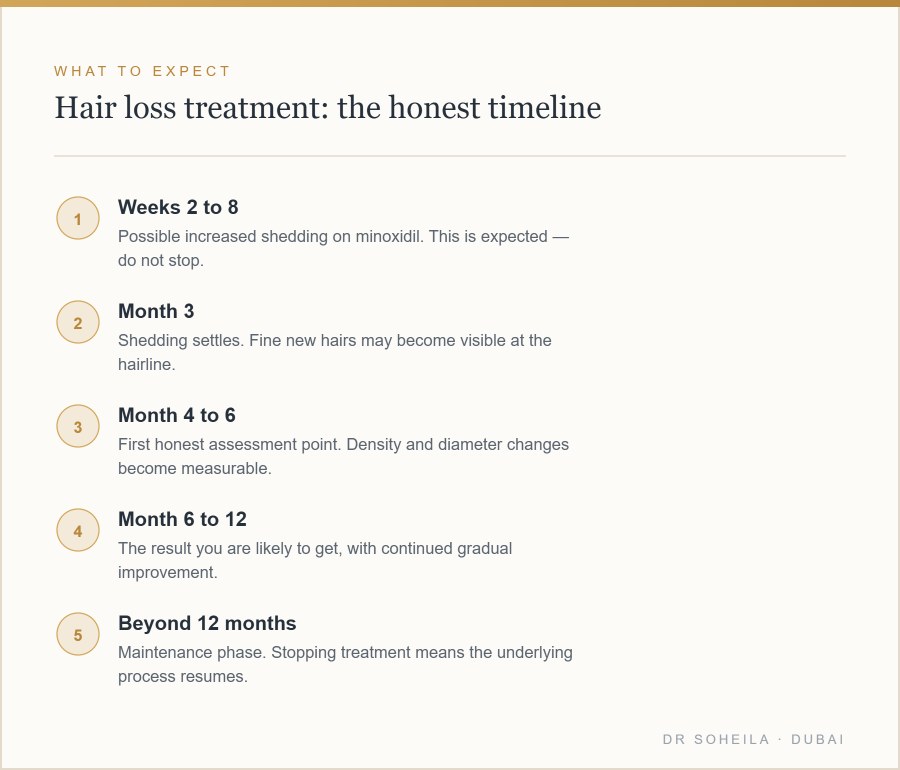
Timeline: What to Expect and When
| Time | What typically happens |
|---|---|
| Weeks 2–8 | Possible increased shedding on minoxidil. Expected. Do not stop |
| Month 3 | Shedding settles. Fine new hairs may be visible at the hairline |
| Month 4–6 | First honest assessment point. Density and diameter changes become measurable |
| Month 6–12 | The result you are likely to get. Continued gradual improvement |
| Beyond 12 months | Maintenance phase. Stopping treatment means loss resumes |
That last row is the one patients most want to argue with. Androgenetic alopecia is a progressive genetic condition. Treatment holds it and partially reverses it; it does not cure it. Stopping means the underlying process resumes and gains are lost over the following months. Anyone planning treatment should plan for it as ongoing.
Hair Loss Factors Specific to Dubai
Several environmental factors here are genuinely relevant, though they are usually contributors rather than primary causes:
- Hard water. High mineral content leaves deposits on the hair shaft, making hair feel rough, dull, and more prone to breakage. This causes hair to look thinner without follicular loss. A shower filter and chelating shampoo help
- Chlorinated pool water. Frequent swimming strips lipids from the shaft. Wetting hair with clean water before swimming reduces uptake
- UV exposure. Degrades keratin and worsens shaft damage. A hat is a genuinely useful intervention
- Vitamin D deficiency. Common here despite the sunshine, because sun avoidance and indoor lifestyles are the norm. Worth testing
- Relocation stress. Moving country, changing jobs, illness, or a significant diet change can all trigger telogen effluvium — which appears two to three months after the event, so patients rarely connect the two
Our guide to sun and water damage in Dubai covers the environmental side in more detail.
Hair Loss Treatment Cost in Dubai
Market rates in DHA-licensed clinics generally run:
- Consultation with dermoscopy: approximately AED 300 to AED 800
- Blood panel: approximately AED 400 to AED 1,200
- PRP session: approximately AED 1,200 to AED 3,000, with three to four initial sessions typical
- Mesotherapy for hair: approximately AED 800 to AED 2,000 per session
- Topical minoxidil: modest monthly cost, ongoing
- Hair transplant: variable and graft-dependent, typically in the tens of thousands of dirhams
Because treatment is ongoing rather than one-off, the number that matters is annual cost of the plan, not the price of a single session. Ask for that figure. A clinic that will not put an annual plan and cost in front of you is worth being cautious about.
Warning Signs When Choosing a Clinic
- No diagnosis and no blood tests. If nobody examined your scalp under dermoscopy or checked your ferritin and thyroid, you are buying a package rather than a treatment.
- Guaranteed regrowth. Nobody can guarantee this. Response varies and some follicles are beyond recovery.
- PRP presented as a replacement for approved treatments. The evidence supports it as an adjunct, and rates its certainty as low to very low.
- Large upfront packages before any assessment of response. Reasonable plans have review points.
- No standardised photography. Without fixed-position, fixed-lighting images, neither of you can honestly judge whether it worked.
- Proprietary “secret formula” injections. You are entitled to know what is going into your scalp.
Treating With Dr Soheila
Dr Soheila Eskandari treats hair loss in Dubai under DHA licence, beginning with diagnosis rather than with a treatment menu. The first appointment establishes which condition is actually present, whether there is a correctable systemic contributor, and — for scarring alopecias — whether onward specialist referral is the right immediate step.
Where androgenetic alopecia is confirmed, the plan follows the evidence: correct deficiencies, establish a daily topical, add an in-clinic component where appropriate, photograph properly, and reassess at four to six months rather than pronouncing on it at week eight. Patients are told upfront that treatment is ongoing, because the alternative — discovering that at month twelve — is how people lose their results.
Where telogen effluvium is the diagnosis, patients often need reassurance and a corrected deficiency more than they need a course of injections, and Dr Soheila will say so.
Frequently Asked Questions
Does PRP work for hair loss?
A meta-analysis of PRP combined with minoxidil found significant increases in hair density and hair diameter versus minoxidil alone at one, three, and five to six months. However the same work rated certainty of evidence as low to very low, citing few studies, risk of bias, and wide variation in how PRP is prepared. It is best used as an adjunct alongside proven topicals, not as a replacement.
Why is my hair shedding more since I started minoxidil?
This is expected in the first four to eight weeks. Minoxidil pushes resting follicles into the growth phase, which releases old hairs before new ones emerge. It is a sign the treatment is acting. Stopping at this point is the most common reason minoxidil “fails”.
How long before I see results?
Four to six months is the first honest assessment point, with continued improvement typically to twelve months. Judging at week eight — during the shedding phase — will mislead you.
Do I have to continue treatment forever?
For androgenetic alopecia, effectively yes. It is a progressive genetic condition. Treatment holds and partially reverses it but does not cure it, so stopping means the underlying process resumes and gains are lost over the following months.
Is minoxidil plus finasteride better than minoxidil alone?
A 2025 systematic review and meta-analysis of seven randomised controlled trials found the topical combination superior to monotherapy in male androgenetic alopecia, with clinically meaningful improvements in hair density, diameter, and global photographic assessment. Finasteride requires a proper physician discussion and is not suitable for women of childbearing potential.
What blood tests should I have for hair loss?
At minimum ferritin, full blood count, thyroid function, vitamin D, and vitamin B12, with androgen levels in women where clinically indicated. Ferritin matters even when haemoglobin is normal — follicles are sensitive to iron status before anaemia develops.
Can hard water in Dubai cause hair loss?
Hard water does not cause follicular loss, but mineral deposits on the hair shaft make hair rough, dull, and more prone to breakage, which makes it look thinner. A shower filter and periodic chelating shampoo help. It is a contributor to appearance, not a cause of true alopecia.
What is telogen effluvium and how is it different?
It is diffuse shedding across the whole scalp, usually following a trigger — illness, surgery, major stress, childbirth, crash dieting, relocation — by two to three months. It is generally self-limiting once the trigger resolves and any deficiency is corrected, and it needs a different approach from androgenetic alopecia.
When should I see a doctor urgently about hair loss?
If you have redness, scaling, pain, or loss of visible follicular openings, or if patches are smooth and expanding rapidly. These can indicate a scarring alopecia, where follicles are being permanently destroyed, and delay costs permanent hair.
How much does hair loss treatment cost in Dubai?
Market rates generally run AED 300 to AED 800 for consultation with dermoscopy, AED 400 to AED 1,200 for a blood panel, and AED 1,200 to AED 3,000 per PRP session with three to four sessions initially. Because treatment is ongoing, ask for an annual plan cost rather than comparing single-session prices.
This article is general health information and is not medical advice, a diagnosis, or a treatment recommendation for any individual. Hair loss has many causes and requires proper diagnosis before treatment. Outcomes vary between patients and no result is guaranteed. Scalp redness, scaling, pain, or rapidly expanding patches require prompt medical assessment. Dr Soheila Eskandari is licensed by the Dubai Health Authority. Prices quoted are general market ranges for information only and are not an offer.


 English
  Arabic