
Forehead Wrinkle Treatment in Dubai: Options Compared, Risks and Timelines
Forehead Wrinkle Treatment in Dubai: Options Compared, Risks and Timelines
Forehead wrinkle treatment in Dubai depends on what is creating the lines. Anti-wrinkle injections soften lines made by the frontalis muscle when you raise your brows, while skin boosters, microneedling and chemical peels improve the skin itself and the finer lines that remain when your face is relaxed. Most people have a mix of both, so a plan usually combines treatments, and filler is approached with particular caution in the forehead because of the blood vessels close to the surface.
This guide explains how to tell dynamic lines from static lines and skin quality, how each option works and what it can and cannot do, why filler in the forehead needs caution, and why heavy forehead treatment can lower the brows. It also covers combination plans, timelines, risks, who should avoid each option and costs in Dubai. Results vary between people, and suitability must be confirmed in person by a licensed physician.
What Causes Forehead Wrinkles?
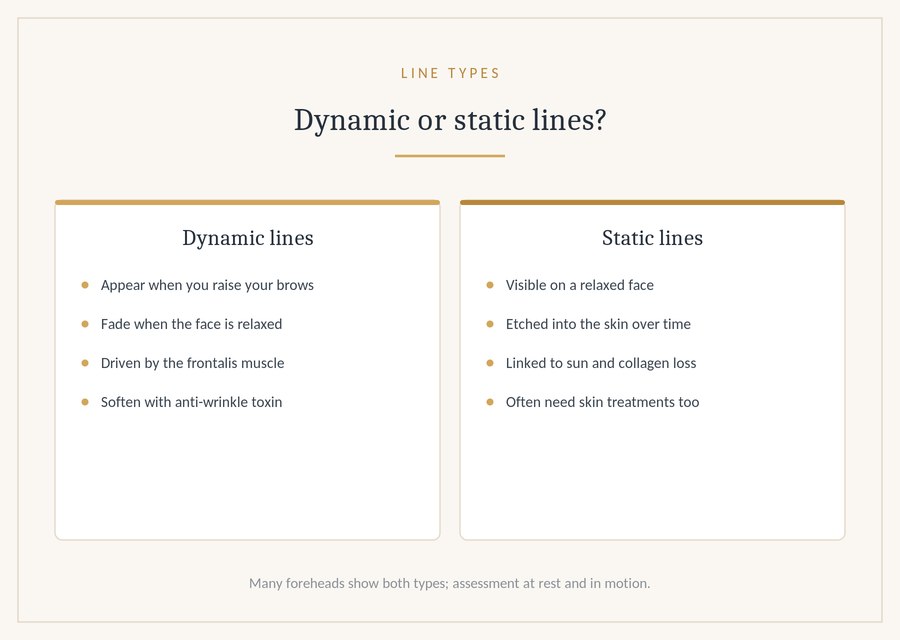
Dynamic lines: movement from the frontalis muscle
The frontalis is a thin, flat muscle across the forehead that lifts the eyebrows. Each time it contracts, the skin above it folds into horizontal creases, which is why lines appear when you look surprised or lift your brows to see better. Lines that fade when your face is relaxed are dynamic lines. The frontalis is the only muscle that raises the brows, while smaller muscles between and around the eyes pull them down.
Static lines: creases that stay at rest
Static lines are visible when your face is completely relaxed. They develop when years of folding combine with thinning skin, falling collagen and elastin, and sun damage, so the crease becomes etched into the skin. Strong year-round sunlight in Dubai can add to this. Many foreheads show both types: a line that began as movement and has gradually become fixed.
Skin quality: the surface the lines sit in
Skin quality means hydration, texture, thickness and sun damage. Dry, thin or rough skin shows lines more clearly, and fine, crêpey creases often reflect skin quality more than muscle activity. To check at home, look in a mirror with your face relaxed, then raise your brows: lines that appear only with movement are mostly dynamic, and lines that stay visible at rest are mostly static. A physician needs to see you at rest and in motion to separate them reliably.
Which Forehead Wrinkle Treatments Are Available in Dubai?
Each option works on a different layer, so they are compared here by what they treat rather than ranked.
Anti-wrinkle injections: relaxing the frontalis
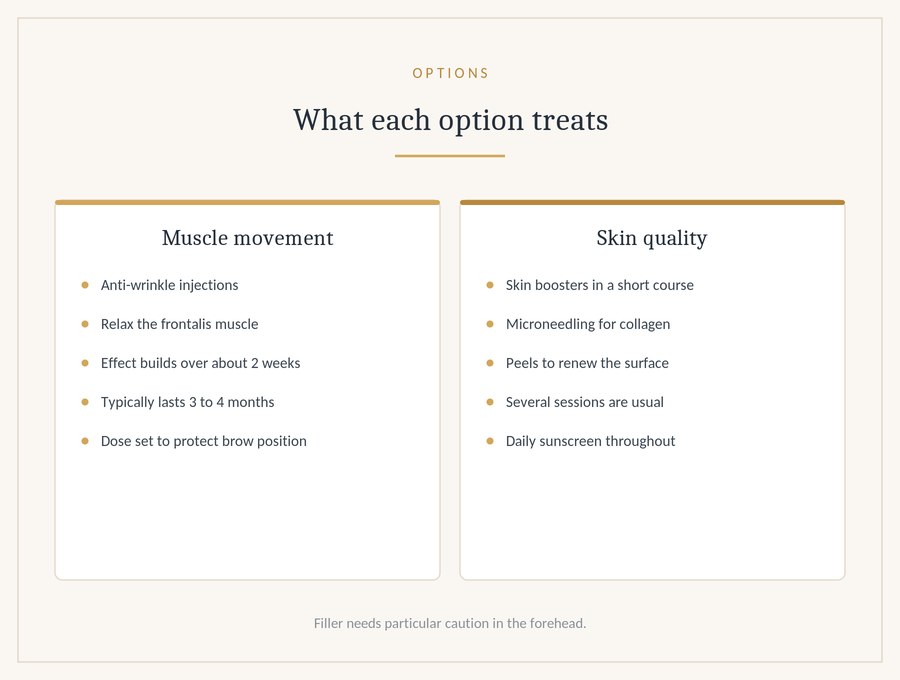
Anti-wrinkle injections use botulinum toxin type A, which blocks the nerve signal that tells a muscle to contract. Small amounts placed in the frontalis let the skin above it fold less, so dynamic lines soften. Dr Soheila works with Dysport, Botox (Allergan) and Nabota, which are all type A toxins; their units are not interchangeable, so a dose only makes sense for the product used. The US label for Botox Cosmetic lists 20 units across five forehead sites, given with 20 units for the frown lines. The first change usually appears within two to five days, the full effect at around two weeks, and the result typically lasts about three to four months. Our forehead Botox guide covers dosing in depth, and the page on anti-wrinkle treatments gives an overview.
Toxin softens movement but does not remove lines already etched into the skin, although partly fixed lines may ease as the skin is folded less. Common effects are small bumps, redness, bruising and mild headache. Less commonly, the toxin affects a nearby muscle, causing a heavy brow, a drooping eyelid or uneven movement. Treatment is usually avoided in pregnancy, breastfeeding, infection at the injection site, known allergy and neuromuscular conditions such as myasthenia gravis, and some medicines, including certain antibiotics, can interact with it.
Skin boosters: improving hydration and fine lines
Skin boosters are injectable products placed in or just under the skin to improve hydration, elasticity and surface quality. They do not relax muscle, so they make little difference to a line that deepens every time you lift your brows, but they can soften fine, crêpey lines that remain at rest. Dr Soheila works with Profhilo, NCTF and Jalupro. Profhilo is a heat-stabilised hyaluronic acid gel designed to spread through tissue from a few injection points; NCTF combines hyaluronic acid with vitamins, amino acids, minerals and antioxidants; Jalupro combines it with amino acids. The choice depends on your skin and goals, and our comparison of skin boosters and Botox explains where each fits.
Boosters are given as a course, usually two or three sessions two to four weeks apart depending on the product, and improvement builds gradually and commonly lasts around six months. Expect small bumps, then redness, swelling and bruising for a few days. Lumps can persist, cold sores can be triggered, and a blocked blood vessel is very rare with superficial boosters. Treatment is usually postponed in pregnancy, breastfeeding, active skin infection and known allergy, and needs care with autoimmune disease or a tendency to raised scars.
Microneedling: stimulating collagen from within
Microneedling uses fine needles to create tiny channels into the dermis while leaving the surface largely intact. The controlled injury prompts new collagen, so it is used for fine lines, texture and pore size rather than movement. A typical plan is three to six sessions about four weeks apart, with maintenance every six to twelve months, and redness resembling sunburn lasts one to three days. Our guide to microneedling explains the technique.
The main risks are post-inflammatory pigmentation, which is more likely in deeper skin tones, infection if sterility is inadequate, and cold sore flare-ups. It is avoided over active infection, inflammation or acne, usually postponed in pregnancy and breastfeeding, and needs caution after oral isotretinoin. Evidence for wrinkles comes mostly from small studies, so expect gradual, modest improvement.
Chemical peels: renewing the surface
A chemical peel applies an acid that removes controlled layers of the surface, and the skin renews itself as it heals. Superficial peels brighten dull skin and soften very fine lines, while medium-depth peels reach the upper dermis and need more recovery time. Peels are usually a course of four to six sessions two to four weeks apart. A superficial peel brings light flaking for two to four days, and a medium-depth peel visible peeling for five to seven days. Our guide to chemical peels covers the options.
Risks include stinging, prolonged redness, chemical burns if the wrong strength is used, infection and post-inflammatory pigmentation, which rises with peel depth and is more likely in deeper skin tones and strong sun. Peels are avoided over active infection, cold sores, sunburn or broken skin, usually postponed in pregnancy and breastfeeding, and need caution after oral isotretinoin. They are not usually combined with microneedling in one session, because the combined injury raises the chance of pigmentation.
Why Does Filler in the Forehead Need Particular Caution?
Filler is designed to add volume or soften folds, not to relax a muscle, so it does not stop the movement that creates dynamic lines. The larger concern is blood supply. The supraorbital and supratrochlear arteries run close to the surface of the forehead and are branches of the artery that supplies the eye. If filler enters or compresses one of these vessels, blood flow can be blocked, causing skin damage and, rarely, loss of vision. In 2015 the US FDA warned that unintended injection into a blood vessel can cause blindness, stroke and damage to skin and underlying tissue, and professional guidance lists the forehead and the area between the brows among the higher-risk sites.
For these reasons many physicians consider other options first for forehead lines. If filler is used, for a deep etched line or to shape the forehead, the usual precautions are small amounts, slow injection with minimal pressure, careful depth, thorough knowledge of the vessel anatomy and hyaluronidase available. Severe or increasing pain, white or mottled skin, or any change in vision needs immediate action. Filler is generally postponed or avoided after previous forehead surgery or scarring, with infection, in pregnancy or breastfeeding, and with known allergy.
Can Forehead Treatment Lower Your Brows?
Yes, it can, which is why dose and placement matter. The frontalis is the only muscle that lifts the brows, and muscles between and around the eyes pull them down. If too much toxin is placed in the frontalis, or too low on the forehead, the brows can sit lower and feel heavy, which crowds the upper eyelids and gives a tired look. People with naturally low brows, hooded eyelids or excess upper eyelid skin are affected more, because they already rely on the frontalis to hold the brows up. In the US trials of Botox Cosmetic for forehead lines, given with the frown lines, brow ptosis was reported in about 2% of participants.
Brow position is protected by assessing your brows at rest and in movement, adjusting the dose for your sex and muscle strength, keeping injection points well above the brow, and treating the frown area at the same time so the muscles that lower the brows are balanced. Lower-dose approaches, sometimes called baby Botox, may preserve more movement but can wear off sooner. A heavy brow from toxin can last several weeks and cannot be reversed quickly. Skin treatments do not affect brow position, and our guide to Botox brow lift explains how toxin is used to shape the brow.
How Do Combination Plans and Timelines Work?
Because most foreheads have more than one cause, plans usually combine a muscle treatment with a skin treatment. A common sequence is injections first, a review at around two weeks, then a skin booster course, microneedling or peels once the effect of the toxin can be judged. Different treatments in the same area are often spaced by about two weeks so that swelling or bruising settles. Dull, thin or crêpey skin may point to a skin course first, while movement lines point to toxin first.
The toxin takes effect over about two weeks and is repeated when movement returns, usually at three to four months and not sooner than about three months. A booster course of two or three sessions, four to six peels or three to six microneedling sessions runs alongside, with improvement building over weeks to months. Maintenance is then planned, often around every six months for boosters, with daily broad-spectrum sunscreen throughout. Deep static lines may soften but rarely disappear completely, so the aim is a smoother, natural-looking forehead and not a frozen one.
Who Should Avoid Forehead Wrinkle Treatments?
Pregnancy and breastfeeding are reasons to postpone injections and most skin procedures, because safety data are limited. Active infection, cold sores, eczema or acne flares in the area, sunburn and known allergy to an ingredient are reasons to wait or choose differently. Bleeding disorders and blood-thinning medicines increase bruising; discuss them, but never stop a prescribed medicine without the prescriber’s advice. Keloid scarring, recent isotretinoin, autoimmune disease and very low brows or heavy eyelids call for extra care. A licensed physician must assess suitability in person.
Choosing Who Treats You
Forehead treatment involves muscle, skin and blood-vessel anatomy, so choose a licensed physician whose DHA licence you can verify on the DHA Sheryan portal. Ask about their experience with forehead and brow treatment, whether they assess your lines and brow position at rest and in movement before injecting, and how they would respond to a vascular complication.
A sound plan names the products and doses, explains why each treatment is included, sets out the sessions and spacing, and includes a review at around two weeks, written aftercare and a clear way to reach the clinic. At dr-soheila.com, treatments are planned and performed by Dr Soheila Eskandari, a DHA-licensed general practitioner with aesthetic privileges with 20 years of experience in aesthetic medicine.
The Short Version
Forehead wrinkles have three parts: movement from the frontalis, lines etched into the skin, and the quality of the skin itself. Anti-wrinkle injections suit movement and typically last about three to four months, while skin boosters, microneedling and chemical peels work on skin quality and fine static lines. Filler needs particular caution in the forehead because of the vessels near the surface, and too much toxin, or toxin placed too low, can lower the brows.
Most people benefit from a combined, well-spaced plan with daily sun protection. Each option has side effects, and injections and skin procedures are usually postponed in pregnancy, breastfeeding, active infection and known allergy. Results vary, and a licensed physician must confirm suitability in person.
Questions Worth Asking
Are my lines dynamic, static or both? The answer decides whether you need injections, skin treatments or a combination.
How will you protect my brow position? You should hear about dose, injection height and treating the frown area as well.
Why this option, and why not filler? A clear explanation should cover your anatomy, the vascular risk and the emergency plan.
What are the sessions, spacing and review? Expect a plan that names the products, the timing and a check at around two weeks.
Frequently Asked Questions
Which treatment works for forehead wrinkles?
It depends on the cause: injections soften movement lines, skin treatments improve skin quality and fine lines at rest, and many people need a combination.
What is the difference between dynamic and static forehead lines?
Dynamic lines appear when you raise your brows and fade at rest, while static lines stay visible with a relaxed face because the crease is etched into the skin.
How long do forehead anti-wrinkle injections take to work and last?
The first change usually appears within two to five days and the full effect at around two weeks; the result typically lasts about three to four months.
Can forehead anti-wrinkle injections lower my eyebrows?
Yes, if too much toxin is placed in the frontalis or too low; brow ptosis was reported in about 2% of participants in the US forehead trials, and careful dosing and treating the frown area reduce the risk.
Can skin boosters improve forehead lines?
They can improve hydration and fine, crêpey lines, usually over two or three sessions, but they do not relax the frontalis, so lines made by raising your brows persist.
Can microneedling or chemical peels improve forehead lines?
They can improve texture and fine lines over a course of sessions, but neither stops muscle movement and both carry a risk of pigmentation, especially in deeper skin tones.
Why does filler in the forehead need particular caution?
Arteries that branch from the artery supplying the eye run close to the surface, so filler that enters or blocks a vessel can cause skin damage and, rarely, loss of vision; many physicians consider other options first.
Can I combine forehead treatments, and in what order?
Yes; a common order is toxin first, a review at around two weeks, then a skin booster course, microneedling or peels, with microneedling and a peel kept to separate sessions.
Who should avoid forehead wrinkle treatments?
Injections and most skin procedures are usually postponed in pregnancy, breastfeeding, active infection and known allergy, toxin is avoided in neuromuscular conditions such as myasthenia gravis, and suitability must be assessed in person.
What does forehead wrinkle treatment cost in Dubai?
Market rates generally run from around AED 800 to AED 1,500 per upper-face area for injections, AED 1,200 to AED 2,500 per skin booster session, AED 800 to AED 2,000 per microneedling session and AED 500 to AED 1,200 per peel; courses need several sessions, so ask for a written quote.
This article is general information about aesthetic and dermatological treatments and is not medical advice, a diagnosis, or a treatment recommendation for any individual. Outcomes vary between patients and no result is guaranteed. Prescription medications and injectable products carry risks and contraindications that must be assessed by a licensed physician during a personal consultation. Dr Soheila Eskandari is licensed by the Dubai Health Authority. Prices quoted are general market ranges for information only and are not an offer.


 English
 Arabic