
Botox Brow Lift in Dubai: How a Few Units Can Lift the Brows
Botox Brow Lift in Dubai: How a Few Units Can Lift the Brows
A Botox brow lift relaxes the muscles that pull the eyebrow down, so that the forehead muscle can hold the brow slightly higher. The change is usually a lift of a few millimetres, most visible at the outer end of the brow, with a first effect within days, a full effect at around two weeks and a typical duration of about three to four months. It suits mild heaviness at the tail of the brow and does not replace a surgical brow lift when the brow has dropped significantly.
Over the years the brows tend to settle lower, especially at the outer ends, and the eyes can look more tired. This guide explains how the brow muscles work, what a chemical (non-surgical) brow lift can and cannot do, who suits it, typical units, how it is combined with forehead and crow’s feet treatment without dropping the brow, the risks, aftercare and the cost in Dubai.
What Controls the Position of the Brow?
The only muscle that lifts the brow
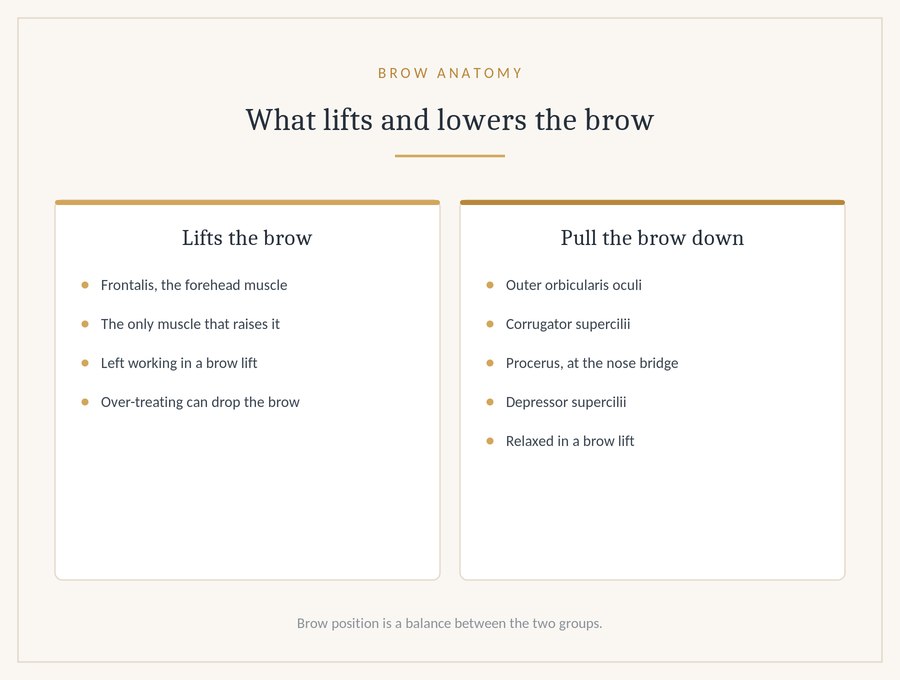
The frontalis is the broad muscle of the forehead, and it is the only muscle that raises the eyebrow. It does not reach all the way to the outer end of the brow, which is one reason the outer brow tends to settle first as the years pass.
The muscles that pull it down
Several muscles work in the opposite direction. Between the brows, the corrugator supercilii draws the brows together and down, the procerus pulls the inner end of each brow down and the small depressor supercilii adds to that pull. Around the eye, the outer part of the orbicularis oculi, the ring muscle that closes the eyelids, pulls the outer brow down when you squint or smile broadly, and strong sun in Dubai makes squinting frequent.
The position of the brow at rest is a balance between the frontalis pulling up and these muscles pulling down. Skin laxity, fat and bone changes, and gravity also contribute, so muscle activity is only part of the picture.
How Does Botox Lift the Brow?
Botox is a brand name for onabotulinumtoxinA, a purified prescription medicine that blocks the nerve signal telling a muscle to contract. For a brow lift, very small amounts are injected into the muscles that pull the brow down: the outer part of the orbicularis oculi near the tail of the brow and, in many plans, the corrugators and procerus. With the downward pull reduced, the frontalis, which is left largely free to work, holds the brow a little higher, mostly at the outer end where the injection is placed.
Brow lifting is not an indication in the product’s approved labelling, so it is an off-label use. Off-label use is common in aesthetic medicine, but it makes assessment and informed consent more important. Treating the frown area alone can also raise the brows slightly, and our guide to frown lines Botox explains that area.
What a Chemical Brow Lift Can and Cannot Do
What to expect
Published measurements are modest. In one series of 22 patients, 7 to 10 units placed in the outer part of the ring muscle on both sides raised the brow above the outer corner of the eye by an average of about 5 millimetres at two weeks, while the rise over the middle of the eye was about 1 millimetre. Reports of lower-dose techniques describe a lateral lift of around 1 to 3 millimetres. That is a subtle change, and most published data come from small case series with short follow-up, so the figures are a guide rather than a prediction for any one person.
What it cannot do
Botox acts on muscle, not on skin. It does not tighten loose skin, remove excess eyelid skin, replace lost volume or raise a brow that sits well below the bony ridge above the eye. When the brow has dropped significantly (brow ptosis), or the upper lids are heavy because of excess skin, a surgical brow lift or eyelid surgery (blepharoplasty) is usually the more appropriate route, and a chemical brow lift does not replace it. For mild heaviness, Botox can be a modest option that wears off in time, but it should not be presented as a substitute for surgery.
How Many Units Are Used?
There is no single number that suits everyone, because the dose depends on the technique, the strength of the muscles and the result you want. Published reports for the outer part of the ring muscle range from about 3 to 10 units of Botox, with lower-dose methods using one or a few points near the tail of the brow. With so few units involved, small differences in dose and placement matter, so a conservative first treatment is common.
For comparison, the dosing in the product’s approved labelling is 20 units for the frown lines, 20 units for the forehead lines and 24 units for crow’s feet, and a brow-lift plan may use smaller amounts in these areas rather than the full labelled dose. Men often need more because their muscles are stronger. Units are product-specific, so compare quotes only for the same product. If you prefer a lighter touch overall, our guide to baby Botox explains lower-dose treatment.
Who Is Suitable for a Botox Brow Lift?
Mild heaviness at the outer brow
A Botox brow lift tends to suit people whose brow tail sits low or slopes downwards because of muscle pull, who squint or frown strongly and who have little excess skin on the upper eyelids. The brow is usually still at or near the bony ridge above the eye, and the goal is a subtle, more open look rather than a dramatic change. Men often have a flatter, lower brow by nature, so the aim is usually to keep that shape rather than to arch it.
Brow ptosis, heavy eyelids and hooded eyes
Treatment is less suitable when the brow sits clearly below the bony ridge, when excess upper eyelid skin (dermatochalasis) causes hooded eyes that relaxing a muscle will not change, or when the eyelid itself droops. People who raise their brows all day to keep their eyes open also need care, because relaxing the forehead can make the brows and lids feel heavier.
During the assessment, the physician looks at the brow at rest and in movement and gently holds it higher to see how the eyelid responds. If the hooding is mainly skin, an opinion from a plastic or oculoplastic surgeon may be the better next step.

What Happens at the Appointment
The consultation starts with your medical history, including medicines, previous treatments, eye or eyelid problems, and pregnancy or breastfeeding. The physician looks at your brows at rest and while you raise them, frown and smile, checks the eyelids and records the brow position, often with photographs for comparison at the review.
The skin is cleaned and the injection points may be marked. Very fine needles are used, and the injections take only a few minutes. Most people describe a brief sting, and you can usually return to normal activities straight away.
Onset, Peak Effect and How Long It Lasts
After a Botox brow lift, the first change is usually noticed within two to five days, although it can take up to a week. The full effect is normally clear at around two weeks, which is why a review is planned then. The effect typically lasts about three to four months, after which the muscles gradually recover and the brow settles back. Smaller doses tend to wear off a little sooner, and strong muscles may shorten the effect further. Repeat treatment is planned when the brow feels heavy again, not on a fixed schedule.
Combining a Brow Lift With Forehead and Crow’s Feet Treatment
The upper face works as a unit, so a Botox brow lift is usually planned together with the frown area and the outer eye. The same muscles are involved, which makes it natural to treat frown lines and crow’s feet at the same visit, as long as the doses are planned together. The brow-lift injection sits higher than the crow’s feet points, so the whole plan is mapped at once. Our guide to crow’s feet Botox explains how that area is dosed.
Why an over-treated forehead can drop the brow
Because the frontalis is the only muscle that lifts the brow, weakening it too much, or too low on the forehead, removes the support the brow depends on. The result can be a lowered or heavy brow, a tired look and, in some people, a sense that the upper lids are pressing down. This is more likely in people whose brows are already low or who are older. A brow-lift plan therefore generally uses lower forehead doses, places them higher and leaves the lowest fibres alone. Treating the middle of the forehead while the outer frontalis stays active can instead produce an over-arched outer brow, sometimes called a Spock brow, which a small adjustment often corrects. Our guide to forehead Botox covers that area in more detail.
Aftercare
For the first few hours, stay upright and avoid rubbing or pressing the treated area. Avoid heavy exercise, saunas and very hot environments for the rest of the day. Make-up can usually be applied gently after a few hours if the skin is not broken. A small bruise usually fades within a week. Your physician’s own instructions always take priority.
Side Effects and Rare Risks
Small bumps at the injection points, redness, mild swelling and tenderness are common and short-lived. Bruising can occur, particularly near the eye where the skin is thin, and some people have a mild headache for a day or two. The brows can also look slightly uneven, because they were uneven before treatment or because the two sides respond differently; a small adjustment at the two-week review can usually balance them.
Less commonly, the brow sits lower or the outer brow arches too much. Drooping of the upper eyelid (eyelid ptosis) is uncommon. It happens when the product spreads to the muscle that lifts the lid, usually appears within days to two weeks and settles over several weeks; prescription eye drops can sometimes soften it meanwhile. Allergic reactions are rare. Anyone who notices drooping of an eyelid, changes in vision, difficulty swallowing or breathing, or marked weakness should contact the clinic urgently or seek emergency care.
Who Should Avoid a Botox Brow Lift?
Treatment is usually postponed during pregnancy and breastfeeding, when there is an infection or active skin problem at the injection sites, and when there is a known allergy to botulinum toxin or any ingredient. Botox is avoided in people with certain neuromuscular conditions, such as myasthenia gravis, and some medicines, including certain antibiotics, can interact with it. Extra care is needed with an existing eyelid droop, heavy upper lids, significant dry eye or previous eyelid or brow surgery. Blood-thinning medicines and supplements increase bruising and should be discussed, but never stopped without the advice of the prescribing doctor.
Choosing Who Treats You
Botox is a prescription medicine, and a brow lift depends on judging the balance between the muscles that lift and lower the brow, so the person injecting should be a licensed physician whose DHA licence you can verify on the DHA Sheryan portal. Ask about their experience with brow-position planning, not only wrinkle treatment, and whether they assess your brow height, eyelids and forehead movement before injecting.
A sound plan includes the product name and dose, a review at around two weeks, written aftercare and a clear way to reach the clinic if something concerns you. The page on Botox and anti-wrinkle treatments gives an overview of the areas treated. At dr-soheila.com, treatments are planned and performed by Dr Soheila Eskandari, a DHA-licensed general practitioner with aesthetic privileges with 20 years of experience in aesthetic medicine.
The Short Version
A Botox brow lift relaxes the muscles that pull the brow down, mainly the outer part of the ring muscle around the eye and the frown muscles, so that the frontalis, the only muscle that lifts the brow, holds it slightly higher. The lift is usually a few millimetres, starts within days, reaches its full effect at around two weeks and typically lasts about three to four months.
It suits mild outer brow heaviness. It does not replace surgery for true brow ptosis, heavy lids or excess eyelid skin, and over-treating the forehead can lower the brow. Bruising, headache and mild asymmetry are the more common effects, and eyelid drooping is uncommon. Treatment is avoided in pregnancy, breastfeeding and certain neuromuscular conditions, and suitability should be confirmed in person by a licensed physician.
Questions Worth Asking
Is my brow low, or is the heaviness from eyelid skin? The answer decides whether Botox, surgery or no treatment is the right option.
How much lift is realistic for me? The answer should be a few millimetres, with the limits explained.
How will you protect my brow when treating the forehead? Expect lower doses, higher placement and a plan for the lowest fibres.
What happens at my two-week review? A review and any small adjustment should be part of the plan from the start.
Frequently Asked Questions
How much can Botox lift the eyebrows?
Usually a few millimetres, most visible at the outer end of the brow. Published measurements range from about 1 to 5 millimetres at the outer brow and only about 1 millimetre over the middle of the eye.
How many units are used for a Botox brow lift?
Published reports for the outer part of the ring muscle range from about 3 to 10 units, often with smaller amounts added to the frown muscles, and the dose is set for each person.
How soon will I see results?
Most people notice a change within two to five days, and the full effect is usually clear at around two weeks.
How long does a Botox brow lift last?
The effect typically lasts about three to four months, after which the muscles recover and the brow settles back; smaller doses and strong muscles can mean it fades sooner.
Can Botox replace a surgical brow lift?
No. Botox can give a modest lift for mild outer brow heaviness, but significant brow ptosis, heavy lids or excess eyelid skin need assessment for surgery.
Who is not suitable for a Botox brow lift?
It is usually avoided in pregnancy, breastfeeding, infection at the injection sites, known allergy and certain neuromuscular conditions, and it is less suitable with true brow ptosis, heavy upper lids or an existing eyelid droop.
Can forehead Botox make my brows drop?
Yes. The frontalis is the only muscle that lifts the brow, so too much product, or product placed too low, can lower it; careful planning uses lower doses placed higher on the forehead.
Can a Botox brow lift be combined with forehead and crow’s feet treatment?
Yes, the upper face is often treated as a whole, but the doses must be planned together so that the brow keeps enough support and the result stays balanced.
What are the risks of a Botox brow lift?
Bruising, small bumps, headache and mild asymmetry are the more common effects; a heavy brow, an over-arched outer brow and, uncommonly, a drooping upper eyelid can occur, and these are temporary.
What does a Botox brow lift cost in Dubai?
Market rates generally run from around AED 30 to AED 60 per unit, and a brow lift on its own is often quoted from around AED 500 to AED 1,500; combined upper-face plans are often quoted between AED 2,000 and AED 4,000, and our Botox price guide explains what a fair quote includes.
This article is general information about aesthetic and dermatological treatments and is not medical advice, a diagnosis, or a treatment recommendation for any individual. Outcomes vary between patients and no result is guaranteed. Prescription medications and injectable products carry risks and contraindications that must be assessed by a licensed physician during a personal consultation. Dr Soheila Eskandari is licensed by the Dubai Health Authority. Prices quoted are general market ranges for information only and are not an offer.


 English
 Arabic