
Acne Treatment in Dubai: Grading, Evidence and Why Timing Matters
Acne Treatment in Dubai: Grading, Evidence and Why Timing Matters
Acne is treated in aesthetic clinics more often than almost anything else, and it is also the condition where the gap between a clinic-led approach and a dermatological one is widest. A facial and a peel can help. They are not a treatment plan for moderate or severe acne, and offering them as one wastes time that matters.
Time matters here because active inflammatory acne scars. Every month of inadequate treatment is a month in which permanent textural damage can develop, and scarring is considerably harder and more expensive to address than the acne that caused it.
What Is Actually Happening in the Skin
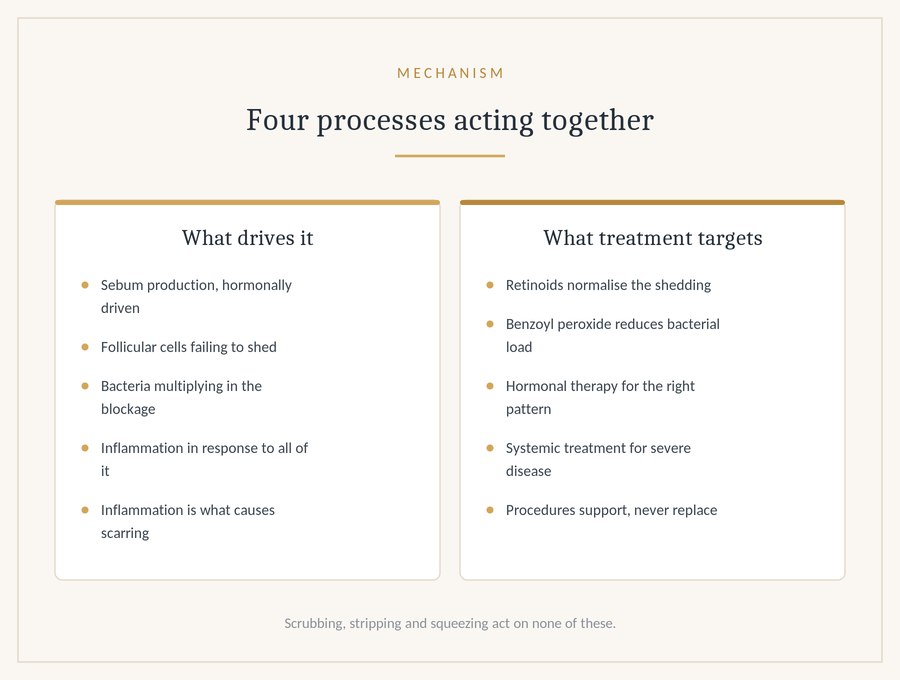
Four processes combine, and useful treatments target one or more of them.
Excess sebum. Driven largely by hormonal signalling at the level of the oil gland. This is why acne is common in adolescence and why it recurs in adult women around hormonal changes.
Abnormal keratinisation. Cells lining the follicle fail to shed properly and block the opening, producing the comedone — the blackhead or whitehead that precedes an inflammatory lesion.
Bacterial proliferation. Cutibacterium acnes is a normal skin resident that multiplies in the blocked, sebum-rich follicle.
Inflammation. The immune response to all of the above produces the redness, swelling and pain of a papule, pustule or nodule — and the inflammation is what damages surrounding tissue and leads to scarring.
Grading, Because It Decides Everything
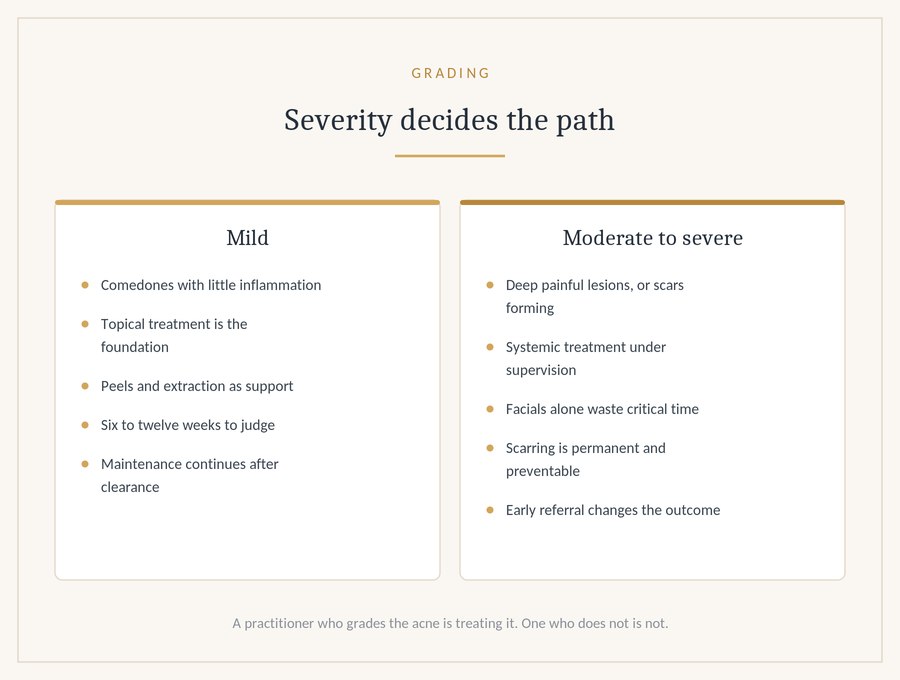
The single most useful thing a consultation does is establish severity, because the treatment path differs completely.
Comedonal acne — blackheads and whiteheads without much inflammation. Responds to topical treatment that normalises keratinisation, supported by appropriate in-clinic procedures.
Mild to moderate inflammatory acne — papules and pustules alongside comedones. Topical treatment remains the foundation, often combined, and oral treatment is added where the response is inadequate.
Moderate to severe acne, and nodulocystic acne — deep, painful lesions, widespread involvement, or acne already producing scars. This needs systemic treatment under medical supervision, and delaying it in favour of facials is the most common and most costly error in this area.
A practitioner who grades the acne and explains which category you are in is treating it. One who proposes a course of facials without doing so is not.
What Has Real Evidence
Topical Treatment
Retinoids remain the foundation for most presentations. They normalise the way follicular cells shed, which addresses the blockage that starts the process, and they are one of the few treatments that work on both existing lesions and the formation of new ones. They cause irritation and dryness in the first weeks, and they increase sun sensitivity, which matters particularly in this climate.
Benzoyl peroxide reduces bacterial load and has the advantage that resistance does not develop to it, which is why it is frequently paired with topical antibiotics rather than used alone.
Topical antibiotics are effective but should not be used as monotherapy over long periods, for resistance reasons.
Azelaic acid is useful where irritation limits other options and has the additional benefit of helping the post-inflammatory pigmentation that follows acne in darker skin types.
Oral Treatment
Oral antibiotics are used in courses for inflammatory acne, generally alongside topical treatment rather than instead of it, and for a defined period rather than indefinitely.
Hormonal treatment is relevant for a specific group — typically adult women with lesions concentrated along the jaw and chin, flaring in a cyclical pattern. Where that pattern is present, treating the hormonal driver is more effective than treating the surface.
Oral isotretinoin is the treatment for severe, scarring or treatment-resistant acne. It requires medical supervision, monitoring and strict precautions, particularly regarding pregnancy. It is not a cosmetic decision and it should not be initiated casually — but nor should it be avoided in someone who needs it, because the alternative is permanent scarring.
In-Clinic Procedures
These support a medical plan. They do not replace one.
Chemical peels — salicylic acid in particular is well suited to oily, congested skin because it is lipid-soluble and penetrates the follicle. A course produces measurable improvement in comedonal and mild inflammatory acne. The wider use of peels is covered in the guide to chemical peels in Dubai.
Extraction — performed properly, clears comedones that topical treatment is slow to shift. Performed badly, it causes inflammation and pigmentation.
Intralesional injection — a very small amount of corticosteroid into an individual inflamed nodule settles it within a day or two. Useful for an occasional deep lesion; not a strategy for widespread acne, and repeated use in the same site can cause a depression in the skin.
Light and laser-based treatments — evidence is mixed and generally supports them as adjuncts rather than primary treatment.
What the Evidence Does Not Support
Aggressive scrubbing and abrasive exfoliation worsen inflammation. Stripping the skin of oil provokes more oil production and damages the barrier, which makes tolerating effective treatment harder. Elaborate multi-step routines frequently contain irritants and fragrance that make acne-prone skin worse. Squeezing lesions causes the pigmentation and scarring that the whole plan is trying to avoid.
Pigmentation After Acne
In Middle Eastern, South Asian and other deeper skin types, the marks left behind are frequently the primary complaint rather than the acne itself. These are usually post-inflammatory hyperpigmentation — flat brown marks — rather than scars, and they fade over months.
Two things govern that fading: controlling the inflammation that causes it, and sun protection, without which the marks persist and darken. Treatments that help pigmentation are covered in the guide to pigmentation and melasma treatment.
Flat marks fade. Textural change — a depression or a raised area — is a scar and needs a different approach, set out in the guide to acne scar treatment. Distinguishing between the two early prevents a lot of wasted money.
What a Realistic Timeline Looks Like
Topical treatment takes six to twelve weeks to show meaningful change, and skin frequently looks worse in the first two to four weeks as treatment brings existing congestion to the surface. Stopping at week three because it has not worked is the most common reason a good plan fails.
Oral courses are assessed over months rather than weeks. Maintenance treatment continues after clearance, because acne is a condition that recurs when treatment stops rather than one that is cured.
Cost in Dubai
Consultation fees generally run from around AED 300 to AED 800. Prescription topicals vary widely by product. Peel sessions commonly run from around AED 500 to AED 1,200 each and are sold as courses of four to six. Oral treatment costs depend on the medication and the monitoring required.
The honest financial point is that a properly chosen medical plan is usually cheaper than a long series of facials that do not address the underlying process.
The Short Version
Acne is driven by sebum, blocked follicles, bacteria and inflammation, and effective treatment targets those. Grading the severity decides the plan: topical treatment for mild disease, oral treatment added for moderate, systemic treatment for severe or scarring acne.
In-clinic procedures support a medical plan rather than substituting for one. The urgency comes from scarring, which is permanent, far harder to treat and entirely preventable with adequate treatment started early.
Questions Worth Asking
How would you grade my acne? A specific answer indicates a proper assessment.
Is any of what I have already scarred? This changes the urgency substantially.
What is the medical part of the plan? If the answer is only procedures, seek a dermatological opinion.
When should I expect to see change, and when should I come back if I do not? A defined review point separates a plan from a sale.
Living With Treatment in This Climate
Several practical factors matter more in Dubai than in cooler places, and they influence whether a plan succeeds.
Sun exposure. Retinoids and many other acne treatments increase sun sensitivity, and ultraviolet exposure darkens post-inflammatory marks. Daily broad-spectrum sun protection is not an optional extra here; it is part of the treatment.
Air conditioning and barrier function. Constant air conditioning is drying, and acne treatments are drying. Combining them without a simple moisturiser makes irritation the reason people stop treatment. A bland, non-comedogenic moisturiser used alongside active treatment improves tolerance considerably.
Heat, sweat and occlusion. Sweat itself does not cause acne, but prolonged occlusion — under a mask, a helmet, tight sportswear — can aggravate it. Cleansing after sweating rather than leaving it on the skin is a reasonable habit.
Product layering. The most common self-inflicted problem is too many actives at once. Two or three effective products used consistently outperform ten used erratically, and they are considerably easier to tolerate.
Adult Acne Is Not Teenage Acne
Adult acne, particularly in women, frequently presents differently: fewer comedones, more deep tender lesions along the jaw and chin, flaring cyclically, on skin that is also drier and more sensitive than adolescent skin.
The implication is practical. Treatments aimed at oily teenage skin are often too aggressive, and a plan that addresses the hormonal pattern while protecting the barrier tends to work better than one built on stripping oil away. Being told to use a harsher cleanser is usually the wrong advice for this group.
Frequently Asked Questions
What causes acne?
Four processes acting together: increased sebum production driven by hormonal signalling, abnormal shedding of cells lining the follicle which blocks it, proliferation of bacteria within that blocked follicle, and the inflammation the body mounts in response. Effective treatments target one or more of these.
Will facials clear my acne?
They can help mild comedonal congestion as part of a plan, but they do not address the underlying process and they are not a treatment for moderate or severe acne. Relying on them while inflammatory acne continues is how preventable scarring develops.
How long before I see improvement?
Topical treatment generally takes six to twelve weeks, and skin often looks worse for the first two to four weeks as existing congestion surfaces. Stopping during that early phase is the most common reason an otherwise sound plan fails.
Does diet cause acne?
The evidence is modest. High-glycaemic diets and, in some studies, dairy have been associated with acne severity, but the effect is small relative to hormonal and follicular factors. Dietary change is a reasonable adjunct and a poor substitute for treatment.
Is isotretinoin dangerous?
It is a serious medication requiring medical supervision, monitoring and strict precautions, particularly in relation to pregnancy. Used appropriately in severe or scarring acne it is highly effective, and avoiding it in someone who needs it carries its own cost in permanent scarring.
Why do I get acne on my jaw and chin as an adult?
That distribution, especially when lesions are deep and flare cyclically, often points to a hormonal pattern. It responds better to treatment aimed at that driver than to harsher surface treatment, and adult skin generally tolerates aggressive regimes poorly.
Will the dark marks left behind go away?
Flat brown marks are post-inflammatory pigmentation and generally fade over months, faster with good inflammation control and consistent sun protection. Marks that involve a change in texture — a depression or a raised area — are scars and need a different approach.
Should I stop moisturising because my skin is oily?
No. Stripping the skin provokes more oil production and damages the barrier, which makes effective treatment harder to tolerate. A simple non-comedogenic moisturiser alongside active treatment improves both comfort and adherence.
Can I have peels or laser while on acne medication?
It depends on the medication. Some treatments, notably oral isotretinoin, require caution and a waiting period before certain procedures. This should always be disclosed at consultation rather than assumed to be irrelevant.
What does acne treatment cost in Dubai?
Consultations generally run from around AED 300 to AED 800, peel sessions from around AED 500 to AED 1,200 and are usually sold in courses, and medication costs vary by product and monitoring needs. A correctly chosen medical plan is commonly less expensive overall than an extended series of facials.
This article is general information about aesthetic and dermatological treatments and is not medical advice, a diagnosis, or a treatment recommendation for any individual. Outcomes vary between patients and no result is guaranteed. Prescription medications and injectable products carry risks and contraindications that must be assessed by a licensed physician during a personal consultation. Dr Soheila Eskandari is licensed by the Dubai Health Authority. Prices quoted are general market ranges for information only and are not an offer.


 English
  Arabic