
Acne Scar Treatment in Dubai: Matching the Method to the Scar
Acne Scar Treatment in Dubai: Matching the Method to the Scar
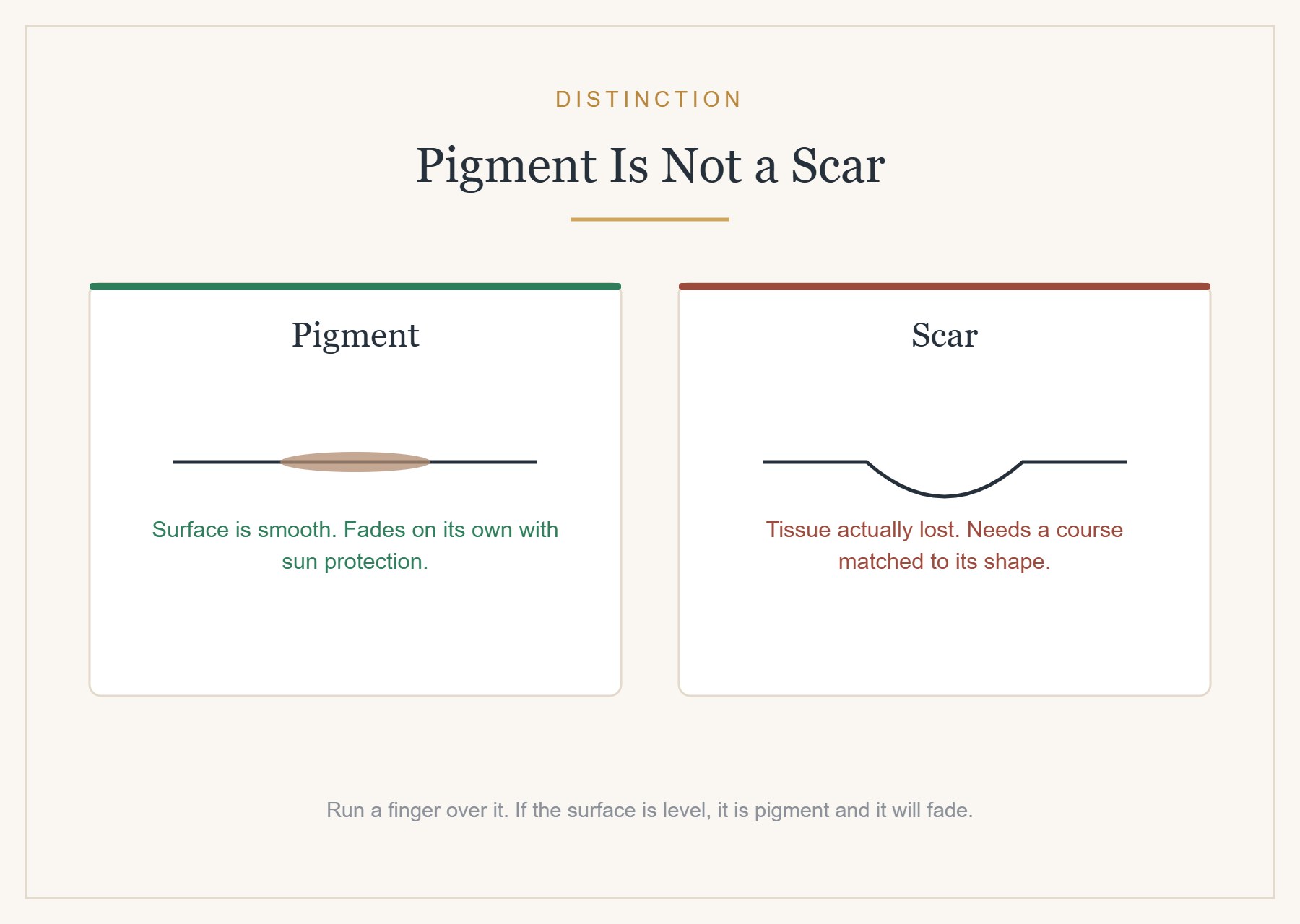
Most people who come in about acne scarring have two separate things on their face, and only one of them is a scar. The flat red or brown marks left where a spot used to be are pigment. They fade on their own. The dips and ridges you can feel with a fingertip are scars, and they do not.
Telling those apart before spending anything is the single most useful step, because pigment responds to time and sun protection while scarring needs a course of treatment matched to its shape. This guide covers how the types differ, which method suits each, what improvement is realistic, and why skin type changes the plan in this region.
Pigment Is Not a Scar
After an inflammatory spot settles, the skin is often left discoloured. In lighter skin this tends to be red or purple — post-inflammatory erythema, essentially dilated vessels. In darker skin it is more often brown — post-inflammatory hyperpigmentation, excess melanin deposited in response to the inflammation.
Neither involves lost tissue. Run a finger over them and the surface is smooth. Both fade without any procedure: erythema over weeks to months, pigmentation over months, sometimes up to a year.
What accelerates that is unglamorous and cheap: daily broad-spectrum sun protection, and not picking. What delays it is ultraviolet exposure, which is abundant here year-round. A patient who arrives distressed about “scars” that turn out to be pigment can often be reassured rather than treated, and that is a better outcome than a course of resurfacing.
A true scar is a permanent change in the skin’s architecture — tissue either lost or overgrown. That is what the rest of this article is about.
The Shapes, and Why They Matter
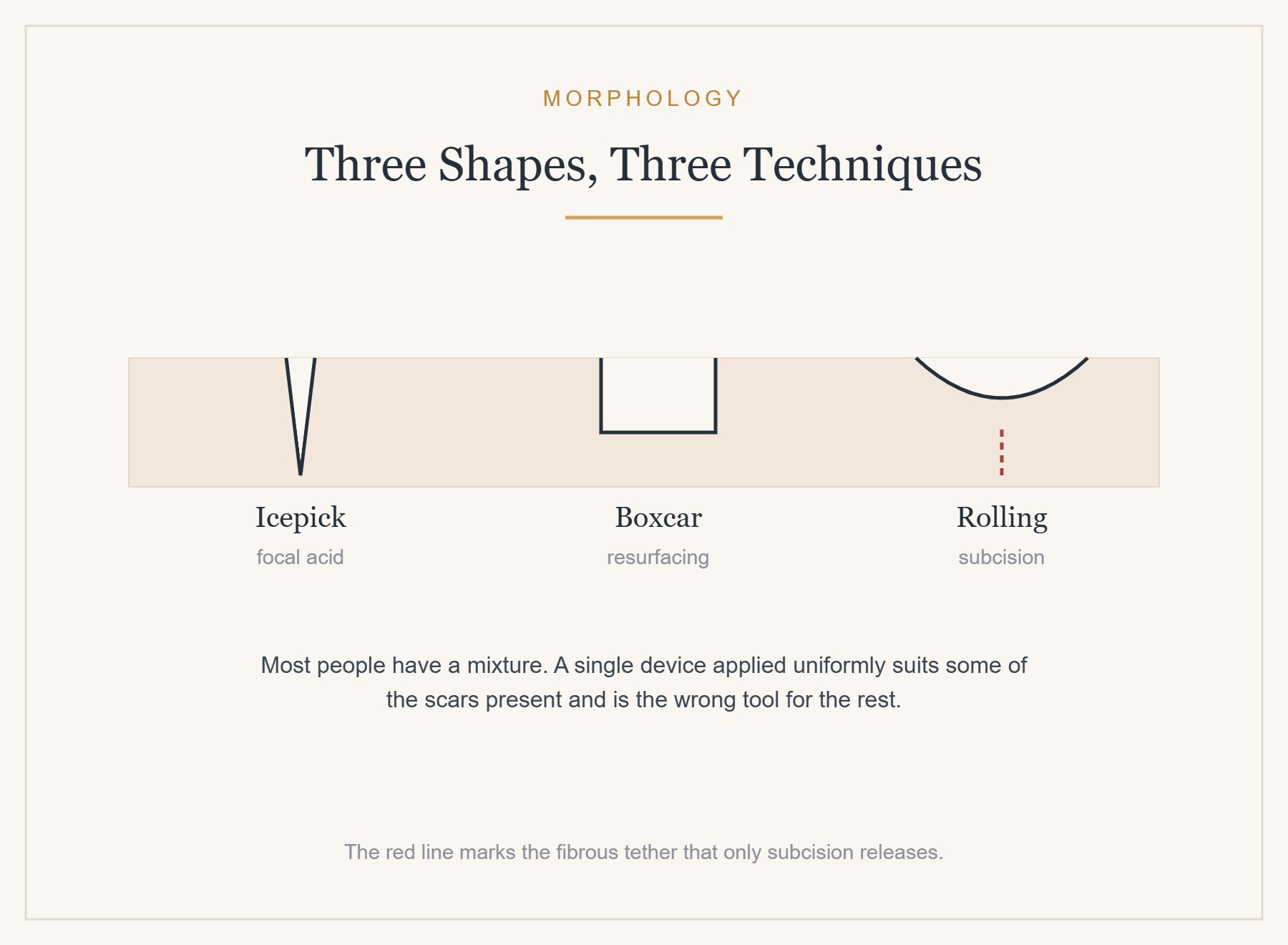
Atrophic scars — depressions where collagen was destroyed — account for the large majority of acne scarring. They divide into three shapes, and the shape determines the technique.
Icepick scars are narrow, deep and steep-sided, like a puncture. They often extend further down than they appear. Because the tract is narrow and deep, resurfacing devices cannot reach the base — they treat the surface around the scar and leave the pit.
Boxcar scars are wider with sharply defined vertical walls and a flat base, like a small crater. They are shallower than icepick scars relative to their width, and they respond to techniques that resurface the edges so the transition softens.
Rolling scars are broad, shallow depressions with sloping edges, produced by fibrous tethers pulling the skin down from below. They give the skin an undulating look in raking light. Because the cause is tethering rather than lost surface, releasing the tether matters more than resurfacing.
Hypertrophic and keloid scars — raised rather than depressed — behave differently again and are managed with intralesional treatment rather than resurfacing.
Almost everyone has a mixture. That is precisely why a single device applied uniformly across a face disappoints: it will suit some of the scars present and be the wrong tool for others.
Matching Method to Scar
Subcision
A needle or cannula is passed under the scar to cut the fibrous tethers pulling it down. This is the treatment for rolling scars specifically, and nothing else releases a tether. Bruising is expected and can be significant for a week. Often combined with a resurfacing technique in the same session.
Microneedling
Controlled micro-injury that stimulates collagen remodelling. Reasonable evidence in atrophic scarring, gentler than laser, and — importantly here — a lower risk of post-inflammatory pigmentation in darker skin. It needs more sessions than laser for equivalent change. I have written about the technique and the serums used with it in the guide to microneedling with growth factors.
Fractional laser resurfacing
Columns of thermal injury that trigger remodelling, with untreated skin between them for faster healing. Non-ablative devices are gentler with less downtime; ablative devices remove tissue and produce more change per session with more downtime and more risk.
This is where skin type matters most, and I will come back to it.
Focal chemical reconstruction
A high-strength acid applied precisely into the tract of an individual icepick scar with a fine applicator, to provoke healing from the base upward. It is the one technique suited to narrow deep scars, and it is focal rather than a resurfacing of the whole face. Repeated across several sessions.
Filler
Placed under an individual broad depressed scar it lifts it immediately, and the result lasts as long as the product. It is a finishing tool for specific scars rather than a plan for widespread texture, and it does nothing for icepick scars.
Skin Type Changes the Plan Here
Most patients in Dubai fall into Fitzpatrick types III to V. In that range, the main risk of scar treatment is not the treatment failing — it is the skin responding to the injury with pigment.
Post-inflammatory hyperpigmentation after aggressive resurfacing can take many months to fade and is, in the interim, a more visible problem than the scarring being treated. It is the single most common way an acne scar course makes someone look worse before it makes them look better.
What reduces the risk: choosing gentler modalities where they will do, conservative settings, starting low and escalating across sessions rather than treating aggressively once, appropriate pre-treatment of the skin, and strict photoprotection afterwards.
A practitioner who has not raised pigmentation risk with you before treating darker skin has skipped a conversation that matters more than which device they own.
Active Acne Comes First
This is not a preference, it is a sequence. Treating scars while acne is still active does two things wrong: new lesions create new scars faster than the course resolves old ones, and needling or lasering through inflammatory lesions spreads bacteria and inflammation.
Acne should be controlled and stable — typically for several months — before scar treatment begins. Patients on oral isotretinoin have historically been asked to wait a period after finishing, though current thinking on that interval is less rigid than it once was and is a decision for the treating physician.
The frustration of waiting is real. It is still cheaper than paying for a course that is working against an active process.
What Improvement Is Realistic
Partial. That is the honest word.
A well-planned course combining appropriate techniques commonly produces meaningful softening — scars that are noticeably less visible under normal lighting and in photographs, skin that reads as textured rather than scarred. Complete clearance is not an outcome that acne scar treatment reliably delivers, and any clinic promising it is overselling.
Improvement also continues after the course finishes. Collagen remodelling runs for months, so the result at three months after the final session is better than the result at three weeks. Judging too early is a common reason people conclude a course did not work.
Photographs matter more here than in almost any other treatment. Take them before the first session in consistent lighting, ideally with some side lighting, because texture is invisible under flat front lighting and that is exactly how most people look at themselves.
What a Course Looks Like
A typical plan runs three to six sessions spaced four to six weeks apart, often combining techniques — subcision for the rolling component, a resurfacing modality across the area, focal treatment for individual icepick scars, and possibly filler at the end for one or two stubborn depressions.
Recovery depends on the modality: a day or two of redness for microneedling, several days of redness and peeling for fractional laser, and a week of bruising where subcision has been used.
Sun protection afterwards is not advisory. In this climate it is the difference between the result you paid for and a pigmentation problem.
Costs in Dubai
Market rates generally run from around AED 800 to AED 2,000 per microneedling session and AED 2,000 to AED 4,500 per fractional laser session, with subcision often priced as an addition to whichever session it accompanies.
Because effective treatment combines techniques across several sessions, a per-session price is close to meaningless on its own. The figure worth asking for is the cost of the planned programme, and the number of sessions that programme assumes.
The Short Version
Separate pigment from scarring first — the first fades on its own, the second does not. Then match technique to shape: subcision for rolling, resurfacing for boxcar, focal treatment for icepick, and filler as a finishing tool.
Control active acne before starting. Expect meaningful softening rather than clearance. And in skin types III to V, accept a gentler, longer course in exchange for a much lower risk of trading a texture problem for a pigment one.
Assessment: What Should Happen Before Anything Is Booked
A useful consultation for acne scarring looks specific, and it is short.
Lighting. Scars are examined under side lighting, not flat front lighting. Texture disappears under direct illumination, which is why patients often see their scarring most clearly in a car mirror or a lift and least clearly in a clinic mirror.
Stretching the skin. Gently stretching the area distinguishes tethered rolling scars — which flatten when stretched — from boxcar scars, which retain their sharp edges. This takes seconds and directly determines whether subcision belongs in the plan.
Counting the types. A practitioner should be able to tell you roughly what proportion of your scarring is rolling, boxcar and icepick, because that proportion is the treatment plan.
Skin type and history. Fitzpatrick type, any history of post-inflammatory pigmentation, keloid tendency, cold sores, and current or recent acne medication.
If none of this happens and a package is quoted, the plan is being drawn from a price list rather than from your face.
What Makes the Difference Between a Good and a Poor Course
Three things, none of which are the device.
Combining techniques. The single most reliable predictor of a good result is whether the plan addresses the different scar shapes differently. A course of one modality applied uniformly will partly work.
Adequate intervals. Four to six weeks between sessions exists because collagen remodelling takes that long. Compressing the schedule to finish faster produces more inflammation without more benefit.
Finishing the course and then waiting. The result at three months after the final session is meaningfully better than at three weeks. A significant number of patients conclude treatment failed while it was still working.
Frequently Asked Questions
Are the marks left after acne actually scars?
Often not. Flat red or brown marks are post-inflammatory erythema or pigmentation, which fade over months without leaving a textural change. A true scar is a change in the skin surface you can feel. The distinction matters because they need entirely different treatments.
What are the main types of acne scar?
Atrophic scars, which sit below the surface, are the most common and divide into icepick, boxcar and rolling shapes. Hypertrophic and keloid scars sit above the surface and behave differently. Most patients have a mixture, which is why a single technique rarely addresses everything.
Which treatment works for which scar?
Broadly: rolling scars respond to microneedling, subcision and energy devices; boxcar scars to fractional resurfacing and sometimes focal techniques; and narrow icepick scars to focal chemical reconstruction rather than resurfacing, because the tract is too deep and narrow for a device to reach.
How much improvement is realistic?
A well-planned course commonly produces partial improvement rather than clearance. Softening that makes scars far less noticeable under normal lighting is a good outcome, and a practitioner promising to remove acne scarring completely is overselling.
How many sessions will I need?
Most protocols run to three to six sessions spaced four to six weeks apart, often combining more than one technique. Deep or mixed scarring may need more, and the improvement continues for months after the final session as collagen remodels.
Should active acne be treated first?
Yes, and this is not negotiable. Treating scars while acne is still active creates new scars faster than the treatment resolves old ones, and needling through inflammatory lesions spreads them. Controlling the acne comes first.
Is laser better than microneedling?
Neither is universally better. Ablative fractional lasers produce more change per session with more downtime and a higher pigmentation risk in darker skin. Microneedling is gentler and safer in pigment-prone skin but needs more sessions. In Dubai, where most patients have skin types III to V, that trade-off matters.
Will treatment cause pigmentation?
It can, particularly with heat-based devices in darker skin types. The risk is reduced by conservative settings, appropriate pre-treatment, strict sun protection afterwards and staged escalation. Anyone who does not raise this with you before treating has skipped an important conversation.
Can filler be used for acne scars?
For individual broad depressed scars, yes, and it gives an immediate result that lasts as long as the product does. It does not address widespread textural scarring and is best thought of as a finishing tool alongside a resurfacing course rather than a standalone plan.
What does a course cost in Dubai?
Market rates generally run from around AED 800 to AED 2,000 per microneedling session and AED 2,000 to AED 4,500 per fractional laser session. Because courses combine techniques, the total for a planned programme is the number worth asking for.
This article is general information about aesthetic and dermatological treatments and is not medical advice, a diagnosis, or a treatment recommendation for any individual. Outcomes vary between patients and no result is guaranteed. Prescription medications carry risks and contraindications that must be assessed by a licensed physician during a personal consultation. Dr Soheila Eskandari is licensed by the Dubai Health Authority. Prices quoted are general market ranges for information only and are not an offer.


 English
 Arabic