
Nabota in Dubai: How It Compares With Botox and Dysport, Results and Risks
Nabota in Dubai: How It Compares With Botox and Dysport, Results and Risks
Nabota is a botulinum toxin type A made by Daewoong Pharmaceutical in South Korea and sold in the United States under the name Jeuveau. It is used in Dubai, like Botox and Dysport, to soften frown lines, forehead lines and crow’s feet by relaxing the muscles that crease the skin. In clinical trials for frown lines it was studied at the same 20-unit dose as Botox and produced comparable results, with effects that typically appear within a few days and last around three to four months.
This guide explains what Nabota is, how it compares with Botox and Dysport, what the evidence shows, which areas it is used for, what treatment involves, how long results last, the risks, who should avoid it and what it costs in Dubai. Results vary between people, and suitability must be confirmed in person by a licensed physician.
What Is Nabota?
The active ingredient
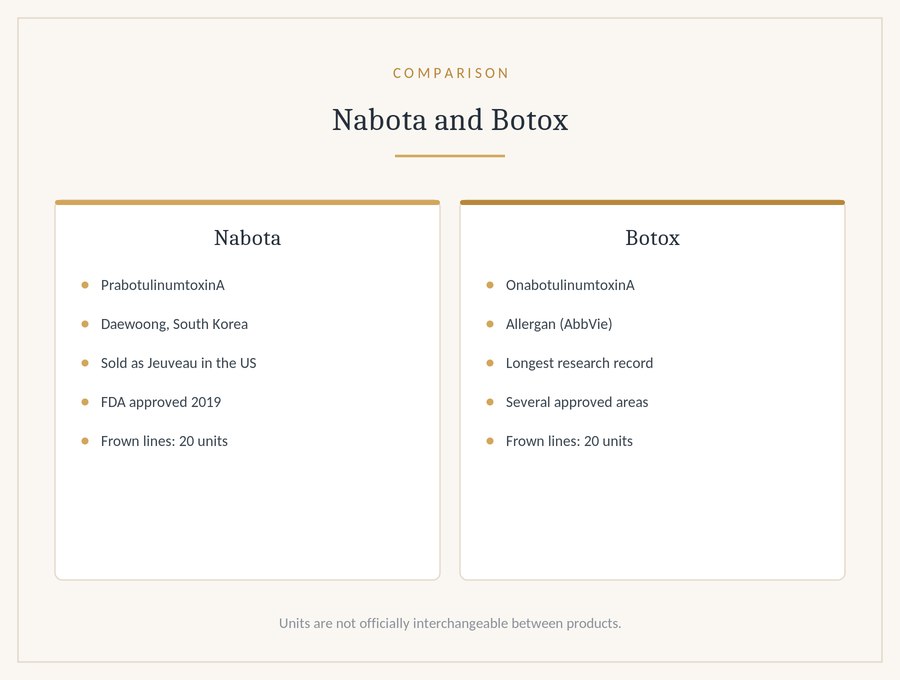
The active ingredient in Nabota is prabotulinumtoxinA, a purified botulinum toxin type A. Like other products of this type, it blocks the release of the chemical messenger that tells a muscle to contract, so the treated muscle relaxes and the skin above it folds less. Nerves gradually form new connections over the following months, which is why the effect wears off and treatment is repeated if you wish to maintain it.
Where it comes from and how it is regulated
Nabota is made by Daewoong Pharmaceutical. Under the name Jeuveau, it was approved by the US Food and Drug Administration in 2019 for the temporary improvement of moderate to severe frown lines in adults, and it is approved in many other countries under different names. In the UAE, products are registered locally, so it is reasonable to ask how the product used in your treatment is registered.
What is in the vial
The toxin is supplied as a powder with accompanying proteins and is mixed with sterile saline before injection. The manufacturer describes a purification process intended to produce a highly purified toxin. Unlike Dysport, Nabota is not listed as containing cow’s milk protein. Dr Soheila works with Nabota, Botox (Allergan) and Dysport, and the product is chosen at the consultation.
How Does Nabota Compare With Botox and Dysport?
Units and doses
Each botulinum toxin is measured in its own units, and the product information for each states that units are not interchangeable. In practice, the doses studied for Nabota and Botox in frown lines are the same, 20 units, which is why many physicians find them similar to plan, while Dysport doses are written as larger numbers. Even so, the dose for each person is planned for their own muscles, and a change of product is a reason to review the dose. Our guide to Dysport explains why units differ between products.
What the trials show
In large phase III trials for frown lines, Nabota at 20 units was more effective than placebo, and in a head-to-head trial in Europe and Canada it was found to be non-inferior to Botox at the same dose, which means the results were comparable within the limits the study set. Onset, peak effect and duration were broadly similar. These trials studied frown lines; other areas are treated based on experience with botulinum toxin in general.
Price
Nabota is often priced lower than Botox in Dubai. A lower price does not by itself mean a weaker effect, but it is important to compare quotes by the product named, the number of units and the total price for the areas planned.
Choosing between them
Botox, Dysport and Nabota are all botulinum toxin type A and produce similar results when each is dosed correctly. Differences between them are small and inconsistent between studies. The choice may depend on your history with a product, any allergy, price and the physician’s experience. If you have had a good result with one product, there is often no reason to change. Our Botox vs Dysport comparison covers the two other products in more detail.
Which Areas Is Nabota Used For?
The approved use is frown lines between the brows. In practice, physicians also use it for forehead lines and crow’s feet, often treating the three upper-face areas together, as described in our guide to full face Botox. Other uses, such as the jaw, neck bands or excessive sweating, are planned individually and some are off-label. Each area needs its own assessment and dose.
Can I Switch to Nabota From Botox or Dysport?
Yes. Many people switch between toxins for reasons of price, availability or preference, and there is no need for a gap beyond the usual interval of about three months since the last treatment. Because units and spread can behave slightly differently between products, the first treatment with a new product is usually planned conservatively and reviewed at two weeks. Bring a record of your previous product, the units used and how long the effect lasted, as this helps the physician plan the new dose.
If you have been very happy with a product, there is often no reason to change. If an earlier treatment wore off unusually quickly or seemed weaker than expected, the physician will look at the dose, the injection pattern and the interval before assuming the product itself was the cause.
How Is a Natural-Looking Dose Planned?
There is no single correct dose. Strong frown muscles usually need more than light ones, and men often need more than women. The position of the brows matters: if your brows already sit low, or you rely on the forehead muscle to keep your eyelids open, the forehead is treated lightly or not at all. Many physicians start conservatively at a first treatment and adjust at the review, so some movement remains and expressions still look like your own. If you are new to treatment, our guide to first-time anti-wrinkle injections explains what to expect.
What Happens During Treatment?
The assessment
The physician looks at your face at rest and in movement, checks the position of your brows and eyelids, reviews your medical history, medicines, previous treatments and allergies, and discusses how much movement you would like to keep.
The injections
The skin is cleaned and small amounts are injected with a very fine needle at several points. Most people describe a brief sting. The appointment usually takes around fifteen to thirty minutes, and you can return to normal activities the same day.
Aftercare
You are usually advised not to rub the treated areas, to avoid strenuous exercise, saunas, facials and lying flat for the rest of the day, and to avoid alcohol for a day. Make-up can usually be applied after a few hours.
When Will I See Results, and How Long Do They Last?
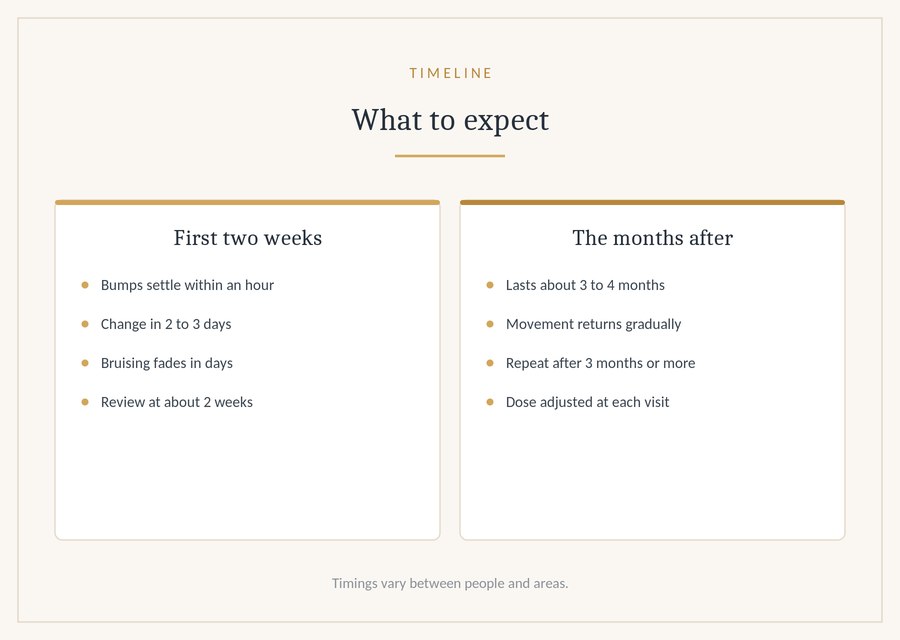
Many people notice a change within two to three days, and the full effect is judged at around two weeks, when a review is often arranged. Results typically last around three to four months, depending on the dose, the strength of the muscles, the area and the person. Treatment is usually not repeated more often than every three months. Our article on how long anti-wrinkle injections last explains the factors involved.
How Should I Prepare?
Tell the physician about all medicines and supplements, as aspirin, fish oil and some herbal products can increase bruising; do not stop a prescribed medicine without advice from the doctor who prescribed it. Avoid alcohol the evening before if you bruise easily, and arrive without heavy make-up. If you have an event, plan treatment at least two weeks beforehand so that the full effect has developed and any bruising has faded.
Can Nabota Be Combined With Other Treatments?
Yes. Anti-wrinkle injections soften lines caused by movement, but lines that remain visible at rest usually need treatment of the skin itself, such as skin boosters, microneedling or peels, and volume loss may need filler. When treatments are combined, the toxin is often given first and reviewed at around two weeks before other procedures are added. Our guide to forehead wrinkle treatment explains how combined plans are made.
What Are the Risks of Nabota?
Common effects
Headache, redness, small bumps, tenderness and bruising at the injection sites are the most common effects and usually settle within days.
Effects on nearby muscles
If the toxin affects muscles next to the treated area, a drooping eyelid, heavy or uneven brows or an uneven smile can occur. These effects are temporary but can last several weeks. Careful dosing and placement reduce the risk.
Rare serious effects
All botulinum toxin products carry a warning that, rarely, the effect can spread and cause generalised weakness or difficulty swallowing or breathing. Any such symptom needs urgent medical attention. Allergic reactions are also possible.
Who Should Avoid Nabota?
Treatment is avoided in people with an allergy to any botulinum toxin product or to any ingredient of the vial, in people with an infection at the injection site, and in neuromuscular conditions such as myasthenia gravis or Lambert-Eaton syndrome. It is postponed during pregnancy and breastfeeding. Some medicines, including certain antibiotics, can increase the effect, so tell the physician everything you take. A licensed physician must confirm suitability in person.
Can the Body Become Resistant to Botulinum Toxin?
Rarely, the immune system produces antibodies against botulinum toxin, which can make treatment less effective or stop it working. This is uncommon at the doses used for facial lines. The factors linked with it include high total doses, frequent top-ups at short intervals and, possibly, the amount of accompanying protein in a product. Using the lowest dose that gives the result you want and keeping to intervals of about three months or more are sensible ways to reduce the risk, whichever product is used.
If a treatment seems to have little or no effect, the physician will first check other explanations, such as the dose, the injection pattern, how the product was stored and prepared, and whether the lines are mainly static, which toxin does not treat. Switching product is sometimes tried, but true resistance is diagnosed only after a careful review.
Choosing Who Treats You
Botulinum toxin is a prescription medicine and should be injected by a licensed physician whose DHA licence you can verify on the DHA Sheryan portal and who treats the face regularly. Ask which product will be used, how many units for each area and when you will be reviewed.
The overview of anti-wrinkle treatment describes the areas treated. At dr-soheila.com, treatments are planned and performed by Dr Soheila Eskandari, a DHA-licensed general practitioner with aesthetic privileges with 20 years of experience in aesthetic medicine.
The Short Version
Nabota is prabotulinumtoxinA, a botulinum toxin type A made by Daewoong in South Korea and sold in the US as Jeuveau. It was approved by the FDA in 2019 for frown lines and, in trials, gave results comparable to Botox at the same 20-unit dose. It is also used for forehead lines and crow’s feet, and it is often priced lower than Botox in Dubai.
Effects appear within a few days, are judged at around two weeks and typically last three to four months. Common effects include headache and bruising, and a heavy brow or eyelid can occur. People with relevant allergies, neuromuscular conditions or infection at the site should avoid it, treatment is postponed in pregnancy and breastfeeding, and a licensed physician must assess suitability in person.
Questions Worth Asking
Which product will you use, and how many units for each area? The quote should name the product and the units.
Why do you suggest Nabota for me? The reason should relate to your history, allergies, price or the physician’s experience.
How is the product registered in the UAE? It is reasonable to ask about the product used in your treatment.
When will you review the result? A review at around two weeks allows a small adjustment if needed.
Frequently Asked Questions
What is Nabota?
Nabota is prabotulinumtoxinA, a botulinum toxin type A made by Daewoong Pharmaceutical in South Korea, used to soften frown lines and other expression lines.
Is Nabota the same as Jeuveau?
Yes, Jeuveau is the name used in the United States for the same toxin, approved by the FDA in 2019 for moderate to severe frown lines.
Is Nabota as effective as Botox?
In a head-to-head trial for frown lines, Nabota at 20 units gave results comparable to Botox at 20 units; individual results vary.
Are Nabota units the same as Botox units?
Each product has its own units and they are not officially interchangeable, but the doses studied for frown lines are the same, 20 units.
How long does Nabota last?
Results typically last around three to four months, depending on the dose, the muscles and the person.
How quickly does Nabota work?
Many people notice a change within two to three days, and the full effect is judged at around two weeks.
Why is Nabota often cheaper than Botox?
Pricing reflects the manufacturer and market rather than strength; compare quotes by product, units and the total for the planned areas.
What are the side effects of Nabota?
Headache, bruising and redness are common; a heavy brow, drooping eyelid or uneven result can occur, and difficulty swallowing or breathing is rare and needs urgent care.
Who should avoid Nabota?
People with an allergy to botulinum toxin or its ingredients, neuromuscular conditions or infection at the site should avoid it, and it is postponed in pregnancy and breastfeeding.
What does Nabota cost in Dubai?
Market rates generally run from around AED 700 to AED 1,500 for the forehead, frown lines and crow’s feet together, and some clinics price per unit, so ask for a written quote naming the product and units.
This article is general information about aesthetic and dermatological treatments and is not medical advice, a diagnosis, or a treatment recommendation for any individual. Outcomes vary between patients and no result is guaranteed. Prescription medications and injectable products carry risks and contraindications that must be assessed by a licensed physician during a personal consultation. Dr Soheila Eskandari is licensed by the Dubai Health Authority. Prices quoted are general market ranges for information only and are not an offer.


 English
 Arabic