
Radiesse for Hands in Dubai: Treating Thin, Veiny-Looking Hands
Radiesse for Hands in Dubai: Treating Thin, Veiny-Looking Hands
Radiesse for hands is an injectable treatment that restores lost volume to the back of the hand using calcium hydroxylapatite, so that veins, tendons and knuckles look less prominent. The gel fills the area straight away, and the tiny mineral particles it carries then stimulate your skin to make some of its own collagen, with improvement still recorded at 12 months in the US pivotal study.
Hands are one of the first places where age shows, and in Dubai strong sun, frequent washing and hand sanitiser add to the wear. This guide explains why hands age, how Radiesse works and how it is regulated, what happens during treatment, what recovery involves, how long results last, the alternatives, the risks, who should avoid treatment, how to protect your hands from the sun, and what it costs in Dubai. Results vary, and suitability must be confirmed in person.
Why Do Hands Start to Look Thin and Veiny?
The skin on the back of the hand is thin and sits over very little fat, with tendons, veins and the bones of the hand just beneath it. With age, the fat under the skin shrinks, the skin loses collagen and elastin, and the structures underneath show through. Veins look raised, tendons look like cords and the knuckles stand out. Rapid weight loss, family history and years of sun exposure can speed this up.
Volume, skin quality and pigment are different problems
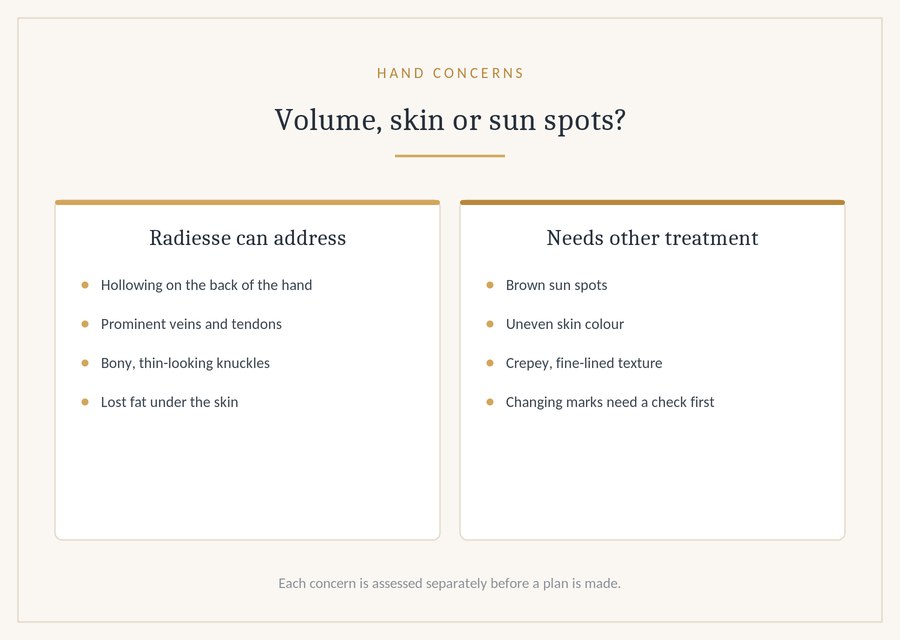
Three changes usually overlap. Volume loss gives the hollow, bony look. Thin, crepey skin adds fine lines and a papery texture. Sun damage adds brown sun spots and uneven colour. A filler such as Radiesse addresses the first, while the others need skin-quality or pigment treatments, which is why each one should be assessed before a plan is made. In Dubai, bright light all year, sun on the steering wheel and repeated washing make all three more noticeable.
How Does Radiesse Work on the Hands?
Radiesse is a soft-tissue filler made of synthetic calcium hydroxylapatite particles, about 25 to 45 micrometres across, suspended in a gel of water, glycerine and sodium carboxymethylcellulose. The gel gives an immediate filling effect. Over the following weeks it is gradually absorbed, while the particles stay in place and prompt your own cells to lay down new collagen, and the particles are themselves slowly broken down by the body. Radiesse belongs to a group of products called biostimulators, which our guide to collagen biostimulators compares.
What is its regulatory status?
Radiesse is regulated as a medical device. In the United States, the FDA approved it in 2015 for hand augmentation, to correct volume loss in the back of the hands, and it has other approved uses, including facial wrinkles and folds. Approvals and labelling differ between countries, so ask your physician how the product they use is registered and which uses are on-label.
What did the pivotal study show?
The US approval rested on a randomised, masked study of 114 adults aged 26 to 79, most of them women, at six sites. At three months, 75% of treated participants (64 of 85) had improved by at least one point in both hands on the Merz Hand Grading Scale, which grades hand volume loss, including how visible the veins and tendons are, compared with 3% (1 of 29) of untreated controls. The figure was about 66% when one high-scoring site was excluded, and results in individual people vary.
Is Radiesse Suitable for Your Hands?
Treatment starts with an in-person assessment of your hands at rest and when making a fist, a review of your medical history and medicines, and a look at the skin for sun damage, rough patches or marks that need checking first. Dr Soheila uses Radiesse (calcium hydroxylapatite) for hand rejuvenation after an in-person assessment of this kind.
Expectations matter. Radiesse softens the look of veins and tendons; it does not remove them, and it does not treat sun spots or crepey texture. The US labelling notes that people with very severe fat loss and marked visibility of veins and tendons were not studied, so effectiveness and risk in that group are not established.
What Happens During the Treatment?
Preparation and dilution
Rings are removed, the hands are cleaned and the injection points may be marked. Topical or local anaesthetic is used at the physician’s discretion. The product is mixed with a small amount of lidocaine, usually to improve comfort and ease of injection; in the US labelling, about 0.26 mL of 2% lidocaine is added to a 1.5 mL syringe. Some practitioners dilute Radiesse further with saline, as described in published case series, to spread it more widely for skin quality, but that goes beyond the labelled instructions.
Needle or cannula, bolus and spread
The labelled technique uses a fine needle. The skin is lifted so the needle stays clear of veins and tendons, the physician aspirates to check the tip is not in a vessel, and small boluses of up to 0.5 mL are placed between the fat layer and the superficial fascia over the back of the hand, away from the knuckle joints. Published reports also describe a blunt-tip cannula passed through a few small entry points and fanned across the hand, an approach some physicians prefer around veins. Whichever method is used, vessels, tendons and nerves lie close to the surface, so anatomical knowledge and slow, controlled placement matter.
Massage and finishing
After injection, the hand is warmed and gently massaged, often with the fist closed, until the product is spread evenly between the wrist crease and the knuckles. The label advises matching the volume to the deficit, with no deliberate overcorrection, and volumes above 3 mL per hand in one session have not been studied. You leave with instructions on swelling, rings and activity.
What Is Recovery Like?
The first days and weeks
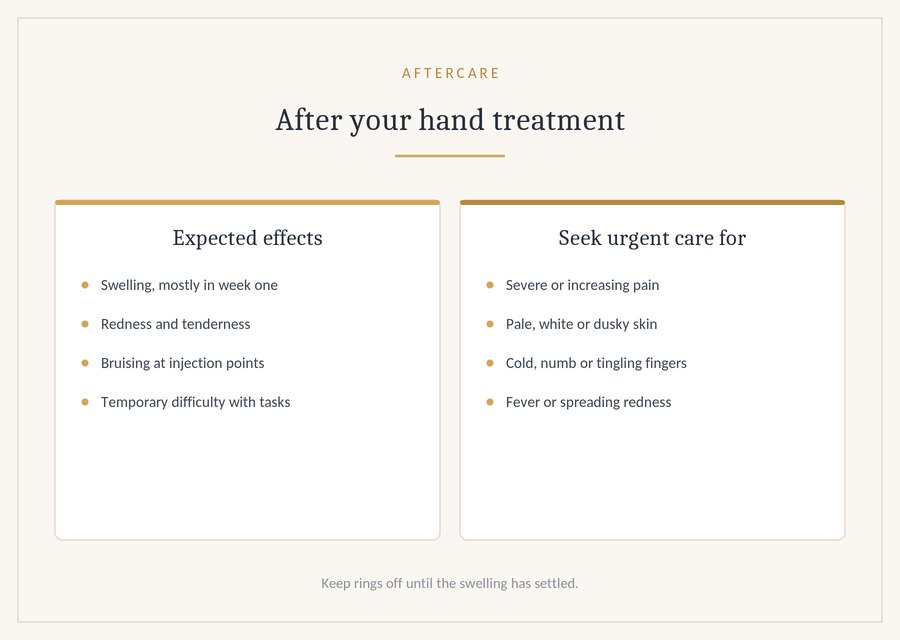
Swelling is expected. In the pivotal study’s diaries, 99% of participants recorded swelling over the 12 months, 92% recorded pain, 81% redness and 73% bruising, mostly in the first one to two weeks. About half (48%) reported temporary difficulty with everyday hand activities, and the label notes a higher rate (68%) among participants with Fitzpatrick skin types IV to VI, a small group in the study. Keep rings off until the swelling settles, avoid strenuous activity, heat and strong sun for about 24 hours, and follow your own physician’s instructions.
When effects last longer
Most effects settled within about two weeks, but not all. Swelling beyond 14 days was recorded in 29% of participants, pain in 25%, lumps in 7%, difficulty with activities in 6% and bruising in 3%, and in the study all of these resolved without lasting effects. Plan treatment away from important events and from work that depends on fine hand use, and allow about two weeks before judging the result.
How Long Do the Results Last?
In the US study, 77% of treated participants still showed at least a one-point improvement at three months and 73% at six months. Among those not re-treated, the figures were about 71% at nine months and 68% at 12 months, although only 35 and 22 people reached those later checks. The labelling states that safety in the hands beyond one year has not been investigated in clinical trials. In practice, duration depends on the volume used, the dilution, your metabolism, how hard you use your hands and sun exposure, so any repeat treatment is planned from how your hands look at the time. No particular duration can be promised.
What Are the Alternatives to Radiesse for Hands?
Hyaluronic acid fillers
Hyaluronic acid fillers add volume by binding water, and some are approved in certain countries for the back of the hand. A practical difference is that they can be dissolved with hyaluronidase, whereas calcium hydroxylapatite cannot. Our comparison of Radiesse and hyaluronic filler sets out how they differ, and Sculptra versus Radiesse covers another biostimulator.
Skin boosters
Skin boosters are injectable hydrating or regenerating products placed in the skin itself. They aim to improve hydration and fine crepey texture, but they do not restore the volume of a hollow hand, so they are sometimes planned alongside a filler. Loose skin can also be addressed with energy-based or microneedling approaches, described in our skin tightening guide; whether they suit thin hand skin depends on your assessment.
Laser, light and peels for sun spots
Sun spots are treated with lasers, intense pulsed light, chemical peels or prescription topical products, chosen according to skin type and the spot itself. Any new, changing, raised or irregular mark should be examined first rather than treated as a sun spot. The labelling warns that laser or peel procedures close to a Radiesse treatment may provoke inflammation at the implant site, so the order and interval should be set by your physician.
What Are the Risks and Side Effects?
Common effects are swelling, redness, tenderness, bruising and itching. The labelling warns that nodules, bumps or lumps were reported by 12% of participants and can last up to a year. Reduced sensation was reported by 15%, all mild or moderate, and small sensory nerves run close to the surface of the hand. Infection and allergic reactions can occur. Unlike hyaluronic acid, calcium hydroxylapatite cannot be dissolved with hyaluronidase, so lumps are managed by other means and can take time to settle.
Rare but serious risks include filler entering or blocking a blood vessel, which can lead to tissue damage (necrosis), and weakening of a tendon if product is placed into it. Severe or increasing pain, pale, white, blue or dusky skin, and cold or numb fingers need urgent medical attention. Because the particles can show on X-rays and CT scans, tell any radiologist that you have had calcium hydroxylapatite in your hands.
Who Should Avoid Radiesse for Hands?
The labelling lists a history of anaphylaxis or multiple severe allergies, known hypersensitivity to any component and bleeding disorders as contraindications. Treatment is deferred when there is infection or inflammation in or near the hands. Safety has not been established in pregnancy or breastfeeding, and has not been studied in people prone to keloid or hypertrophic scars or in those under 26 or over 79. Extra care is advised with autoimmune disease affecting the hand, Dupuytren’s contracture, Raynaud’s disease, vascular malformations, hand implants, a history of hand tumour or a risk of tendon rupture. Blood-thinning medicines and supplements increase bruising; discuss them, but never stop a prescribed medicine without the prescriber’s advice. A licensed physician must assess suitability in person.
How Should You Protect Your Hands From the Sun?
Filler does not protect the skin, and sun damage will keep producing spots and thinning. Apply a broad-spectrum sunscreen to the backs of your hands every morning, reapply after washing them and about every two hours outdoors, and keep a tube in the car, because UVA passes through many car side windows. Gloves, shade and long sleeves help in the strongest sun, and a moisturiser supports the dryness that frequent washing causes. Protect the skin more strictly after any laser, peel or injection. Our guide to sun and water damage in Dubai covers the wider picture.
Choosing Who Treats You
The back of the hand has veins, tendons and nerves close to the surface, so choose a licensed physician whose DHA licence you can verify on the DHA Sheryan portal. Ask about their experience with hand treatment in particular, whether they examine your hands and explain what the product can and cannot do before injecting, and how they would respond to a vascular complication.
A sound plan includes the product name and volume, written aftercare, a review at around two weeks and a clear way to reach the clinic if something worries you. The page on Radiesse treatments gives an overview of the product. At dr-soheila.com, treatments are planned and performed by Dr Soheila Eskandari, a DHA-licensed general practitioner with aesthetic privileges with 20 years of experience in aesthetic medicine.
The Short Version
Hands look thin and veiny when fat and volume are lost from the back of the hand and the skin thins. Radiesse is a calcium hydroxylapatite filler that gives immediate volume and stimulates collagen. In the United States it is FDA-approved for correcting volume loss in the back of the hands, and the pivotal study recorded improvement at up to 12 months, but it does not treat sun spots or crepey skin, and sun protection remains essential.
Swelling, redness and tenderness are expected, and about half of study participants had temporary difficulty with everyday hand activities. Lumps, altered sensation and, rarely, vascular or tendon injury can occur. Treatment is avoided with severe allergy, bleeding disorders, infection, pregnancy and breastfeeding, and suitability must be confirmed in person by a licensed physician.
Questions Worth Asking
Is my problem volume, skin quality or sun spots? The answer decides whether a filler, a skin treatment or a combination is appropriate.
How will you dilute and place the product? You should hear about needle or cannula, depth and how veins and tendons are avoided.
What will you do if a finger turns pale or very painful? A clear emergency plan should exist before you are injected.
What happens if I develop a lump or am unhappy? Calcium hydroxylapatite cannot be dissolved with hyaluronidase, so the review plan matters.
Frequently Asked Questions
Is Radiesse approved for use on the hands?
In the United States, the FDA approved Radiesse in 2015 to correct volume loss in the back of the hands; approvals and labelling differ between countries, so ask your physician how the product is registered.
How does Radiesse make hands look younger?
The gel restores volume straight away and the calcium hydroxylapatite particles stimulate your own collagen, so veins and tendons look less prominent; it does not remove sun spots or crepey texture.
Does Radiesse for hands hurt?
Some discomfort is expected; topical or local anaesthetic and lidocaine in the product reduce it, and pain or tenderness afterwards was commonly reported in the pivotal study.
How long is recovery after hand filler?
Swelling is expected, and about half of study participants had temporary difficulty with everyday hand activities; most effects settled within about two weeks, although some lasted longer.
How long do Radiesse results last on the hands?
In the US study, 15 of the 22 people not re-treated who were assessed at 12 months still showed improvement; duration varies, and repeat treatment is planned from how your hands look at the time.
How does Radiesse differ from hyaluronic acid filler for hands?
Hyaluronic acid fillers add volume by binding water and can be dissolved with hyaluronidase, while Radiesse adds volume and stimulates collagen but cannot be dissolved, so the choice depends on your hands, history and preferences after assessment.
Can Radiesse treat sun spots on the hands?
No, it adds volume only; sun spots are treated with lasers, light-based treatments, peels or topical products, and any changing mark should be examined first.
What are the risks of Radiesse for hands?
Swelling, bruising and tenderness are common; lumps, reduced sensation and infection can occur, and a blocked blood vessel or tendon injury is rare but needs urgent care.
Who should not have Radiesse injected into the hands?
People with a history of anaphylaxis or multiple severe allergies, bleeding disorders or infection near the hands should avoid it, and safety is not established in pregnancy or breastfeeding.
What does Radiesse for hands cost in Dubai?
Market rates generally run from around AED 2,000 to AED 4,500 per 1.5 mL syringe, and the total for both hands depends on how many syringes your physician recommends; ask for a written quote.
This article is general information about aesthetic and dermatological treatments and is not medical advice, a diagnosis, or a treatment recommendation for any individual. Outcomes vary between patients and no result is guaranteed. Prescription medications and injectable products carry risks and contraindications that must be assessed by a licensed physician during a personal consultation. Dr Soheila Eskandari is licensed by the Dubai Health Authority. Prices quoted are general market ranges for information only and are not an offer.


 English
 Arabic