
Sculptra vs Radiesse in Dubai: How They Differ and When Each Is Chosen
Sculptra vs Radiesse in Dubai: How They Differ and When Each Is Chosen
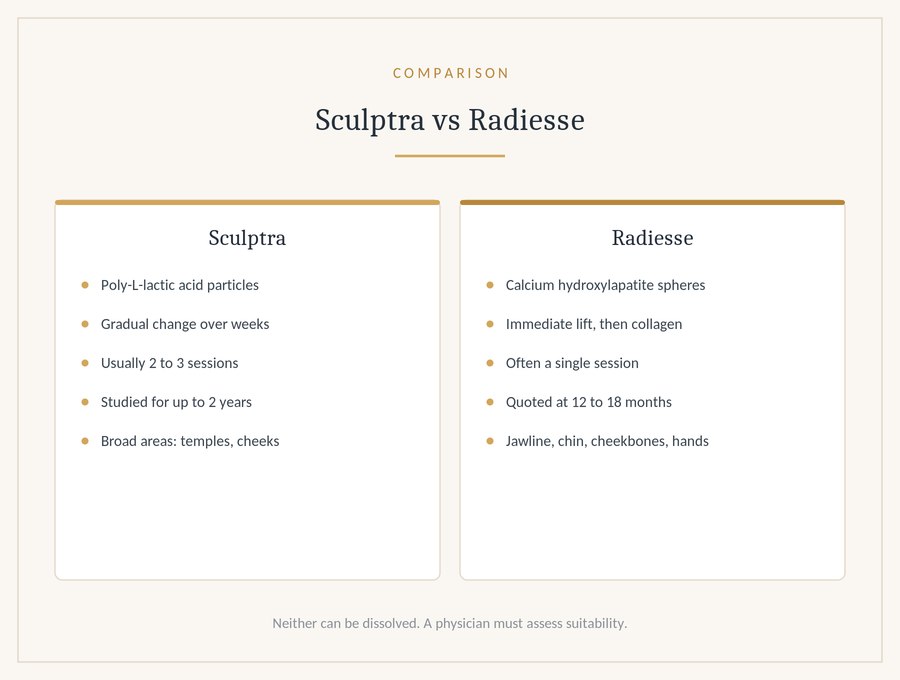
Sculptra vs Radiesse comes down mainly to timing. Radiesse lifts and defines the face straight away and then builds collagen over the following months, while Sculptra changes little on the day and restores volume gradually, usually over two to three sessions. Both are collagen-stimulating injectables, and neither can be dissolved the way hyaluronic acid filler can, so the choice deserves more thought than a comparison of price per syringe.
This guide compares Sculptra (poly-L-lactic acid) with Radiesse (calcium hydroxylapatite): how each works, how many sessions to expect, how long results last, which areas suit each, what hyperdilute Radiesse means, the risks, and how a physician chooses between them or combines them. It does not repeat the comparison in the guide to Radiesse versus hyaluronic filler or the overview of collagen biostimulators, and is meant to be read alongside them.
How Do Sculptra and Radiesse Stimulate Collagen?
Sculptra: Poly-L-Lactic Acid
Sculptra contains microparticles of poly-L-lactic acid, a synthetic material that the body absorbs naturally and that has long been used in dissolvable stitches. It is supplied as a powder and mixed with sterile water before injection, so most of what goes in is fluid. The particles remain and provoke a measured response in the surrounding tissue. Over the following weeks and months the body lays down new collagen around them while they are slowly broken down.
Radiesse: Calcium Hydroxylapatite
Radiesse contains tiny microspheres of calcium hydroxylapatite, a mineral also found in bone and teeth, suspended in a smooth gel. The gel provides volume at once and is gradually absorbed. The microspheres last longer, act as a scaffold around which the body forms its own collagen, and are eventually broken down into minerals the body processes.
In short, Radiesse is a filler first and a stimulator second, while Sculptra is a stimulator with almost no filling effect. Most of the other differences in this guide follow from that.
Immediate or Gradual: What Will You See, and When?
With Radiesse, the lift created by the gel is visible on the day and becomes clearer as swelling settles over a week or two. The collagen that forms over the following months supports and refines it, so the result keeps evolving. This suits people who want a visible change without a long wait.
Sculptra works the other way round. The fullness seen straight after treatment is mostly the injected fluid and fades within a few days, which leads some people to think nothing has happened. Real change builds slowly, with most clinical study participants seeing results from around one month, and it is judged after each session before the next is planned. Because improvement continues after treatment, the manufacturer’s safety information advises against overcorrecting at a single visit. If an event is a week away, Sculptra does not fit that timeline.
How Many Sessions Do You Need, and How Long Do Results Last?
Sculptra
The manufacturer describes an average of two to three sessions over a few months, typically at least three to four weeks apart, with the number set by how much volume has been lost and how you respond. The area is usually massaged afterwards, often following a “5-5-5” rule of five minutes, five times a day, for five days, as your physician instructs. In clinical studies, results were sustained for up to two years, although duration varies with the person, the area and the amount used.
Radiesse
A single session is common, sometimes followed by a small touch-up at a review once swelling has settled. Results are commonly quoted at around twelve to eighteen months, with part of the effect coming from the body’s own new collagen. Maintenance is planned from how the face changes rather than on a fixed calendar.
Longer-lasting is only an advantage when the result is right. Because neither can be dissolved, both are usually built up in stages.
Which Areas Suit Sculptra, and Which Suit Radiesse?
As a rough guide, Sculptra suits broad areas of gradual volume loss and thinning skin, while Radiesse suits areas needing support and definition over bone. Labelled uses differ between products and countries, and some uses below, particularly on the neck and body, go beyond them.
Temples
Temple hollowing is usually a wide, gentle concavity, which suits Sculptra’s gradual build. Radiesse is used less often here, as its firmness and the area’s blood vessels lead many physicians to choose other materials. The area is covered in the guide to temple filler.
Cheeks
Both are used. Radiesse placed deep over the cheekbone gives immediate support and projection, while Sculptra restores volume more diffusely across the cheek and mid-face and has labelled uses in some countries for fine cheek lines and wrinkles.
Jawline and Chin
Radiesse is the more common choice: its firmness lifts and defines the jaw angle and chin, and it has regulatory approval in some countries for jawline contour. Sculptra supports the lower face more gradually and is considered when loosening skin, rather than a weak bony outline, is the main concern.
Neck
Thin, crepey neck skin is usually treated with diluted products rather than volumising ones. Hyperdilute Radiesse has the larger body of published work, and some physicians use diluted Sculptra. Thin skin and constant movement make lumps a particular concern here.
Hands
Radiesse is the better-established choice for the back of the hands, softening the look of prominent veins and tendons, and it has regulatory approval for this in some countries. Evidence for Sculptra there is thinner.
Body
Hyperdilute Radiesse is used for lax skin on the arms, abdomen, thighs, knees and buttocks, and some physicians use Sculptra for gradual volume in areas such as the buttocks and chest. Evidence is mostly small studies and consensus recommendations, results vary, and large areas need large amounts of product. The guide to skin tightening covers wider options.
Where Neither Is Used
Both are avoided in the lips and around the eyes, where skin is thin and a lump could not be dissolved. Sculptra’s manufacturer states it should not be injected into the red part of the lip or the area around the eyes; hyaluronic acid is used there instead.
What Is Hyperdilute Radiesse?
Standard Radiesse is injected as supplied. In hyperdilute treatment the same product is mixed with saline, and sometimes a little local anaesthetic, into a thin fluid. Diluted generally means roughly equal parts product and diluent, hyperdiluted means substantially more diluent than product, and published protocols vary in the exact ratio. The mixture is spread through a wide area just beneath the skin, usually with a cannula or fine needle.
Because it is so thin, it adds little visible volume. The aim is to spread the microspheres across a large area so that the surrounding skin produces more collagen and elastin, improving firmness and the crepey texture of the neck, décolletage and upper arms. A global consensus panel has published guidance, and small studies, including ultrasound assessments of the neck, report improved skin laxity and quality.
The evidence is still developing, largely consensus recommendations and small studies with short follow-up, and lumps in the neck have been reported even with hyperdilution. Sculptra is also mixed before use, but that is its standard preparation rather than a separate technique.
What Are the Side Effects and Rare Risks?
Swelling, tenderness, redness, itching and bruising are common with both products and usually settle within days. Small bumps that can be felt but not seen are also reported.
Nodules. Lumps are the main concern with both. For Sculptra, the manufacturer’s safety information notes that larger lumps, some with delayed onset, with or without inflammation or skin discolouration, have been reported. Technique influences the risk: correct depth, adequate dilution, avoiding superficial placement and massage afterwards all help. With Radiesse, lumps are more likely when it is placed too superficially or in thin, mobile tissue, which is why such areas are avoided.
Vascular occlusion. This is rare but serious: product blocks or compresses a blood vessel, causing severe or increasing pain, skin that turns pale, dusky or mottled and, if vessels near the eye are involved, changes in vision. It needs same-day medical attention. Both products carry this warning, and because neither can be reversed with an enzyme, anatomical knowledge, careful technique and an emergency plan matter all the more.
Other effects. Infection, asymmetry, contour irregularities and rare delayed inflammatory reactions can occur. Radiesse can show up on X-rays and CT scans, so tell any radiologist you have had it.
Can Either Be Dissolved?
No. Hyaluronic acid fillers can be broken down with the enzyme hyaluronidase, as explained in the guide to dissolving filler, but neither Sculptra nor Radiesse responds to it, and there is no routinely used, reliable antidote for either. Some case reports describe other agents used on calcium hydroxylapatite, but these are not established practice.
If a problem occurs, management depends on its type. Some lumps soften with time and massage as advised, persistent or inflamed ones may be treated with injections of saline or anti-inflammatory medication, and occasionally a lump has to be removed surgically.
Who Should Avoid Sculptra or Radiesse?
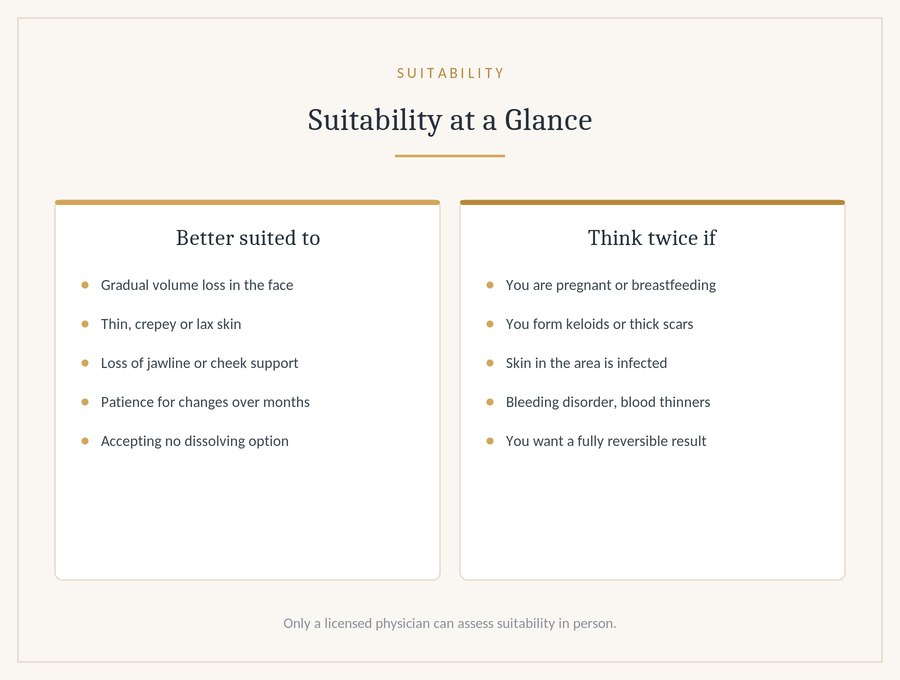
Treatment is postponed or avoided in pregnancy, breastfeeding and under the age of 18, because its effects in these groups have not been established. It is also avoided with active infection, inflammation, acne or a rash in or near the area, and with known allergy to any component, including the local anaesthetic in some preparations.
A history of keloid or hypertrophic scarring is listed by Sculptra’s manufacturer as a reason not to use it, and calls for caution with any product that provokes a tissue response. Bleeding disorders, blood-thinning medicines, autoimmune or connective tissue conditions and weakened immunity need individual assessment. Anyone who could not accept a result that cannot be dissolved should consider hyaluronic acid instead. Only a licensed physician can judge suitability, in person, after a full history and examination.
How Does a Physician Choose Between Them, or Combine Them?
The decision follows the problem rather than the product. A physician first works out whether the main concern is lost volume, lost structure or loose, crepey skin. Lost structure over bone, such as a soft jaw angle or flat cheekbone, points towards Radiesse. Widespread volume loss with thinning skin points towards Sculptra. Crepey skin on the neck or body points towards diluted preparations.
Other factors narrow the choice: how soon a result is wanted, the size of the area, how thin or mobile the tissue is, whether several visits are practical, and how much it matters to be able to reverse the result.
Many faces benefit from both. A common plan uses Sculptra to restore volume gradually across the cheeks and temples, Radiesse for the jawline or chin, and hyaluronic acid for fine detail such as the lips. They are usually given at separate visits, so the response to one can be judged before the next is added. Published evidence for specific combination protocols is limited, so plans are individual and conservative.
Choosing Who Treats You
Because neither product can be dissolved, who plans and places it matters more than the brand name. Check that the doctor’s DHA licence can be verified on the Dubai Health Authority’s Sheryan portal, and ask how often they have treated the specific area with the specific product, since the temples, neck and hands each call for different technique.
Expect a proper assessment before anything is injected, an honest discussion of risks, and a clear plan for review and aftercare: when you will be seen again, how lumps or concerns are handled, and whom to contact urgently. At dr-soheila.com, treatments are planned and performed by Dr Soheila Eskandari, a DHA-licensed general practitioner with aesthetic privileges with 20 years of experience in aesthetic medicine.
The Short Version
Radiesse is a filler that also stimulates collagen. It lifts and defines straight away, is often given in one session, is commonly quoted at twelve to eighteen months, and suits the jawline, chin, cheekbones and back of the hands. Sculptra is a stimulator with little immediate effect. It builds volume gradually over two to three sessions, was sustained for up to two years in studies, and suits broad areas such as the temples, cheeks and lower face.
Neither can be dissolved, both carry the risk of lumps and, rarely, vascular occlusion, and both are avoided in pregnancy, breastfeeding and active infection. The right choice depends on the problem, the area, the time available and how much you value being able to reverse a result. Often the answer is a staged combination, planned after an in-person assessment by a licensed physician.
Questions Worth Asking
Is my concern volume, structure or skin quality? The answer should decide the product, not the other way round.
How many sessions and how much product should I plan for? Expect a staged plan for Sculptra and a clear estimate for either.
What will you do if I develop a lump or a vascular problem? Neither product can be dissolved, so there should be a clear plan.
Would a lighter or reversible option meet my goal? A physician willing to suggest one is giving useful advice.
Frequently Asked Questions
What is the main difference between Sculptra and Radiesse?
Radiesse gives an immediate lift from its gel and then stimulates collagen, usually in one session. Sculptra gives little immediate change and builds volume gradually as collagen forms, usually over two to three sessions.
Which lasts longer, Sculptra or Radiesse?
In clinical studies, Sculptra results were sustained for up to two years, while Radiesse is commonly quoted at around twelve to eighteen months. Duration varies with the area, the amount used and the person.
How many sessions of Sculptra are needed?
The manufacturer describes an average of two to three sessions over a few months, typically at least three to four weeks apart. The number depends on the volume lost and how you respond.
Which is better for the jawline?
Radiesse is more often chosen for its firmness and lift over bone. Sculptra may support the lower face more gradually when skin laxity is the main concern.
Can they be used on the neck, hands and body?
In selected cases. Radiesse is better established for the back of the hands, and hyperdilute Radiesse has the larger body of work for the neck and body. Some physicians use diluted Sculptra. These uses often go beyond labelled indications.
What is hyperdilute Radiesse?
Radiesse mixed with much more saline than product, sometimes with local anaesthetic, and spread thinly beneath the skin. It aims to improve firmness and crepey texture rather than add volume, and the evidence is still developing.
Can Sculptra or Radiesse be dissolved?
No. Neither responds to hyaluronidase, the enzyme used for hyaluronic acid fillers, and there is no routine antidote. Lumps are managed according to their type, sometimes with injections or, rarely, surgery.
What are the main risks?
Swelling, bruising, tenderness and lumps, including delayed nodules. Vascular occlusion is rare but serious, and severe pain, pale or dusky skin or any change in vision needs same-day medical attention.
Who should avoid Sculptra or Radiesse?
Treatment is avoided in pregnancy, breastfeeding, active infection at the site, a history of keloid or thick scarring, and allergy to a component. Bleeding disorders, blood thinners and autoimmune conditions need a physician’s assessment.
What does it cost in Dubai?
Market rates generally run from around AED 2,000 to AED 3,500 per vial of Sculptra and from around AED 2,000 to AED 4,500 per syringe of Radiesse, depending on the area and the clinic. Sculptra often needs several vials across sessions, so the total depends on the plan.
This article is general information about aesthetic and dermatological treatments and is not medical advice, a diagnosis, or a treatment recommendation for any individual. Outcomes vary between patients and no result is guaranteed. Prescription medications and injectable products carry risks and contraindications that must be assessed by a licensed physician during a personal consultation. Dr Soheila Eskandari is licensed by the Dubai Health Authority. Prices quoted are general market ranges for information only and are not an offer.


 English
 Arabic