
Liquid Facelift in Dubai: What Filler Can Lift and What It Cannot
Liquid Facelift in Dubai: What Filler Can Lift and What It Cannot
A liquid facelift is a non-surgical treatment that places hyaluronic acid filler at the structural support points of the face, mainly the temples, cheeks and midface, jawline and chin, to restore lost volume and give the tissues above a modest lift. It can refresh a face with mild to moderate volume loss, but it cannot remove excess skin or reposition sagging tissue the way surgery does. Results typically last around 12 to 18 months, and the amount of filler is usually built up in stages.
The phrase is a marketing term rather than a medical one, so what matters is what is injected, where and how much. This guide to the liquid facelift in Dubai covers the logic of restoring support rather than filling lines, who suits the treatment and who is better served by threads or surgery, typical volumes in ml, how long results last by area, how to avoid an overfilled look, the risks including vascular occlusion, aftercare and costs.
What Does “Liquid Facelift” Actually Mean?
No tissue is cut, removed or repositioned. A physician injects a hyaluronic acid gel, a substance the body naturally contains, into selected points where the face has lost support. Firmer gels are generally used deep, close to the bone, where they act as a scaffold, while softer gels are kept for finer areas. Because hyaluronic acid can be dissolved with an enzyme called hyaluronidase, the treatment can be adjusted in a way that many alternatives cannot.
Some plans add collagen-stimulating injections, which build support gradually, and botulinum toxin, which relaxes muscles that pull the lower face downwards. Others use filler alone, depending on what is changing in your face. The label describes an approach rather than a single product or procedure.
Why Restoring Support Works Better Than Filling Lines
Ageing is not only a matter of lines. The facial bones shrink slightly, deep fat compartments lose volume, and the skin and soft tissue above them lose elasticity and slide downwards. The result is flatter cheeks, hollow temples, a softer jawline and deeper folds around the mouth, even though the folds are not where the change began.
Filling each fold directly treats the consequence rather than the cause. It adds product to the surface of a face that has lost its foundation, and the more lines are filled, the fuller and heavier the face can look. Restoring support works from the upper and middle face downwards: rebuilding the temples and cheeks reduces the shadowing and the drag on the tissue below, and nearby folds often soften as a result. Any lines that remain can then be treated on their own, with smaller amounts.
Be realistic about the word lift. Filler lifts by adding volume beneath the tissue, which tents it upwards slightly, but it does not tighten skin or reposition it.

The Four Support Points
Temples
Hollow temples make the upper face look narrow and the brow bone more prominent. An open-label study of temple volumising used an average of about 1.1 ml per temple, and nearly all treated temples still showed improvement at 12 months. Vessels run close to the surface in places, so depth and technique matter; our guide to temple filler explains the area.
Cheeks and midface
The cheeks are the structural centre of the plan. Filler placed deep over the cheekbone supports the soft tissue above it and softens the shadow beneath the eyes and the fold beside the mouth. A first treatment commonly uses around 2 ml in total, one syringe per side, although published studies of midface volume loss report average totals of roughly 4 to 7 ml across both cheeks, in some cases including a touch-up. Our cheek filler guide covers the anatomy and placement.
Jawline
A softening jawline and early jowls are often what people notice first. Filler along the jaw adds definition and gives the lower face a firmer outline, but it works only when the skin is not heavily lax. A retrospective study of 30 people having the chin and jaw contoured with a firm gel reported an average of about 4 ml. Our jawline filler article covers this area.
Chin
Chin projection affects the balance of the whole lower face, and the chin is often planned together with the jaw. Smaller amounts are usually enough, and the plan should be judged from the side as well as the front.
Where Do Collagen Stimulators and Botulinum Toxin Fit?
Collagen-stimulating injectables, such as those based on poly-L-lactic acid or calcium hydroxylapatite, are used when volume loss is spread across a wider area or when a gradual change is preferred. They cannot be dissolved with hyaluronidase, so they are placed with extra care. Botulinum toxin is added when muscle pull is part of the picture, for example in the masseters, the corners of the mouth or the neck bands.
Who Is a Good Candidate for a Liquid Facelift?
Who it suits
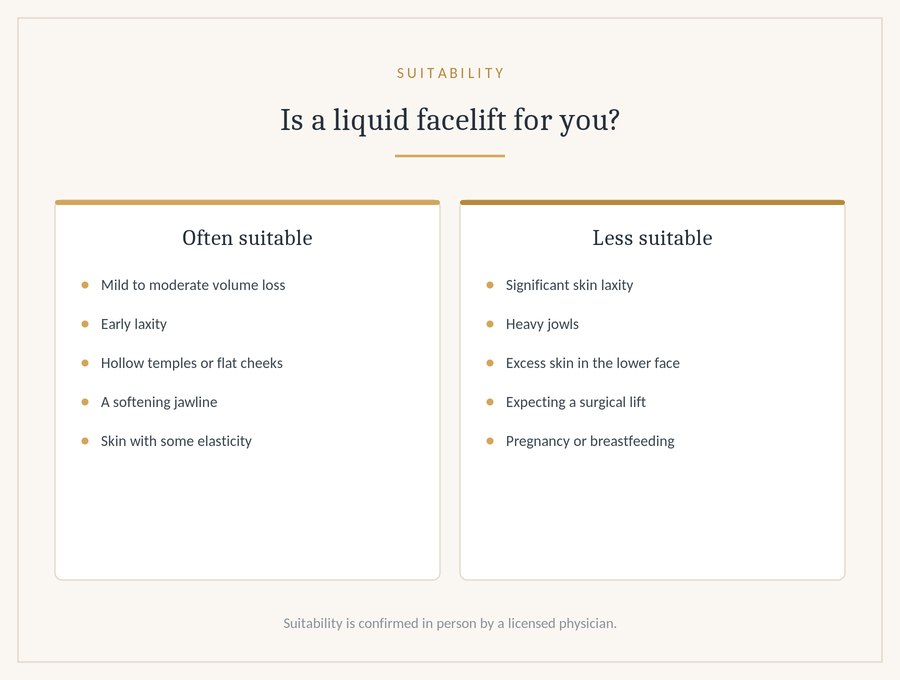
A liquid facelift suits adults with mild to moderate volume loss and early laxity: flattening cheeks, hollowing temples, a jawline that has begun to soften, and shadows rather than overhanging skin. Skin that still has reasonable elasticity tends to respond more predictably. It also suits people who want a gradual, adjustable change and accept that filler needs repeating.
Who may be better served by threads or surgery
Significant laxity, heavy jowls or a good deal of excess skin are not problems that volume solves. Adding filler to tissue that is already descending can add weight and make jowls more visible. In these cases a physician may discuss thread lifting for moderate descent with adequate volume, or a referral to a surgeon for a surgical facelift. An honest assessment sometimes ends with advice not to inject at all.
How Much Filler Is Used, and Why Treatment Is Staged
The amount depends on how much support has been lost, not on a standard package. Taking the figures above together, a plan covering all four areas ranges from about 4 ml for a limited correction to 10 ml or more when volume loss is marked. Most syringes hold 1 ml, so that means roughly four to ten syringes or more.
Larger plans are usually divided into two visits. The first session builds the foundation, often the cheeks and temples, with a deliberately conservative amount. A review two to four weeks later, once swelling has settled, shows what has been achieved and what is still needed; in clinical trials of cheek and chin filler, an optional touch-up was allowed at around four weeks. Staging lets the face adapt gradually, and a session commonly takes 45 to 60 minutes including time for numbing cream.
How Long Do the Results Last?
Duration varies with the gel, the volume, the area and your own metabolism. As a broad guide, cheek filler often lasts around 12 to 18 months, and some studies have followed results to two years. Temple, jawline and chin studies have mostly followed patients for about 12 months, with improvement still present at that point. Areas under more movement, and people who exercise heavily, may notice fading sooner.
Botulinum toxin, if used, lasts about three to four months, while collagen-stimulating products build over months and can last up to around two years. These are typical figures rather than certainties, and topping up before the filler has fully faded generally needs less product than rebuilding from nothing.
How to Avoid the Overfilled Look
An overfilled face usually comes from one of four causes: too much product in one area, product placed in the wrong layer, repeated touch-ups without reassessing the original deficit, or attempts to fill every line and fold directly. A wide, shelf-like fullness at the side of the cheek is a common sign.
Several habits reduce the risk: a conservative first session with a review before more is added; assessment from the front, the side and the three-quarter view, and while you smile; balanced treatment across the support points rather than one area filled repeatedly; a clear upper limit agreed in advance; and a physician who is willing to say that enough has been done. If an area does look too full, hyaluronidase can dissolve some or all of the filler, which is one reason hyaluronic acid is the usual choice for this approach. Our guide to dissolving filler explains how it works.
Side Effects and Risks
Common and short-lived effects
Bruising, swelling, tenderness, redness and small bumps at the injection points are common. Swelling usually peaks within the first two days and settles over a week or so, and bruises generally fade within one to two weeks. Mild asymmetry from swelling is checked at the review.
Lumps and irregularities
Early lumps are usually due to uneven spread of the gel or to swelling, and many settle or can be smoothed by the physician. Less often, firm or inflamed nodules appear weeks or months later, sometimes after an illness or dental work. Persistent lumps can be treated, including with hyaluronidase. Infection and allergic reactions are uncommon.
Vascular occlusion, and why hyaluronidase and anatomy matter
The most serious risk is vascular occlusion. It occurs when filler is injected into a blood vessel or presses on one, reducing the blood supply to the skin it feeds. It is rare, but without prompt treatment the skin can break down and scar, and in very rare cases filler entering vessels connected to the eye has caused loss of vision. Early signs include sudden severe pain, a white or blanched patch, a mottled purple discolouration and any visual disturbance, during the injection or in the hours afterwards.
Two things reduce the risk and the harm. The first is anatomical knowledge: knowing where the arteries run in the temples, cheeks, jaw and chin and at what depth, and injecting slowly, at low pressure and in small amounts while watching the skin. The second is preparedness. Consensus guidance says clinics that inject hyaluronic acid filler should keep hyaluronidase on site with staff trained to use it, because treatment depends on prompt, high-dose injection of the enzyme into the affected area, with urgent eye assessment if vision is involved.
Who Should Avoid a Liquid Facelift?
Treatment is usually postponed during pregnancy and breastfeeding, when there is infection, inflammation or an active skin problem in the area, and when there is a known allergy to hyaluronic acid products or lidocaine. Extra care is needed with bleeding disorders, blood-thinning medicines, autoimmune or inflammatory conditions, a tendency to keloid or raised scarring, and previous non-absorbable fillers or implants in the face. Medicines should never be stopped without the advice of the prescribing doctor, and suitability must be confirmed in person by a licensed physician.
Aftercare
For the first few hours, stay upright and avoid pressing or massaging the treated areas unless your physician advises it. For 24 to 48 hours, avoid strenuous exercise, saunas, steam rooms and alcohol, and sleep on your back with your head slightly raised if you can. Gentle cold compresses can ease swelling. Avoid facials, laser treatments and non-urgent dental work for around two weeks, and tell your dentist about the filler. Contact the clinic urgently for severe pain, pale or dusky skin, spreading redness or heat, or any change in vision. Your physician’s own instructions always take priority.
Choosing Who Treats You
A liquid facelift involves several areas of the face where vessels lie close to the surface, so the person injecting should be a licensed physician whose DHA licence you can verify on the DHA Sheryan portal. Ask about their experience with this specific treatment, whether they assess your face from several angles and while you move, and which gels they would use in each area.
A sound plan includes a written estimate of the volume for each area, a review at around two weeks, hyaluronidase kept on site, written aftercare and a clear way to reach the clinic if something concerns you. The page on face lift with filler gives an overview of the approach. At dr-soheila.com, treatments are planned and performed by Dr Soheila Eskandari, a DHA-licensed general practitioner with aesthetic privileges with 20 years of experience in aesthetic medicine.
The Short Version
A liquid facelift restores support at the temples, cheeks, jawline and chin with hyaluronic acid filler, sometimes together with collagen-stimulating injections and botulinum toxin. It suits mild to moderate volume loss and early laxity, is usually built up over one or two staged sessions, and typically lasts around 12 to 18 months, varying by area. It cannot tighten skin or replace surgery when laxity is significant.
Bruising and swelling are common, lumps are less so, and vascular occlusion is rare but serious, which is why anatomical knowledge and hyaluronidase on site matter. An overfilled look is avoided by restraint, staging and review. Treatment is postponed in pregnancy and breastfeeding, and suitability should be confirmed in person by a licensed physician.
Questions Worth Asking
How much filler do you plan for each area, and why? The answer should be in millilitres and tied to your face, not to a package.
Would threads or surgery suit me better? An honest assessment includes options that are not filler.
Do you keep hyaluronidase on site, and what is your vascular occlusion plan? The answer should be immediate and specific.
When is my review, and how is a touch-up decided? A review at around two weeks should be planned from the start.
Frequently Asked Questions
Is a liquid facelift the same as a surgical facelift?
No. It adds volume at support points, so it cannot remove skin or reposition sagging tissue; significant laxity is better assessed for threads or surgery.
How much filler does a liquid facelift need?
It depends on the loss: studies report about 1 ml per temple, 4 to 7 ml for the cheeks and about 4 ml for chin and jaw, so plans range from around 4 ml to 10 ml or more.
How long does a liquid facelift last?
Results typically last around 12 to 18 months, with cheeks often lasting longest and temples, jawline and chin about 12 months in studies. Botulinum toxin, if added, lasts about three to four months.
Who is a good candidate for a liquid facelift?
Adults with mild to moderate volume loss, early laxity and skin that still has some elasticity. Heavy jowls, significant laxity or excess skin usually call for threads or surgery to be assessed instead.
Will a liquid facelift make me look overfilled?
The risk is reduced by staged sessions, a conservative first amount, placement at support points, assessment from several angles and a review before any touch-up. Hyaluronidase can correct excess filler.
Does a liquid facelift hurt, and what is recovery like?
Most people feel pressure and brief pinching, eased by numbing cream and the lidocaine in many gels. Swelling peaks in the first two days, and bruises usually fade within one to two weeks.
What are the risks of a liquid facelift?
Bruising, swelling, tenderness and small bumps are common. Persistent lumps, delayed nodules, infection and allergy are uncommon, and vascular occlusion is rare but serious and needs urgent treatment.
What is vascular occlusion, and why does hyaluronidase matter?
It is blocked blood flow caused by filler in or pressing on a vessel. Hyaluronidase dissolves hyaluronic acid and, given promptly in high doses, is the main treatment, so it should be on site.
Can a liquid facelift be combined with botulinum toxin or collagen stimulators?
Yes, when the assessment supports it. Botulinum toxin relaxes muscles that pull the lower face down, and collagen stimulators add gradual support but cannot be dissolved, so they are placed carefully.
What does a liquid facelift cost in Dubai?
Market rates generally run from around AED 1,800 to AED 3,500 per syringe of hyaluronic acid filler, depending on the product and the clinic, so a plan of four to six syringes usually totals around AED 7,200 to AED 21,000, with fuller plans costing more.
This article is general information about aesthetic and dermatological treatments and is not medical advice, a diagnosis, or a treatment recommendation for any individual. Outcomes vary between patients and no result is guaranteed. Prescription medications and injectable products carry risks and contraindications that must be assessed by a licensed physician during a personal consultation. Dr Soheila Eskandari is licensed by the Dubai Health Authority. Prices quoted are general market ranges for information only and are not an offer.


 English
 Arabic