
Radiesse for Cellulite in Dubai: How Diluted Radiesse Works on Thighs and Buttocks
Radiesse for Cellulite in Dubai: How Diluted Radiesse Works on Thighs and Buttocks
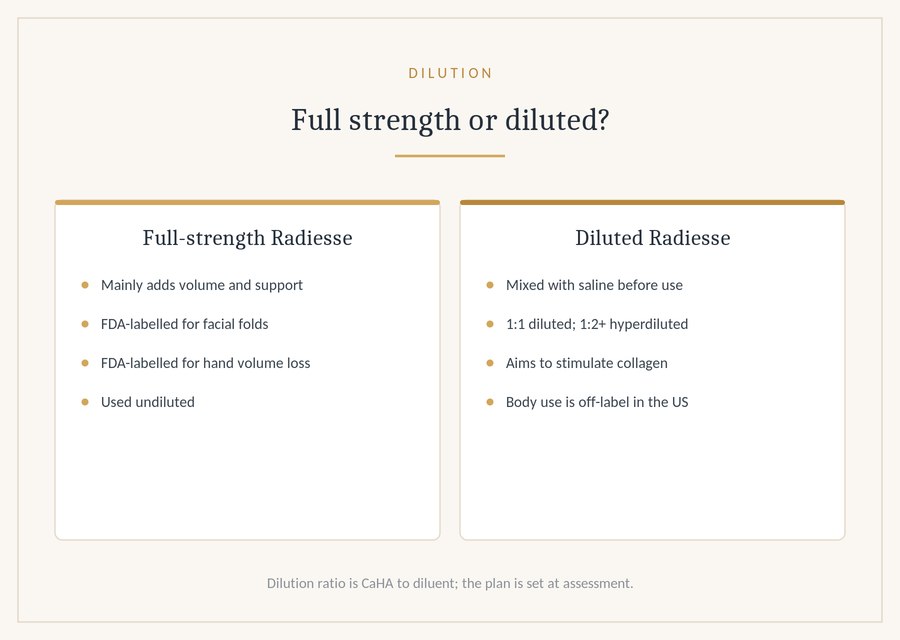
Radiesse for cellulite means injecting calcium hydroxylapatite (CaHA) diluted with saline into areas such as the thighs, buttocks and the skin above the knees. It may improve the appearance of mild to moderate dimpling and thin, crepey skin, but it does not remove cellulite. The product is placed through a cannula with the aim of stimulating the skin’s own collagen, and the evidence comes from small studies that assessed results at around three months. Use on the body is off-label in the US, and no large randomised trial or durability data have been reported.
This guide covers what cellulite is, how diluted and hyperdiluted Radiesse works, what the studies show, who suits it, aftercare, risks and cost in Dubai. Dr Soheila uses diluted Radiesse (calcium hydroxylapatite) for cellulite and crepey skin on the thighs, buttocks and above the knees, after an in-person assessment.
What Is Cellulite, and Why Does Skin Quality Matter?
Cellulite is the dimpled, uneven surface seen mainly on the thighs and buttocks. In the current model, fibrous bands called septa anchor the skin to deeper tissue at fixed points while lobules of fat bulge upwards between them, and imaging studies link visible depressions to more and thicker septa. In women the septa run perpendicular to the skin, whereas in men they cross in a lattice that holds fat in more firmly, which is one reason cellulite is much more common in women; estimates put it at around 80% to 98% of women after puberty. It is not a disease.
Septa are only part of the picture. Fat deposition, changes in small blood vessels, inflammation and a dermis that thins with age also contribute, and the authors of the knee study below noted that cellulite and skin laxity are interconnected. Thinner, laxer skin may show the structures beneath it more readily, which is one reason skin quality matters. Diluted Radiesse is aimed at that skin side of the picture rather than at releasing the bands. Our overview of cellulite treatment in Dubai covers the other approaches.
Crepey skin and the area above the knees
Crepey skin is thin, finely crinkled skin that does not spring back. Above the knees it often appears together with soft dimples and laxity. The knee cellulite severity score used in research rates the number and depth of depressions and the degree of skin laxity, each from 0 to 3.
How Does Diluted Radiesse Work?
Radiesse is a dermal filler made of calcium hydroxylapatite microspheres suspended in a gel. At full strength it is used mainly to add volume and support. Diluted with saline, sometimes with local anaesthetic added, the same particles are spread through a larger volume. A 2018 consensus of 14 physicians defined 1:1 as diluted and 1:2 or more as hyperdiluted, and described the aim as stimulating new collagen to improve laxity and skin quality, including on the upper legs and buttocks.
The reasoning is that new collagen may thicken and firm the dermis. A small histology study of diluted CaHA in the neck and décolleté, cited by the knee-study authors, reported more collagen and elastin, new blood vessels and a thicker dermis. It did not examine the thighs or buttocks, so the effect on the legs is inferred rather than shown.
This differs from a hyaluronic acid filler, which mainly adds volume by binding water; our comparison of Radiesse and hyaluronic filler explains the distinction. Radiesse also belongs to the group of collagen biostimulators, and our guide to Sculptra versus Radiesse compares it with poly-L-lactic acid.
What Does the Research Show?
The research on diluted Radiesse for cellulite is limited: the studies are small and mostly retrospective or open-label, and no large randomised trial has been reported. Evidence across cellulite treatments in general is also limited, with a 2015 systematic review of 67 studies finding only 19 that were randomised and placebo-controlled. The findings below describe the people studied, not what any one person can expect.
The knee study
A 2020 retrospective pilot study treated 20 women, mean age 50, for loose skin and dimples above the knees. One 1.5 ml syringe of CaHA, diluted 1:4, was injected into each knee in a single session. Three dermatologists on the study team scored photographs taken at baseline and at three months, blinded to which was which, on a knee cellulite severity scale running from 0 to 9. Average scores fell from about 5 to about 2, with larger gains in women whose baseline scores were lower, and every patient reported being satisfied. The authors listed the small numbers, retrospective design, women-only sample and lack of data on how long the effect lasts as limitations.
The buttock study
A prospective, open-label, single-centre study published in Aesthetic Plastic Surgery in January 2024 treated adult women for buttock dimples with 1:1 diluted CaHA over three sessions, using a cannula-based subcision technique. Of the 24 women who completed it, 91.6% rated their cellulite appearance as improved or better, and at week 14 the mean number of visible dimples was down by about 54% and their depth by about 50%. No serious complications were reported. The study was funded by a grant from the manufacturer.
Other reports and what is still unknown
A 2017 retrospective report of 20 women combined diluted CaHA with microfocused ultrasound (an energy-based option covered in our guide to skin tightening in Dubai) on the buttocks and thighs, so the contribution of each treatment cannot be separated. A 2023 case series of seven patients treated with hyperdiluted CaHA on the buttocks reported high satisfaction, and its authors called for prospective studies. Results in the knee and buttock studies were assessed at around three months, there are no durability data, and a 2019 consensus of ten clinicians on body areas states that further clinical studies are needed.
Who May Suit Radiesse for Cellulite, and Who May Not?
Mild to moderate dimpling with thin or lax skin
Diluted Radiesse is mainly considered for mild to moderate dimpling on the thighs, buttocks or above the knees where the skin is also thin, crepey or lax. In the knee study the improvement was larger in women with lower baseline scores and smaller in those with severe scores, so milder cases may respond better, although this was a small sample and not a promise.
Deep, tethered dimples
A deep dimple held down by a strong fibrous band is a different problem, because improving skin quality may not release the band. It may need subcision, in which the fibrous band is divided so the skin can lift. The buttock study combined diluted CaHA with a cannula-based subcision technique, and whether subcision is needed is decided at assessment.
Localised fat
Cellulite and localised fat are separate issues. Diluted Radiesse is not a fat-reduction treatment, and a bulge caused by fat deposits needs to be assessed on its own terms rather than as cellulite.
What Happens During Treatment?
Treatment starts with a consultation covering your medical history, medicines, allergies and previous treatments, then an examination of the skin standing and relaxed. The depth of the dimples, the thickness and laxity of the skin and any localised fat are assessed, which decides whether diluted Radiesse is suitable, which areas to treat and what is realistic. Dr Soheila uses diluted Radiesse after this kind of in-person assessment.
The product is diluted just before use. In the knee study, each 1.5 ml syringe was mixed with 0.5 ml of 1% lidocaine and 5.5 ml of saline, passed between two syringes at least 20 times and injected promptly, because the mixture separates on standing. The area was marked with the patient standing, and a fine blunt-tipped cannula fanned the product through the tissue before it was massaged in.
How many sessions?
The number of sessions is individual. The knee study used one session and the buttock study used three, with 12 syringes in total, but these were research protocols and not a standard course. Your plan depends on the area, the degree of dimpling and laxity and how your skin responds, and it is reviewed as treatment goes on.
What to Expect Afterwards
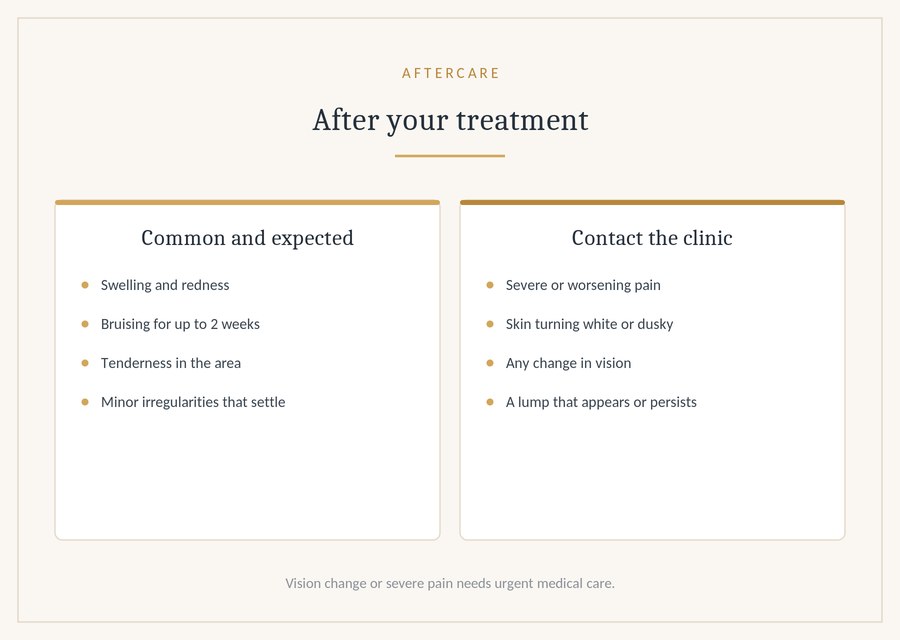
Swelling, redness and bruising are the usual effects, often with some tenderness. In the knee study the only adverse events were minor swelling, redness, bruising and skin irregularities, which the authors summarised as lasting two to three weeks. In the detailed results, almost all patients had some redness and swelling that settled within about five days, nine of the 20 had bruising lasting up to two weeks, and discomfort during treatment averaged about 2 on a 10-point scale, with lidocaine in the mixture.
In that study the area was massaged after injection and exercise was avoided for 24 hours; your own instructions may differ and take priority. Contact the clinic if swelling, pain or redness is increasing rather than settling, if a lump appears or persists, or if there are signs of infection.
When Will Results Show, and Is Maintenance Needed?
Any change is likely to be gradual, because it depends on the skin’s own collagen response rather than volume placed on the day. Both studies assessed outcomes at around three months, and neither established when the first change appears or how long it lasts. With no durability data there is no established maintenance schedule, so any repeat treatment is decided individually, based on how the skin looks and feels at the time.
Risks, Side Effects and Who Should Avoid Treatment
Besides the temporary effects above, the main concern is lumps or nodules, which are more likely if product is placed too superficially, in the epidermis or upper dermis; the labelling also lists hardening, infection and extrusion of product with superficial placement. A 2018 consensus noted that injecting less diluted product too superficially in thin skin raises adverse events. The hand label reports lumps in 12% of patients, lasting up to a year, although that figure comes from the hands and not the body.
Rare vascular events can occur. If product enters a blood vessel it can block blood flow and damage tissue, and the labelling describes vision loss, blindness, stroke and skin necrosis after facial injection; it advises injecting slowly with the least pressure. Severe pain, skin turning white or dusky, or any change in vision needs immediate medical attention.
Labelling lists as contraindications anaphylaxis or multiple severe allergies, hypersensitivity to any component and bleeding disorders. Some labels also list infection or inflammation at the site, a tendency to inflammatory skin conditions, hypertrophic scars or keloids and, where lidocaine is included, allergy to amide-type local anaesthetics. Treatment is postponed during pregnancy and breastfeeding, as with other elective injectables. Blood-thinning medicines and supplements increase bruising and should be discussed, but never stopped without the prescribing doctor’s advice. A licensed physician must assess suitability in person.
How Much Does Radiesse for Cellulite Cost in Dubai?
Market rates for Radiesse in Dubai generally run from around AED 2,000 to AED 4,500 per syringe. The total depends on how many syringes a body area needs, which varies with the size of the area, the degree of dimpling and laxity and the number of sessions, so it is estimated only after assessment.
Choosing Who Treats You
Using Radiesse for cellulite goes beyond its US labelled indications, so the person treating you should be a licensed physician whose DHA licence you can verify on the DHA Sheryan portal. Ask about their experience with this specific treatment, whether they assess your skin thickness, laxity and dimple depth before injecting, and whether they explain how limited the evidence is.
A sound plan names the product and dilution, explains the depth and technique, sets a review date and gives written aftercare with a clear way to reach the clinic. The page on cellulite treatment gives an overview of the service. At dr-soheila.com, treatments are planned and performed by Dr Soheila Eskandari, a DHA-licensed general practitioner with aesthetic privileges with 20 years of experience in aesthetic medicine.
The Short Version
Cellulite arises when fibrous bands tether the skin while fat bulges between them, and thin, lax skin may make the pattern more visible. Radiesse for cellulite is diluted or hyperdiluted and injected with a cannula to stimulate collagen, and it may improve the appearance of mild to moderate dimpling and crepey skin on the thighs, buttocks and above the knees. The studies are small and assessed results at around three months, so any change is expected to be gradual, its size cannot be predicted precisely, and there is no established maintenance schedule.
Swelling, redness and bruising are common, with minor events lasting two to three weeks in the knee study, and nodules or, rarely, vascular events are possible. Use on the body is off-label in the US, treatment is postponed in pregnancy and breastfeeding, and a licensed physician must assess suitability in person. Deep, tethered dimples and localised fat may need a different approach.
Questions Worth Asking
Is my concern skin quality, deep tethered dimples or localised fat? The answer decides whether diluted Radiesse is relevant or another approach should come first.
How will the product be diluted, and at what depth will it be placed? The answer should cover the dilution ratio, the cannula and why superficial placement is avoided.
How many syringes and sessions do you expect for my area, and why? The plan should be individual and open to review rather than fixed in advance.
What happens at my review, and how can I reach you if something worries me? A review date, written aftercare and a clear contact route should be part of the plan.
Frequently Asked Questions
Does Radiesse remove cellulite?
No. Small studies suggest diluted Radiesse may improve the appearance of mild to moderate dimpling and skin quality, but it does not remove cellulite and results vary between people.
Is Radiesse approved for cellulite?
Not as a labelled indication. US labelling covers the face, hands and décolleté, so use on the thighs, buttocks and above the knees is off-label and rests on the physician’s judgement.
How many sessions will I need?
It is individual and set at assessment. The knee study used a single session and the buttock study used three, but those were research protocols and not a standard course.
How soon will I see a difference?
Change is likely to be gradual. Both studies assessed results at around three months, and neither defined when the first change appears, so no timeline can be promised.
How long do the results last?
This is not known. The studies followed people for about three months and there are no durability data, so repeat treatment is reviewed individually.
What side effects can I expect?
Swelling, redness, bruising and tenderness are common, and the knee study reported minor events lasting two to three weeks. Nodules can form if product is placed too superficially, and rare vascular events are possible.
Who should not have Radiesse for cellulite?
Treatment is postponed in pregnancy and breastfeeding. Labelling also lists severe allergies, hypersensitivity to the ingredients, bleeding disorders, and infection or inflammation at the site, and a physician must assess suitability in person.
Can diluted Radiesse help crepey skin or dimples above the knees?
A 2020 pilot study of 20 women found lower knee cellulite scores at three months after 1:4 hyperdiluted CaHA, mainly in milder cases, but it was small and retrospective and did not assess durability.
Can it be combined with other treatments?
Research has combined diluted CaHA with microfocused ultrasound and with subcision, which deep tethered dimples may need, but whether a combination suits you is decided at assessment.
What does it cost in Dubai?
Market rates for Radiesse in Dubai generally run from around AED 2,000 to AED 4,500 per syringe, and the total depends on how many syringes a body area needs, which is decided after assessment.
This article is general information about aesthetic and dermatological treatments and is not medical advice, a diagnosis, or a treatment recommendation for any individual. Outcomes vary between patients and no result is guaranteed. Prescription medications and injectable products carry risks and contraindications that must be assessed by a licensed physician during a personal consultation. Dr Soheila Eskandari is licensed by the Dubai Health Authority. Prices quoted are general market ranges for information only and are not an offer.

 English
 Arabic