
Dark Circles Under the Eyes in Dubai: Find the Cause First
Dark Circles Under the Eyes in Dubai: Find the Cause First
Dark circles are the most commonly misdiagnosed concern in aesthetic medicine, and the reason is simple: three completely different problems look almost identical in a mirror. One responds to brightening treatment. One responds to filler. One responds to neither. Treating the wrong one is why so many people have spent money on under-eye treatments that did nothing.
This guide explains how periorbital darkening is actually classified in the dermatology literature, how to work out which type you have, what treats each one, and what a realistic plan looks like in Dubai. Dr Soheila’s consultation for this concern begins with diagnosis rather than a treatment offer, and this article explains why that sequence matters so much.
The Three Types — and the Mixed Ones
Periorbital hyperpigmentation is classified in the clinical literature into pigmented, vascular, structural, and mixed types, based on clinical appearance. Mixed presentations are common and include pigmented-vascular, pigmented-structural, vascular-structural, and combinations of all three.
| Type | What it looks like | What is actually happening |
|---|---|---|
| Pigmented | Brown hue below the eye, often extending onto the lid | Excess melanin in the skin itself |
| Vascular | Blue, purple or pink hue, sometimes with puffiness | Blood vessels visible through very thin skin |
| Structural | Skin-coloured; a shadow rather than a colour | Volume loss and tear trough anatomy casting a shadow |
| Mixed | Combination of the above | More than one mechanism, requiring a combined plan |
Two tests you can do yourself
These are not diagnostic, but they are genuinely informative and will make your consultation more productive.
- The stretch test. Gently stretch the skin under your eye horizontally. If the darkness lightens noticeably, a vascular component is likely — you are flattening the vessels. If it stays the same, pigment is more likely.
- The light test. Look at yourself in a mirror under direct overhead lighting, then hold a light source at chin level pointing upward. If the darkness largely disappears when lit from below, it is a shadow — a structural problem. Shadows can be lit away; pigment cannot.
A great many people who assume they need brightening creams discover with the second test that they have a structural issue. No brightening agent on earth will fix a shadow.

What Treats Each Type
A systematic review of treatments for periorbital hyperpigmentation identifies the effective options as topical creams and serums, chemical peels, lasers, fillers, carboxytherapy, platelet-rich plasma injections, normobaric oxygen, and blepharoplasty — but the crucial point is that these are not interchangeable. Each maps onto a particular mechanism.
Pigmented type
Topical creams and chemical peels are useful for the pigment-based form. The approach is essentially the same as for pigmentation elsewhere on the face — interrupting melanin production and encouraging turnover — but with much more caution, because eyelid skin is the thinnest on the body and irritation here readily causes more pigment.
Photoprotection is central rather than optional. Our guide to pigmentation mesotherapy covers the mechanism and the evidence for the actives used, and much of it applies here in a gentler form.
Vascular type
Lasers are described in the literature as mildly to moderately beneficial for both vascular and pigment types. Vascular-specific devices target haemoglobin.
Non-device measures matter more here than patients expect: sleep, salt intake, allergy control, and nasal congestion all influence how prominent periorbital vessels appear. Chronic allergic rhinitis in particular produces persistent venous congestion around the eyes — treating the allergy sometimes achieves more than any cosmetic procedure.
Structural type
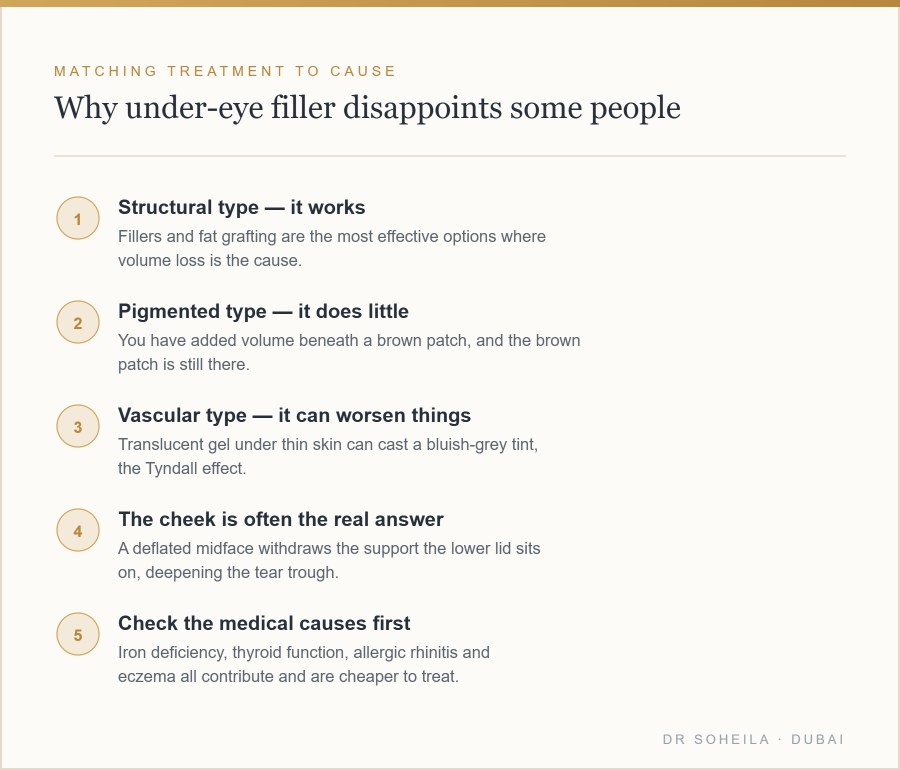
Soft tissue fillers and autologous fat grafting are the most effective options where the cause is volume loss. This is where under-eye filler genuinely earns its reputation — but only in the right patient.
Critically, the volume loss is often not in the under-eye at all but in the cheek beneath it. A deflated midface withdraws the support the lower lid sits on, deepening the tear trough. Treating the cheek frequently improves the under-eye more safely and more naturally than injecting the tear trough directly. Our guides to under-eye filler and cheek filler cover both sides of that decision.
Mixed type
A comprehensive plan for mixed presentations combines topical brightening for the pigment component, tear trough or midface filler for the structural component, and lifestyle or laser intervention for the vascular component. This is normal and should be explained as a sequence rather than delivered all at once.
Why Under-Eye Filler Disappoints Some People
This deserves its own section, because it is the single most common source of dissatisfaction in this area.
Under-eye filler works well for the structural type. In the pigmented type, it does very little — you have added volume beneath a brown patch, and the brown patch is still there. In the vascular type it can actually make things worse: hyaluronic acid is translucent and can produce a bluish-grey cast through thin skin, an effect known as the Tyndall phenomenon, which is exactly the discolouration the patient came in to fix.
This is why Dr Soheila will decline to inject the tear trough in some patients and will explain why. It is not caution for its own sake; it is that the treatment does not address their mechanism.
Causes Worth Investigating Before Treatment
Several contributors are medical rather than cosmetic and are worth excluding, because treating them is cheaper and more effective than any procedure:
- Iron deficiency. Common, particularly in women, and a recognised contributor to periorbital darkening. Ferritin should be checked even when haemoglobin is normal
- Thyroid dysfunction — affects periorbital tissue and fluid balance
- Allergic rhinitis and chronic nasal congestion — produces venous congestion under the eyes
- Atopic dermatitis or eczema around the eyes — chronic rubbing causes post-inflammatory pigmentation
- Sleep debt and dehydration — genuinely relevant, though rarely the sole cause
- Medication — certain drugs, including some glaucoma eye drops, cause periorbital pigmentation
- Genetics and ethnicity — constitutional periorbital hyperpigmentation is common in South Asian, Middle Eastern and Mediterranean populations, and is not a disease
Our article on nutritional testing covers the blood panel that is reasonable to run when a systemic contributor is suspected.
The Dubai Factors
Several local conditions genuinely aggravate every type:
- Year-round high UV. Drives the pigmented component continuously. There is no low-UV season during which it settles
- Visible light and heat. Melanocytes in darker skin respond to visible light as well as UV, which is why tinted sunscreens containing iron oxides outperform clear ones here
- Air conditioning. Chronic low humidity dehydrates and thins already-delicate skin, making vessels more visible
- Dust and seasonal allergens. Prompt eye rubbing, which causes both mechanical pigmentation and venous congestion
- Long screen hours. Associated with reduced blink rate, eye strain and fatigue — contributors to the vascular and puffiness components
Our guide to sun and water damage in Dubai covers the environmental picture in more depth.
What Happens at the Consultation
- Classification. Examination in good light, at rest and with the skin stretched, to determine which type or combination is present
- Lighting assessment to separate shadow from colour
- Skin thickness and quality assessment, which determines what can safely be injected
- Midface assessment, because the cheek determines the under-eye more than most patients realise
- History — sleep, allergy, iron status, thyroid, medications, family history, and previous treatments
- Standardised photographs in fixed lighting, which matters enormously here because casual comparisons under different lighting are meaningless
- Blood tests where a systemic contributor is suspected
Some consultations conclude with a recommendation to correct iron levels and use a proper sunscreen and reassess in three months. That is a legitimate and often correct outcome.
Realistic Expectations
This is a topic where honesty matters more than optimism.
- Constitutional periorbital pigmentation improves but rarely clears. If your family all have it, the goal is meaningful lightening, not elimination
- Structural shadowing responds best and can improve dramatically when the cause is genuinely volume loss
- Vascular darkness is the hardest. You cannot make skin thicker quickly, and the vessels are anatomically where they are
- Mixed types require sequencing. Expect a plan measured in months, not a single appointment
- Photographs are the only reliable judge. Under-eye appearance varies enormously with sleep, salt, hydration and lighting, and self-assessment in a bathroom mirror is unreliable
Cost in Dubai
Market rates in DHA-licensed clinics generally run:
- Consultation with assessment: approximately AED 300 to AED 800
- Blood panel where indicated: approximately AED 400 to AED 1,200
- Under-eye filler: approximately AED 1,800 to AED 3,500 per syringe
- Brightening mesotherapy course: approximately AED 700 to AED 1,800 per session, typically four to six sessions
- Laser or light-based treatment: approximately AED 1,000 to AED 3,000 per session, course-based
- Prescription topicals: modest monthly cost, ongoing
The most important financial advice here: pay for the diagnosis before paying for the treatment. A correct classification costs a few hundred dirhams and determines whether the several thousand you spend afterwards works at all.
Warning Signs When Choosing a Clinic
- No classification. If nobody told you whether your darkness is pigmented, vascular or structural, they do not know what they are treating
- Filler offered immediately, before any assessment of the mechanism
- Guaranteed elimination. Nobody can promise this, particularly for constitutional pigmentation
- No mention of sunscreen or sleep, which are relevant to every type
- No photographs taken in fixed lighting and position
- Aggressive laser proposed in darker skin without discussion of post-inflammatory pigmentation risk
Treating With Dr Soheila
Dr Soheila Eskandari treats periorbital darkening as a diagnostic problem first. The first appointment establishes which type is present, whether there is a correctable systemic contributor such as iron deficiency or untreated allergy, and whether the underlying issue is actually in the midface rather than the eye area.
Where filler is appropriate, it is used. Where it is not — in vascular-dominant cases where a translucent gel risks making the discolouration worse, or pigment-dominant cases where volume changes nothing — patients are told directly and offered the treatment that matches their mechanism instead. In practice a meaningful proportion of consultations conclude with a topical plan, a blood test, and a review, rather than an injection.
That is a slower path than most clinics offer for this concern. It is also the reason patients stop cycling through treatments that were never going to work.
Frequently Asked Questions
How do I know what type of dark circles I have?
Two informal tests help. Gently stretch the skin: if the darkness lightens, a vascular component is likely. Light your face from below: if the darkness largely disappears, it is a shadow and therefore structural. Brown that persists under both conditions is more likely pigmented. Formal classification should be done at a consultation.
Will filler fix my dark circles?
Only if they are structural — caused by volume loss and tear trough anatomy. Fillers and fat grafting are the most effective options for that type. For pigmented dark circles filler does little, and for vascular ones a translucent gel under thin skin can produce a bluish-grey cast that makes the appearance worse.
Can creams get rid of dark circles?
Topical creams and serums are effective for the pigmented component and are a reasonable first step for that type. They will not change a shadow caused by volume loss, and they will not alter vessels visible through thin skin.
Why do my dark circles look worse some days?
Sleep, salt intake, hydration, allergy and nasal congestion all affect the vascular and puffiness components, sometimes markedly. Lighting also has a large effect on how shadowing reads. This is why standardised photographs are more reliable than day-to-day self-assessment.
Should I have blood tests for dark circles?
It is reasonable where a systemic contributor is suspected. Iron deficiency is a recognised contributor and ferritin should be checked even if haemoglobin is normal. Thyroid function is also worth assessing, particularly alongside fatigue or puffiness.
Is laser safe for dark circles in darker skin tones?
It requires care. Lasers are described in the literature as mildly to moderately beneficial for vascular and pigmented types, but heat-based treatment in higher Fitzpatrick skin types carries a real risk of post-inflammatory hyperpigmentation. Device choice, settings, and pre-treatment preparation all matter.
Are dark circles hereditary?
Often, yes. Constitutional periorbital hyperpigmentation is common in South Asian, Middle Eastern and Mediterranean populations and runs in families. It is not a disease. Treatment can lighten it meaningfully but should not be expected to eliminate it.
Can treating my cheeks help my under-eyes?
Frequently. The lower eyelid sits on the midface, and a deflated cheek withdraws that support and deepens the tear trough. In many patients, restoring midface volume improves the under-eye more safely and more naturally than injecting the tear trough directly.
How long does treatment take to work?
Structural correction with filler shows immediately, settling over two weeks. Pigment treatment is measured in months and depends heavily on daily photoprotection. Vascular improvement is the slowest and least predictable. Mixed types need a sequenced plan across several months.
How much does dark circle treatment cost in Dubai?
It depends entirely on the type. Consultation is typically AED 300 to AED 800, under-eye filler AED 1,800 to AED 3,500 per syringe, and brightening mesotherapy AED 700 to AED 1,800 per session over four to six sessions. Paying for a correct diagnosis first is what determines whether the rest of the spend works.
This article is general information about aesthetic and dermatological treatments and is not medical advice, a diagnosis, or a treatment recommendation for any individual. Outcomes vary between patients and no result is guaranteed. Persistent or asymmetric changes around the eye should be medically assessed. Dr Soheila Eskandari is licensed by the Dubai Health Authority. Prices quoted are general market ranges for information only and are not an offer.


 English
 Arabic