
Rejuran vs Profhilo: Repair or Remodel?
Rejuran vs Profhilo: Repair or Remodel?
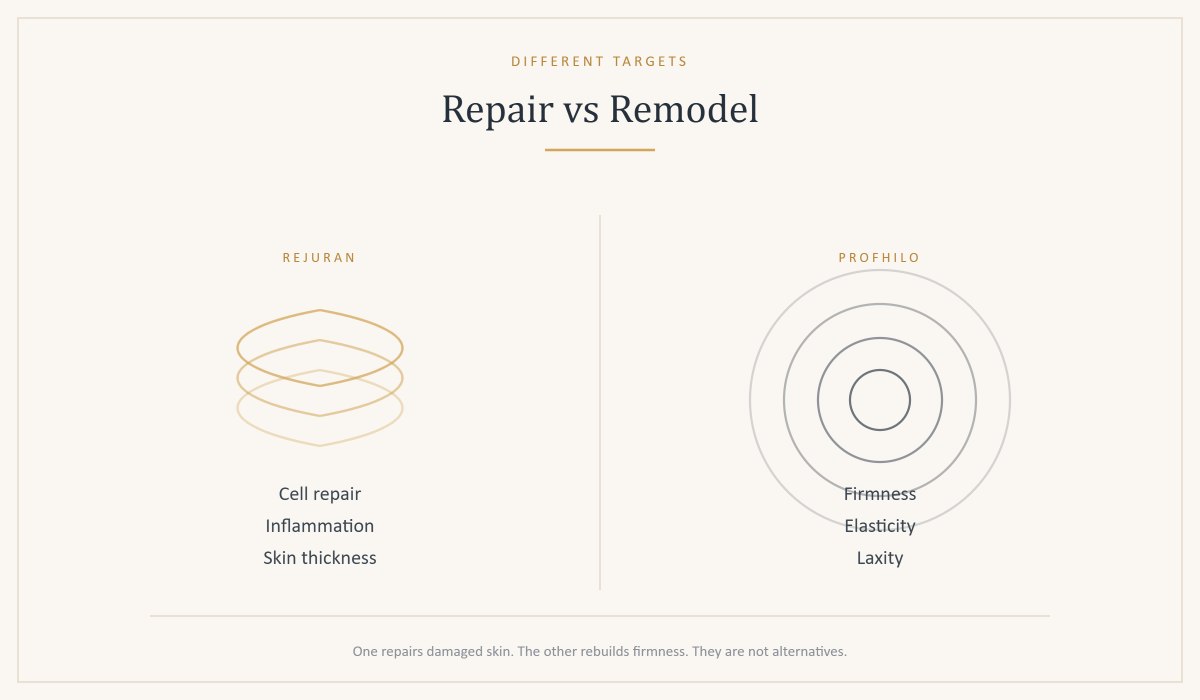
These two treatments are constantly compared, and the comparison is slightly unfair — because they are not really competing for the same job. One is made from hyaluronic acid and works on the architecture of ageing skin. The other is made from purified salmon DNA and works on skin that has been damaged.
Patients usually arrive having decided which one they want, based on something they read. Frequently the assessment points to the other. This guide, prepared with Dr. Soheila Eskandari in Dubai, explains what each one actually does, what the evidence supports, who each suits, and how the decision is made in practice.
Two Very Different Molecules
Profhilo — hyaluronic acid, bioremodelling
Profhilo is an exceptionally concentrated hyaluronic acid preparation — 64 mg in 2 ml — made by binding high and low molecular weight HA chains together without the chemical cross-linkers used in conventional fillers. It is injected at five defined points per side of the face and then spreads through the tissue plane. As it spreads and slowly breaks down, it signals the skin to produce collagen and elastin. The target is laxity.
Rejuran — polynucleotides, repair
Rejuran is built from polynucleotides extracted and purified from salmon DNA. The DNA is not “transplanted” into anyone — it is broken into fragments that the body recognises and uses. Two things happen. The fragments provide raw nucleotide material that cells use to rebuild their own DNA, and they activate a receptor pathway (adenosine A2A) associated with reduced inflammation and improved healing. Longer polynucleotide chains additionally form a light gel-like scaffold in the dermis that fibroblasts can work along. The target is damaged, inflamed or thin skin.
You will also see the term PDRN. PDRN refers to the shorter fragments — roughly 200 to 800 base pairs — from the same salmon source. PDRN leans more on the anti-inflammatory signalling route; longer polynucleotides lean more on the structural scaffold and on driving fibroblast activity. The two overlap heavily, which is why the terms are used loosely in marketing. Clinically the distinction is real but modest.
Side by Side
| Rejuran (polynucleotides) | Profhilo (HA bioremodelling) | |
|---|---|---|
| Source | Purified salmon DNA fragments | Hyaluronic acid, 64 mg / 2 ml |
| Mainly treats | Damage, inflammation, thin or scarred skin | Laxity, firmness, loss of bounce |
| Mechanism | DNA salvage pathway, anti-inflammatory signalling, dermal scaffold | Spread through tissue, collagen and elastin stimulation |
| Injection pattern | Many micro-injections across the area | Five points per side |
| Typical course | 3–4 sessions, 2–4 weeks apart | 2 sessions, 4 weeks apart |
| Downtime | More — visible bumps, possible bruising | Less — five blebs per side, settle in ~24h |
| Predictability | More variable, depends on tissue condition | Highly predictable protocol |
| Strongest use case | Under-eye skin, acne scarring, sensitised skin | Lower face, neck, décolletage, hands |
When Rejuran Is the Better Answer
Rejuran earns its reputation in situations where the skin is not simply older — it is compromised.
- Thin, crepey under-eye skin. This is where it is most requested and, in our experience, most often appropriate. Where tear trough filler corrects a shadow caused by structure, polynucleotides address the quality of the skin covering it. They are not alternatives; they solve different halves of the same complaint. See our guide to under-eye filler in Dubai.
- Acne scarring and post-inflammatory texture. The anti-inflammatory and repair pathways are the whole point here. Often combined with subcision or microneedling.
- Sensitised, reactive or over-treated skin. Patients who have had aggressive lasers, peels or too many actives sometimes need repair before anything else.
- Sun-damaged skin. Relevant in this climate — chronic UV exposure is, at a cellular level, chronic DNA damage.
Rejuran belongs to a family of PDRN and polynucleotide treatments; Plinest and TWAC sit alongside it with different chain lengths and formulations, and Dr. Soheila selects between them according to skin thickness and the specific complaint. See Rejuran.
When Profhilo Is the Better Answer
Profhilo is the better answer when the skin is fundamentally healthy but has lost firmness. The classic presentation is a patient in her forties who says her skin “used to bounce back.” No scarring, no inflammation, no sensitivity — just softening.
- Lower face and jawline definition where the loss is skin quality rather than volume.
- Neck and décolletage, where thin skin and constant movement show ageing early. See our guide to neck lines and wrinkles.
- Hands, where the complaint is nearly always crepiness rather than shape.
- Patients who want minimal downtime. Ten injection points in total, settling within about a day, is considerably less disruptive than a full grid of micro-injections.
Profhilo’s other advantage is predictability. The protocol is fixed, the response is consistent, and it is easy to plan around. See Profhilo, and our comparison of Profhilo versus skin boosters if hydration is your actual complaint.
Can They Be Combined?
Yes — and for patients over forty with both sun damage and early laxity, combining them is often the more complete plan. They are not competing mechanisms; one repairs, the other remodels.
Sequencing matters more than stacking. A reasonable pattern is polynucleotides first where the skin is damaged or thin — because rebuilding on compromised tissue is harder — followed by bioremodelling once the skin has settled. Doing both on the same day is possible but leaves you unable to attribute the result, and it increases swelling on the day for no clinical gain.
Where the Evidence Actually Stands
Being straight about this matters more in aesthetics than in most fields, because the marketing runs well ahead of the literature.
Hyaluronic acid bioremodelling has a reasonable and growing body of clinical work behind it, and the protocol is standardised enough that outcomes are fairly reproducible. Polynucleotide and PDRN treatments have a plausible and well-described mechanism, encouraging clinical data — particularly in wound healing and skin repair — and a body of evidence that is still developing rather than settled. Both are legitimate treatments. Neither is a miracle, and anyone presenting either as one is selling rather than advising.
What neither will do is replace lost volume, lift significant sagging, or substitute for sun protection.
How the Decision Is Actually Made
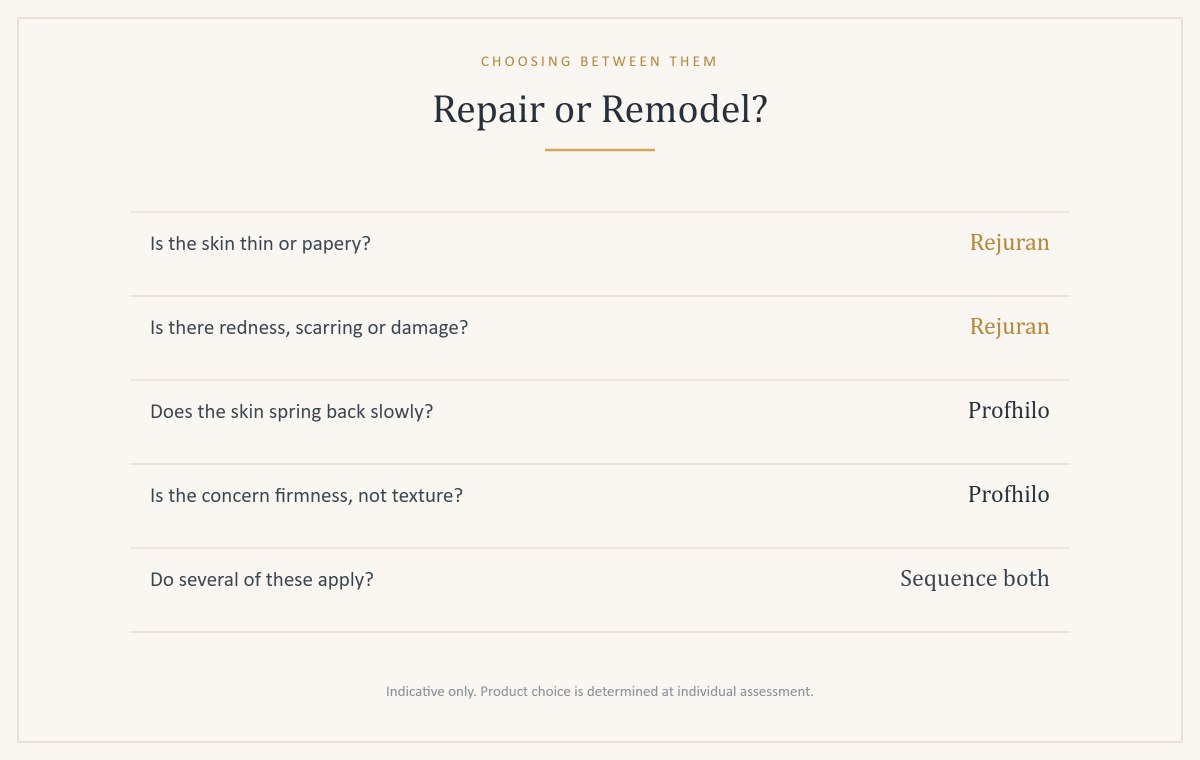
In the consultation room this is not decided by preference. It is decided by four observations, and you can make most of them yourself in a mirror.
- Is the skin thin or normal thickness? Gently pinch the skin over the cheekbone. If it feels papery and you can see fine vessels or crepe lines under the eyes, that is thin skin — polynucleotide territory.
- Does it spring back? Pinch and release. A slow return indicates loss of elastic recoil, which is the specific problem bioremodelling addresses.
- Is there inflammation or damage? Persistent redness, reactivity to products, acne scarring or the mottled texture of chronic sun exposure all point towards repair before remodelling.
- How much downtime can you accept? A genuine practical factor. If you have an event in five days, a full grid of micro-injections is the wrong week for it.
Where several of these point in different directions — thin, damaged skin and laxity, which is common after forty in this climate — the answer is usually sequencing rather than choosing.
What They Combine Well With
Neither treatment lives alone in a well-built plan.
- Microneedling pairs naturally with polynucleotides — the channels created assist delivery, and both drive collagen induction through different routes. Usually spaced rather than same-day.
- PRP overlaps with polynucleotides in intent — growth factors from your own blood supporting repair — and is sometimes preferred where a patient wants an autologous option.
- Biostimulators such as Sculptra and Radiesse address volume loss through collagen stimulation, which is a different problem again. Bioremodelling improves the quality of the skin envelope; biostimulators rebuild what is underneath it.
- Sun protection. Unglamorous and non-negotiable in this climate. Both treatments are rebuilding exactly the proteins that Dubai’s ultraviolet load degrades — see our guide to sun and water damage.
Cost in Dubai
Across the Dubai market, polynucleotide sessions commonly fall in the region of AED 1,500 to AED 3,000 per session, with a usual course of three to four sessions. Profhilo commonly falls between AED 2,000 and AED 3,500 per session over a two-session protocol.
These are general market ranges observed across Dubai clinics, not a quotation. Compare full courses rather than single sessions — a lower per-session price across four sessions is not necessarily the cheaper plan — and always ask which specific product is being used and to see the packaging.
Risks and Suitability
All medical and aesthetic procedures carry potential risks alongside their potential benefits. Both treatments commonly cause temporary swelling, redness, small bumps and occasional bruising. Rejuran typically produces more visible bumps immediately afterwards because of the number of injection points. Less common: nodules, prolonged swelling, or infection. Vascular events with any injectable are rare but serious.
Fish allergy is a specific consideration for polynucleotide treatments given the salmon origin, and must be disclosed. Neither treatment is suitable during pregnancy or breastfeeding, over active skin infection, or in some autoimmune conditions without individual assessment.
Frequently Asked Questions
Which is better, Rejuran or Profhilo?
Neither, in the abstract. Rejuran generally suits damaged, thin, scarred or inflamed skin. Profhilo generally suits healthy skin that has lost firmness. The better treatment is the one that matches your actual skin condition.
Is Rejuran safe if I am allergic to fish?
Disclose it before treatment. The material is highly purified salmon DNA, but a known fish allergy is a genuine consideration and will change the recommendation.
Which has more downtime?
Rejuran, typically. It involves many micro-injections, so visible bumps and occasional bruising are more likely and can last a day or two longer. Profhilo involves ten points in total.
Which works better under the eyes?
Polynucleotides are more commonly chosen for the under-eye area, because the usual complaint there is thin, crepey, discoloured skin rather than laxity. If the complaint is a hollow shadow, neither is the answer — that is a structural issue.
How soon will I see results?
Both are gradual. Profhilo is usually judged four to eight weeks after the second session. Polynucleotide results build across the course and for some weeks after it. Neither produces a next-day change, and any clinic promising one is overselling.
Do I need to keep repeating them?
Both are maintenance treatments rather than permanent corrections. Profhilo maintenance is commonly around every six months; polynucleotide maintenance is typically once or twice a year after the initial course. Ageing continues either way.
Is Rejuran the same as PDRN?
Closely related rather than identical. Both derive from purified salmon DNA. PDRN describes the shorter fragments, roughly 200 to 800 base pairs, which lean towards anti-inflammatory signalling. Longer polynucleotide chains additionally form a scaffold in the dermis and drive fibroblast activity more strongly. The terms are used interchangeably in marketing; clinically the difference is real but modest, and product selection is made according to skin thickness and the specific complaint.
Will either one make my face look fuller?
No. Neither is a volumising treatment. If a cheek has deflated or a temple has hollowed, that is a filler or biostimulator question and no amount of bioremodelling or repair will address it. Treating volume loss with skin-quality treatments is a common and expensive misunderstanding.
Are they safe together with Botox or filler?
They can be combined within a plan, though usually not all in one appointment. Sequencing lets you judge what each element contributed — which matters when deciding what to repeat.
Repair or remodel — which does your skin need?
It depends on whether your skin is damaged or simply older, and that is an assessment rather than a guess. Dr. Soheila Eskandari will examine skin thickness, quality and laxity and recommend accordingly — including combining or sequencing where that is genuinely better.
PDRN & salmon DNA treatments · Book a consultation · WhatsApp +971 50 514 5129
Medically reviewed by Dr. Soheila Eskandari, DHA-licensed physician (Licence No. 00216960-005), Riviera Clinic, Umm Suqeim 1, Dubai. This article is general education and not medical advice. All medical and aesthetic procedures carry potential risks and benefits, which are discussed during consultation. Individual results vary and no outcome is guaranteed. Prices quoted are general Dubai market ranges observed at the time of writing and are not a quotation. Last updated August 2026.


 English
  Arabic