
PRP for Hair Loss in Dubai: Where the Evidence Is Strong and Where It Is Not
PRP for Hair Loss in Dubai: Where the Evidence Is Strong and Where It Is Not
PRP for hair loss occupies an unusual position. It has more supporting evidence than most treatments marketed in aesthetic clinics, and it is simultaneously one of the least standardised — two clinics offering “PRP” may be preparing and injecting quite different products. That combination explains why published results are encouraging while patient experiences vary so widely.
This guide covers which types of hair loss respond, what the evidence actually shows, why preparation protocol changes the outcome, and what a realistic course and cost look like in Dubai.
What PRP Is
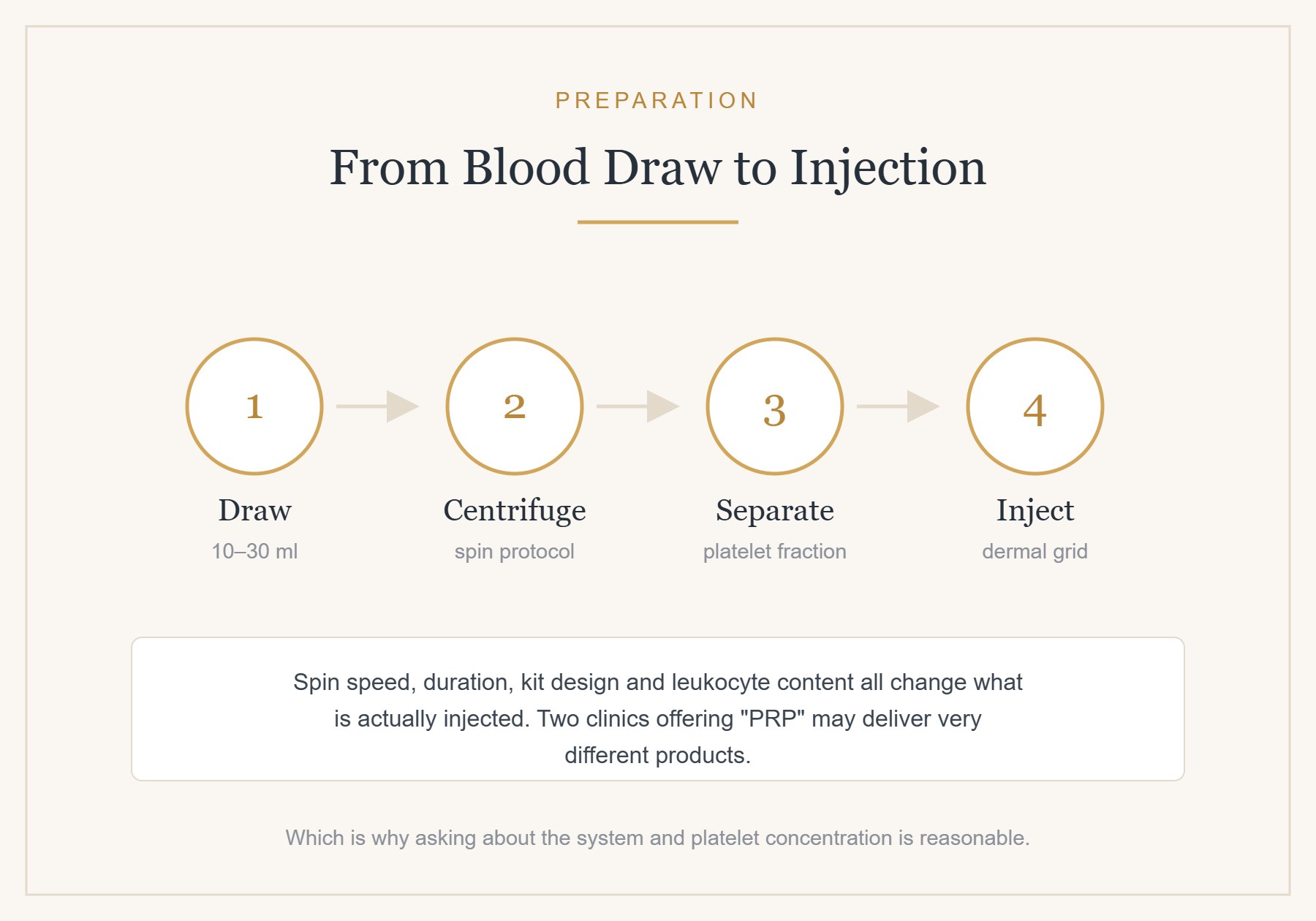
Platelet-rich plasma is produced from your own blood. A sample is drawn, placed in a centrifuge, and separated by density into red cells, a platelet-rich plasma fraction, and platelet-poor plasma. The platelet-rich fraction is collected and injected into the scalp.
Platelets are not only involved in clotting. Their granules contain a concentrated mixture of growth factors — platelet-derived growth factor, transforming growth factor beta, vascular endothelial growth factor, insulin-like growth factor and others. In the scalp these are thought to prolong the growth phase of the hair cycle, improve blood supply to the follicle, and counteract the miniaturisation process that gradually turns terminal hairs into fine, short ones.
Because the material comes from your own body, there is no risk of allergic reaction to a foreign substance, which is a meaningful advantage over injectable alternatives.
Which Hair Loss Responds
This is the question that determines whether PRP is worth your money, and the answer differs sharply by diagnosis.
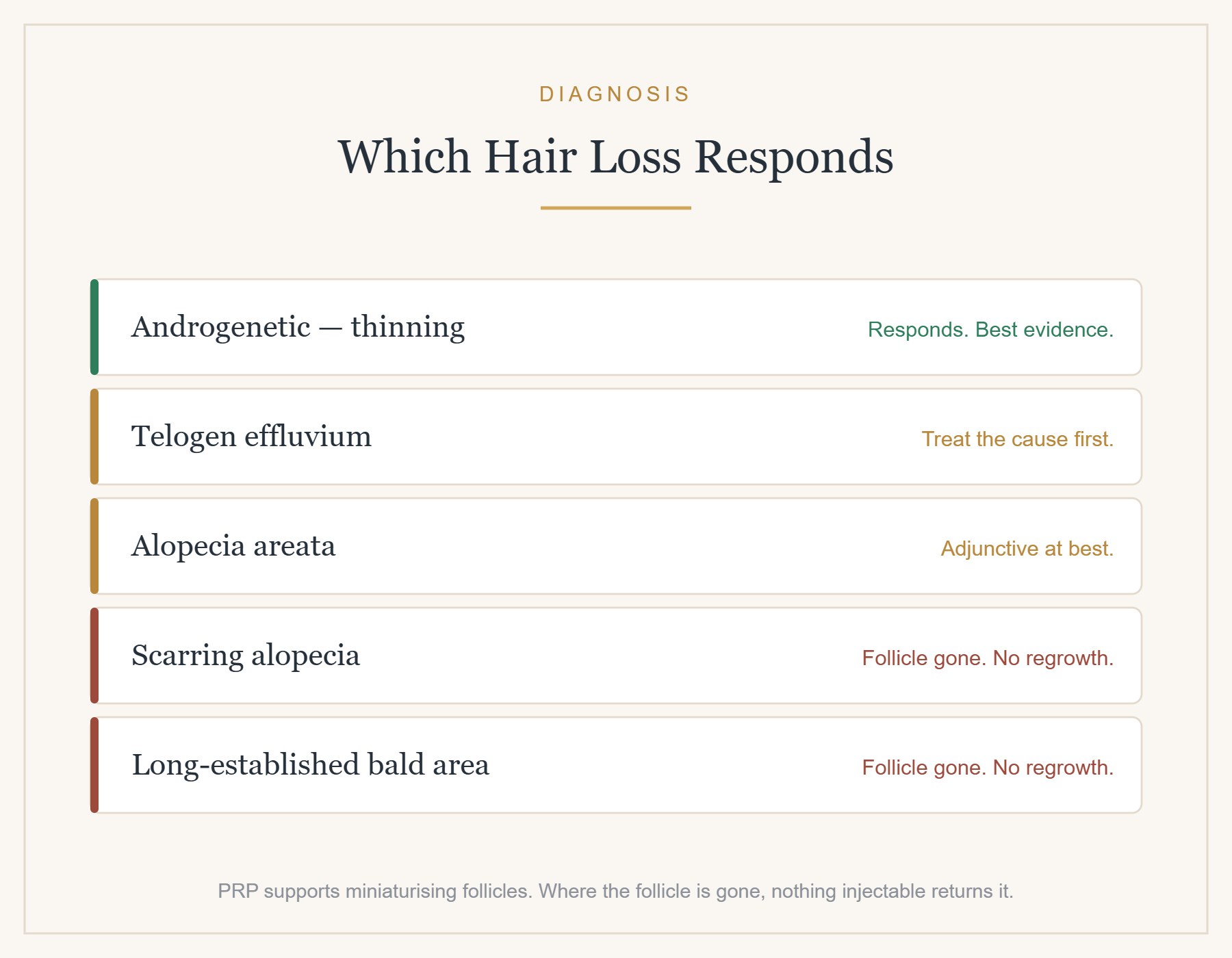
Androgenetic alopecia — pattern hair loss. This is where the evidence sits. Multiple randomised controlled trials and several meta-analyses have found increased hair density and hair thickness with PRP compared with placebo. The effect is real and reproducible enough to take seriously, though it is moderate rather than dramatic.
The critical qualifier is that PRP acts on follicles that still exist but are miniaturising. In an area that has been completely bald for years, the follicles are gone and no injectable treatment brings them back. PRP thickens thinning hair; it does not repopulate a bald scalp.
Telogen effluvium. Diffuse shedding triggered by illness, surgery, childbirth, crash dieting, iron deficiency or thyroid disturbance. This usually resolves once the trigger is corrected. The priority is identifying the cause through blood tests, not injecting the scalp — and treating it with PRP while an untreated iron deficiency continues is expensive and ineffective.
Alopecia areata. An autoimmune condition with its own established treatments. PRP has been studied here with mixed results and is at best adjunctive.
Scarring alopecia. Conditions such as frontal fibrosing alopecia and lichen planopilaris destroy the follicle and replace it with fibrous tissue. Regrowth is not achievable, and the entire goal is halting progression. Anyone offered PRP as a regrowth treatment for scarring alopecia is being misled, and this is why diagnosis before treatment is not a formality.
Hair Loss in the Gulf Climate
Patients in Dubai frequently attribute hair loss to the water, the heat or the air conditioning. These factors are worth putting in proportion.
Hard water leaves mineral deposits on the hair shaft, which affects how hair feels and behaves — dryness, dullness, more tangling and breakage along the length. That is a hair shaft problem, not a follicle problem, and while it can make hair look thinner, it does not cause hair to fall from the root. A shower filter or chelating shampoo addresses it; PRP does not, and does not need to.
Heat and sun exposure damage the hair shaft and can inflame the scalp, contributing to breakage. Frequent tight styling under a scarf or cap, common in this climate, contributes to traction on the follicle, which over years can produce genuine traction alopecia along the hairline.
Relocation itself matters more than most people expect. Moving countries brings dietary change, disrupted sleep, illness and stress, and telogen effluvium commonly appears two to three months after such a period. Many patients who arrive convinced they have pattern loss are actually experiencing a shedding phase that will settle on its own once the trigger passes.
Distinguishing these is exactly why diagnosis precedes treatment. Shaft damage, traction, effluvium and androgenetic loss look superficially similar to the patient and require entirely different responses.
Why Results Vary So Much Between Clinics
PRP is not a standardised pharmaceutical product. Several variables differ between providers, and they plausibly explain much of the inconsistency in both published trials and patient outcomes.
Platelet concentration. Preparations vary widely in how concentrated the platelets are relative to baseline. Too low and there may be insufficient growth factor content to produce an effect; extremely high concentrations have not been shown to be proportionally better.
Centrifuge protocol. Spin speed, duration and whether a single or double spin is used all change the final composition. Clinics using a proper closed commercial kit have a reproducible protocol; those using a generic laboratory centrifuge and improvised tubes may not.
Leukocyte content. Some preparations include white blood cells and some exclude them. The two are not equivalent, and there is ongoing debate about which is preferable in the scalp.
Injection technique. Depth, spacing and total volume delivered vary between practitioners.
The practical implication is that it is reasonable to ask which system a clinic uses and what platelet concentration it achieves. A clinic that cannot answer is not necessarily doing it badly, but it does not know either.
The Workup That Should Precede Treatment
Injecting a scalp without establishing why the hair is thinning is the most common failure in this field, and it is avoidable.
A proper assessment includes a history covering the pattern and duration of loss, family history, recent illness, surgery, pregnancy, weight change and medication. Examination should include the pattern of loss, a pull test, and ideally trichoscopy — magnified examination of the scalp, which distinguishes the variable hair shaft calibre typical of androgenetic alopecia from other patterns and shows whether follicular openings are preserved or lost.
Blood tests commonly include ferritin, a full blood count, thyroid function and vitamin D. Iron deficiency is a frequent and readily correctable contributor to hair shedding, particularly in menstruating women, and ferritin needs to be adequate rather than merely within the laboratory’s normal range for hair growth purposes. In women with signs of androgen excess — irregular periods, acne, unwanted hair growth — hormonal evaluation is appropriate.
This matters financially as well as clinically. A patient with untreated iron deficiency who pays for a course of PRP has bought an expensive treatment that is working against an uncorrected cause. Identifying that first is cheaper and more effective.
PRP Alongside Medical Treatment, Not Instead of It
PRP is frequently presented as the option that lets you avoid medication. That framing does patients a disservice.
Topical minoxidil and, where appropriate and prescribed, oral finasteride have substantially larger and longer-established evidence bases in androgenetic alopecia than PRP does. The strongest results in practice come from combining PRP with proven medical therapy rather than substituting for it.
There is a related point about expectations. Pattern hair loss is progressive. Treatment that maintains your current density over five years is a success, even though it does not feel like one, because the untreated trajectory was continued loss. Judging PRP against a mental image of restored teenage density guarantees disappointment.
Combining PRP With Other Treatments
PRP is frequently used alongside other approaches, and the combinations differ in how well supported they are.
With topical minoxidil is the most common pairing and a sensible one, since the mechanisms differ and the evidence for minoxidil is well established.
With oral medication, where prescribed and appropriate after discussion of the side effect profile, addresses the hormonal driver of pattern loss that PRP does not.
With microneedling of the scalp is offered widely. There is some evidence for microneedling in androgenetic alopecia, and the rationale for combining them is reasonable, though data on the combination specifically remains limited.
Before or after hair transplantation, PRP is sometimes used with the aim of improving graft survival and supporting existing hair around the transplanted area. Practice varies and the evidence is still developing.
What PRP does not do is stop the underlying process in androgenetic alopecia. The hormonal sensitivity of the follicles continues, which is why maintenance is required indefinitely and why combining with medical therapy produces better long-term outcomes than PRP alone.
What the Course Involves
Blood is drawn — typically 10 to 30 ml — and centrifuged while topical anaesthetic takes effect on the scalp. The platelet-rich fraction is then injected across the thinning areas in a grid of small injections into the dermal layer, taking around fifteen to thirty minutes.
The standard protocol is three to four sessions spaced roughly four weeks apart, followed by maintenance every four to six months. Maintenance is not optional in the sense that stopping generally allows gradual return to the previous trajectory.
Comfort and Recovery
The scalp is sensitive and the injections are felt. Topical anaesthetic, cooling and in some cases a ring block reduce this considerably, and most patients describe the experience as uncomfortable rather than painful.
Recovery is minimal — tenderness and mild swelling for a day or two. Hair washing is usually deferred to the following day and strenuous exercise for twenty-four hours.
What Happens When
Reduced shedding is often the first sign, at around four to eight weeks. Visible density change takes three to six months, because hair growth is slow and new hairs must grow long enough to be seen.
Standardised photography at consistent distance and lighting is far more reliable than memory for judging this. Patients who assess progress in a bathroom mirror routinely underestimate improvement, and occasionally overestimate it. For patients whose loss is diffuse rather than patterned, the broader guide to hair loss treatment in Dubai covers the diagnostic workup in more detail.
Costs in Dubai
Market rates generally run from around AED 1,200 to AED 2,500 per session, with packages covering three to four sessions commonly offered at a reduced total.
Wide price variation often reflects genuine differences in the kit and preparation protocol rather than pure margin. A very low price may indicate a basic preparation method producing a lower platelet concentration — which is one of the few cases in aesthetic medicine where price and product quality are reasonably closely linked.
The Short Version
PRP has genuine evidence behind it in androgenetic alopecia, producing moderate improvement in density and thickness on follicles that are thinning rather than gone. It is not standardised between clinics, which is why outcomes vary and why the preparation protocol is a fair question to ask.
It works best combined with established medical treatment rather than as a way to avoid it, and it requires ongoing maintenance. Above all it requires a diagnosis first: the same thinning scalp can reflect pattern loss, an iron deficiency, a thyroid problem or a shedding phase after a stressful year, and only one of those is a reason to inject.
Frequently Asked Questions
Does PRP actually regrow hair?
For androgenetic hair loss the evidence is reasonably supportive: multiple randomised studies show increased hair density and thickness compared with placebo. The effect is real but moderate, and it works best on thinning hair rather than areas that are already bald.
How many sessions do I need?
The usual protocol is three to four sessions spaced four weeks apart, followed by maintenance every four to six months. Stopping maintenance generally means gradual return to the previous trajectory.
Is PRP better than minoxidil or finasteride?
It is not a replacement for them. The strongest results in practice come from combining PRP with proven medical therapy. Presenting PRP as an alternative that lets you avoid medication overstates what it does.
Why do results vary so much between clinics?
Because PRP is not standardised. Centrifuge protocol, platelet concentration, whether leukocytes are included, and injection technique all differ, and these differences plausibly explain much of the inconsistency in published results and in patient experience.
Does it work for alopecia areata or scarring alopecia?
Alopecia areata is an autoimmune condition with its own treatments, and PRP is at best adjunctive. In scarring alopecia the follicle is destroyed and replaced by fibrous tissue, so regrowth is not achievable — the priority there is halting progression.
Is it painful?
The scalp is sensitive and the injections are felt. Topical anaesthetic, cooling and ring block reduce this considerably. Most patients describe it as uncomfortable rather than painful, lasting fifteen to thirty minutes.
Is there any downtime?
Minimal. Scalp tenderness and mild swelling for a day or two is typical. Washing the hair is usually deferred until the following day, and strenuous exercise for twenty-four hours.
Can I have PRP if I take blood thinners?
It requires medical review. Anticoagulation increases bruising risk and some medications affect platelet function, which may reduce the quality of the preparation. This is a case-by-case assessment rather than an automatic refusal.
When will I see a difference?
Reduced shedding is often the first change, at around four to eight weeks. Visible density change takes three to six months, because hair growth cycles are slow. Photographic comparison under consistent lighting is far more reliable than memory.
What does PRP cost in Dubai?
Market rates generally run from around AED 1,200 to AED 2,500 per session, with packages of three to four sessions commonly offered. Wide price variation often reflects differences in the kit and preparation protocol.
This article is general information about aesthetic and dermatological treatments and is not medical advice, a diagnosis, or a treatment recommendation for any individual. Outcomes vary between patients and no result is guaranteed. Prescription medications carry risks and contraindications that must be assessed by a licensed physician during a personal consultation. Dr Soheila Eskandari is licensed by the Dubai Health Authority. Prices quoted are general market ranges for information only and are not an offer.


 English
 Arabic