
Radiesse in Dubai: How It Works, Treatment Areas, Results and Risks
Radiesse in Dubai: How It Works, Treatment Areas, Results and Risks
Radiesse in Dubai is a calcium hydroxylapatite injectable that does two jobs: it adds structure where it is placed, and it encourages the skin to build new collagen over the following months. It is used for the cheeks, jawline, chin, hands and, in a diluted form, for skin quality on the face, neck and arms. Results are visible straight away and usually last around twelve months, sometimes longer, but unlike hyaluronic acid filler it cannot be dissolved with an enzyme.
This guide explains what Radiesse is made of and how it works, the difference between undiluted and diluted Radiesse, which areas it suits and which it does not, what a session involves, how many syringes are typical, when results show and how long they last, the risks, who should avoid it, how it compares with other options and what it costs in Dubai. Suitability must be confirmed in person by a licensed physician.
What Is Radiesse?
What it is made of
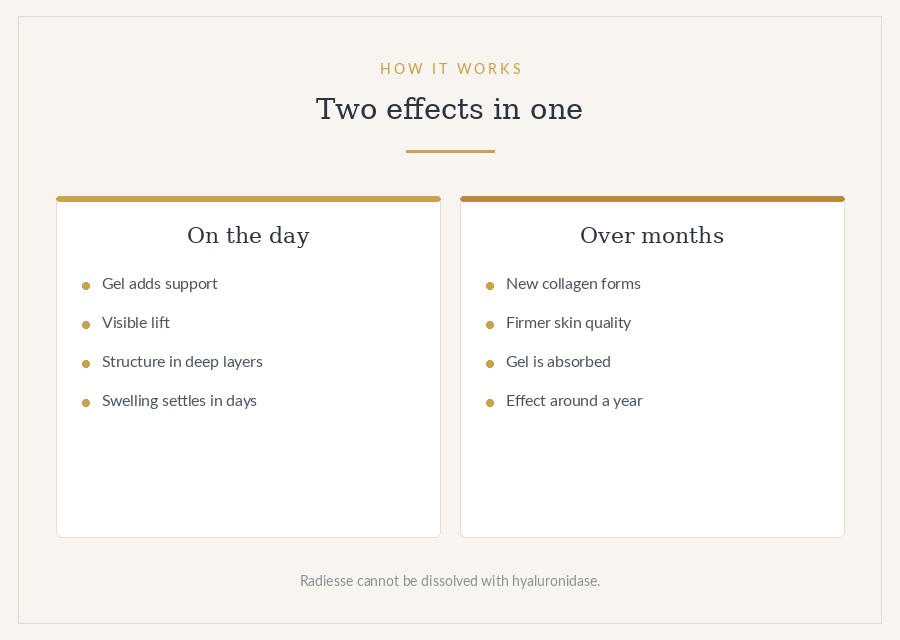
Radiesse is made by Merz Aesthetics. It contains tiny smooth spheres of calcium hydroxylapatite suspended in a water-based gel. Calcium hydroxylapatite is a mineral that is similar to the mineral found naturally in bone and teeth, and the spheres used in Radiesse are manufactured to a uniform size. The gel carrier gives immediate volume and lift; over the following weeks to months the gel is absorbed by the body while the spheres act as a scaffold that the skin builds new collagen around. The spheres themselves are gradually broken down and cleared over time.
A filler and a collagen stimulator
Because of this two-stage action, Radiesse is often described as a hybrid. The first effect is a filler effect that you can see when you leave the clinic. The second effect is a biostimulator effect, which develops gradually as new collagen and elastin form. This is why Radiesse is grouped with collagen biostimulators such as Sculptra, even though Sculptra works without any immediate volume.
Undiluted and Diluted Radiesse
Radiesse can be used in two main ways. Undiluted, or lightly diluted, it is injected deep, close to the bone or in the deeper fat layers, to restore structure in areas such as the cheekbones, jawline and chin. Diluted, or hyperdiluted, it is mixed with sterile saline and local anaesthetic and spread more thinly under the skin to improve firmness, crepey texture and skin quality, rather than to add shape.
The diluted approach is commonly used on the lower face, neck, décolletage, inner arms and above the knees. It does not lift heavy sagging skin, but it can improve the quality of thin or crepey skin over a course of treatment. The choice between the two approaches depends on whether the main concern is lost structure, loose or thin skin, or a combination of both.
Which Areas Can Radiesse Treat?
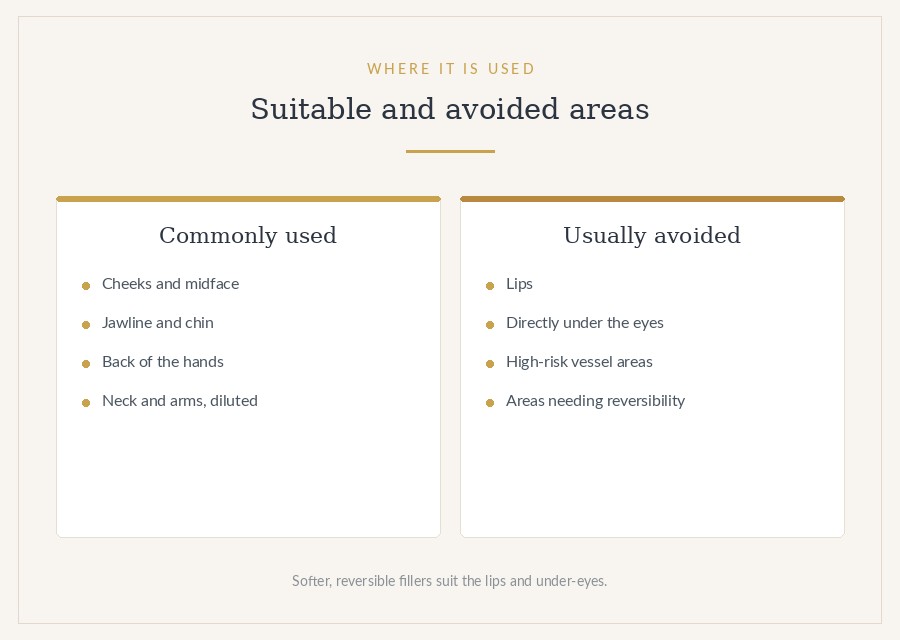
Cheeks and midface
Placed deep over the cheekbone, Radiesse can restore support to a midface that has flattened with age, which can also soften the look of the folds lower down. Because the product is firm and holds its shape, small amounts can provide noticeable support.
Jawline and chin
Radiesse is used to define the jawline and add projection to the chin. Its firmness suits these structural areas, where a crisp outline is often the goal.
Hands
The back of the hands loses fat and skin thickness with age, which makes tendons and veins more visible. Radiesse is approved in many markets for hand rejuvenation and can restore a softer, fuller look. The guide to Radiesse for hands covers this in detail.
Neck, décolletage, arms and knees
In its diluted form, Radiesse is used to improve thin, crepey skin on the neck, chest, upper arms and above the knees. These uses aim at skin quality rather than shape, and results build over a course of sessions.
Which Areas Is Radiesse Not Used For?
Radiesse is not used in the lips, where its firmness and visibility make it unsuitable, and it is generally avoided in the delicate area directly under the eyes, where thin skin and the risk of visible lumps call for softer products. Many clinicians also avoid it in areas of high blood-vessel risk where a reversible product is preferred. In these areas, hyaluronic acid fillers, which can be dissolved, are usually the safer choice in the hands of an experienced injector.
How Is Radiesse Different From Hyaluronic Acid Filler?
Hyaluronic acid filler works mainly by holding water and adding volume, and it can be dissolved with an enzyme called hyaluronidase if the result is not right or a complication occurs. Radiesse adds structure and stimulates collagen, often lasts longer, and cannot be dissolved with hyaluronidase. This last point is the most important practical difference: Radiesse is chosen when its strengths are needed and the injector is confident about placement, not as a default replacement for hyaluronic acid.
Some practitioners use other agents to help break down calcium hydroxylapatite if a lump forms, but the evidence for this is still limited, and prevention through careful technique and correct dilution remains the main approach. The comparison of Radiesse and hyaluronic acid filler explains the differences in more depth.
How Should I Prepare?
Book a consultation first. The doctor will ask about your medical history, medicines, previous filler or threads, allergies and any history of cold sores, keloid scars or autoimmune conditions. Tell the doctor if you have dental work or a vaccination coming up, because many clinicians prefer to space treatments a couple of weeks apart. Avoid alcohol for a day before treatment and do not stop prescribed medicines without speaking to the prescribing doctor.
What Happens During a Session?
The assessment
The doctor assesses facial structure, skin quality and the areas that bother you, and explains whether Radiesse, hyaluronic acid filler, a skin booster or a combination would suit you. Photographs are usually taken so that the result can be compared later.
The treatment
Radiesse is supplied with or mixed with local anaesthetic, which makes the injections more comfortable. Depending on the area, it is placed with a fine needle or a blunt cannula. A structural session for the cheeks or jawline usually takes about thirty to forty-five minutes. A diluted skin-quality session covers a wider area with many small passes.
How many syringes
Structural work commonly uses one to two syringes for the midface and one to three for the jawline and chin, depending on the starting point. Diluted treatments for the neck or arms often use one to two syringes per session, repeated over two or three sessions spaced about four to six weeks apart. The doctor should explain the plan and total cost before starting.
What Is Recovery Like?
Swelling, tenderness and some bruising are common for a few days and usually settle within a week. The treated area may feel firm at first. It is sensible to avoid strenuous exercise, saunas, steam rooms and alcohol for a day, to avoid pressing on the area, and to avoid facial massage or heat-based devices for about two weeks unless the doctor advises otherwise. After diluted treatments, some clinicians recommend gentle massage of the area for a few days to spread the product evenly; follow the specific advice you are given.
When Will I See Results?
The structural effect is visible immediately, although swelling can make it look slightly fuller than the final result for the first few days. The collagen effect develops gradually over two to three months and continues to build for several months after that. For diluted skin-quality treatments, the change is gradual, and the full picture is usually assessed around three months after the last session.
How Long Does Radiesse Last?
For most people and most areas, results last around twelve months, and some studies report effects lasting up to around eighteen months. Longevity depends on the area, the dose, whether the product was diluted, your metabolism, sun exposure and lifestyle. Many people choose a maintenance session every twelve to eighteen months rather than waiting for the effect to disappear completely.
What Are the Risks of Radiesse?
The common effects are swelling, bruising, tenderness and redness, which settle within days. Less commonly, small firm lumps or nodules can form, particularly in thin-skinned areas or with superficial placement. These often settle with time or massage, but persistent nodules may need further treatment.
As with any injectable filler, there is a rare but serious risk of the product entering or compressing a blood vessel, which can affect the blood supply to the skin and, in extremely rare cases, vision. Because Radiesse cannot be dissolved with hyaluronidase, prevention is essential: careful anatomical knowledge, suitable technique, slow injection and avoiding high-risk areas. Tell the clinic immediately if you notice severe pain, skin that turns pale, grey or dusky, or any change in vision after treatment.
Calcium hydroxylapatite is visible on X-rays and scans. It does not interfere with medical imaging, but it is worth telling a radiologist or dentist that you have had it so that it is not mistaken for something else.
Who Should Avoid Radiesse?
Radiesse is not suitable during pregnancy or breastfeeding, in areas with active infection or inflammation, in people with a known allergy to any of its components or to the local anaesthetic, or in people prone to severe keloid scarring. People with autoimmune conditions, bleeding disorders or those taking blood-thinning medicines need an individual assessment. Anyone with a history of reactions to fillers should discuss this openly at the consultation.
Can Radiesse Be Combined With Other Treatments?
Yes, and combination plans are common. Radiesse may provide structure in the midface and jawline while hyaluronic acid filler is used in the lips or under-eye area, and Botox relaxes expression lines. Skin boosters can be added for hydration and glow. The order and spacing should be planned by the doctor so that each treatment has time to settle.
How Does Radiesse Compare With Other Biostimulators?
Sculptra and similar poly-L-lactic acid products work entirely through gradual collagen stimulation, with no immediate volume, and usually need two or three sessions. Radiesse gives an immediate structural effect plus collagen stimulation. Newer calcium hydroxylapatite products such as Facetem work in a similar way. The guides on Sculptra and Radiesse and Radiesse and Facetem compare these options.
Is Radiesse Suitable for Men?
Yes. Men often ask for a stronger jawline, more chin projection or support in the midface, and the firmness of Radiesse suits these structural goals. The aim is usually to keep angles defined and avoid a soft or rounded look, so placement and quantity differ from treatment plans designed for women. Men also tend to have thicker skin and a richer blood supply in the lower face, which the doctor takes into account when planning the technique and discussing the chance of bruising.
Why Do Radiesse Results Vary?
Results depend on the starting point, the amount of structural loss, skin thickness, age, lifestyle, sun exposure, smoking and the plan itself. Collagen production also varies between people. A realistic plan focuses on gradual, natural support rather than dramatic change in a single session.
Choosing Who Treats You
Because Radiesse cannot be dissolved, the injector’s experience matters even more than with reversible fillers. Choose a licensed physician whose DHA licence you can verify on the DHA Sheryan portal, who uses genuine product from an authorised supplier and who can explain the plan, the dilution and how complications would be managed.
The page on Radiesse treatment describes the treatment at the clinic. At dr-soheila.com, treatments are planned and performed by Dr Soheila Eskandari, a DHA-licensed general practitioner with aesthetic privileges with 20 years of experience in aesthetic medicine.
The Short Version
Radiesse is a calcium hydroxylapatite injectable that gives immediate structure and stimulates new collagen over the following months. Undiluted, it supports the cheeks, jawline and chin; diluted, it improves thin and crepey skin on the face, neck, chest, arms and hands. It is not used in the lips or directly under the eyes.
Results usually last around twelve months, sometimes longer. Swelling and bruising are common and short-lived, nodules are less common, and blood-vessel complications are rare but serious. Because Radiesse cannot be dissolved with hyaluronidase, careful assessment and an experienced, licensed injector are essential.
Questions Worth Asking
Why Radiesse rather than hyaluronic acid filler for my concern? The answer should relate to your anatomy and goals, not to a default product.
Will it be used undiluted or diluted, and how many syringes are planned? This determines both the result and the total cost.
How are nodules and vascular complications managed? The clinic should have a clear plan and be reachable after treatment.
When is the review? A review allows the result to be checked once swelling has settled.
Frequently Asked Questions
What is Radiesse made of?
Radiesse contains calcium hydroxylapatite spheres suspended in a water-based gel. The gel gives immediate support and the spheres encourage new collagen.
Is Radiesse a filler or a biostimulator?
It is both. It adds structure straight away and stimulates collagen over the following months.
Which areas can Radiesse treat?
Common areas are the cheeks, jawline, chin and hands. Diluted, it is used for skin quality on the face, neck, chest, arms and above the knees.
Can Radiesse be used in the lips?
No. Radiesse is not used in the lips, and it is generally avoided directly under the eyes, where softer reversible fillers are preferred.
How long does Radiesse last?
Results usually last around twelve months, and some people see effects for up to around eighteen months.
Can Radiesse be dissolved?
It cannot be dissolved with hyaluronidase, the enzyme used for hyaluronic acid filler. This is why careful planning and placement are essential.
Is there downtime after Radiesse?
Most people return to normal activities the same day. Swelling and bruising can last a few days to a week.
How many sessions of Radiesse are needed?
Structural treatment is often a single session with a review. Diluted skin-quality treatment usually involves two or three sessions about four to six weeks apart.
What are the risks of Radiesse?
Swelling and bruising are common. Nodules are less common, and vascular complications are rare but serious, so treatment should be performed by an experienced licensed physician.
What does Radiesse cost in Dubai?
Market rates generally run from around AED 2,000 to AED 4,500 per syringe, depending on the area, the number of syringes and the clinic. A personal quote follows the consultation.
This article is general information about aesthetic and dermatological treatments and is not medical advice, a diagnosis, or a treatment recommendation for any individual. Outcomes vary between patients and no result is guaranteed. Prescription medications and injectable products carry risks and contraindications that must be assessed by a licensed physician during a personal consultation. Dr Soheila Eskandari is licensed by the Dubai Health Authority. Prices quoted are general market ranges for information only and are not an offer.

 English
 Arabic